


Patient information: uses, side effects, how to take - Yesintek
What is the most important information I should know about YESINTEK?
YESINTEK is a medicine that affects your immune system. YESINTEK can increase your risk of having serious side effects, including:
Serious infections. YESINTEK may lower the ability of your immune system to fight infections and may increase your risk of infections. Some people have serious infections during treatment with ustekinumab products, including tuberculosis (TB), and infections caused by bacteria, fungi, or viruses. Some people have to be hospitalized for treatment of their infection.
- Your healthcare provider should check you for TB before starting YESINTEK.
- If your healthcare provider feels that you are at risk for TB, you may be treated with medicine for TB before you begin treatment with YESINTEK and during treatment with YESINTEK.
- Your healthcare provider should watch you closely for signs and symptoms of TB while you are being treated with YESINTEK.
You should not start YESINTEK if you have any kind of infection unless your healthcare provider says it is okay.
Before starting YESINTEK, tell your healthcare provider if you:
think you have an infection or have symptoms of an infection such as:
- fever, sweat, or chills
- weight loss
- muscle aches
- warm, red, or painful skin or sores on your body
- cough
- diarrhea or stomach pain
- shortness of breath
- burning when you urinate or urinate more often than normal
- blood in phlegm
- feel very tired
- are being treated for an infection or have any open cuts.
- get a lot of infections or have infections that keep coming back.
- have TB or have been in close contact with someone with TB.
After starting YESINTEK, call your healthcare provider right away if you have any symptoms of an infection (see above). These may be signs of infections such as chest infections, or skin infections or shingles that could have serious complications. YESINTEK can make you more likely to get infections or make an infection that you have worse.
- People who have a genetic problem where the body does not make any of the proteins interleukin 12 (IL-12) and interleukin 23 (IL-23) are at a higher risk for certain serious infections. These infections can spread throughout the body and cause death. People who take YESINTEK may also be more likely to get these infections.
- Cancers. YESINTEK may decrease the activity of your immune system and increase your risk for certain types of cancers. Tell your healthcare provider if you have ever had any type of cancer. Some people who are receiving ustekinumab products and have risk factors for skin cancer have developed certain types of skin cancers. During your treatment with YESINTEK, tell your healthcare provider if you develop any new skin growths.
What is YESINTEK?
YESINTEK is a prescription medicine used to treat:
- adults and children 6 years of age and older with moderate to severe plaque psoriasis who may benefit from taking injections or pills (systemic therapy) or phototherapy (treatment using ultraviolet light alone or with pills).
- adults and children 6 years of age and older with active psoriatic arthritis.
- adults with moderately to severely active Crohn’s disease.
- adults with moderately to severely active ulcerative colitis.
It is not known if YESINTEK is safe and effective in children with Crohn’s disease or ulcerative colitis or in children less than 6 years of age with plaque psoriasis or psoriatic arthritis.
Who should not use YESINTEK?
Do not use YESINTEK if you are allergic to ustekinumab products or any of the ingredients in YESINTEK. See the end of this Medication Guide for a complete list of ingredients in YESINTEK.
Before you use or receive YESINTEK, tell your healthcare provider about all of your medical conditions, including if you:
- have any of the conditions or symptoms listed in the section “What is the most important information I should know about YESINTEK?”
- ever had an allergic reaction to ustekinumab products. Ask your healthcare provider if you are not sure.
- have recently received or are scheduled to receive an immunization (vaccine). People who are being treated with YESINTEK should avoid receiving live vaccines. Tell your healthcare provider if anyone in your house needs a live vaccine. The viruses used in some types of live vaccines can spread to people with a weakened immune system and can cause serious problems. You should avoid receiving the BCG vaccine during the one year before receiving YESINTEK or one year after you stop receiving YESINTEK.
- have any new or changing lesions within psoriasis areas or on normal skin.
- are receiving or have received allergy shots, especially for serious allergic reactions. Allergy shots may not work as well for you during treatment with YESINTEK. YESINTEK may also increase your risk of having an allergic reaction to an allergy shot.
- receive or have received phototherapy for your psoriasis.
are pregnant or plan to become pregnant. It is not known if YESINTEK can harm your unborn baby. You and your healthcare provider should decide if you will receive YESINTEK.
- are breastfeeding or plan to breastfeed. YESINTEK can pass into your breast milk.
- Talk to your healthcare provider about the best way to feed your baby if you receive YESINTEK.
Tell your healthcare provider about all the medicines you take, including prescription and over-the-counter medicines, vitamins, and herbal supplements.
Know the medicines you take. Keep a list of them to show your healthcare provider and pharmacist when you get a new medicine.
How should I use YESINTEK?
- Use YESINTEK exactly as the healthcare provider tells you to. The healthcare provider will determine the right dose of YESINTEK, the amount for each injection, and how often it should be given. Be sure to keep all scheduled follow up appointments.
- Adults with Crohn’s disease and ulcerative colitis will receive the first dose of YESINTEK through a vein in the arm (intravenous infusion) in a healthcare facility by a healthcare provider. It takes at least 1 hour to receive the full dose of medicine. YESINTEK will then be received as an injection under the skin (subcutaneous injection) 8 weeks after the first dose of YESINTEK, as described below.
- Adults and children 6 years of age and older with plaque psoriasis or psoriatic arthritis will receive YESINTEK as an injection under the skin as described below.
Injecting YESINTEK under the skin
- YESINTEK is intended for use under the guidance and supervision of a healthcare provider.
- In children, it is recommended that YESINTEK be administered by a healthcare provider. If a healthcare provider decides that you or a caregiver may give the injections of YESINTEK at home, you or caregiver should receive training on the right way to prepare and inject YESINTEK.
- Do not try to inject YESINTEK until you have been shown how to inject YESINTEK by a healthcare provider.
- YESINTEK can be injected under the skin in the upper arms, buttocks, upper legs (thighs) or stomach area (abdomen).
- Do not give an injection in an area of the skin that is tender, bruised, red or hard.
- Use a different injection site each time you use YESINTEK.
- If you inject too much YESINTEK, call the healthcare provider or Poison Help line at 1-800-222-1222, or go to the nearest emergency room right away.
Read the detailed Instructions for Use at the end of this Medication Guide for instructions about how to prepare and inject a dose of YESINTEK, and how to properly throw away (dispose of) used needles, syringes, and vials. The syringe, needle, and vial must never be re-used. After the stopper is punctured, YESINTEK can become contaminated by harmful bacteria which could cause an infection if re-used. Therefore, throw away any unused portion of YESINTEK.
What should I avoid while using YESINTEK?
You should avoid receiving a live vaccine during treatment with YESINTEK. See “Before you use or receive YESINTEK, tell your healthcare provider about all of your medical conditions, including if you:”
What are the possible side effects of YESINTEK?
YESINTEK may cause serious side effects, including:
- See “What is the most important information I should know about YESINTEK?”
Serious allergic reactions. Serious allergic reactions including death can occur with YESINTEK. Stop using YESINTEK and get medical help right away if you get any of the following symptoms of a serious allergic reaction:
- feeling faint
- trouble breathing
- swelling of your face, eyelids, tongue, or throat
- skin rash
- chest discomfort
- Posterior Reversible Encephalopathy Syndrome (PRES). PRES is a rare condition that affects the brain and can cause death. Tell your healthcare provider right away if you get any symptoms of PRES during treatment with YESINTEK, including:
- headache o confusion
- seizures o vision problems
- Lung inflammation. Cases of lung inflammation have happened in some people who receive ustekinumab products and may be serious. These lung problems may need to be treated in a hospital. Tell your healthcare provider right away if you develop shortness of breath or a cough that doesn’t go away during treatment with YESINTEK.
The most common side effects of YESINTEK include:
- nasal congestion, sore throat, and runny nose • redness at the injection site
- upper respiratory infections • vaginal yeast infections
- fever • urinary tract infections
- headache • sinus infection
- tiredness • bronchitis
- itching • diarrhea
- nausea and vomiting • stomach pain
- influenza • joint pain
These are not all of the possible side effects of YESINTEK. Call your doctor for medical advice about side effects. You may report side effects to FDA at 1-800-FDA-1088.
You may also report side effects to Biocon Biologics at 1-833-986-1468.
How should I store YESINTEK?
- Store YESINTEK vials and prefilled syringes in a refrigerator between 36°F to 46°F (2°C to 8°C).
- Store YESINTEK vials standing up straight (upright).
- Store YESINTEK in the original carton to protect it from light until time to use it.
- Do not freeze YESINTEK.
- Do not shake YESINTEK.
- If needed, individual YESINTEK prefilled syringes may also be stored at room temperature up to 86ºF (30°C) for a maximum single period of up to 30 days in the original carton to protect from light.
- Record the date when the prefilled syringe is first removed from the refrigerator on the carton in the space provided.
- After a prefilled syringe has been stored at room temperature, do not return it to the refrigerator.
- Throw away (discard) the prefilled syringe if it is not used within 30 days at room temperature storage.
- Do not use YESINTEK after the expiration date on the carton or on the prefilled syringe.
Keep YESINTEK and all medicines out of the reach of children.
General information about the safe and effective use of YESINTEK.
Medicines are sometimes prescribed for purposes other than those listed in a Medication Guide. Do not use YESINTEK for a condition for which it was not prescribed. Do not give YESINTEK to other people, even if they have the same symptoms that you have. It may harm them. You can ask your pharmacist or healthcare provider for information about YESINTEK that was written for health professionals
What are the ingredients in YESINTEK?
Active ingredient: ustekinumab-kfce
Inactive ingredients: Single-dose prefilled syringe and single-dose vial for subcutaneous use contain histidine, L-histidine monohydrochloride monohydrate, Polysorbate 80, and sucrose. Hydrochloric acid and sodium hydroxide added to adjust the pH. Single-dose vial for intravenous infusion contains edetate disodium, histidine, L-histidine hydrochloride monohydrate, methionine, Polysorbate 80, and sucrose. Hydrochloric acid and sodium hydroxide added to adjust the pH.
Manufactured by :
Biocon Biologics Inc.
685 Route 202/206, Suite 204,
Bridgewater, NJ 08807, U.S.A.
U.S. License No. 2324
Product of India
© 2024 Biocon Biologics Inc.
For more information go to www.yesintek.com or call 1-833-986-1468.
This Medication Guide has been approved by the U.S. Food and Drug Administration.
Revised: 03/2026
INSTRUCTIONS FOR USE
YESINTEK® (Yes-in-tek)
(ustekinumab-kfce)
injection, for subcutaneous use.
This Instructions for Use contains information on how to inject YESINTEK using a prefilled syringe.
Read this Instructions for Use before you start using YESINTEK. A healthcare provider should show you how to prepare and give an injection of YESINTEK the right way.
If you cannot give the injection:
- ask a healthcare provider to help you, or
- ask someone who has been trained by a healthcare provider to give the injections.
Do not try to inject YESINTEK until you have been shown how to inject YESINTEK by a healthcare provider.
Important information You Need to Know Before Injecting YESINTEK:
- For subcutaneous use only (inject directly under the skin).
Before you start, check the carton to make sure that it is the right dose. You will have either 45 mg or 90 mg as prescribed by the healthcare provider.
- If the dose is 45 mg, you will receive one 45 mg prefilled syringe.
- If the dose is 90 mg, you will receive either one 90 mg prefilled syringe or two 45 mg prefilled syringes. If you receive two 45 mg prefilled syringes for a 90 mg dose, you will need to give two injections, one right after the other.
- Check the expiration date on the prefilled syringe and carton. If the expiration date has passed or if the prefilled syringe has been kept at room temperature up to 86°F (30°C) for longer than a maximum single period of 30 days or if the prefilled syringe has been stored above 86°F (30°C), do not use it. If the expiration date has passed or if the prefilled syringe has been stored above 86°F (30°C), or at room temperature for longer than 30 days, call the healthcare provider or pharmacist, or call Biocon Biologics at 1-833-986-1468 for help.
- Make sure the syringe is not damaged.
- Check the prefilled syringe for any particles or discoloration. The liquid in the prefilled syringe should look clear and colorless to pale yellow.
- Do not use if it is frozen, discolored, cloudy or has large particles. Get a new prefilled syringe.
- Do not shake the prefilled syringe at any time. Shaking the prefilled syringe may damage the YESINTEK medicine. If the prefilled syringe has been shaken, do not use it. Get a new prefilled syringe.
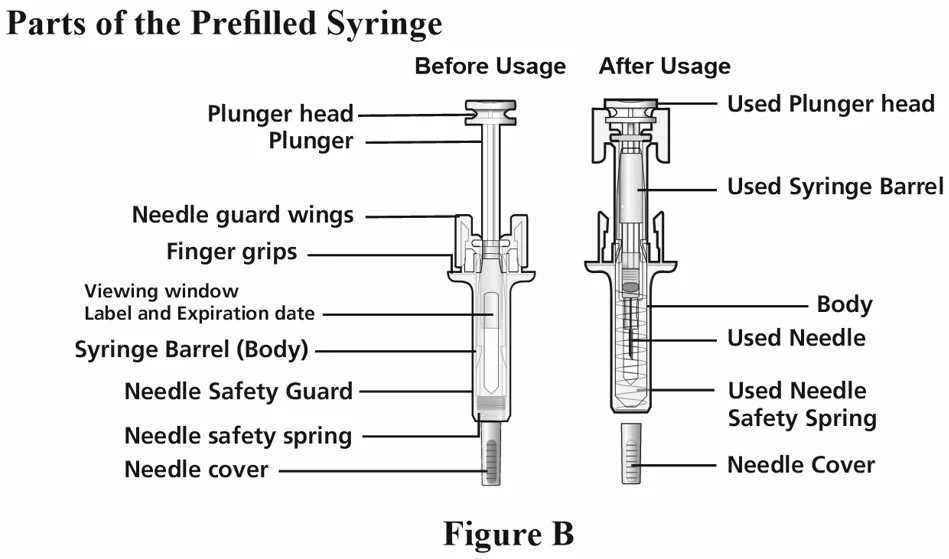
- To reduce the risk of accidental needle sticks, each prefilled syringe has a needle guard that is automatically activated to cover the needle after you have given the injection. Do not pull back on the plunger at any time. Do not attempt to remove the needle safety guard from the prefilled syringe.
Storing YESINTEK prefilled syringes
- Store YESINTEK prefilled syringes in the refrigerator between 36ºF to 46ºF (2ºC to 8ºC).
- Store YESINTEK prefilled syringes in the original carton to protect from light.
- Do not freeze YESINTEK prefilled syringes.
- If needed, YESINTEK prefilled syringe may be stored at room temperature up to 86°F (30°C) for a maximum single period of up to 30 days in the original carton to protect from light.
- Record the date when the prefilled syringe is removed from the refrigerator on the carton in the space provided.
- After a prefilled syringe has been stored at room temperature, do not return it to the refrigerator.
- Throw away (discard) the prefilled syringe if it is not used within 30 days at room temperature storage
Keep YESINTEK and all medicines out of the reach of children.
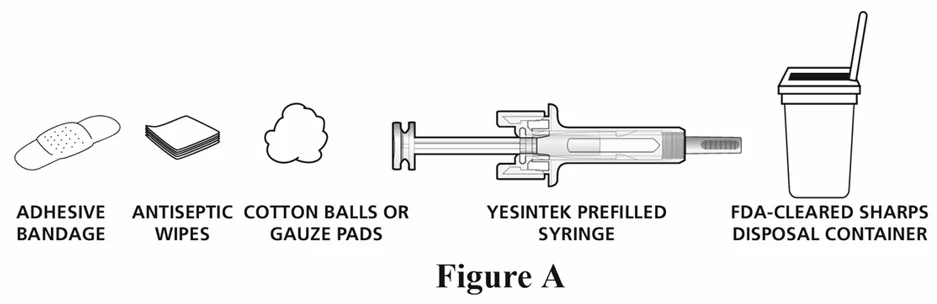
Gather the supplies you will need to prepare and to give the injection. (See Figure A)
You will need:
- your prescribed dose of YESINTEK (See Figure B)
- antiseptic wipes
- cotton balls or gauze pads
- adhesive bandage
- FDA-cleared sharps disposal container. See "Step 4: Disposing of the syringes."
Step 1: Preparing the injection.
- Choose a well-lit, clean, flat work surface.
- Wash your hands well with soap and warm water. Remove prefilled syringe tray from carton
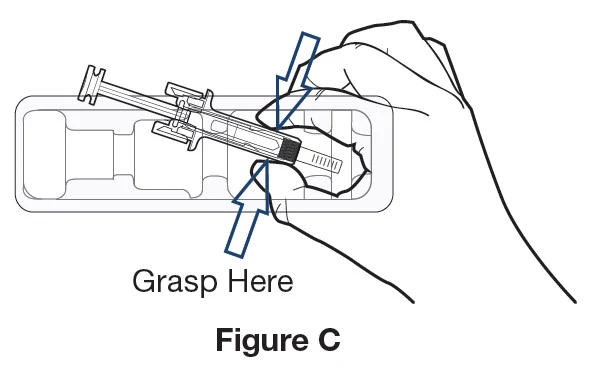
- Open the tray by peeling away the cover. Hold the prefilled syringe by the Needle safety guard (as shown in Figure C) to remove the prefilled syringe from the tray.
For safety reasons:
- Do not touch or grasp the plunger
- Do not grasp the gray needle cover
- Hold the prefilled syringe with the covered needle pointing upward.
Step 2: Preparing the injection site
- Choose an injection site around the stomach area (abdomen), buttocks, upper legs (thighs). If a caregiver is giving the injection, the outer area of the upper arms may also be used. (See Figure D)
- Use a different injection site for each injection. Do not give an injection in an area of the skin that is tender, bruised, red or hard.
- Clean the skin with an antiseptic wipe where you plan to give the injection.
- Do not touch this area again before giving the injection. Let the skin dry before injecting.
- Do not fan or blow on the clean area.
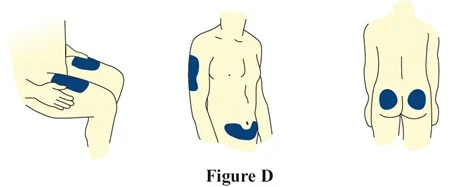
*Areas in blue are recommended injection sites.
Step 3: Injecting YESINTEK
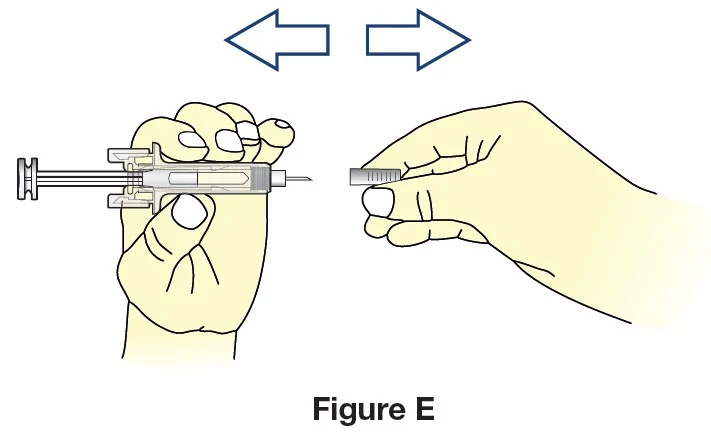
- Remove the needle cover when you are ready to inject YESINTEK.
- Do not touch the plunger or plunger head while removing the needle cover.
- Hold the body of the prefilled syringe with one hand and pull the needle cover straight off. (See Figure E)
- Put the needle cover in the trash.
- You may also see a drop of liquid at the end of the needle. This is normal.
- Do not touch the needle or let it touch anything.
- Do not use the prefilled syringe if it is dropped without the needle cover in place.
- Hold the body of the prefilled syringe in one hand between the thumb and index fingers. (See Figure F)
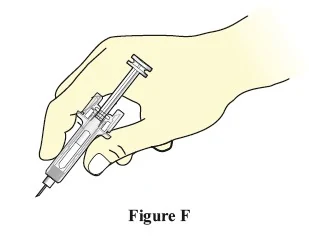
- Do not pull back on the plunger at any time.
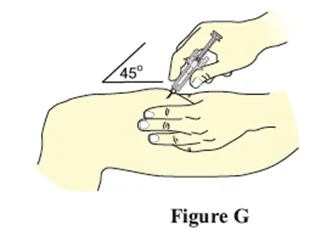
- Use the other hand to gently pinch the cleaned area of skin. Hold firmly.
- Use a quick, dart-like motion to insert the needle into the pinched skin at about a 45-degree angle. (See Figure G)
- Inject all of the liquid by using your thumb to push in the plunger until the plunger head is completely between the needle guard wings. (See Figure H)
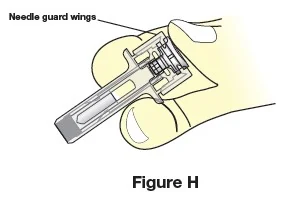
- When the plunger is pushed as far as it will go, keep pressure on the plunger head. Take the needle out of the skin and then let go of the skin.
- Slowly take your thumb off the plunger head. This will let the empty syringe move up until the entire needle is covered by the needle guard. (See Figure I)
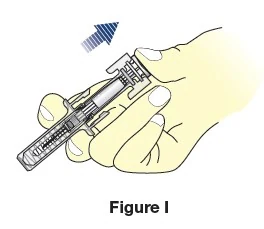
- When the needle is pulled out of the skin, there may be a little bleeding at the injection site. This is normal. You can press a cotton ball or gauze pad to the injection site if needed. Do not rub the injection site. You may cover the injection site with a small adhesive bandage, if necessary.
If the dose is 90 mg, you will receive either one 90 mg prefilled syringe or two 45 mg prefilled syringes. If you receive two 45 mg prefilled syringes for a 90 mg dose, you will need to give a second injection right after the first. Repeat Steps 1 to 3 for the second injection using a new syringe. Choose a different site for the second injection.
Step 4: Disposing of the syringes.
- Put the syringe in an FDA-cleared sharps disposal container right away after use. Do not throw away (dispose of) syringes in your household trash.
If you do not have an FDA-cleared sharps disposal container, you may use a household container that is:
- made of heavy-duty plastic,
- can be closed with a tight-fitting, puncture-resistant lid, without sharps being able to come out,
- upright and stable during use,
- leak-resistant,
- and properly labeled to warn of hazardous waste inside the container.
- When your sharps disposal container is almost full, you will need to follow your community guidelines for the right way to dispose of your sharps disposal container. There may be local or state laws about how to throw away syringes and needles. For more information about safe sharps disposal, and for specific information about sharps disposal in the state that you live in, go to the FDA's website at: http://www.fda.gov/safesharpsdisposal.
- Do not dispose of your sharps disposal container in your household trash unless your community guidelines permit this. Do not recycle your sharps disposal container.
- If you have any questions, talk to your healthcare provider or pharmacist.
Manufactured by:
Biocon Biologics Inc.
685 Route 202/206, Suite 204,
Bridgewater, NJ 08807, U.S.A.
U.S. License No. 2324
Product of India
© 2024 Biocon Biologics Inc.
This Instructions for Use has been approved by the U.S. Food and Drug Administration.
Revised: 03/2026
INSTRUCTIONS FOR USE
YESINTEK® (Yes-in-tek)
(ustekinumab-kfce)
injection, for subcutaneous use
This Instructions for Use contains information on how to inject YESINTEK using a vial.
Read this Instructions for Use before you start using YESINTEK. A healthcare provider should show you how to prepare, measure the dose, and give an injection of YESINTEK the right way.
If you cannot give the injection:
- ask a healthcare provider to help you, or
- ask someone who has been trained by a healthcare provider to give the injections.
Do not try to inject YESINTEK until you have been shown how to inject YESINTEK by a healthcare provider.
Important information You Need to Know Before Injecting YESINTEK:
Before you start, check the carton to make sure that it is the right dose. You will have either 45 mg or 90 mg as prescribed by the healthcare provider.
- If the dose is 45 mg or less, you will receive one 45 mg vial.
- If the dose is 90 mg, you will receive two 45 mg vials and you will need to give two injections, one right after the other.
- Check the expiration date on the vial and carton. If the expiration date has passed, do not use it. If the expiration date has passed, call the healthcare provider or pharmacist, or call Biocon Biologics at 1-833-986-1468 for help.
- Check the vial for any particles or discoloration. The liquid in the vial should look clear and colorless to pale yellow solution.
- Do not use if it is frozen, discolored, cloudy or has large particles. Get a new vial.
- Do not shake the vial at any time. Shaking the vial may damage the YESINTEK medicine. If the vial has been shaken, do not use it. Get a new vial.
- Do not use a YESINTEK vial more than one time, even if there is medicine left in the vial. After the rubber stopper is punctured, YESINTEK can become contaminated by harmful bacteria which could cause an infection if re-used. Therefore, throw away any unused YESINTEK after you give the injection.
- Safely throw away (dispose of) YESINTEK vials, needles, and syringes after use. See “Step 6: Disposing of needles, syringes, and vials.”
- Do not re-use syringes or needles.
- To avoid needle-stick injuries, do not recap needles.
Storing YESINTEK vials
- Store YESINTEK vials in a refrigerator between 36ºF to 46ºF (2ºC to 8ºC).
- Store YESINTEK vials standing up straight (upright).
- Store YESINTEK vials in the original carton to protect from light until the time of use.
- Do not freeze YESINTEK vials.
Keep YESINTEK and all medicines out of the reach of children.
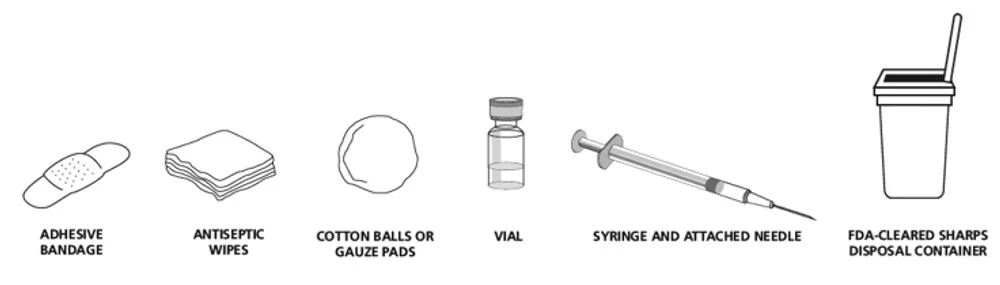
Gather the supplies you will need to prepare YESINTEK and to give the injection. (See Figure A)
You will need:
- a syringe with the needle attached, you will need a prescription from a healthcare provider to get syringes with the needles attached from a pharmacy.
- antiseptic wipes
- cotton balls or gauze pads
- adhesive bandage
- your prescribed dose of YESINTEK
- FDA-cleared sharps disposal container. See “Step 6: Disposing of needles, syringes and vials.”
Figure A
Step 1: Preparing the injection
- Choose a well-lit, clean, flat work surface.
- Wash your hands well with soap and warm water.
Step 2: Preparing your injection site
- Choose an injection site around the stomach area (abdomen), buttocks, and upper legs (thighs).
- If a caregiver is giving the injection, the outer area of the upper arms may also be used. (See Figure B)
- Use a different injection site for each injection. Do not give an injection in an area of the skin that is tender, bruised, red or hard.
- Clean the skin with an antiseptic wipe where you plan to give the injection.
- Do not touch this area again before giving the injection. Let the skin dry before injecting.
- Do not fan or blow on the clean area.
Figure B
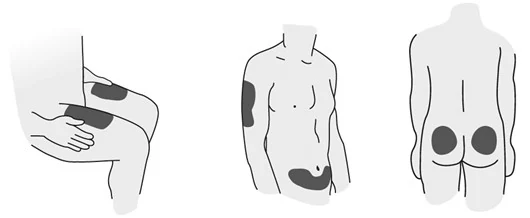
*Areas in gray are recommended injection sites
Step 3: Preparing the vial
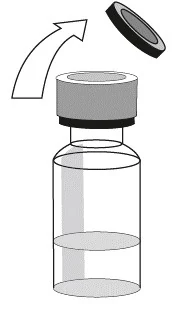
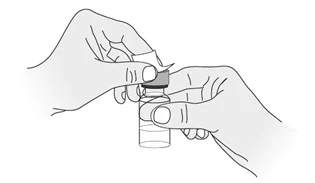
- Remove the cap from the top of the vial. Throw away the cap but do not remove the rubber stopper. (See Figure C)
Figure C
- Clean the rubber stopper with an antiseptic wipe. (See Figure D)
Figure D
- Do not touch the rubber stopper after you clean it.
- Put the vial on a flat surface.
Step 4: Preparing the syringe
- Pick up the syringe with the needle attached.
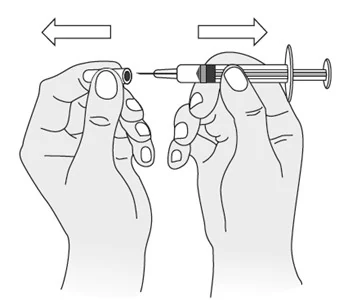
- Remove the cap that covers the needle. (See Figure E)
- Throw the needle cap away. Do not touch the needle or allow the needle to touch anything.
Figure E
- Carefully pull back on the plunger to the line that matches the dose prescribed by the healthcare provider.
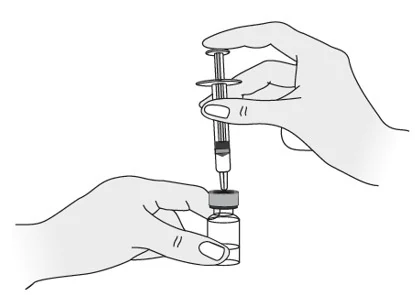
- Hold the vial between your thumb and index (pointer) finger.
- Use your other hand to push the syringe needle through the center of the rubber stopper. (See Figure F)
Figure F
- Push down on the plunger until all of the air has gone from the syringe into the vial.
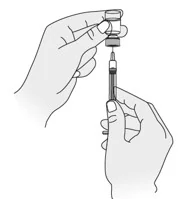
- Turn the vial and the syringe upside down. (See Figure G)
- Hold the YESINTEK vial with one hand.
- It is important that the needle is always in the liquid in order to prevent air bubbles forming in the syringe.
- Pull back on the syringe plunger with your other hand.
- Fill the syringe until the black tip of the plunger lines up with the mark that matches the prescribed dose.
Figure G
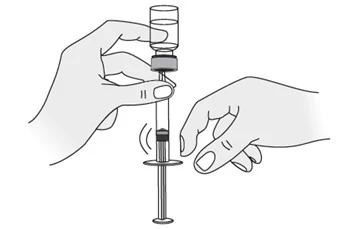
- Do not remove the needle from the vial. Hold the syringe with the needle pointing up to see if it has any air bubbles inside.
- If there are air bubbles, gently tap the side of the syringe until the air bubbles rise to the top. (See Figure H)
- Slowly press the plunger up until all of the air bubbles are out of the syringe (but none of the liquid is out).
- Remove the syringe from the vial. Do not lay the syringe down or allow the needle to touch anything.
Figure H
Step 5: Injecting YESINTEK
- Hold the barrel of the syringe in one hand, between the thumb and index fingers.
- Do not pull back on the plunger at any time.
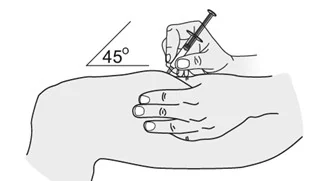
- Use the other hand to gently pinch the cleaned area of skin. Hold firmly.
- Use a quick, dart-like motion to insert the needle into the pinched skin at about a 45-degree angle. (See Figure I)
Figure I
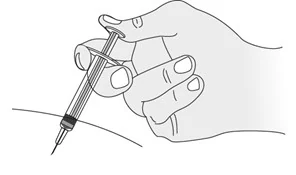
- Push the plunger with your thumb as far as it will go to inject all of the liquid. Push it slowly and evenly, keeping the skin gently pinched.
- When the syringe is empty, pull the needle out of the skin and then let go of the skin. (See Figure J)
Figure J
- When the needle is pulled out of the skin, there may be a little bleeding at the injection site. This is normal. You can press a cotton ball or gauze pad to the injection site if needed. Do not rub the injection site. You may cover the injection site with a small adhesive bandage, if necessary.
If the dose is 90 mg, you will receive two 45 mg vials and you will need to give a second injection right after the first. Repeat Steps 1 to 5 using a new syringe. Choose a different site for the second injection.
Step 6: Disposing of needles, syringes, and vials.
- Do not re-use a syringe or needle.
- To avoid needle-stick injuries, do not recap a needle.
- Put the needles and syringes in an FDA-cleared sharps disposal container right away after use. Do not throw away (dispose of) needles and syringes in your household trash.
If you do not have an FDA-cleared sharps disposal container, you may use a household container that is:
- made of heavy-duty plastic,
- can be closed with a tight-fitting, puncture-resistant lid, without sharps being able to come out,
- upright and stable during use,
- leak-resistant,
- and properly labeled to warn of hazardous waste inside the container.
- When your sharps disposal container is almost full, you will need to follow your community guidelines for the right way to dispose of your sharps disposal container. There may be local or state laws about how to throw away syringes and needles. For more information about safe sharps disposal, and for specific information about sharps disposal in the state that you live in, go to the FDA’s website at: http://www.fda.gov/safesharpsdisposal.
- Do not dispose of your sharps disposal container in your household trash unless your community guidelines permit this. Do not recycle your sharps disposal container.
- Throw away the vial into the container where you put the syringes and needles.
- If you have any questions, talk to your healthcare provider or pharmacist.
Manufactured by:
Biocon Biologics Inc.
685 Route 202/206, Suite 204,
Bridgewater, NJ 08807, U.S.A.
U.S. License No. 2324
Product of India
© 2024 Biocon Biologics Inc.
This Instructions for Use has been approved by the U.S. Food and Drug Administration.
Revised: 03/2026