


Patient information: uses, side effects, how to take - Actemra
What is the most important information I should know about ACTEMRA?
ACTEMRA can cause serious side effects including:
- Serious Infections. ACTEMRA is a medicine that affects your immune system. ACTEMRA can lower the ability of your immune system to fight infections. Some people have serious infections while taking ACTEMRA, including tuberculosis (TB), and infections caused by bacteria, fungi, or viruses that can spread throughout the body. Some people have died from these infections. Your healthcare provider should assess you for TB before starting ACTEMRA (except if you have COVID-19).
If you have COVID-19, your healthcare provider should monitor you for signs and symptoms of new infections during and after treatment with ACTEMRA.
Your healthcare provider should monitor you closely for signs and symptoms of TB during and after treatment with ACTEMRA.
- You should not start taking ACTEMRA if you have any kind of infection unless your healthcare provider says it is okay.
Before starting ACTEMRA, tell your healthcare provider if you:
- think you have an infection or have symptoms of an infection, with or without a fever, such as:
- sweating or chills
- shortness of breath
- warm, red, or painful skin or sores on your body
- feel very tired
- muscle aches
- blood in phlegm
- diarrhea or stomach pain
- cough
- weight loss
- burning when you urinate or urinating more often than normal
- are being treated for an infection.
- get a lot of infections or have infections that keep coming back.
- have diabetes, HIV, or a weak immune system. People with these conditions have a higher chance for infections.
- have TB, or have been in close contact with someone with TB.
- live or have lived, or have traveled to certain parts of the country (such as the Ohio and Mississippi River valleys and the Southwest) where there is an increased chance for getting certain kinds of fungal infections (histoplasmosis, coccidiomycosis, or blastomycosis). These infections may happen or become more severe if you use ACTEMRA. Ask your healthcare provider, if you do not know if you have lived in an area where these infections are common.
- have or have had hepatitis B.
After starting ACTEMRA, call your healthcare provider right away if you have any symptoms of an infection. ACTEMRA can make you more likely to get infections or make worse any infection that you have.
Tears (perforation) of the stomach or intestines.
- Tell your healthcare provider if you have had diverticulitis (inflammation in parts of the large intestine) or ulcers in your stomach or intestines. Some people taking ACTEMRA get tears in their stomach or intestine. This happens most often in people who also take nonsteroidal anti-inflammatory drugs (NSAIDs), corticosteroids, or methotrexate.
- Tell your healthcare provider right away if you have fever and new onset stomach-area pain that does not go away, and a change in your bowel habits.
- Liver problems (Hepatotoxicity): Some people have experienced serious life-threatening liver problems, which required a liver transplant or led to death. Your healthcare provider may tell you to stop taking ACTEMRA if you develop new or worse liver problems during treatment with ACTEMRA. Tell your healthcare provider right away if you have any of the following symptoms:
- feeling tired (fatigue)
- lack of appetite for several days or longer (anorexia)
- yellowing of your skin or the whites of your eyes (jaundice)
- abdominal swelling and pain on the right side of your stomach-area
- light colored stools
- weakness
- nausea and vomiting
- confusion
- dark "tea-colored" urine
Changes in certain laboratory test results. Your healthcare provider should do blood tests before you start receiving ACTEMRA. If you have rheumatoid arthritis (RA), giant cell arteritis (GCA), or systemic sclerosis-interstitial lung disease (SSc-ILD) your healthcare provider should do blood tests every 4 to 8 weeks after you start receiving ACTEMRA for the first 6 months and then every 3 months after that. If you have polyarticular juvenile idiopathic arthritis (PJIA) you will have blood tests done every 4 to 8 weeks during treatment. If you have systemic juvenile idiopathic arthritis (SJIA) you will have blood tests done every 2 to 4 weeks during treatment. These blood tests are to check for the following side effects of ACTEMRA:
- low neutrophil count. Neutrophils are white blood cells that help the body fight off bacterial infections.
- low platelet count. Platelets are blood cells that help with blood clotting and stop bleeding.
- increase in certain liver function tests.
- increase in blood cholesterol levels. You may also have changes in other laboratory tests, such as your blood cholesterol levels. Your healthcare provider should do blood tests to check your cholesterol levels 4 to 8 weeks after you start receiving ACTEMRA.
Your healthcare provider will determine how often you will have follow-up blood tests. Make sure you get all your follow-up blood tests done as ordered by your healthcare provider.
You should not receive ACTEMRA if your neutrophil or platelet counts are too low or your liver function tests are too high.
Your healthcare provider may stop your ACTEMRA treatment for a period of time or change your dose of medicine if needed because of changes in these blood test results.
- Cancer. ACTEMRA may increase your risk of certain cancers by changing the way your immune system works. Tell your healthcare provider if you have ever had any type of cancer.
See "What are the possible side effects with ACTEMRA?" for more information about side effects.
What is ACTEMRA?
ACTEMRA is a prescription medicine called an Interleukin-6 (IL-6) receptor antagonist. ACTEMRA is used:
- To treat adults with moderately to severely active rheumatoid arthritis (RA), after at least one other medicine called a Disease-Modifying Anti-Rheumatic Drug (DMARD) has been used and did not work well.
- To treat adults with giant cell arteritis (GCA).
- For slowing the rate of decline in lung function in adults with systemic sclerosis-associated interstitial lung disease (SSc-ILD) (also known as scleroderma associated ILD).
- To treat people with active PJIA ages 2 and above.
- To treat people with active SJIA ages 2 and above.
- To treat people age 2 years and above who experience severe or life-threatening Cytokine Release Syndrome (CRS) following chimeric antigen receptor (CAR) T cell treatment.
- To treat hospitalized people ages 2 years and above with coronavirus disease 2019 (COVID-19) receiving systemic corticosteroids and requiring supplemental oxygen or mechanical ventilation.
- ACTEMRA is not approved for subcutaneous use in people with CRS or COVID-19.
It is not known if ACTEMRA is safe and effective in children with PJIA, SJIA, CRS or COVID-19 under 2 years of age or in children with conditions other than PJIA, SJIA, CRS or COVID-19.
Do not take ACTEMRA: if you are allergic to tocilizumab, or any of the ingredients in ACTEMRA. See the end of this Medication Guide for a complete list of ingredients in ACTEMRA.
Before you receive ACTEMRA, tell your healthcare provider about all of your medical conditions, including if you:
- have an infection. See "What is the most important information I should know about ACTEMRA?"
- have liver problems.
- have any stomach-area (abdominal) pain or been diagnosed with diverticulitis or ulcers in your stomach or intestines.
- have had a reaction to tocilizumab or any of the ingredients in ACTEMRA before.
- have or had a condition that affects your nervous system, such as multiple sclerosis.
have recently received or are scheduled to receive a vaccine:
- All vaccines should be brought up-to-date before starting ACTEMRA, unless urgent treatment initiation is required.
- People who take ACTEMRA should not receive live vaccines.
- People taking ACTEMRA can receive non-live vaccines.
- plan to have surgery or a medical procedure.
are pregnant or plan to become pregnant. ACTEMRA may harm your unborn baby. Tell your healthcare provider if you become pregnant or think you may be pregnant during treatment with ACTEMRA.
- are breastfeeding or plan to breastfeed. It is not known if ACTEMRA passes into your breast milk. Talk to your healthcare provider about the best way to feed your baby if you take ACTEMRA.
Tell your healthcare provider about all of the medicines you take, including prescription, over-the-counter medicines, vitamins and herbal supplements. ACTEMRA and other medicines may affect each other causing side effects.
Especially tell your healthcare provider if you take:
- any other medicines to treat your RA. Taking ACTEMRA with these medicines may increase your risk of infection.
- medicines that affect the way certain liver enzymes work. Ask your healthcare provider if you are not sure if your medicine is one of these.
Know the medicines you take. Keep a list of them to show to your healthcare provider and pharmacist when you get a new medicine.
How will I receive ACTEMRA?
Into a vein (IV or intravenous infusion) for Rheumatoid Arthritis, Giant Cell Arteritis, PJIA, SJIA, CRS or COVID-19:
- If your healthcare provider prescribes ACTEMRA as an IV infusion, you will receive ACTEMRA from a healthcare provider through a needle placed in a vein in your arm. The infusion will take about 1 hour to give you the full dose of medicine.
- For rheumatoid arthritis, giant cell arteritis or PJIA you will receive a dose of ACTEMRA about every 4 weeks.
- For SJIA you will receive a dose of ACTEMRA about every 2 weeks.
- For CRS you will receive a single dose of ACTEMRA, and if needed, additional doses.
- For COVID-19, you will receive a single dose of ACTEMRA, and if needed one additional dose.
- While taking ACTEMRA, you may continue to use other medicines that help treat your rheumatoid arthritis, PJIA, SJIA or COVID-19 such as methotrexate, non-steroidal anti-inflammatory drugs (NSAIDs) and prescription steroids, as instructed by your healthcare provider.
- Keep all of your follow-up appointments and get your blood tests as ordered by your healthcare provider.
Under the skin (SC or subcutaneous injection) for Rheumatoid Arthritis, Giant Cell Arteritis, SSc-ILD, PJIA or SJIA:
- See the Instructions for Use at the end of this Medication Guide for instructions about the right way to prepare and give your ACTEMRA injections at home.
- ACTEMRA is available as a single-dose Prefilled Syringe or single-dose prefilled ACTPen® autoinjector.
- You may also receive ACTEMRA as an injection under your skin (subcutaneous). If your healthcare provider decides that you or a caregiver can give your injections of ACTEMRA at home, you or your caregiver should receive training on the right way to prepare and inject ACTEMRA. Do not try to inject ACTEMRA until you have been shown the right way to give the injections by your healthcare provider.
- For PJIA or SJIA, you may self-inject with the Prefilled Syringe or prefilled ACTPen® autoinjector, or your caregiver can give you ACTEMRA, if both your healthcare provider and parent/legal guardian find it appropriate.
- Your healthcare provider will tell you how much ACTEMRA to use and when to use it.
What are the possible side effects with ACTEMRA?
ACTEMRA can cause serious side effects, including:
- See "What is the most important information I should know about ACTEMRA?"
- Hepatitis B infection in people who carry the virus in their blood. If you are a carrier of the hepatitis B virus (a virus that affects the liver), the virus may become active while you use ACTEMRA. Your healthcare provider may do blood tests before you start treatment with ACTEMRA and while you are using ACTEMRA. Tell your healthcare provider if you have any of the following symptoms of a possible hepatitis B infection:
- feel very tired
- vomiting
- chills
- dark urine
- skin or eyes look yellow
- clay-colored bowel movements
- stomach discomfort
- skin rash
- little or no appetite
- fevers
- muscle aches
Serious Allergic Reactions. Serious allergic reactions, including death, can happen with ACTEMRA. These reactions can happen with any infusion or injection of ACTEMRA, even if they did not occur with an earlier infusion or injection. Stop taking ACTEMRA, contact your healthcare provider, and get emergency help right away if you have any of the following signs of a serious allergic reaction:
- swelling of your face, lips, mouth, or tongue
- trouble breathing
- wheezing
- severe itching
- skin rash, hives, redness, or swelling outside of the injection site area
- dizziness or fainting
- fast heartbeat or pounding in your chest (tachycardia)
- sweating
- Nervous system problems. While rare, Multiple Sclerosis has been diagnosed in people who take ACTEMRA. It is not known what effect ACTEMRA may have on some nervous system disorders.
The most common side effects of ACTEMRA include:
- upper respiratory tract infections (common cold, sinus infections)
- headache
- increased blood pressure (hypertension)
- injection site reactions
Tell your healthcare provider about any side effect that bothers you or does not go away. These are not all the possible side effects of ACTEMRA. For more information, ask your healthcare provider or pharmacist.
Call your doctor for medical advice about side effects. You may report side effects to FDA at 1-800-FDA-1088.
You may also report side effects to Genentech at 1-888-835-2555.
General information about the safe and effective use of ACTEMRA.
Medicines are sometimes prescribed for purposes other than those listed in a Medication Guide. Do not give ACTEMRA to other people, even if they have the same symptoms that you have. It may harm them. You can ask your pharmacist or healthcare provider for information about ACTEMRA that is written for health professionals.
What are the ingredients in ACTEMRA?
Active ingredient: tocilizumab.
Inactive ingredients of Intravenous ACTEMRA: disodium phosphate dodecahydrate/sodium dihydrogen phosphate dihydrate buffered solution, polysorbate 80, sucrose, and water for Injection.
Inactive ingredients of Subcutaneous ACTEMRA: L-arginine hydrochloride, L-histidine, L-histidine hydrochloride monohydrate, L-methionine, polysorbate 80, and water for Injection.
ACTEMRA is a registered trademark of Chugai Seiyaku Kabushiki Kaisha Corp., a member of the Roche Group.
ACTPen is a registered trademark of Chugai Seiyaku Kabushiki Kaisha Corp., a member of the Roche Group.
Genentech, Inc.,
A Member of the Roche Group, 1 DNA Way, South San Francisco, CA 94080-4990 U.S. License No.: 1048
© 2025 Genentech, Inc. All rights reserved.
For more information, go to www.ACTEMRA.com or call 1-800-ACTEMRA.
Instructions for Use
ACTEMRA® (AC-TEM-RA)
(tocilizumab)
Injection, For Subcutaneous Use
Single-dose Prefilled Syringe
Read and follow the Instructions for Use that come with your ACTEMRA prefilled syringe before you start using it and each time you get a prescription refill. Before you use ACTEMRA prefilled syringe for the first time, make sure your healthcare provider shows you the right way to use it.
- Do not remove the needle cap until you are ready to inject ACTEMRA.
- Do not try to take apart the syringe at any time.
- Do not reuse the same syringe.
Parts of your ACTEMRA Prefilled Syringe (See Figure A).
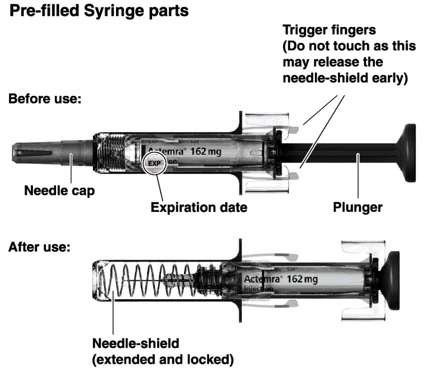
Figure A
Supplies needed for your ACTEMRA Prefilled Syringe Injection (See Figure B):
- ACTEMRA prefilled syringe
- alcohol pad
- sterile cotton ball or gauze
puncture-resistant container or sharps container for safe disposal of needle cap and used syringe (See Step 4 "Dispose of the syringe")
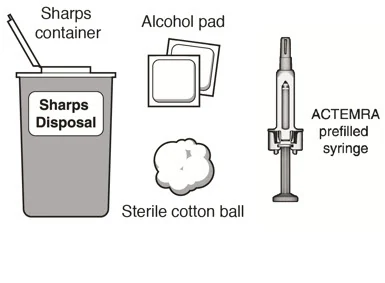
Figure B
Step 1. Preparing for an ACTEMRA Injection
Find a comfortable space with a clean, flat, working surface.
- Take the box containing the syringe out of the refrigerator and open the box. Do not touch the trigger fingers on the syringe as this may damage the syringe.
- Remove 1 single-use ACTEMRA prefilled syringe from the box and let it warm up for 30 minutes to allow it to reach room temperature. If the syringe does not reach room temperature, this could cause your injection to feel uncomfortable and make it difficult to push the plunger in.
- Do not speed up the warming process in any way, such as using the microwave or placing the syringe in warm water.
- Check the expiration date on the ACTEMRA prefilled syringe (See Figure A). Do not use it if the expiration date has passed because it may not be safe to use. If the expiration date has passed safely dispose of the syringe in a sharps container and get a new one.
Do not remove the needle cap while allowing your ACTEMRA prefilled syringe to reach room temperature.
- Keep your unused syringes in the original carton and keep in the refrigerator at 36°F to 46°F (2°C to 8°C). Do not freeze.
Once removed from the refrigerator, your prefilled syringe can be stored up to 2 weeks at or below 86°F (30°C). Your prefilled syringe must always be kept in the original carton in order to protect from light and moisture. Hold your ACTEMRA prefilled syringe with the covered needle pointing down (See Figure C).
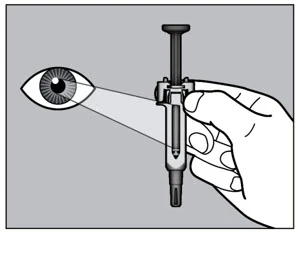
Figure C
- Check the liquid in the ACTEMRA prefilled syringe. It should be clear and colorless to pale yellow. Do not inject ACTEMRA if the liquid is cloudy, discolored, or has lumps or particles in it because it may not be safe to use. Safely dispose of the syringe in a sharps container and get a new one.
- Wash your hands well with soap and water.
Step 2. Choose and Prepare an Injection Site
Choose an Injection Site
- The front of your thigh and your abdomen except for the 2-inch area around your navel are the recommended injection sites (See Figure D).
- The outer area of the upper arms may also be used only if the injection is being given by a caregiver. Do not attempt to use the upper arm area by yourself (See Figure D).
Rotate Injection Site
- Choose a different injection site for each new injection at least 1-inch from the last area you injected.
Do not inject into moles, scars, bruises, or areas where the skin is tender, red, hard or not intact.
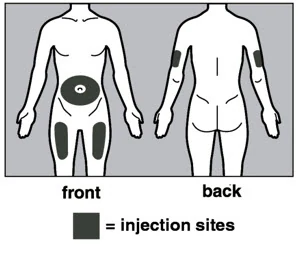
Figure D
Prepare the Injection Site
- Wipe the injection site with an alcohol pad in a circular motion and let it air dry to reduce the chance of getting an infection. Do not touch the injection site again before giving the injection.
- Do not fan or blow on the clean area.
Step 3. Inject ACTEMRA
Hold the ACTEMRA prefilled syringe with 1 hand and pull the needle cap straight off with your other hand (See Figure E). Do not hold the plunger while you remove the needle cap. If you cannot remove the needle cap you should ask a caregiver for help or contact your healthcare provider.
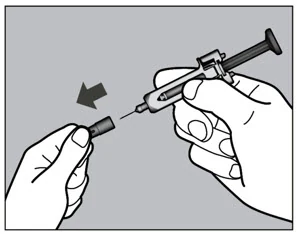
Figure E
- Throw away the needle cap in a sharps container.
- There may be a small air bubble in the ACTEMRA prefilled syringe. You do not need to remove it.
- You may see a drop of liquid at the end of the needle. This is normal and will not affect your dose.
- Do not touch the needle or let it touch any surfaces.
- Do not use the prefilled syringe if it is dropped.
- If it is not used within 5 minutes of needle cap removal, the syringe should be disposed of in the puncture resistant container or sharps container and a new syringe should be used.
- Never reattach the needle cap after removal.
Hold the ACTEMRA prefilled syringe in 1 hand between the thumb and index finger (See Figure F).
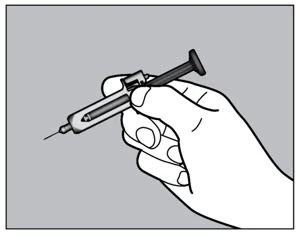
Figure F
- Do not pull back on the plunger of the syringe.
- Use your other hand and gently pinch the area of skin you cleaned. Hold the pinched skin firmly. Pinching the skin is important to make sure that you inject under the skin (into fatty tissue) but not any deeper (into muscle). Injection into muscle could cause the injection to feel uncomfortable.
- Do not hold or push on the plunger while inserting the needle into the skin.
Use a quick, dart-like motion to insert the needle all the way into the pinched skin at an angle between 45° to 90° (See Figure G). It is important to use the correct angle to make sure the medicine is delivered under the skin (into fatty tissue), or the injection could be painful and the medicine may not work.
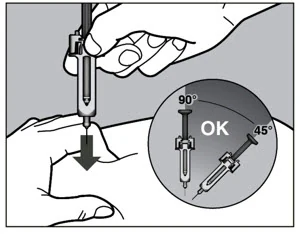
Figure G
- Keep the syringe in position and let go of the pinch of skin.
Slowly inject all of the medicine by gently pushing the plunger all the way down (See Figure H). You must press the plunger all the way down to get the full dose of medicine and to ensure the trigger fingers are completely pushed to the side. If the plunger is not fully depressed the needle shield will not extend to cover the needle when it is removed. If the needle is not covered, carefully place the syringe into the puncture resistant container to avoid injury with the needle.
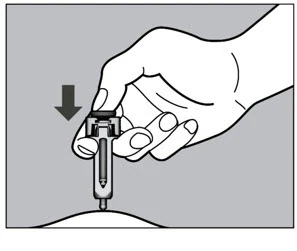
Figure H
- After the plunger is pushed all the way down, keep pressing down on the plunger to be sure all of the medicine is injected before taking the needle out of the skin.
Keep pressing down on the plunger while you take the needle out of the skin at the same angle as inserted (See Figure I).
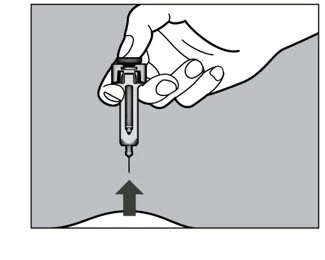
Figure I
After the needle is removed completely from the skin, release the plunger, allowing the needle-shield to protect the needle (See Figure J).
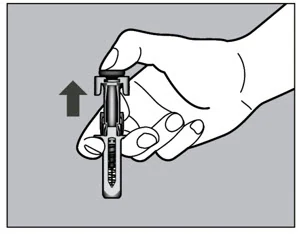
Figure J
After the Injection
- There may be a little bleeding at the injection site. You can press a cotton ball or gauze over the injection site.
- Do not rub the injection site.
- If needed, you may cover the injection site with a small bandage.
Step 4. Dispose of the syringe
- The ACTEMRA prefilled syringe should not be reused.
- Put the used syringe into your puncture resistant container (See "How do I throw away used syringes?")
- Do not put the needle cap back on the needle.
- If your injection is given by another person, this person must also be careful when removing the syringe and disposing of the syringe to prevent accidental needle stick injury and passing infection.
How do I throw away used syringes?
Put your used needles and syringes including ACTEMRA in a FDA-cleared sharps disposal container right away after use (See Figure K). Do not throw away (dispose of) loose needles and syringes in your household trash.
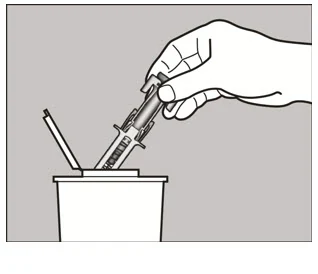
Figure K
If you do not have a FDA-cleared sharps disposal container, you may use a household container that is:
- made of a heavy-duty plastic
- can be closed with a tight-fitting, puncture-resistant lid, without sharps being able to come out
- upright stable during use
- leak-resistant
properly labeled to warn of hazardous waste inside the container
- When your sharps disposal container is almost full, you will need to follow your community guidelines for the right way to dispose of your sharps disposal container. There may be state or local laws about how you should throw away used needles and syringes. For more information about the safe sharps disposal, and for specific information about sharps disposal in the state that you live in, go to the FDA's website at: http://www.fda.gov/safesharpsdisposal.
- Do not dispose of your used sharps disposal container in your household trash unless your community guidelines permit this. Do not recycle your used sharps disposal container.
- Keep ACTEMRA prefilled syringes and the disposal container out of the reach of children.
Record your Injection
- Write the date, time, and specific part of your body where you injected yourself. It may also be helpful to write any questions or concerns about the injection so you can ask your healthcare provider.
If you have questions or concerns about your ACTEMRA prefilled syringe, please contact your healthcare provider familiar with ACTEMRA or call 1-800-ACTEMRA.
This Medication Guide and Instructions for Use has been approved by the U.S. Food and Drug Administration.
Medication Guide Revised: 08/2025
ACTEMRA is a registered trademark of Chugai Seiyaku Kabushiki Kaisha Corp., a member of the Roche Group.
Genentech, Inc.
A Member of the Roche Group
1 DNA Way
South San Francisco, CA 94080-4990
U.S. License No.: 1048
© 2025 Genentech, Inc. All rights reserved.
Instructions for Use
ACTEMRA® (AC-TEM-RA)
(tocilizumab)
Injection, For Subcutaneous Use
Single-dose Prefilled ACTPen® (AKT-PEN) Autoinjector
Read and follow the Instructions for Use that come with your ACTEMRA ACTPen autoinjector before you start using it and each time you get a prescription refill. Before you use the ACTEMRA ACTPen autoinjector for the first time, make sure your healthcare provider shows you the right way to use it.
Important: Keep your unused Autoinjectors in the original carton and keep in the refrigerator at 36°F to 46°F (2°C to 8°C). Do not freeze. Once removed from the refrigerator, your Autoinjector can be stored up to 2 weeks at or below 86°F (30°C). Your Autoinjector must always be kept in the original carton in order to protect from light and moisture.
- Do not remove the Autoinjector cap until you are ready to inject ACTEMRA.
- Do not try to take apart the Autoinjector at any time.
- Do not reuse the same Autoinjector.
- Do not use the Autoinjector through clothing.
- Do not leave the Autoinjector unattended.
- Do not use the Autoinjector if it appears to be damaged or if you have accidentally dropped the Autoinjector.
- Keep out of the reach of children.
Parts of your ACTEMRA ACTPen autoinjector (See Figure A).
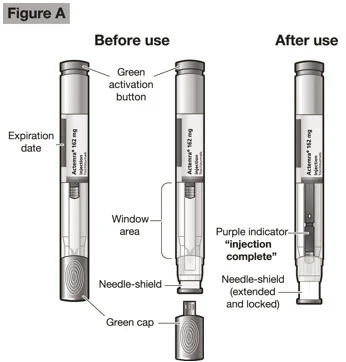
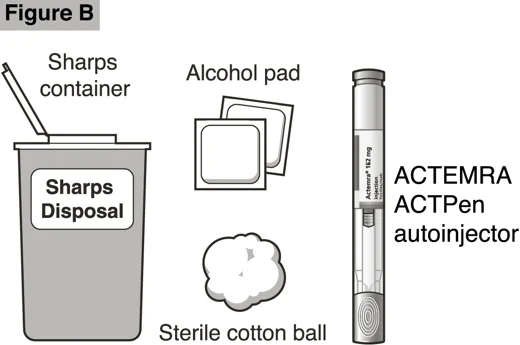
Supplies needed for an injection using your ACTEMRA ACTPen autoinjector (See Figure B):
- 1 ACTEMRA ACTPen autoinjector
- 1 Alcohol pad
- 1 Sterile cotton ball or gauze
- 1 Puncture-resistant container or sharps container for safe disposal of Autoinjector cap and used Autoinjector (See Step 4 "Dispose of the Autoinjector")
Step 1. Preparing for an ACTEMRA Injection
Find a comfortable space with a clean, flat, working surface.
- Take the box containing the Autoinjector out of the refrigerator.
- If you are opening the box for the first time, check to make sure that it is properly sealed. Do not use the Autoinjector if the box looks like it has already been opened.
- Check that the Autoinjector box is not damaged. Do not use ACTEMRA ACTPen autoinjector if the box looks damaged.
- Check the expiration date on the Autoinjector box. Do not use the Autoinjector if the expiration date has passed because it may not be safe to use.
- Open the box, and remove 1 single-use ACTEMRA ACTPen autoinjector from the box.
- Return any remaining autoinjectors in the box to the refrigerator.
- Check the expiration date on the ACTEMRA ACTPen autoinjector (See Figure A). Do not use it if the expiration date has passed because it may not be safe to use. If the expiration date has passed, safely dispose of the Autoinjector in a sharps container and get a new one.
- Check the Autoinjector to make sure it is not damaged. Do not use the Autoinjector if it appears to be damaged or if you have accidentally dropped the Autoinjector.
Place the Autoinjector on a clean, flat surface and let the Autoinjector warm up for 45 minutes to allow it to reach room temperature. If the Autoinjector does not reach room temperature, this could cause your injection to feel uncomfortable and it could take longer to inject.
- Do not speed up the warming process in any way, such as using the microwave or placing the Autoinjector in warm water.
- Do not leave the Autoinjector to warm up in direct sunlight.
- Do not remove the green cap while allowing your ACTEMRA ACTPen autoinjector to reach room temperature.
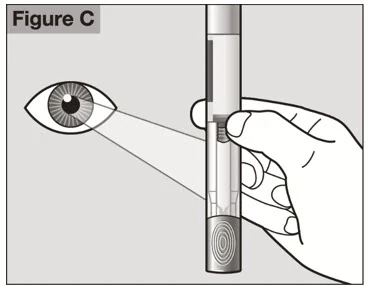
- Hold your ACTEMRA ACTPen autoinjector with the green cap pointing down (See Figure C).
- Look in the clear Window area. Check the liquid in the ACTEMRA ACTPen autoinjector (See Figure C). It should be clear and colorless to pale yellow. Do not inject ACTEMRA if the liquid is cloudy, discolored, or has lumps or particles in it because it may not be safe to use. Safely dispose of the Autoinjector in a sharps container and get a new one.
- Wash your hands well with soap and water.
Step 2. Choose and Prepare an Injection Site
Choose an Injection Site
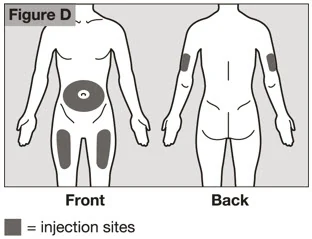
- The front of your thigh or your abdomen except for the 2-inch (5cm) area around your navel are the recommended injection sites (See Figure D).
- The outer area of the upper arms may also be used only if the injection is being given by a caregiver. Do not attempt to use the upper arm area by yourself (See Figure D).
Rotate Injection Site
- Choose a different injection site for each new injection at least 1 inch (2.5cm) from the last area you injected.
- Do not inject into moles, scars, bruises, or areas where the skin is tender, red, hard or not intact.
Prepare the Injection Site
- Wipe the injection site with an alcohol pad in a circular motion and let it air dry to reduce the chance of getting an infection. Do not touch the injection site again before giving the injection.
- Do not fan or blow on the clean area.
Step 3. Inject ACTEMRA
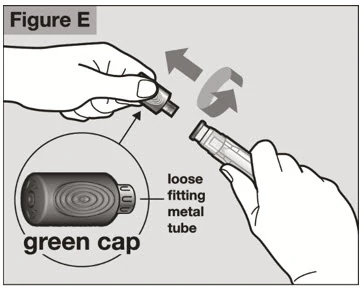
- Hold the ACTEMRA ACTPen autoinjector firmly with one hand. Twist and pull off the green cap with the other hand (See Figure E). The green cap contains a loose fitting metal tube.
If you cannot remove the green cap you should ask a caregiver for help or contact your healthcare provider.
Important: Do not touch the needle shield which is located at the tip of the Autoinjector below the Window area (See Figure A), to avoid accidental needle stick injury.
- Throw away the green cap in a sharps container.
- After you remove the green cap, the Autoinjector is ready for use. If the Autoinjector is not used within 3 minutes of the cap removal, the Autoinjector should be disposed of in the sharps container and a new Autoinjector should be used.
- Never reattach the green cap after removal.
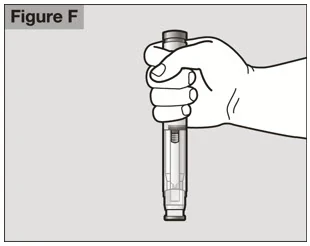
- Hold the Autoinjector comfortably in 1 hand by the upper part, so that you can see the Window area of the Autoinjector (See Figure F).
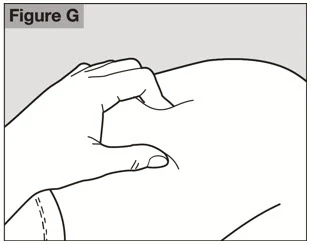
- Use your other hand to gently pinch the area of skin you cleaned, to prepare a firm injection site (See Figure G). The Autoinjector requires a firm injection site to properly activate. Pinching the skin is important to make sure that you inject under the skin (into fatty tissue) but not any deeper (into muscle). Injection into muscle could cause the injection to feel uncomfortable.
Do not press the green Activation button yet.
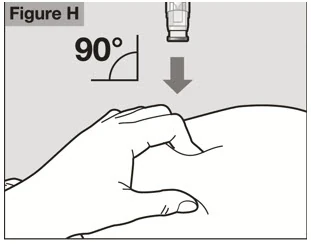
Place the needle-shield of the Autoinjector against your pinched skin at a 90° angle (See Figure H).
- It is important to use the correct angle to make sure the medicine is delivered under the skin (into fatty tissue), or the injection could be painful and the medicine may not work.
- Continue to gently pinch throughout the injection procedure.
- To use the Autoinjector, you first have to unlock the green Activation button. To unlock it, press the Autoinjector firmly against your pinched skin until the needle-shield is completely pushed in (See Figure I).
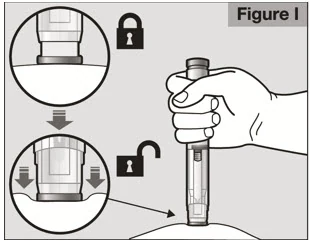
- Continue to keep the needle-shield pushed in. If you do not keep the needle-shield completely pushed against the skin, the green Activation button will not work. Continue to pinch the skin while you keep the Autoinjector in place.
- Press the green Activation button to start the injection. A "click" sound indicates the start of the injection. Keep the green button pressed in and continue holding the Autoinjector pressed firmly against your skin (See Figure J). If you cannot start the injection you should ask for help from a caregiver or contact your healthcare provider.
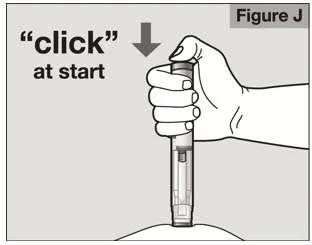
- The purple indicator will move along the Window area during the injection (See Figure K).
- Watch the purple indicator until it stops moving to be sure the full dose of medicine is injected. This may take up to 10 seconds.
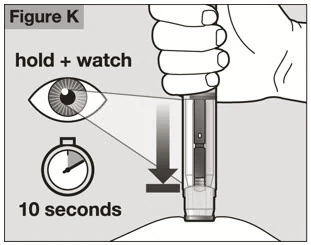
- You may hear a second "click" during the injection but you should continue to hold the Autoinjector firmly against your skin until the purple indicator stops moving.
- When the purple indicator has stopped moving, release the green button. Lift the Autoinjector straight off of the injection site at a 90° angle to remove the needle from the skin. The needle-shield will then move out and lock into place covering the needle (See Figure L).
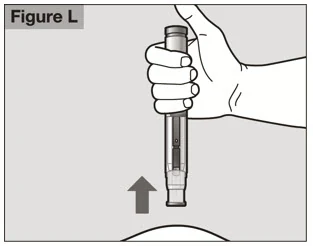
- Check the Window area to see that it is filled with the purple indicator (See Figure L).
If the Window area is not filled by the purple indicator then:
- The needle-shield may not have locked. Do not touch the needle-shield of the Autoinjector, because you may stick yourself with the needle. If the needle is not covered, carefully place the Autoinjector into the sharps container to avoid any injury with the needle.
- You may not have received your full dose of ACTEMRA. Do not try to re-use the Autoinjector. Do not repeat the injection with another Autoinjector. Call your healthcare provider for help.
After the Injection
- There may be a little bleeding at the injection site. You can press a cotton ball or gauze over the injection site.
- Do not rub the injection site.
- If needed, you may cover the injection site with a small bandage.
Step 4. Dispose of the Autoinjector
- The ACTEMRA ACTPen autoinjector should not be reused.
- Put the used Autoinjector into your sharps container (See "How do I dispose of used Autoinjectors? ").
- Do not put the cap back on the Autoinjector.
- If your injection is given by another person, this person must also be careful when removing the Autoinjector and disposing of it to prevent accidental needle stick injury and passing infection.
How do I dispose of used Autoinjectors?
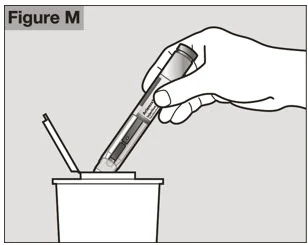
- Put your used ACTEMRA ACTPen autoinjector and green cap in a FDA-cleared sharps disposal container right away after use (See Figure M).
- Do not throw away (dispose of) the Autoinjector and the green cap in your household trash.
If you do not have a FDA-cleared sharps disposal container, you may use a household container that is:
- made of a heavy-duty plastic
- can be closed with a tight-fitting, puncture-resistant lid, without sharps being able to come out
- upright stable during use
- leak-resistant
properly labeled to warn of hazardous waste inside the container
- When your sharps disposal container is almost full, you will need to follow your community guidelines for the right way to dispose of your sharps disposal container. There may be state or local laws about how you should dispose of used Autoinjectors. For more information about the safe sharps disposal, and for specific information about sharps disposal in the state that you live in, go to the FDA's website at: http://www.fda.gov/safesharpsdisposal.
- Do not dispose of your used sharps disposal container in your household trash unless your community guidelines permit this. Do not recycle your used sharps disposal container.
Keep the ACTEMRA ACTPen autoinjector and disposal container out of the reach of children.
Record your Injection
- Write the date, time, and specific part of your body where you injected yourself. It may also be helpful to write any questions or concerns about the injection so you can ask your healthcare provider.
If you have any questions or concerns about your ACTEMRA ACTPen autoinjector, talk to your healthcare provider familiar with ACTEMRA or call 1-800-ACTEMRA.
This Medication Guide and Instructions for Use has been approved by the U.S. Food and Drug Administration.
Medication Guide Revised: 08/2025
ACTEMRA is a registered trademark of Chugai Seiyaku Kabushiki Kaisha Corp., a member of the Roche Group.
ACTPen is a registered trademark of Chugai Seiyaku Kabushiki Kaisha Corp., a member of the Roche Group.
Genentech, Inc.
A Member of the Roche Group
1 DNA Way
South San Francisco, CA 94080-4990
U.S. License No.: 1048
© 2025 Genentech, Inc. All rights reserved.