


Patient information: uses, side effects, how to take - Atrovent
Patient's Instructions for Use
Atrovent®
(ipratropium bromide)
Nasal Spray 0.03%
21 mcg/spray
Read complete instructions carefully before using.
In order to ensure proper dosing, do not attempt to change the size of the spray opening.
ATROVENT Nasal Spray 0.03% is indicated for the symptomatic relief of rhinorrhea (runny nose) associated with allergic and nonallergic perennial rhinitis in adults and children age 6 years and older. ATROVENT Nasal Spray 0.03% does not relieve nasal congestion, sneezing, or postnasal drip associated with allergic or nonallergic perennial rhinitis.
Read complete instructions carefully and use only as directed.
To Use:
- 1.
Remove the clear plastic dust cap and the green safety clip from the nasal spray pump (Figure 1). The safety clip prevents the accidental discharge of the spray in your pocket or purse.
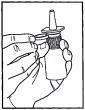
Figure 1
- 2.
The nasal spray pump must be primed before Atrovent® (ipratropium bromide) Nasal Spray 0.03% is used for the first time. To prime the pump, hold the bottle with your thumb at the base and your index and middle fingers on the white shoulder area. Make sure the bottle points upright and away from your eyes. Press your thumb firmly and quickly against the bottle seven times (Figure 2). The pump is now primed and can be used. Your pump should not have to be reprimed unless you have not used the medication for more than 24 hours; repriming the pump will only require two sprays. If you have not used your nasal spray for more than seven days, repriming the pump will require seven sprays.
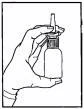
Figure 2
- 3. Before using ATROVENT Nasal Spray 0.03%, blow your nose gently to clear your nostrils if necessary.
- 4.
Close one nostril by gently placing your finger against the side of your nose, tilt your head slightly forward and, keeping the bottle upright, insert the nasal tip into the other nostril (Figure 3). Point the tip toward the back and outer side of the nose.
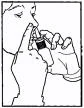
Figure 3
- 5. Press firmly and quickly upwards with the thumb at the base while holding the white shoulder portion of the pump between your index and middle fingers. Following each spray, sniff deeply and breathe out through your mouth.
- 6. After spraying the nostril and removing the unit, tilt your head backwards for a few seconds to let the spray spread over the back of the nose.
- 7. Repeat steps 4 through 6 in the same nostril.
- 8. Repeat steps 4 through 7 in the other nostril (i.e., two sprays per nostril).
- 9. Replace the clear plastic dust cap and safety clip.
- 10. At some time before the medication is completely used up, you should consult your physician or pharmacist to determine whether a refill is needed. You should not take extra doses or stop using Atrovent® (ipratropium bromide) Nasal Spray 0.03% without consulting your physician.
To Clean:
If the nasal tip becomes clogged, remove the clear plastic dust cap and safety clip. Hold the nasal tip under running, warm tap water (Figure 4) for about a minute. Dry the nasal tip, reprime the nasal spray pump (step 2 above), and replace the plastic dust cap and safety clip.
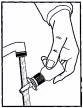
Figure 4
Caution:
ATROVENT Nasal Spray 0.03% is intended to relieve your rhinorrhea (runny nose) with regular use. It is therefore important that you use ATROVENT Nasal Spray 0.03% as prescribed by your physician. For most patients, some improvement in runny nose is usually apparent during the first full day of treatment with ATROVENT Nasal Spray 0.03%. Some patients may require up to two weeks of treatment to obtain maximum benefit.
Do not spray ATROVENT Nasal Spray 0.03% in your eyes. Should this occur, immediately flush your eye with cool tap water for several minutes. If you accidentally spray ATROVENT Nasal Spray 0.03% in your eyes, you may experience a temporary blurring of vision, visual halos or colored images in association with red eyes from conjunctival and corneal congestion, development or worsening of narrow-angle glaucoma, pupil dilation, or acute eye pain/discomfort, and increased sensitivity to light, which may last a few hours. Should acute eye pain or blurred vision occur, contact your doctor.
Should you experience excessive nasal dryness or episodes of nasal bleeding contact your doctor.
If you have glaucoma or difficulty urinating due to an enlargement of the prostate, be sure to tell your physician prior to using ATROVENT Nasal Spray 0.03%.
If you are pregnant or you are breast feeding your baby, be sure to tell your physician prior to using ATROVENT Nasal Spray 0.03%.
Address medical inquiries to: http://us.boehringer-ingelheim.com, (800) 542-6257 or (800) 459-9906 TTY.
Store tightly closed at 25°C (77°F); excursions permitted to 15°-30°C (59°-86°F) [see USP Controlled Room Temperature]. Avoid freezing. Keep out of reach of children.
Distributed by:
Boehringer Ingelheim Pharmaceuticals, Inc.
Ridgefield, CT 06877 USA
Licensed from:
Boehringer Ingelheim International GmbH
Copyright 2010 Boehringer Ingelheim International GmbH
ALL RIGHTS RESERVED
Rev: July 2010
IT4000DG1710
10001900/06