


Patient information: uses, side effects, how to take - N/a
Instructions for Use
ATROPINE
injection, for intramuscular use
2 mg Atropine single-dose autoinjector
If possible, a healthcare provider or someone who has been trained to identify and treat the symptoms of exposure to nerve agents or insecticides should give (administer) the Atropine autoinjector. If a healthcare provider is not available during an emergency,a patient or a caregiver might need to give the Atropine injection.
Individuals should not rely only on Atropine for protection from nerve agent or insecticide poisoning.
Patients and caregivers need to wear clothing to protect their skin and goggles and masks to protect their face and eyes when available to avoid exposure.
Leave the exposed (contaminated) area as quickly as possible.
Get medical help right away after exposure.
Step 1: Decide if the 2 mg Atropine autoinjector is right to use based on weight and age.
- The 2 mg Atropine autoinjector is for use only in adults and children weighing over 90 pounds (41 kg) (generally over 10 years of age).
- Do notuse the 2 mg Atropine autoinjector for children weighing 90 pounds (41 kg) and less (generally 10 years of age and younger). The dose of the 2 mg Atropine autoinjector cannot be changed.
Step 2: Decide if symptoms are mild or severe using Table 1 below.The number of injections needed depends on if there are 2 or more mild symptoms or if there are any severe symptoms.
Note: You may not see all of these symptoms in yourself or others exposed to a nerve agent or certain insecticide poisoning.
Table 1. Symptoms of Nerve Agent or Insecticide Poisoning
Mild symptoms include:
| Severe symptoms include:
|
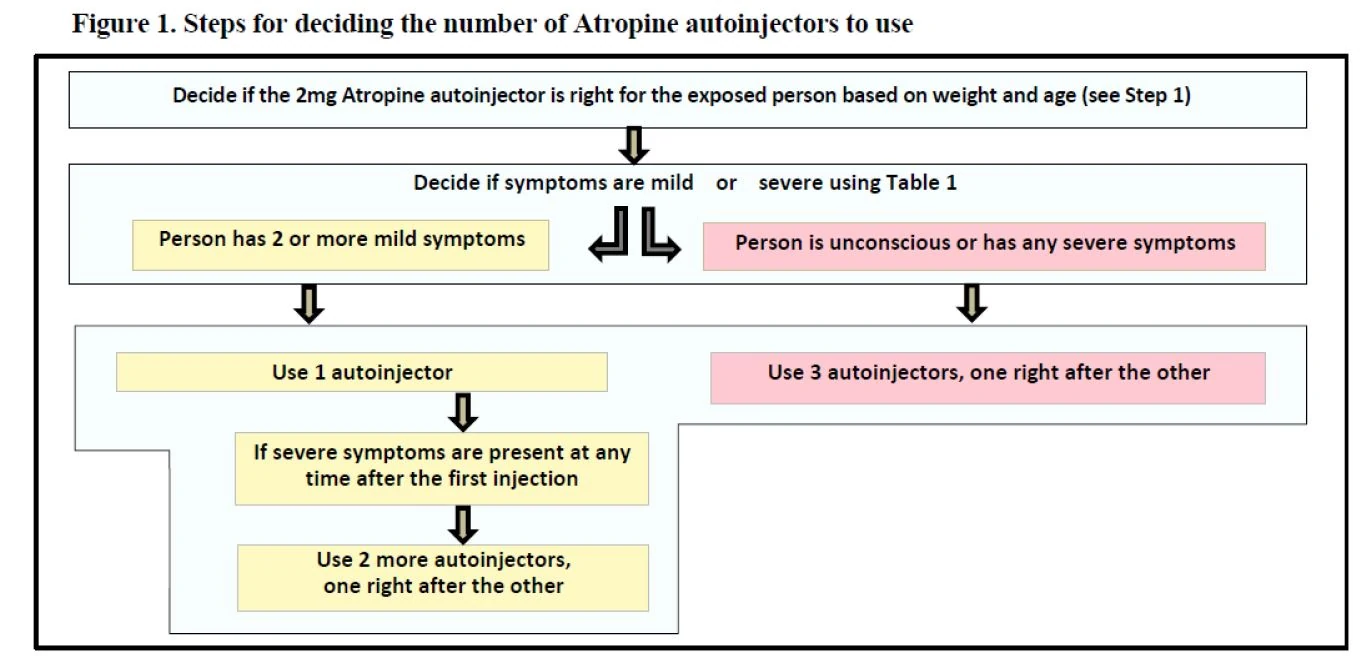
Step 3: Decide the number of Atropine autoinjectors to use based on if the symptoms are mild or severe. See Table 1and Figure 1.
Mild Symptoms (see Table 1)
First Dose: If you have or see someone with 2 or more mild symptomslisted in Table 1and exposure is known or suspected, give 1 injectionof Atropine into the outer thigh using the Atropine autoinjector. You can inject through clothing, but make sure pockets at the injection site are empty. Keep checking to see if symptoms continue or get worse. Get medical help right away.
Additional Doses: If at any time after the first dose(1 injection) the person who was exposed starts to have any of the severe symptoms listed in Table 1, you will need to give 2 more injectionsquickly one right after the other using a new Atropine autoinjector for each injection. Do notuse the same autoinjector more than one time. If you have given yourself the first injection, someone else should give you the second and third injections, if possible.
You can inject additional doses through clothing, but make sure pockets at the injection site are empty.
No more injections are needed if the person who was exposed does not get sever symptoms 10 to 15 minutes after the first dose (1 injection).
Severe Symptoms (see Table 1)
If you have or see someone with anyof the severe symptomslisted in Table 1and exposure is known or suspected, or you see an exposed person passed out (unconscious), give 3 injectionsinto the outer thigh quickly one right after the other, using 3 new autoinjectors.
You can inject through clothing, but make sure pockets at the injection site are empty. Get medical help right away.
 Step 4: Instructions for how to use the Atropine autoinjector
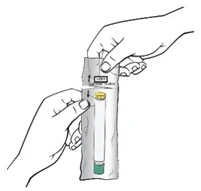 | A.) Hold the plastic sleeve on both sides of the dotted lines (perforation) and tear apart at the edge to open. Remove the autoinjector from the plastic sleeve. Be careful not to place fingers on the green tip. |
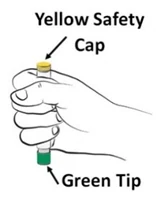 | B.) Firmly hold the autoinjector with the green tip pointed down. |
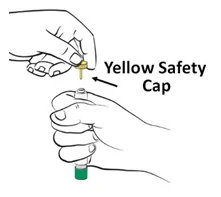 | C.) Pull off the yellow safety cap with your other hand. |
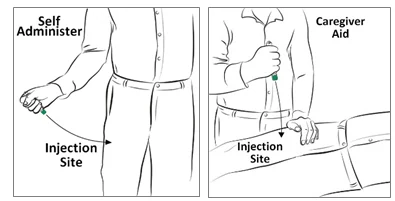 | D.) Aim and firmly inject the green tip straight down (at a 90° angle) against the outer thigh. The autoinjector will give the medicine when you do this. You can inject through clothing, but make sure pockets at the injection site are empty. Note: People who may not have a lot of fat at the injection siteshould also be injected in the outer thigh. Before giving the injection, pinch a fold of skin firmly on the outer thigh to provide a thicker area for the injection. |
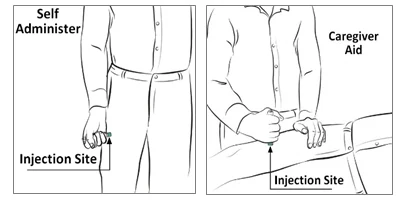 | E.) Hold the autoinjector firmly in place for at least 10 secondsto allow the injection to finish. |
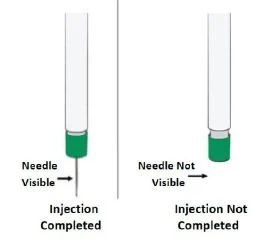 | F.) After 10 seconds, remove the autoinjector from the outer thigh and massage the injection site in a circle motion for several seconds. Note: If you do not see the needle after removing it from the outer thigh, the injection is not completed. Check to be sure the yellow safety cap has been removed.If the yellow safety cap has been removed, repeat Step 4 D) to Step 4 E) pressing more firmly against the outer thigh to activate the autoinjector. If you still do not see the needle, use a new autoinjector and start over again at Step 4 A). |
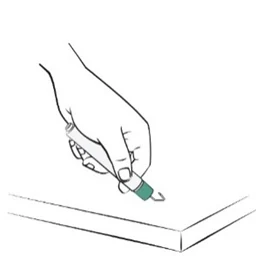 | G.) After the injection, avoid contact with blood or the needle by carefully bending the needle back against the autoinjector using a hard surface. Use the bent needle as a hook to pin the used autoinjector to the clothing of the person who has been exposed. This will allow medical personnel to see the number of Atropine autoinjectors given. You can also put the used autoinjector back into the plastic sleeve and leave it next to the person or write the dose and number of autoinjectors used on a triage tag, hand, forehead, chest or other part of the body. Move yourself and the exposed person away from the contaminated area right away. Get medical help right away. Each autoinjector has only a single dose (1 injection) of medicine. If you need more than 1 injection,repeat the instructions in Step 4 using a new autoinjector for each injection. |
This Instructions for Use has been approved by the U.S. Food and Drug Administration.
Manufactured by:
Rafa Laboratories, Ltd.
Jerusalem, Israel
Revised: 07/2019