


Patient information: uses, side effects, how to take - ATROPEN Auto-Injector
Instructions for Use
ATROPEN (at-ROW-pen)
(atropine injection)
for intramuscular use
Self and Caregiver Instructions for Use of ATROPEN
Important: Follow these instructions only when ready to use ATROPEN. If possible, a healthcare provider or someone who has been trained to identify and treat the symptoms of nerve agent and insecticide poisoning should give the ATROPEN injection. If a healthcare provider is not available during an emergency, a patient or caregiver might need to give the ATROPEN injection.
Individuals should not rely only on ATROPEN for protection from nerve agent and insecticide poisoning. Exposed persons and caregivers need to wear clothing to protect their skin and goggles and masks to protect their face and eyes when available, to avoid exposure.
Step 1
Choose the Correct Dose
Adults and children
weighing over 90 pounds (41 kg)
(generally over 10 years of age
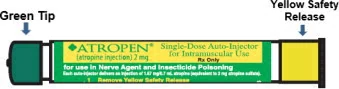
2 mg ATROPEN (green label)
2 mg
Children
weighing 40 pounds to 90 pounds (18 kg to 41 kg)
(generally 4 to 10 years of age)
1 mg ATROPEN (red label)
 1 mg
Children
weighing 15 pounds to 40 pounds (7 kg to 18 kg)
(generally 6 months to 4 years of age)
0.5 mg ATROPEN (blue label)
 0.5 mg
Infants
weighing less than 15 pounds (7 kg)
(generally less than 6 months of age)
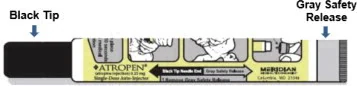
0.25 mg ATROPEN (yellow label)
0.25 mg
Caution: When the ATROPEN is activated, the needle will quickly extend from the green tip and black tip. Keep your fingers away from the green tip and black tip.
Step 2
Decide if Symptoms are Mild or Severe
If nerve agent or insecticide exposure is known or suspected, you may see the following mild and severe symptoms. You may not have all of the symptoms or see all symptoms in others exposed to a nerve agent or certain insecticide poisoning:
Mild Symptoms
Severe Symptoms
Blurred vision and sore eyes
Excessive, unexplained teary eyes
Excessive, unexplained runny nose
Increase saliva or sudden drooling
Chest tightness or breathing problems
Shaking (tremors) throughout the body or muscle twitching
Nausea and vomiting
Unexplained wheezing, coughing or increase in mucus (phlegm) coming from the lungs
Sudden stomach cramping
Fast heartbeat (tachycardia) or slow heartbeat (bradycardia)
Strange or confused behavior
Severe breathing problems or a large amount of fluid (secretions) coming from the lungs
Severe muscle twitching and general weakness
Problems controlling urine or stool (bowel movement)
Seizures (convulsions)
Passing out (unconsciousness)
Symptoms in infants and young children:
The mild symptoms excessive, unexplained teary eyes, excessive, unexplained runny nose and increased saliva or sudden drooling, and the severe symptom problems controlling urine or stool (bowel movement) are sometimes seen in healthy infants and young children. In infants and young children, these symptoms are seen less often than the other mild and severe symptoms listed above. Symptoms must be looked at together when nerve agent or insecticide exposure is known or suspected.
The severe symptoms severe muscle twitching and general weakness can happen in infants. Infants may become drowsy or pass out, with muscle floppiness instead of muscle twitching, soon after exposure to nerve agents or insecticides.
Step 3
Treating Mild Symptoms
First Dose: Give 1 dose of ATROPEN (1 injection) if you get 2 or more mild symptoms of nerve agent or insecticide exposure. Give the injection in the outer thigh. Ask a caregiver to check your symptoms to see if they continue or get worse. Get medical help right away.
Additional Doses: If, any time after the first injection of ATROPEN, the exposed person gets any of the severe symptoms listed above, give 2 more doses of ATROPEN (2 injections) in the outer thigh quickly one right after the other. Use a new ATROPEN for each injection. If you have given yourself the first injection, someone else should give you the second and third ATROPEN injections, if possible.
Treating Severe Symptoms
If you get any of the severe symptoms of nerve agent or insecticide exposure listed above or you see an exposed person who has passed out (unconscious), give 3 doses of ATROPEN (3 injections) right away. Give the 3 injections in the outer thigh quickly, one right after the other, using a new ATROPEN for each injection. Get medical help right away.
Warning: Giving more ATROPEN injections by mistake in people who do not have nerve agent or insecticide poisoning may cause an overdose of atropine. This can lead to being unable to see or walk well for several hours. People with heart problems may have serious side effects, that can lead to death.
Step 4
Give the ATROPEN Injection
Instructions for Use of 2 mg, 1 mg, and 0.5 mg ATROPEN
(see below for 0.25 mg dose instructions)
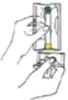
(A) Snap the grooved end of the plastic sleeve down and over the yellow safety release. Remove the ATROPEN from the plastic sleeve.
Caution: Do not place fingers on the green tip.
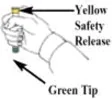
(B) Firmly grasp the ATROPEN in 1 hand with the green tip pointed down.
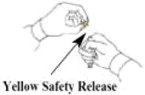
(C) Pull off the yellow safety release with your other hand.
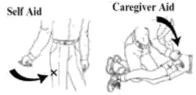
(D) Aim and firmly jab the green tip straight down (at a 90 degree angle) against the outer thigh. The ATROPEN will activate and deliver the medicine. You can inject through clothing, but make sure pockets at the injection site are empty.
Note: People who do not have a lot of fat at the injection site and small children should also be injected in the outer thigh. Before giving the ATROPEN injection, pinch a fold of skin on the outer thigh to provide a thicker area for injection.
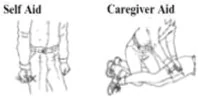
(E) Hold the ATROPEN firmly in place for at least 10 seconds to allow the injection to finish.

(F) After 10 seconds, remove the ATROPEN and massage the injection site for several seconds.
Note: If you see the needle after removing the ATROPEN, the injection is complete.
If you do not see the needle, check to make sure the yellow safety release has been removed. If the yellow safety release has been removed, repeat Step 4 (D) and Step 4 (E), but press harder to activate the ATROPEN.
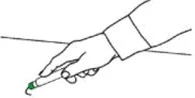
(G) After the injection, bend the needle back against the ATROPEN using a hard surface. Use the bent needle as a hook to pin the used ATROPEN to the clothing of the exposed person. You can also show the used ATROPEN to the first medical person you see. This will allow medical personnel to see the number of ATROPENs used and the dose.
Move yourself and the exposed person away from the contaminated area right away. Get medical help right away.
Instructions for Use of 0.25 mg ATROPEN
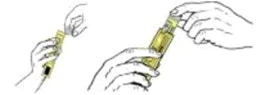
(A) Remove the plastic cap from the yellow tube and slide the ATROPEN out of the tube.
Caution: Do not place fingers on the black tip.

(B) Firmly grasp the ATROPEN in 1 hand with the black tip pointed down.
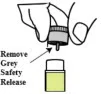
(C) Pull off the gray safety release with your other hand.

(D) Pinch a fold of skin on the outer thigh to provide a thicker area for injection. Aim and firmly jab the black tip straight down (at a 90 degree angle) against the outer thigh. The ATROPEN will activate and deliver the medicine. You can inject through clothing, but make sure pockets at the injection site are empty.
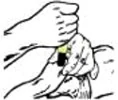
(E) Hold the ATROPEN firmly in place for at least 10 seconds to allow the injection to finish.
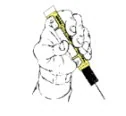
(F) After 10 seconds, remove the ATROPEN and massage the injection site for several seconds.
Note: If you see the needle after removing the ATROPEN, the injection is complete.
If you do not see the needle, check to make sure the gray safety release has been removed. If the gray safety release has been removed, repeat Step 4 (D) and Step 4 (E), but press harder to activate the ATROPEN.
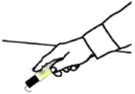
(G) After the injection, bend the needle back against the ATROPEN using a hard surface. Use the bent needle as a hook to pin the used ATROPEN to the clothing of the exposed person. You can also show the used ATROPEN to the first medical person you see. This will allow medical personnel to see the number of ATROPENs used and the dose.
Move yourself and the exposed person away from the contaminated area right away. Get medical help right away.
This Instructions for Use has been approved by the U.S. Food and Drug Administration.
ATROPEN® is a registered trademark of
Meridian Medical Technologies®, LLC
St. Louis, MO 63146
1-833-739-0945
Revised: 09/2022