


Patient information: uses, side effects, how to take - Neulasta
What is Neulasta?
Neulasta is a prescription medicine that is used:
- in adults and children to reduce the chance of infection due to a low white blood cell count, in people with certain types of cancer (non-myeloid), who receive anti-cancer medicines (chemotherapy) that can cause fever and low blood cell count.
- to increase survival in adults and children with sudden exposure to high levels of radiation that damage the bone marrow so it cannot make enough blood cells (this is called hematopoietic syndrome of acute radiation syndrome [H-ARS]). The effectiveness of Neulasta for this use was only studied in animals, because it could not be studied in people.
Do not take Neulasta if you have had a serious allergic reaction to pegfilgrastim or filgrastim.
Before you receive Neulasta, tell your healthcare provider about all of your medical conditions, including if you:
- have a sickle cell disorder.
- have kidney problems.
- are allergic to latex. The needle cap on the prefilled syringe contains dry natural rubber (derived from latex). You should not give Neulasta using the prefilled syringe if you have latex allergies.
are pregnant or plan to become pregnant. It is not known if Neulasta will harm your unborn baby.
- are breastfeeding or plan to breastfeed. It is not known if Neulasta passes into your breast milk.
Tell your healthcare provider about all of the medicines you take, including prescription and over-the-counter medicines, vitamins, and herbal supplements.
How will I receive Neulasta?
- Neulasta is given as an injection under your skin (subcutaneous injection) by a healthcare provider. If your healthcare provider decides that the subcutaneous injections can be given at home by you or your caregiver, follow the detailed "Instructions for Use" that comes with your Neulasta for information on how to prepare and inject a dose of Neulasta using the prefilled syringe.
For adults of any weight and children weighing 99 pounds (45 kg) or more:
- You and your caregiver will be shown how to prepare and inject Neulasta using the prefilled syringe before you use it.
For children weighing less than 99 pounds (45 kg):
- Do not inject a dose from a Neulasta prefilled syringe. A dose less than 0.6 mL (6 mg) cannot be accurately measured using the Neulasta prefilled syringes.
- Your healthcare provider will prepare and give the dose of Neulasta using the vials.
- If you are receiving Neulasta because you are also receiving chemotherapy, the last dose of Neulasta should be injected at least 14 days before and 24 hours after your dose of chemotherapy.
- If you miss a dose of Neulasta, talk to your healthcare provider about when you should give your next dose.
- If you inject too much Neulasta, call your healthcare provider or Poison Help line at 1-800-222-1222 or go to the nearest hospital emergency room right away.
What are possible side effects of Neulasta?
Neulasta can cause serious side effects, including:
- Spleen rupture. Your spleen may become enlarged and can rupture. A ruptured spleen can cause death. Tell your healthcare provider right away if you develop pain in the left upper stomach area or your left shoulder.
- A serious lung problem called Acute Respiratory Distress Syndrome (ARDS). Tell your healthcare provider or get emergency help right away if you develop shortness of breath with or without a fever, trouble breathing, or a fast rate of breathing.
- Serious allergic reactions. Allergic reactions can cause a rash over your whole body, shortness of breath, wheezing, dizziness, swelling around your mouth or eyes, fast heart rate, and sweating. If you develop any of these symptoms, stop using Neulasta and tell your healthcare provider or get emergency medical help right away.
- Sickle cell crises in people with sickle cell disorder. You may have a severe sickle cell crisis, which could lead to death. Tell your healthcare provider right away if you develop symptoms of sickle cell crisis such as pain or difficulty breathing.
Kidney injury. Tell your healthcare provider right away if you develop any of the following symptoms:
- swelling of your face or ankles
- blood in your urine or dark colored urine
- you urinate less than usual
- Increased white blood cell count (leukocytosis). Your healthcare provider will check your blood count during treatment with Neulasta.
- Decreased platelet count (thrombocytopenia). Your healthcare provider will check your blood count during treatment with Neulasta. Tell your healthcare provider if you develop unusual bleeding or bruising during treatment with Neulasta.
Capillary Leak Syndrome (CLS). Neulasta can cause fluid to leak from blood vessels into your body's tissues. CLS can quickly cause you to have symptoms that may become life-threatening. Get emergency medical help right away if you develop any of the following symptoms:
- swelling or puffiness and are urinating less than usual
- trouble breathing
- swelling of your stomach area (abdomen) and feeling of fullness
- dizziness or feeling faint
- a general feeling of tiredness
- Myelodysplastic Syndrome (MDS) and Acute Myeloid Leukemia (AML). If you have breast cancer or lung cancer, when Neulasta is used with chemotherapy and radiation therapy, or with radiation therapy alone, you may have an increased risk of developing a precancerous blood condition called MDS or a blood cancer called AML. Tell your healthcare provider if you develop any symptoms of MDS and AML, including tiredness, fever, or easy bruising or bleeding.
- Inflammation of the arteries (arteritis). Serious inflammation of the large and medium blood vessels that carry blood from your heart to the body, including the aorta (the largest artery), can happen in people receiving Neulasta. Tell your healthcare provider right away if you develop fever, stomach (abdominal) pain, back pain, headache, neck pain, or generally feel unwell.
The most common side effects of Neulasta are pain in the bones, arms, and legs.
These are not all the possible side effects of Neulasta.
Call your healthcare provider for medical advice about side effects. You may report side effects to FDA at 1-800-FDA-1088.
How should I store Neulasta?
- Store Neulasta in the refrigerator between 36°F and 46°F (2°C to 8°C).
- Avoid freezing Neulasta prefilled syringes. If Neulasta prefilled syringe is frozen 1 time, thaw in the refrigerator before using it. If it is frozen more than 1 time, throw it away and use a new Neulasta prefilled syringe.
- Do not freeze Neulasta vials.
- Keep Neulasta in the original carton to protect from light or physical damage.
- Do not shake Neulasta.
- Take Neulasta out of the refrigerator 30 minutes before use and allow it to reach room temperature, 68°F to 77°F (20°C to 25°C), before preparing an injection.
- Throw away (dispose of) any Neulasta that has been left at room temperature, 68°F to 77°F (20°C to 25°C), for more than 48 hours.
Keep Neulasta and all medicines out of the reach of children.
General information about the safe and effective use of Neulasta.
Medicines are sometimes prescribed for purposes other than those listed in a Patient Information leaflet. Do not use Neulasta for a condition for which it was not prescribed. Do not give Neulasta to other people, even if they have the same symptoms that you have. It may harm them. You can ask your pharmacist or healthcare provider for information about Neulasta that is written for health professionals.
What are the ingredients in Neulasta?
Active ingredient: pegfilgrastim
Inactive ingredients: acetate, polysorbate 20, sodium and sorbitol in water for injection.
Manufactured by:
Amgen Inc., One Amgen Center Drive, Thousand Oaks, California 91320-1799
U.S. License No. 1080
Patent: http://pat.amgen.com/onpro/
©2002-2026 Amgen Inc. All rights reserved.
For more information go to www.neulasta.com, or call 1-800-77-AMGEN (1-800-772-6436).
1xxxxx v19
Patient Information
Neulasta® (nu-las-tah)
(pegfilgrastim)
injection
On-body injector for Neulasta
This Patient Information has been approved by the U.S. Food and Drug Administration.
Revised: 08/2026
What is the most important information I need to know about receiving Neulasta with the on-body injector for Neulasta?
See the Instructions for Use for the on-body injector for Neulasta for detailed information about the on-body injector for Neulasta and important information about your dose delivery that has been written by your healthcare provider.
- Know the time that delivery of your dose of Neulasta is expected to start.
Avoid traveling, driving, or operating heavy machinery during hour 26 through hour 29 after the on-body injector for Neulasta is applied. Avoid activities and places that may interfere with monitoring during the 45-minute period that Neulasta is expected to be delivered by the on-body injector for Neulasta, and for 1 hour after delivery.
- A caregiver should be with you the first time that you receive Neulasta with the on-body injector for Neulasta.
- Before your next scheduled Neulasta dose, avoid use of lotions, creams, or oils on your arms and stomach area (abdomen) to help keep the device on your skin.
- If placed on the back of the arm, a caregiver must be available to monitor the status of the on-body injector.
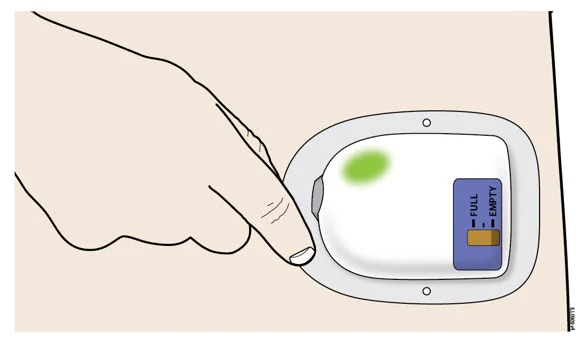
- If you have an allergic reaction during the delivery of Neulasta, remove the on-body injector for Neulasta by grabbing the edge of the adhesive pad and peeling off the on-body injector for Neulasta. Get emergency medical help right away.
- You should only receive a dose of Neulasta on the day your healthcare provider tells you.
- You should not receive your dose of Neulasta any sooner than 24 hours after you finish receiving your chemotherapy. The on-body injector for Neulasta is programmed to deliver your dose about 27 hours after your healthcare provider places the on-body injector for Neulasta on your skin.
Do not expose the on-body injector for Neulasta to the following because the on-body injector for Neulasta may be damaged and you could be injured:
- Diagnostic imaging (e.g., CT Scan, MRI, Ultrasound, X-ray)
- Radiation treatment
- Oxygen rich environments, such as hyperbaric chambers
- Avoid airport X-ray scans. Request a manual pat down instead. Use care during a manual pat down to help prevent the on-body injector for Neulasta from being accidentally removed.
- Keep the on-body injector for Neulasta at least 4 inches away from electrical equipment such as cell phones, cordless telephones, microwaves and other common appliances. If the on-body injector for Neulasta is too close to electrical equipment, it may not work correctly and can lead to a missed or incomplete dose of Neulasta.
- The on-body injector is for adults only.
- If your on-body injector is not working properly, you may miss your dose or you may not receive your full dose of Neulasta. If you miss your dose or do not receive your full dose of Neulasta, you may have an increased risk of developing fever or infection.
Call your healthcare provider right away, as you may need a replacement dose, if any of the following occur:
- on-body injector for Neulasta comes off before or during a dose delivery. Do not re-apply it.
- on-body injector for Neulasta is leaking.
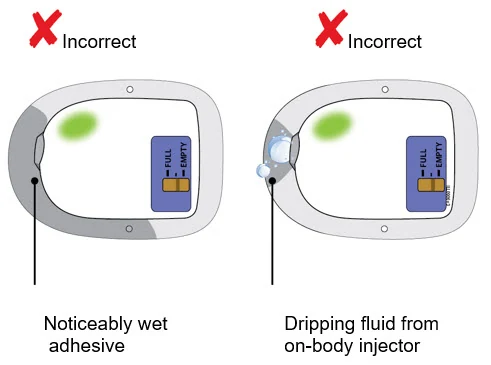
- adhesive on your on-body injector for Neulasta becomes noticeably wet (saturated) with fluid, or there is dripping. This may mean that Neulasta is leaking out of your on-body injector for Neulasta. If this happens you may only receive some of your dose of Neulasta, or you may not receive a dose at all.
- on-body injector for Neulasta status light is flashing red.
What is Neulasta?
Neulasta is a prescription medicine used to help reduce the chance of infection due to a low white blood cell count, in people with certain types of cancer (non-myeloid), who receive anti-cancer medicines (chemotherapy) that can cause fever and low blood cell count.
Do not take Neulasta if you have had a serious allergic reaction to pegfilgrastim or filgrastim.
Before you receive Neulasta, tell your healthcare provider about all of your medical conditions, including if you:
- have a sickle cell disorder
- have had severe skin reactions to acrylic adhesives
- are allergic to latex. The needle cap on the prefilled syringe contains dry natural rubber (derived from latex).
- have kidney problems
- are pregnant or plan to become pregnant. It is not known if Neulasta may harm your unborn baby.
- are breastfeeding or plan to breastfeed. It is not known if Neulasta passes into your breast milk.
Tell your healthcare provider about all the medicines you take, including prescription and over-the-counter medicines, vitamins, and herbal supplements.
How will I receive Neulasta?
See the Instructions for Use for detailed information about how you will receive a dose of Neulasta with the on-body injector for Neulasta, and how to remove and dispose of the on-body injector for Neulasta.
- See the section "What is the most important information I need to know about receiving Neulasta with the on-body injector for Neulasta?"
- Neulasta is given as an injection under the skin (subcutaneous). Your healthcare provider will use a prefilled syringe with Neulasta to fill the on-body injector prior to applying it. The prefilled syringe with Neulasta and the on-body injector are provided to your healthcare provider as part of Neulasta Onpro® kit. The on-body injector for Neulasta will be applied to the stomach area (abdomen) or back of your arm by your healthcare provider. If the on-body injector for Neulasta was placed on the back of your arm, a caregiver must be available to monitor the on-body injector for Neulasta.
- Your healthcare provider should place the on-body injector for Neulasta on an area of your skin that does not have swelling, redness, cuts, wounds, or abrasions. Tell your healthcare provider about any skin reactions that happen in the on-body injector for Neulasta application area after it has been applied.
- The on-body injector for Neulasta is programmed to deliver your dose about 27 hours after your healthcare provider places the on-body injector for Neulasta on your skin.
- The dose of Neulasta will be delivered over about 45 minutes. During dose delivery and for 1 hour after delivery, it is best to stay in a place where you or a caregiver can monitor the on-body injector for Neulasta to make sure you receive your full dose of Neulasta and watch for symptoms of an allergic reaction.
- Your healthcare provider will show you how to monitor the on-body injector for Neulasta to make sure delivery has been completed.
- Keep the on-body injector for Neulasta dry for about the last 3 hours before the dose delivery is expected to start. This will help you to better detect possible leaking from the on-body injector for Neulasta.
- Only expose the on-body injector for Neulasta to temperatures between 41°F to 104°F (5°C to 40°C).
While the on-body injector for Neulasta is in place you should avoid:
- traveling, driving or operating heavy machinery during hour 26 through hour 29 after the on-body injector for Neulasta is applied.
- sleeping on the on-body injector for Neulasta or applying pressure on the on-body injector for Neulasta. The on-body injector for Neulasta may not work properly.
- bumping the on-body injector for Neulasta or knocking it off your body.
- using other materials to hold the on-body injector in place. Using other materials could cover audio or visual indicators or press the on-body injector against your skin, and lead to a missed dose or incomplete dose of Neulasta.
- getting body lotion, creams, oils, and skin cleansing products near the on-body injector for Neulasta. These products may loosen the adhesive that holds the on-body injector for Neulasta onto your body.
- using bath tubs, hot tubs, whirlpools, or saunas, and direct sunlight. These may affect Neulasta.
- peeling off or disturbing the on-body injector for Neulasta adhesive before you receive your full dose of Neulasta.
What are the possible side effects of Neulasta?
Neulasta can cause serious side effects, including:
- Spleen rupture. Your spleen may become enlarged and can rupture. A ruptured spleen can cause death. Tell your healthcare provider right away if you develop pain in your left upper stomach area or left shoulder.
- A serious lung problem called Acute Respiratory Distress Syndrome (ARDS). Tell your healthcare provider or get emergency medical help right away if you develop shortness of breath with or without a fever, trouble breathing, or a fast rate of breathing.
Serious allergic reactions. Allergic reactions can cause a rash over your whole body, shortness of breath, wheezing, dizziness, swelling around your mouth or eyes, fast heart rate and sweating.
If you have an allergic reaction during the delivery of Neulasta, remove the on-body injector for Neulasta by grabbing the edge of the adhesive pad and peeling off the on-body injector for Neulasta. Get emergency medical help right away.
- Sickle cell crises in people with sickle cell disorder. You may have a severe sickle cell crisis, which could lead to death. Tell your healthcare provider right away if you develop symptoms of sickle cell crisis such as pain or difficulty breathing.
Kidney injury. Tell your healthcare provider right away if you develop any of the following symptoms:
- swelling of your face or ankles
- blood in your urine or dark colored urine
- you urinate less than usual
- Increased white blood cell count (leukocytosis). Your healthcare provider will check your blood count during treatment with Neulasta.
- Decreased platelet count (thrombocytopenia). Your healthcare provider will check your blood count during treatment with Neulasta. Tell your healthcare provider if you develop unusual bleeding or bruising during treatment with Neulasta.
Capillary Leak Syndrome (CLS). Neulasta can cause fluid to leak from blood vessels into your body's tissues. CLS can quickly cause you to have symptoms that may become life-threatening. Get emergency medical help right away if you develop any of the following symptoms:
- swelling or puffiness and are urinating less than usual
- trouble breathing
- swelling of your stomach-area (abdomen) and feeling of fullness
- dizziness or feeling faint
- a general feeling of tiredness
- Myelodysplastic Syndrome (MDS) and Acute Myeloid Leukemia (AML). If you have breast cancer or lung cancer, when Neulasta is used with chemotherapy and radiation therapy, or with radiation therapy alone, you may have an increased risk of developing a precancerous blood condition called MDS or a blood cancer called AML. Tell your healthcare provider if you develop any symptoms of MDS and AML, including tiredness, fever, or easy bruising or bleeding.
- Inflammation of the arteries (arteritis). Serious inflammation of the large and medium blood vessels that carry blood from your heart to the body, including the aorta (the largest artery), can happen in people receiving Neulasta. Tell your healthcare provider right away if you develop fever, stomach (abdominal) pain, back pain, headache, neck pain, or generally feel unwell.
The most common side effect of Neulasta is pain in your bones, and in your arms, and legs.
These are not all the possible side effects of Neulasta.
Call your healthcare provider for medical advice about side effects. You may report side effects to FDA at 1-800-FDA-1088.
General information about the safe and effective use of Neulasta.
Medicines are sometimes prescribed for purposes other than those listed in a Patient Information leaflet. If you would like more information about Neulasta, talk with your healthcare provider or pharmacist. You can ask your pharmacist for information about Neulasta that is written for health professionals.
What are the ingredients in Neulasta?
Active ingredient: pegfilgrastim
Inactive ingredients: acetate, polysorbate 20, sodium and sorbitol in water for injection
Manufactured by:
Amgen Inc., One Amgen Center Drive, Thousand Oaks, California 91320-1799
U.S. License No. 1080
Patent: http://pat.amgen.com/onpro/
© 2002 to 2026 Amgen Inc. All rights reserved.
For more information, go to www.neulasta.com or call 1-844-696-3852 (1-844-MYNEULASTA).
V10
Neulasta® (pegfilgrastim) Onpro® kit
Healthcare Provider INSTRUCTIONS FOR USE
Guide to Parts Neulasta Prefilled Syringe |
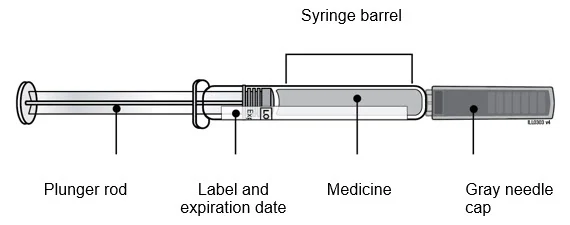 |
| On-body Injector for Neulasta |
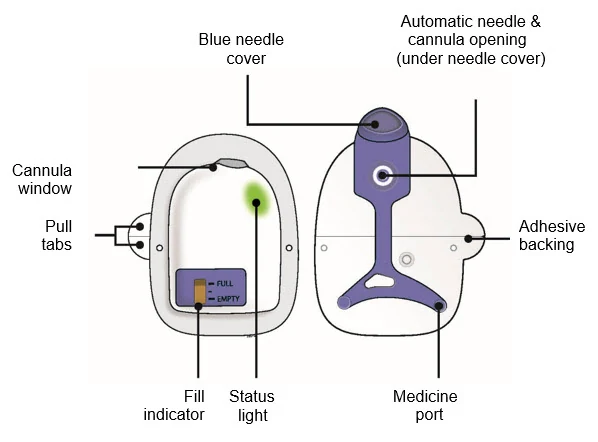 |
Important
READ THE FOLLOWING INSTRUCTIONS BEFORE USING NEULASTA ONPRO KIT
Prescribing Information
- See Prescribing Information for information on Neulasta.
- The on-body injector is for adult patients only.
- The on-body injector is not recommended for patients with Hematopoietic Subsyndrome of Acute Radiation Syndrome.
- Neulasta prefilled syringe gray needle cap contains dry natural rubber, which is derived from latex.
- For patients who have had severe skin reactions to acrylic adhesives, consider the benefit:risk profile before administering pegfilgrastim via the on-body injector for Neulasta.
Application Information
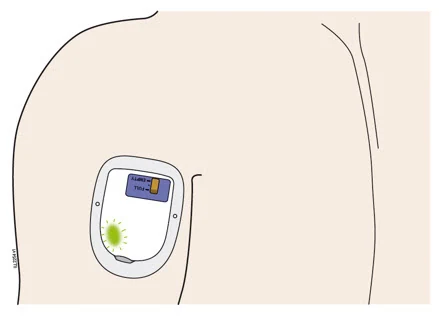
- The on-body injector should be applied to intact, non-irritated skin on the abdomen or back of the arm. The back of the arm may only be used if there is a caregiver available to monitor the status of the on-body injector.
- The on-body injector has a self-adhesive backing to attach it to the skin, do not use additional materials to hold it in place as this could dislodge the cannula and lead to a missed or incomplete dose of Neulasta.
Environmental Information
Do not expose the on-body injector for Neulasta to the following environments as the on-body injector may be damaged and the patient could be injured:
- Diagnostic imaging (e.g., CT Scan, MRI, Ultrasound, X-ray)
- Radiation treatment
- Oxygen rich environments such as hyperbaric chambers
Cautions
- Do not use Neulasta Onpro kit to deliver any other drug product
- Do not use the on-body injector if its packaging has been previously opened, or the expiration date on the carton or any components has passed.
- Do not use if the name Neulasta does not appear on Neulasta Onpro kit carton.
- Do not modify the on-body injector.
- Do not attempt to reapply the on-body injector.
- Do not use if either the on-body injector or prefilled syringe is dropped. Start again with a new kit
Storage Information
- Store the kit in the refrigerator at 36°F to 46°F (2°C to 8°C) until ready for use. If the kit is stored at room temperature (68°F to 77°F [20°C to 25°C] ), for more than 12 hours, do not use. Start again with a new kit.
- Keep the prefilled syringe in the kit carton until use to protect from light.
- Do not freeze the kit.
- Do not separate the components of Neulasta Onpro kit until ready for use.
For all questions, or if a patient calls you regarding any injector problems, call Amgen at 1-800-772-6436.
Step 1: Prepare
| A | Place the syringe tray and the on-body injector tray on a clean, well-lit work surface. Allow the syringe and on-body injector to come naturally to room temperature for 30 minutes prior to activating. Do not warm the kit components using a heat source. | |
| B | Choose the patient's injection site. 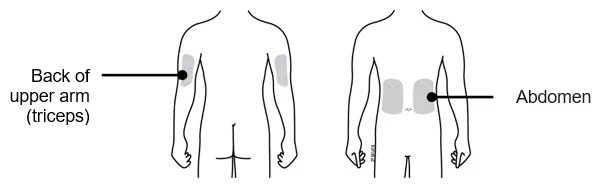 Ask the patient about their ability to monitor and remove the on-body injector.
| |
| C | Clean an area on the injection site larger than the on-body injector adhesive backing. | |
Thoroughly clean the site with alcohol to enhance on-body adherence to the skin.
| 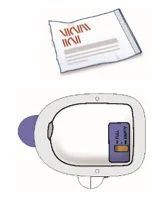 | |
| Remove Neulasta prefilled syringe from tray. | ||
| D | ||
For safety reasons:
| ||
| E | Inspect Neulasta prefilled syringe. Neulasta liquid should always be clear and colorless. 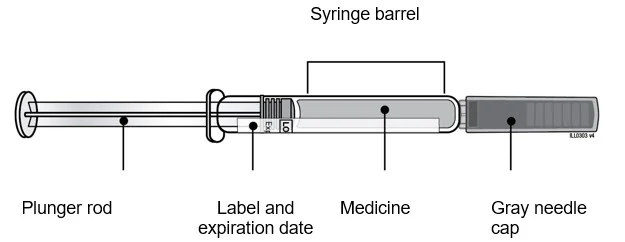
In all the above cases, start again with a new kit. | |
Step 2: Fill
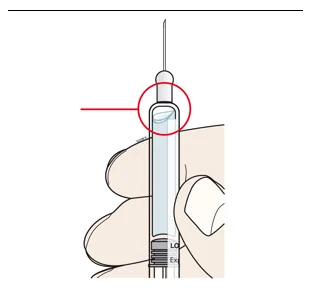
| A | Remove air bubbles in prefilled syringe. Injecting air bubbles could interfere with proper operation of the on-body injector.
|  | ||
| B | Center the needle directly over the medicine port and insert all the way into the port, avoiding sides. | |||
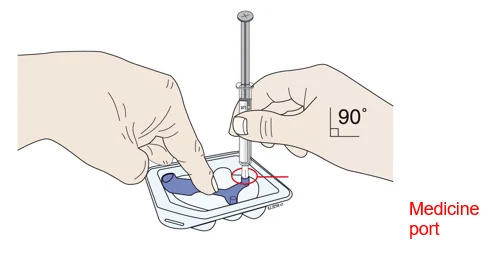 | ||||
Insert needle into medicine port at a 90 degree angle only.
- Do not remove the blue needle cover before filling the on-body injector.
- Do not insert the needle more than once.
- Do not bend the needle. Avoid spilling the medicine.
| C | Push the plunger rod to empty entire syringe contents into the on-body injector. | |
Discard used syringe in sharps container. | 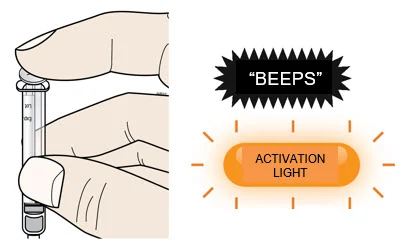 | |
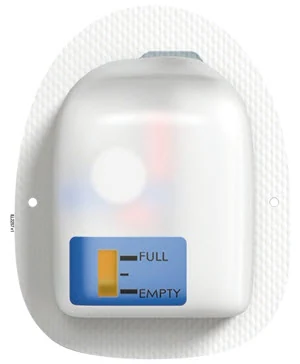
| D | Check to see if the on-body injector is full and the amber light is flashing. You should see a black line next to FULL on the fill indicator. 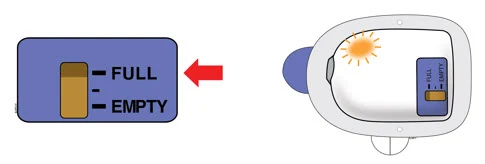 If this is not the case, do not use. Start again with a new Neulasta Onpro kit. | |
| E | Firmly lift and remove the blue needle cover away from the on-body injector. 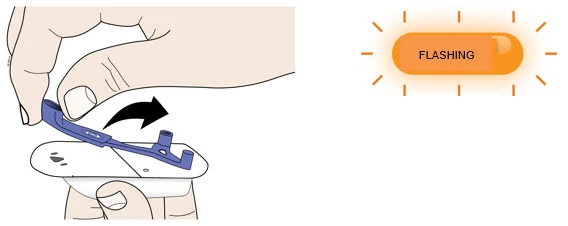 | |
Step 3: Apply
| A | Peel away both pull tabs to show the adhesive. Never touch hands or gloves to the adhesive. Make sure skin is dry prior to applying the on-body injector. 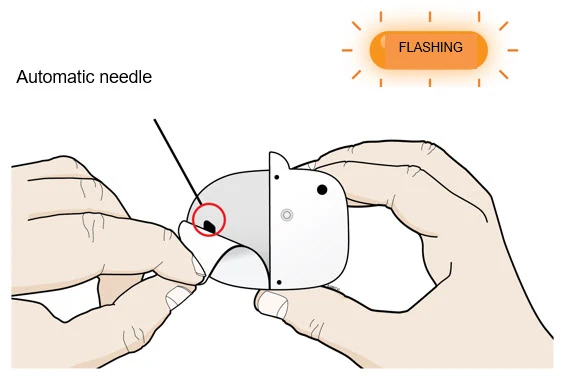
| ||
| B | Before the cannula inserts, securely apply the on-body injector so it is visible and can be monitored by the patient or caregiver. You now have time to carefully apply the on-body injector without folding or wrinkling the adhesive. | ||
| 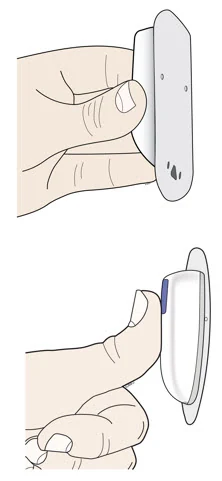 | ||
Back of upper arm (triceps) Vertical with the light facing down toward the elbow | 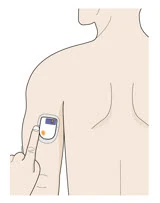 | ||
Abdomen Horizontal with the light facing up and visible to the patient | 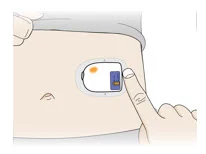 | ||
 | Do not worry if the on-body injector is quiet. When 3 minutes are up, the on-body injector will beep telling you the cannula is about to insert. |
Step 4: Finish
| A | Wait for the status light to turn green. This means the cannula has been inserted. Do not remove the on-body injector during cannula insertion to avoid needle stick injury to you or to the patient. |

| Check the quality of adhesion before sending the patient home. |
If the adhesive is wrinkled in front of the cannula window or has folds anywhere that prevent the on-body injector from securely adhering, remove the on-body injector. Start again with a new kit and call Amgen at 1-800-772-6436.
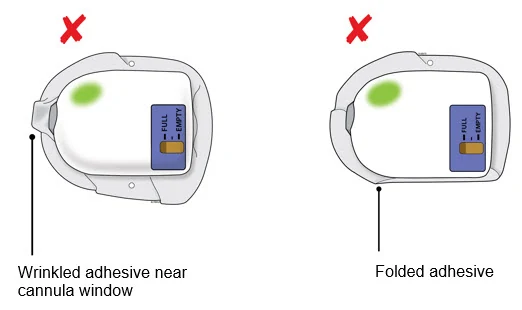 | |
| B | Provide the Patient IFU Booklet for the patient to take home. Fill in the Dose Delivery information on the booklet, and review the following instructions with your patient:
|
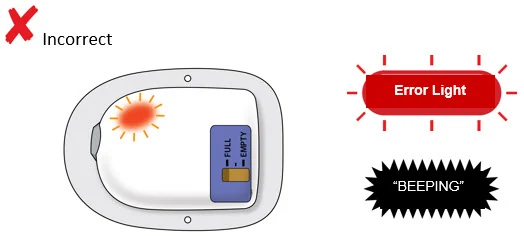
Attention! What to do if you hear beeping or when you look at status light and it is flashing red. 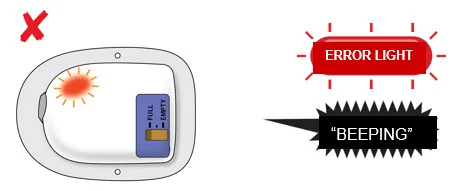 If at any time the on-body injector beeps continuously for 5 minutes, and the status light is flashing red, take the on-body injector off of the patient.
In all cases, do not use. Start over with a new Neulasta Onpro kit, and call Amgen at 1-800-772-6436. | |
What to do if your patient reports the status light is flashing red. If the patient reports the status light is flashing red, they may not have received the full dose. Schedule a follow-up appointment with your patient. | |
What to do if your patient reports the adhesive is saturated with fluid or the on-body injector is dripping. 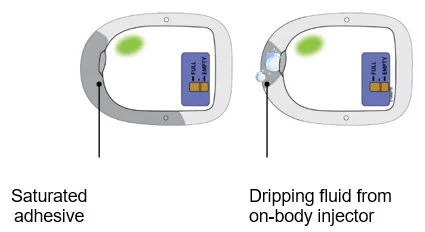 If the patient reports an on-body injector leak, they may not have received the full dose. Schedule a follow-up appointment with your patient. | |
In all cases report the incident to Amgen at 1-800-772-6436.
Neulasta® (pegfilgrastim)
Manufactured by:
Amgen Inc.
One Amgen Center Drive
Thousand Oaks, California 91320-1799
US License No. 1080
Patent: http://pat.amgen.com/onpro/
© 2002 to 2025 Amgen Inc. All rights reserved.
http://www.neulasta.com/
1-844-MYNEULASTA (1-844-696-3852)
Revised: 08/2025
V14
Before You Begin
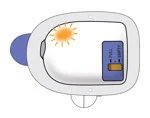
 | The following is an overview of on-body injector preparation steps. Read this section first To prepare and apply the on-body injector, you will use a pre-filled syringe to fill and activate it. As part of this process, the on-body injector uses lights and sounds as signals to help guide you through the preparation and application process. As you fill the on-body injector, the status light flashes amber and the on-body injector beeps 3 times. When the status light flashes amber and the on-body injector beeps, this means it has been properly filled and activated. | |
After the on-body injector activates, you will have 3 full minutes to remove the blue needle guard and adhesive backing, and then apply the on-body injector to your patient.
|  | |
| When the status light flashes green, this means the on-body injector has successfully inserted the cannula. | 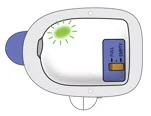 | |
For all questions, or if a patient calls you regarding any on-body injector problems, call Amgen at 1-800-772-6436. ← Turn over to continue with the Instructions for Use |
| Symbol | Meaning |
|---|---|
 | Do not reuse this on-body injector. Single-use only |
 | Refer to Instructions for Use |
 | Do not use if packaging is damaged |
 | Temperature limitation |
 | Humidity limitation |
 | Expiration date (use by date) |
 | Reference/model number |
 | Lot number |
 | Type BF medical device (protection from electrical shock) |
 | Sterilized by ethylene oxide |
 | Waterproof up to 8 feet for 1 hour |
 | Prescription use only |
 | MR Unsafe |
 | On-body injector for Neulasta® (pegfilgrastim) |
 | Neulasta® (pegfilgrastim) prefilled syringe |
 | Pressure Limitation |
Do not expose the on-body injector for Neulasta to the following environments as the on-body injector may be damaged and the patient could be injured:
- Diagnostic imaging (e.g., CT Scan, MRI, Ultrasound, X-ray)
- Radiation treatment
- Oxygen rich environments such as hyperbaric chambers
Electromagnetic Compatibility
The information contained in this section (such as separation distances) is, in general, specifically written in regard to the on-body injector for Neulasta. The numbers provided will not guarantee faultless operation but should provide reasonable assurance of such. This information may not be applicable to other medical electrical equipment; older equipment may be particularly susceptible to interference.
General Notes:
Medical electrical equipment requires special precautions regarding electromagnetic compatibility (EMC), and needs to be installed and put into service according to the EMC information provided in this document.
Portable and mobile RF communications equipment can affect medical electrical equipment.
Cables and accessories not specified within the instructions for use are not authorized. Using cables and/or accessories may adversely impact safety, performance, and electromagnetic compatibility (increased emission and decreased immunity).
Care should be taken if the on-body injector for Neulasta is used adjacent to other electrical equipment; if adjacent use is inevitable, the on-body injector for Neulasta should be observed to verify normal operation in this setting.
| Electromagnetic Emissions | ||
|---|---|---|
| The on-body injector for Neulasta is intended for use in the electromagnetic environment specified below. The user of the on-body injector for Neulasta should ensure that it is used in such an environment. | ||
| Emissions | Compliance according to | Electromagnetic environment |
| RF Emissions (CISPR 11) | Group 1 | The on-body injector for Neulasta uses RF energy only for its internal function. Therefore, its RF emissions are very low and are not likely to cause any interference in nearby equipment. |
CISPR B Emissions Classification | Class B | |
| Electromagnetic Immunity | |||
|---|---|---|---|
| The on-body injector for Neulasta is intended for use in the electromagnetic environment specified below. The user of this equipment should ensure that it is used in such an environment. | |||
| Immunity Test | IEC 60601 Test Level | Compliance Level | Electromagnetic Environment-Guidance |
ESD IEC 61000-4-2 | ±8 kV Contact ±15 kV Air | ±8 kV Contact ±15 kV Air | Floors should be wood, concrete or ceramic tile. If floors are synthetic, the r/h should be at least 30%. |
Power Frequency 50/60 Hz Magnetic Field IEC 61000-4-8 | 30 A/m | 30 A/m | Power frequency magnetic fields should be that of typical commercial or hospital environment. |
Radiated RF Fields 61000-4-3 | 3 V/m 80 MHz to 2.7 GHz | (E1)=3 V/m | Portable and mobile communications equipment should be separated from the on-body injector for Neulasta by no less than the distances calculated/listed below: D=(3.5/V1)(√P)150 kHz to 80 MHz D=(3.5/E1)(√P)80 to 800 MHz D=(7/E1)(√P)800 MHz to 2.5 GHz Where P is the max power in watts and D is the recommended separation distance in meters. Field strengths from fixed transmitters, as determined by an electromagnetic site survey, should be less than the compliance levels (V1 and E1). Interference may occur in the vicinity of equipment containing a transmitter. |
| Test specifications for ENCLOSURE PORT IMMUNITY to RF wireless communications equipment | ||||||
|---|---|---|---|---|---|---|
| The on-body injector for Neulasta is intended for use in the radio frequency environment specified below. The user of this equipment should ensure that it is used in such an environment. | ||||||
| Test Frequency | BandFor some services, only the uplink frequencies are included. | Service | ModulationThe carrier shall be modulated using a 50% duty cycle square wave signal. | Maximum Power | Distance | Immunity Test Level |
| (MHz) | (MHz) | (W) | (m) | (V/m) | ||
| NOTE If necessary to achieve the IMMUNITY TEST LEVEL, the distance between the transmitting antenna and the ME EQUIPMENT OF ME SYSTEM may be reduced to 1 m. The 1 m test distance is permitted by IEC 61000-4-3. | ||||||
| 385 | 380-390 | TETRA 400 | Pulse modulation 18 Hz | 1.8 | 0.3 | 27 |
| 450 | 430-470 | GMRS 460, FRS 460 | FM As an alternative to FM modulation, 50% pulse modulation at 18 Hz may be used because while it does not represent actual modulation, it would be worst case. ± 5 kHz deviation 1 kHz sine | 2 | 0.3 | 28 |
| 710 | 704-787 | LTE Band 13, 17 | Pulse modulation 217 Hz | 0.2 | 0.3 | 9 |
| 745 | ||||||
| 780 | ||||||
| 810 | 800-960 | GSM 800/900, TETRA 800, iDEN 820, CDMA 850, LTE Band 5 | Pulse modulation 18 Hz | 2 | 0.3 | 28 |
| 870 | ||||||
| 930 | ||||||
| 1720 | 1700-1990 | GSM 1800; CDMA 1900; GSM 1900; DECT; LTE Band 1, 3, 4, 25; UMTS | Pulse modulation 217 Hz | 2 | 0.3 | 28 |
| 1845 | ||||||
| 1970 | ||||||
| 2450 | 2400-2570 | Bluetooth, WLAN, 802.11 b/g/n, RFID 2450, LTE Band 7 | Pulse modulation 217 Hz | 2 | 0.3 | 28 |
| 5240 | 5100-5800 | WLAN 802.11 a/n | Pulse modulation 217 Hz | 0.2 | 0.3 | 9 |
| 5500 | ||||||
| 5785 | ||||||
| Recommended separation distances between portable and mobile RF communications equipment and the on-body injector for Neulasta | |||
|---|---|---|---|
| You can help prevent electromagnetic interference by maintaining a minimum distance between portable and mobile RF communications equipment (transmitters) and the on-body injector for Neulasta, as recommended below, according to the maximum power of the communication equipment. | |||
| Rated maximum output power of transmitter, in watts | Separation distance according to frequency of transmitter, in meters | ||
| 150 kHz to 80 MHz | 80 MHz to 800 MHz | 800 MHz to 2.5 GHz | |
| D=(3.5/V1)(√P) | D=(3.5/E1)(√P) | D=(7/E1)(√P) | |
| 0.01 | 0.11667 | 0.11667 | 0.23333 |
| 0.1 | 0.36894 | 0.36894 | 0.73785 |
| 1 | 1.1667 | 1.1667 | 2.3333 |
| 10 | 3.6894 | 3.6894 | 7.3785 |
| 100 | 11.667 | 11.667 | 23.333 |
Instructions for Use
Neulasta (nu-las-tah)
(pegfilgrastim)
injection, for subcutaneous use
Single-Dose Prefilled Syringe
Guide to parts
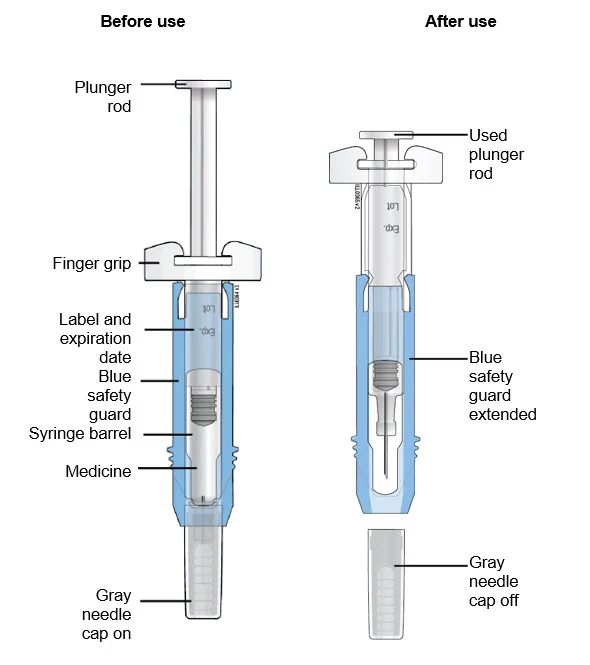
Important: The needle is covered by the gray needle cap before use.
Important
Read the Patient Information for important information you need to know about Neulasta before using these Instructions for Use.
Before you use a Neulasta prefilled syringe, read this important information.
Storing the prefilled syringe
- Store Neulasta in the refrigerator between 36°F and 46°F (2°C to 8°C).
- Avoid freezing. If Neulasta prefilled syringe is frozen 1 time, thaw in refrigerator before using it. If it is frozen more than 1 time, throw it away and use a new Neulasta prefilled syringe.
- Keep the prefilled syringe in the original carton to protect from light or physical damage.
- Throw away (dispose of) a syringe that has been left at room temperature, 68°F to 77°F (20°C to 25°C), for more than 48 hours.
- Keep the Neulasta prefilled syringe out of the reach of children.
Using the prefilled syringe
- It is important that you do not try to give the injection unless you or your caregiver has received training from your healthcare provider.
- Make sure the name Neulasta appears on the carton and prefilled syringe label.
- Check the carton and prefilled syringe label to make sure the dose strength is 6 mg.
- Do not inject a dose of Neulasta to children weighing less than 99 pounds (45 kg) from a Neulasta prefilled syringe. A dose less than 0.6 mL (6 mg) cannot be accurately measured using the Neulasta prefilled syringe.
- Do not use a prefilled syringe after the expiration date on the label.
- Do not shake the prefilled syringe.
- Do not remove the gray needle cap from the prefilled syringe until you are ready to inject.
- Do not use the prefilled syringe if the carton is open or damaged.
- Do not use a prefilled syringe if it has been dropped on a hard surface. The prefilled syringe may be broken even if you cannot see the break. Use a new prefilled syringe.
- Do not slide the blue safety guard over the needle before you give the injection. This will "activate" or lock the blue safety guard. Use another prefilled syringe that has not been activated and is ready to use.
- The gray needle cap on the prefilled syringe contains dry natural rubber (made from latex). Tell your healthcare provider if you are allergic to latex. You should not give Neulasta using the prefilled syringe if you have latex allergies.
Call your healthcare provider if you have any questions.
Step 1: Prepare
A Remove the prefilled syringe carton from the refrigerator.
Check the expiration date.
Important: Do not use if the expiration date has passed.
Remove the syringe tray from the carton. On a clean, well-lit surface, place the syringe tray at room temperature, 68°F to 77°F (20°C to 25°C), for 30 minutes before you give an injection.
- Do not use the prefilled syringe if the carton is damaged.
- Do not try to warm the prefilled syringe by using a heat source such as hot water or microwave.
- Do not leave the prefilled syringe in direct sunlight.
- Do not shake the prefilled syringe.
Open the tray by peeling away the cover. Grab the blue safety guard to remove the prefilled syringe from the tray.
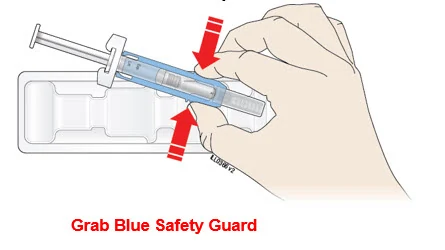
For safety reasons:
- Do not grab the plunger rod.
- Do not grab the gray needle cap.
B Inspect the medicine and prefilled syringe.
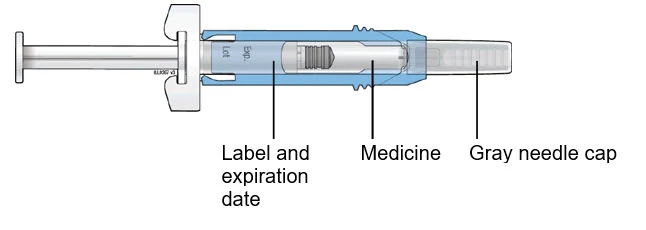
Make sure the medicine in the prefilled syringe is clear and colorless. It is normal to see air bubbles in the syringe.
Do not use the prefilled syringe if:
- The medicine is cloudy or discolored or contains flakes or particles.
- Any part appears cracked or broken.
- The prefilled syringe has been dropped.
- The gray needle cap is missing or not securely attached.
- The expiration date printed on the label has passed.
In all cases, use a new prefilled syringe and call your healthcare provider.
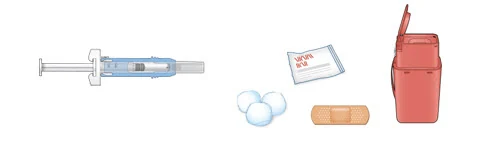
C Gather all materials needed for the injection.
Wash your hands thoroughly with soap and water.
On a clean, well-lit work surface, place the:
- Prefilled syringe
- Alcohol wipe
- Cotton ball or gauze pad
- Adhesive bandage
- Sharps disposal container
Step 2: Get ready
D Prepare and clean the injection site.
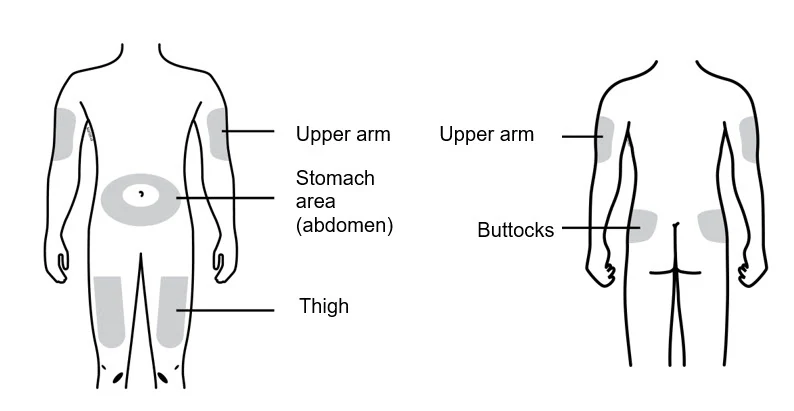
You can use:
- Thigh
- Stomach area (abdomen), except for a 2-inch area right around the navel (belly button)
- Upper outer area of the buttocks (only if someone else is giving you the injection)
- Outer area of upper arm (only if someone else is giving you the injection)
Clean the injection site with an alcohol wipe. Let the skin dry.
- Do not touch this area again before injecting.
- If you want to use the same injection site, make sure it is not the same spot on the injection site you used for a previous injection.
- Do not inject into areas where the skin is tender, bruised, red, or hard. Avoid injecting into areas with scars or stretch marks.
E Hold the prefilled syringe by the syringe barrel. Carefully pull the gray needle cap straight off and away from your body.
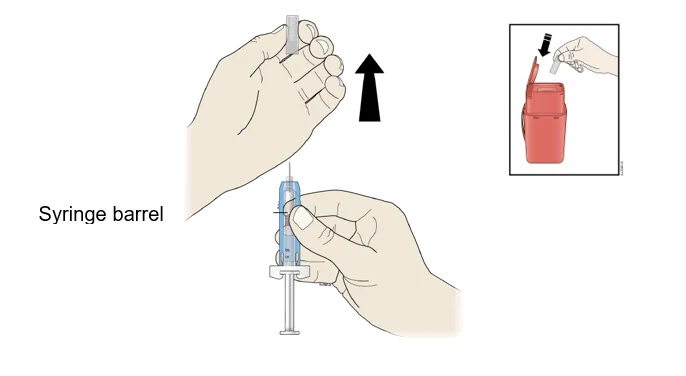
- Do not remove the gray needle cap from the prefilled syringe until you are ready to inject.
- Do not twist or bend the gray needle cap.
- Do not hold the prefilled syringe by the plunger rod.
- Do not put the gray needle cap back onto the prefilled syringe.
Important: Throw the gray needle cap into the sharps disposal container.
Step 3: Subcutaneous (under the skin) injection
F Pinch the injection site to create a firm surface.
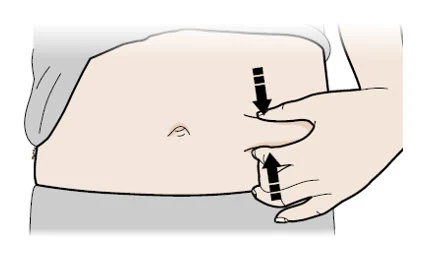
Important: Keep skin pinched while injecting.
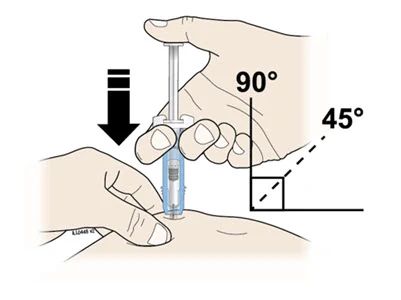
G Hold the pinch. Insert the needle into the skin at 45 to 90 degrees.
H Using slow and constant pressure, push the plunger rod until it reaches the bottom.
When done, gently pull the syringe off of the skin.
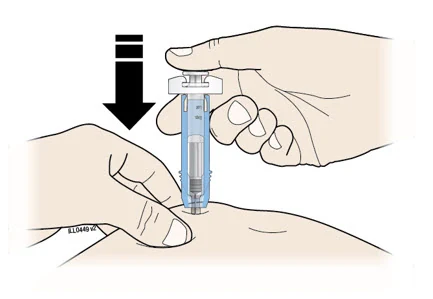
Important: When you remove the syringe, if it looks like the medicine is still in the syringe barrel, this means you have not received a full dose. Call your healthcare provider right away.
Step 4: Finish
| I |  | Before you finish! |
For your safety, pull the blue safety guard until it clicks and covers the needle.
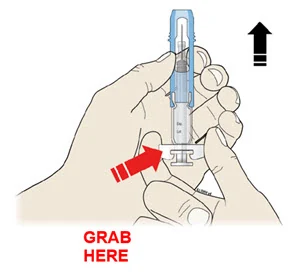
Once extended, the blue safety guard will lock into position and will not slide back over the needle.
Keep your hands away from the needle at all times.
J Discard (throw away) the used prefilled syringe.
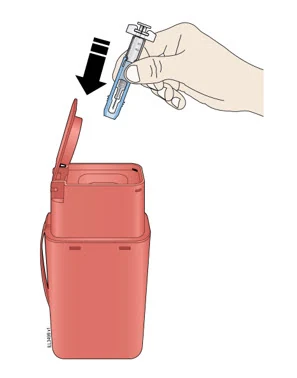
- Put the used prefilled syringe in an FDA-cleared sharps disposal container right away after use. Do not throw away (dispose of) the syringe in the household trash.
If you do not have an FDA-cleared sharps disposal container, you may use a household container that is:
- made of a heavy-duty plastic,
- can be closed with a tight-fitting, puncture-resistant lid, without sharps being able to come out,
- upright and stable during use,
- leak-resistant, and
- properly labeled to warn of hazardous waste inside the container.
- When your sharps disposal container is almost full, you will need to follow your community guidelines for the right way to dispose of your sharps disposal container. There may be state or local laws about how you should throw away used needles and syringes. For more information about safe sharps disposal, and for specific information about sharps disposal in the state that you live in, go to the FDA's website at: http://www.fda.gov/safesharpsdisposal
- Do not reuse the prefilled syringe.
- Do not recycle the prefilled syringe or sharps disposal container or throw them into household trash.
Important: Always keep the sharps disposal container out of the reach of children.
K Examine the injection site.
If there is blood, press a cotton ball or gauze pad on the injection site. Do not rub the injection site. Apply an adhesive bandage if needed.
This Instructions for Use has been approved by the U.S. Food and Drug Administration.
Manufactured by:
Amgen Inc.
One Amgen Center Drive
Thousand Oaks, California 91320-1799
U.S. License No. 1080
Patent: http://pat.amgen.com/onpro/
© 2002-2026 Amgen Inc. All rights reserved.
1xxxxxx
Revised: 08/2026 v5
Patient INSTRUCTIONS FOR USE
Neulasta® Onpro® (nu-las-tah)
(pegfilgrastim) injection
Single-Use On-body Injector
| Your On-body injector was applied: | |||
 | AM | ||
| Day | Time | PM | |
| Injection of your dose (delivery) will start around: | |||
| AM | |||
| Day | Time | PM | |
| Healthcare Provider name: | |||
| Healthcare Provider contact number: | |||
| On-body Injector lot number: | |||
AMGEN
Neulasta ®
(pegfilgrastim)
Onpro ®
kit
Get to Know Your On-body Injector
| Parts and Signals | ||
| Status Light | ||
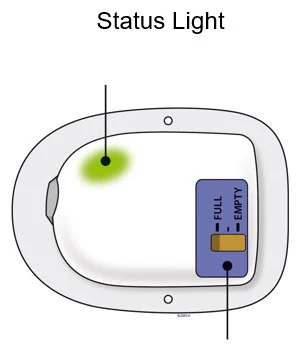 |  | Flashing Green: The on-body injector is working properly. Do not remove the on-body injector if the status light is flashing green. |
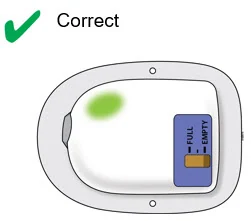
 | Solid Green (or off): Signals dose delivery is complete. Check to see if fill indicator reads empty. | |
 | Flashing Red: On-body injector error. If you hear beeping at any time, check the status light. If it is flashing red, call your healthcare provider right away as you may need a replacement dose. | |
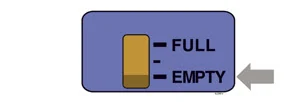
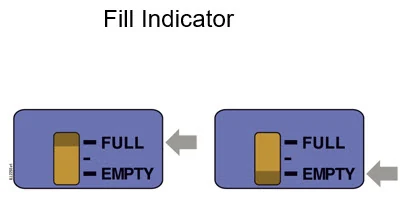 | Fill Indicator: Black line shows how much Neulasta is in the on-body injector. |
Contents
IMPORTANT INFORMATION Learn about your Neulasta On-body Injector. | INFO |
STEP 1: MONITOR What to expect from your device for most of the day. | |
STEP 2: OBSERVE What to watch for during dose delivery and what to do if there is an issue. | |
STEP 3: VERIFY Understand when delivery is complete and when you may remove the device. | |
STEP 4: FINISH Confirm the dose was delivered and dispose of the device. | |
FAQ When it is safe to remove your on-body injector and answers to frequently asked questions. |
| Important Information | |
| On-body Injector for Neulasta Description | |
| INFO |
|
Warnings
| |
| |
Important Information Wearing the On-body Injector
| |
| Environmental Precautions | ||
| 1 | |
|
A healthcare provider who is familiar with Neulasta should answer your questions. For general questions or support call 1-844-MYNEULASTA (1-844-696-3852) or visit www.neulasta.com.
Step 1: Monitor On-body Injector
| A | For the next 27 hours, occasionally check the status light for at least 10 seconds. If the status light is flashing green, it is okay. | ||
| 1 | 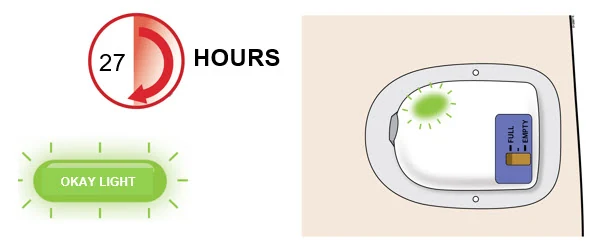 | ||
| |||
| 2 | ||
Step 2: Observe Dose Delivery
| A | After about 27 hours, your on-body injector will begin to deliver your dose of Neulasta. | ||
| |||
| 2 | 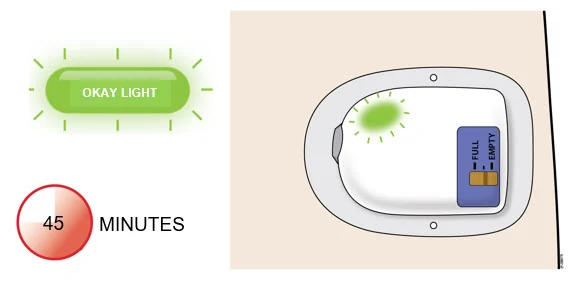 | ||
| |||
 | Check your on-body injector often for leaks during the 45-minute dose delivery. If the on-body injector was placed on the back of your arm, a caregiver must be available to check your on-body injector. | ||
| 3 | ||
Step 3: Verify Dose Complete
| A | After the beep, check the color of the status light. | |||
| 3 | 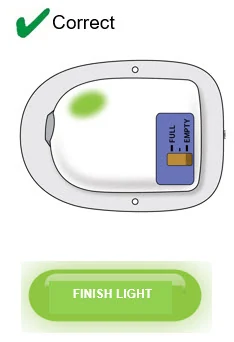 Check to see if the status light is SOLID GREEN or has switched off. This means the dose is complete. If the dose is complete, go to the next step. Do not remove the on-body injector if the status light is flashing green. | 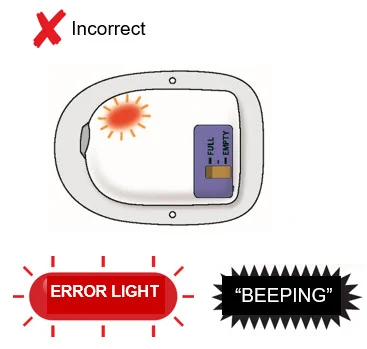 If you see the status light is FLASHING RED, and your on-body injector is beeping, your on-body injector is not functioning properly. Call your healthcare provider right away, as you may need a replacement dose. | ||
| B | Grab the edge of the adhesive pad. Slowly peel off the on-body injector. | |||
 | 4 | |||
| ||||
Step 4: Finish
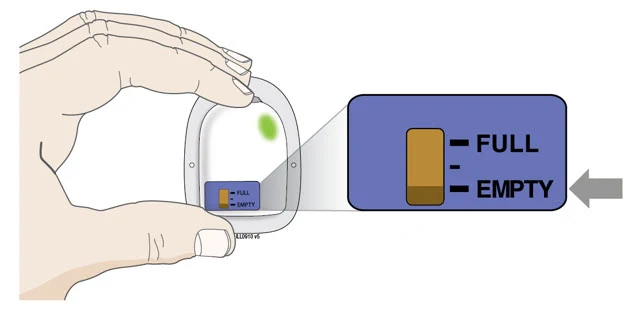
 | Check to see if your on-body injector is empty. | |||
| 4 |
| |||
| A | Check off the box below to record how your on-body injector looks after use. | |||
| ⃞ | Status light is solid green or the status light has switched off. This means that the delivery is complete. | |||
| ⃞ | On-body injector leaked, call your healthcare provider right away, as you may need a replacement dose. | |||
| ⃞ | Status light is red, call your healthcare provider right away, as you may need a replacement dose. | |||
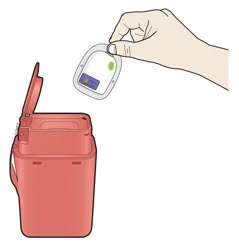
| B | Properly dispose of the on-body injector. | |||
|  | |||
| FAQ | |||
| ||||
Frequently Asked Questions
How do I know it is safe to remove the on-body injector?
It is safe to remove the on-body injector after checking the following:
 |
|
 |
|
FAQ
What to do if you hear beeping or when you look at the status light and it is flashing red?
- If the status light is flashing red, you may not have received your full dose and may need a replacement dose. Call your healthcare provider right away.
What do I do if the on-body injector comes off before the full dose is delivered?
- Call your healthcare provider right away if the on-body injector at any time comes away from your skin before your full dose delivery, as you may need a replacement dose. Do not reapply it.
What if there is blood at my application site after the on-body injector has been removed?
- If there is blood, press a clean cotton ball or gauze pad on the application site. Apply an adhesive bandage if needed.
What if my application site is red or tender after on-body injector removal?
- Call your healthcare provider right away if you experience persistent or worsening redness or tenderness at the application site, as this can be a sign of infection.
Notes
Neulasta® Onpro®
Patient INSTRUCTIONS FOR USE
Neulasta® (pegfilgrastim)
Manufactured by:
Amgen Inc.
One Amgen Center Drive
Thousand Oaks, California 91320-1799
US License No. 1080
Patent: http://pat.amgen.com/onpro/
© 2002 to 2025 Amgen Inc. All rights reserved.
http://www.neulasta.com
1-844-MYNEULASTA (1-844-696-3852)
Revised: 08/2025
V11