


Patient information: uses, side effects, how to take - Epinephrine Injection 0.15 mg/0.15 mL
What is the most important information I should know about Epinephrine Injection?
- 1. Epinephrine Injection is a medicine used to treat allergic emergencies (anaphylaxis). Anaphylaxis can be life-threatening and can happen within minutes. If untreated, anaphylaxis can lead to death.
Allergic emergencies may be caused by stinging and biting insects, allergy injections, foods, medicines, exercise, or other unknown causes.
Symptoms of anaphylaxis may include:
- trouble breathing
- wheezing
- hoarseness (changes in the way your voicesounds)
- hives (raised reddened rash that may itch)
- severe itching
- swelling of your face, lips, mouth, or tongue
- skin rash, redness, or swelling
- fast heartbeat
- weak pulse
- feeling very anxious
- confusion
- stomach pain
- losing control of urine or bowel movements (incontinence)
- diarrhea or stomach cramps
- dizziness, fainting, or “passing out” (unconsciousness)
- 2. It is recommended that people are prescribed and have immediate access to 2 Epinephrine Injection devices at all times. Sometimes a single dose of epinephrine may not be enough to treat a serious allergic reaction before seeking emergency medical help. You should also have immediate access to 2 Epinephrine Injection devices in case the first device is activated before the dose can be given. A device that has been activated accidentally cannot be used to treat an allergic emergency (anaphylaxis).
Note: Epinephrine Injection has been activated if you see the needle sticking out of the red needle end and the viewing window is blocked.
You may not know when an allergic emergency (anaphylaxis) will happen.
Talk to your healthcare provider if you need additional Epinephrine Injection devices to keep at work, school, or other locations. If you use 1 Epinephrine Injection device to treat an emergency allergic reaction, be sure to replace it so you always have immediate access to 2 devices. Tell your family members, caregivers, and others where you keep your Epinephrine Injection. Make sure they know how to use it before you need it. You may be unable to speak in an allergic emergency.
3. When you have an allergic emergency (anaphylaxis) use Epinephrine Injection right away.
Get emergency medical help for further treatment of the allergic emergency (anaphylaxis), if needed, after using Epinephrine Injection. Before you receive Epinephrine Injection, your healthcare provider should talk to you about when to get emergency help.
If symptoms do not improve or if they worsen after the first dose, or you accidentally inject Epinephrine Injection intothe fingers, toes, hands or feet, a second dose of Epinephrine Injection may be administered with a second auto-injector starting 5 minutes after the first dose. If more than 2 doses are needed for an allergic emergency, they must be given by a healthcare provider.
What is Epinephrine Injection?
- Epinephrine Injection is a medicine used to treat life-threatening allergic emergencies (anaphylaxis). It is delivered using a disposable, prefilled automatic injection device (auto-injector). Each auto-injector contains a single dose of epinephrine.
- Epinephrine Injection is for immediate administration by you or your caregiver. Get emergency medical help, if needed, after using Epinephrine Injection. Your healthcare provider should talk to you about when to get emergency help.
- Epinephrine Injection is for people who have been prescribed this medicine by their healthcare provider.
- The Epinephrine Injection 0.3 mg auto-injector is for people who weigh 66 pounds or greater.
- The Epinephrine Injection 0.15 mg auto-injector is for people who weigh 33 pounds to less than 66 pounds.
- It is not known if Epinephrine Injection is safe and effective in children who weigh less than 33 pounds.
What should I tell my healthcare provider before using Epinephrine Injection?
Before you use Epinephrine Injection, tell your healthcare provider about all your medical conditions. Your healthcare provider may give you more instructions about when and how to use your Epinephrine Injection if you have the following:
- heart problems or high blood pressure
- diabetes
- thyroid problems
- asthma
- a history of depression
- Parkinson’s disease
kidney (renal) problems
You may also receive more instructions if you:
are pregnant or plan to become pregnant. It is not known if epinephrine will harm your unborn baby.
- are breastfeeding or plan to breastfeed. It is not known if epinephrine passes into your breast milk.
Tell your healthcare provider about all the medicines you take, including prescription and over-the-counter medicines, vitamins and herbal supplements. Also tell your healthcare provider about all known allergies. Some medicines may increase or decrease the effects of epinephrine, and epinephrine may affect how other medicines work.
Know the medicines you take. Keep a list of all your medicines, including over-the-counter medicines, vitamins and herbal supplements to show your healthcare provider and pharmacist when you get a new medicine.
Use your Epinephrine Injection for treatment of anaphylaxis as prescribed by your healthcare provider, regardless of your medical conditions or the medicine you take.
How should I use Epinephrine Injection?
- Use your single-dose Epinephrine Injection exactly as your healthcare provider tells you to use it.
- When you have an allergic emergency (anaphylaxis), use Epinephrine Injection right away. Get emergency medical help, if needed, after using Epinephrine Injection.
- You may need to use a second Epinephrine Injection if symptoms continue or come back after the first dose. A second dose may be administered starting 5 minutes after the first dose while you wait for emergency medical help, or if the first Epinephrine Injection is activated before the dose can be given. If you need more than 2 doses of epinephrine for a single anaphylaxis episode, additional doses must be given by a healthcare provider.
- Epinephrine Injection should only be injected into the middle of the outer thigh (upper leg). It can be injected through clothing if needed.
- Do not inject into a vein, buttocks, fingers, toes, hands or feet. If Epinephrine Injection is injected into the fingers, toes, hands or feet, administer a second dose of Epinephrine Injection into the middle of the outer thigh (upper leg). If symptoms worsen or persist, go immediately to the nearest emergency room for further treatment of anaphylaxis.
- Read and make sure you understand the Instructions for Use for information about the correct way to use Epinephrine Injection.
- Your healthcare provider will show you how to safely use Epinephrine Injection.
- It is very important that you hold Epinephrine Injection firmly against the middle of the outer thigh (upper leg) for a full 10 seconds. If you do not hold it in place long enough, Epinephrine Injection may not deliver the full dose of medicine.
- Caution: Never put your thumb, fingers, or hand over the red needle end. Never press or push the red needle end with your thumb, fingers, or hand.The needle comes out of the red needle end. Accidental injection into the fingers, hands, or feet may cause a loss of blood flow to those areas. If this happens, give a second dose of Epinephrine Injection into the middle of the outer thigh (upper leg) and go immediately to the nearest emergency room. Tell the healthcare provider where on your body the injection occurred.
- Warning: After the device is activated, the needle does not retract back into the device. After use, carefully place the used auto-injector into the carrier tube, if possible, and throw away (dispose of) it properly as directed.
- See the Instructions for Use for detailed information on how to safely handle and throw away (dispose of) the used auto-injector.
- Epinephrine Injection is packaged in a carton containing 2 Epinephrine Injections auto-injectors, each in an individual carrier tube.
- Do not drop the carrier tube or Epinephrine Injection. If the carrier tube or Epinephrine Injection is dropped, check for damage or leakage. Throw away (dispose of) and replace Epinephrine Injection if damage or leakage is noticed or suspected.
- You may request a separate Trainer at www.epinephrineautoinject.com. The epinephrine injection Trainer has a beige color. The beige epinephrine injection Trainer contains no medicine and no needle. Practice using the Trainer before an allergic emergency occurs so you know how to use Epinephrine Injection correctly. Always carry your real Epinephrine Injection, USP auto-injector with you in case of an allergic emergency.
What are the possible side effects of Epinephrine Injection?
Epinephrine Injection may cause serious side effects.
Injection-related complications
- Epinephrine Injection should only be injected into the middle of your outer thigh (upper leg). Do not inject Epinephrine Injection into a vein, buttocks, fingers, toes, hands, or feet. If you accidentally inject Epinephrine Injection into any other part of your body, administer a second dose of Epinephrine Injection into the middle of the outer thigh (upper leg) and go to the nearest emergency room right away. Tell the healthcare provider where on your body the injection occurred.
Serious infections at the injection site
Rarely, people who have used Epinephrine Injection may develop serious skin and soft tissue infections at the injection site within a few days after injection. Call your healthcare provider right away if you notice any of the following at the injection site:
- redness that does not go away
- swelling
- tenderness
- warmth at the injection site
Other side effects
- If you have certain medical conditions, or take certain medicines, your condition may get worse or you may have more or longer lasting side effects when you use Epinephrine Injection. Talk to your healthcare provider about all of your medical conditions.
Common side effects of Epinephrine Injection include:
- fast, irregular or “pounding” heartbeat
- sweating
- headache
- weakness
- shakiness
- paleness
- feelings of excitement, nervousness or anxiety
- dizziness
- ·nausea or vomiting
- breathing problems
These side effects may go away with rest. Tell your healthcare provider if you have any side effect that bothers you or that does not go away.
These are not all the possible side effects of Epinephrine Injection. For more information, ask your healthcare provider or pharmacist.
Call your doctor for medical advice about side effects. You may report side effects to FDA at 1-800-FDA-1088.
You may also report side effects to Amneal Pharmaceuticals LLC at 1-877-835-5472.
How should I store Epinephrine Injection?
- Store Epinephrine Injection at room temperature between 68°F to 77°F (20°C to 25°C).
- Keep Epinephrine Injection in the individual carrier tube provided to protect it from light and damage. The carrier tube is not waterproof.
- Do not expose Epinephrine Injection to extreme heat or cold. For example, do not store in your vehicle’s glove box and do not store it in the refrigerator or freezer.
- Periodically examine the solution through the viewing window of your Epinephrine Injection. The solution should be clear and colorless. Replace Epinephrine Injectionif the solution appears discolored (pinkish or brown), cloudy, or contains particles.
- The blue needle shield cap and blue end cap helps to prevent accidental injection. Do not remove the blue needle shield cap or blue end caps until you are ready to use Epinephrine Injection. After the auto-injector is used, throw away the blue end caps immediately, as they may pose a choking hazard for young children.
Keep Epinephrine Injection and all medicines out of the reach of children.
Disposing of an Expired, Unused or Used Epinephrine Injection
- Your Epinephrine Injection has an expiration date. Replace it before the expiration date.
- Throw away (dispose of) expired, unwanted, or unused Epinephrine Injections in an FDA-cleared sharps disposal container. Do not throw away Epinephrine Injection in your household trash. If you do not have an FDA-cleared sharps disposal container, you may use a household container that is:
- Made of heavy-duty plastic,
- Can be closed with a tight-fitting, puncture-resistant lid, without sharps being able to come out,
- Upright and stable during use,
- Leak-resistant, and
- Properly labeled to warn of hazardous waste inside the container.
When your sharps disposal container is almost full, follow your community guidelines for proper disposal. There may be state or local laws about how you should dispose of used needles and syringes. For more information about safe sharps disposal, visit the FDA website at www.fda.gov/safesharpsdisposal .
General information about the safe and effective use of Epinephrine Injection:
Medicines are sometimes prescribed for purposes other than those listed in a Patient Information leaflet. Do not use Epinephrine Injection for a condition for which it was not prescribed. Do not give Epinephrine Injection to other people.
This Patient Information leaflet summarizes the most important information about Epinephrine Injection. If you would like more information, talk to your healthcare provider. You can ask your pharmacist or healthcare provider for information about Epinephrine Injection that is written for health professionals.
For more information and video instructions on the use of Epinephrine Injection, go to www.epinephrineautoinject.com or call 1-877-835-5472.
What are the ingredients in Epinephrine Injection?
Active Ingredient: epinephrine
Inactive Ingredients: sodium chloride, chlorobutanol, sodium bisulfite, hydrochloric acid, sodium hydroxide, and water.
Important Information
- The Epinephrine Injection, 0.3 mg auto-injector has a yellow-colored label.
- The Epinephrine Injection, 0.15 mg auto-injector has an orange-colored label.
- The Epinephrine Injection Trainer has a beige color, and contains no medicine and no needle.
- Your Epinephrine Injection is designed to work through clothing.
- The blue needle shield cap and the blue end cap on Epinephrine Injection help to prevent accidental injection of the device. Do not remove the blue needle shield cap and blue end caps until you are ready to use it.
- Choking hazard: The blue needle shield cap and blue end caps are small parts that may become a choking hazard for children. Throw away the blue end caps immediately after use.
- Only inject into the middle of the outer thigh (upper leg). Never inject into any other part of the body.
- Never put your thumb, fingers, or your hand over the red needle end. The needle comes out of the red needle end.
- If an accidental injection happens, get medical help right away.
- Do not place patient information or any other foreign objects in carrier with the auto-injector, as this may prevent you from removing Epinephrine Injection for use.
Incorrect Use and Correct Use of Epinephrine Injection
| Incorrect Use | Correct Use and Important Reminders |
| Storing Epinephrine Injection outside the carrier tube. | Always keep Epinephrine Injection stored in the individual carrier tube provided to protect it from light and damage. The carrier tube is not waterproof. |
| Storing of the Epinephrine Injection outside of the recommended storage conditions. | Always keep your Epinephrine Injection stored at room temperature (68°F to 77°F / 20°C to 25°C). |
| Failing to remove the Epinephrine Injection from the carrier tube before use. | Remove Epinephrine Injection from the carrier tube before use. |
| Failing to remove both the blue caps in proper sequence before use. | Before use, remove the blue needle shield cap first to expose the red needle end. Then remove the blue end cap. |
| Failing to remove both blue caps before use. | Epinephrine Injection will not activate or deliver the dose if both blue caps are not removed. |
| Failing to remove the blue caps in the proper order. | Removing the blue caps in the incorrect order may cause premature activation of Epinephrine Injection. |
| Failing to remove the blue needle shield cap properly, resulting in the needle sheath remaining in place. | Pull off the blue needle shield cap by grasping the ribbed area and pulling straight off until the red needle end is visible. Do not squeeze the non-ribbed area. |
| Activating Epinephrine Injection upside down, resulting in injection into the hand. | The needle exits from the red needle end, which must be placed against the middle of the outer thigh (upper leg) at a 90˚ angle (perpendicular) before and during activation. |
| Failing to apply enough force to activate Epinephrine Injection. | Press down hard and hold Epinephrine Injection firmly against the outer thigh at a 90˚ angle for 10 seconds. Do not swing or jab the device. |
| Expecting an audible click to confirm activation. | You may or may not hear a sound when the injection starts. |
| Assuming the dose was not delivered because liquid remains in the device. | It is normal for most of the medicine to remain in the auto-injector after the dose is delivered. The dose has been delivered if the needle is visible after use. |
| Administering at an injection site other than the outer thigh. | Inject Epinephrine Injection only into the middle of the outer thigh (upper leg). |
| Removing the device at an angle, causing needle bending. | Place the red needle end against the thigh at a 90° angle (perpendicular), press down firmly, and remove the device straight out at a 90° angle after injection. |
| Failing to hold Epinephrine Injection in place long enough. | Hold Epinephrine Injection firmly in place for a full 10 seconds to ensure dose delivery. |
| Failing to locate the expiration date. | Remove Epinephrine Injection from the carrier tube. The expiration date is located on the auto-injector label. |
For more information and video instructions on the use of Epinephrine Injection, go to www.epinephrineautoinject.com or call 1-877-835-5472.
This Patient Information has been approved by the U.S. Food and Drug Administration Rev. 03/2026
Instructions for Use
EPINEPHRINE injection (ep″ i nef′ rin),
for intramuscular or subcutaneous use
Epinephrine Injection USP, 0.3 mg
Each Epinephrine Injection USP, 0.3 mg delivers a single dose of 0.3 mg epinephrine USP in 0.3 mL (0.3 mg/0.3 mL)
Epinephrine Injection USP, 0.15 mg
Each Epinephrine Injection USP, 0.15 mg delivers a single dose of 0.15 mg epinephrine USP in 0.15 mL (0.15 mg/0.15 mL)
For allergic emergencies (anaphylaxis)
This Instructions for Use contains information on how to properly administer Epinephrine Injection.
Your Epinephrine Injection
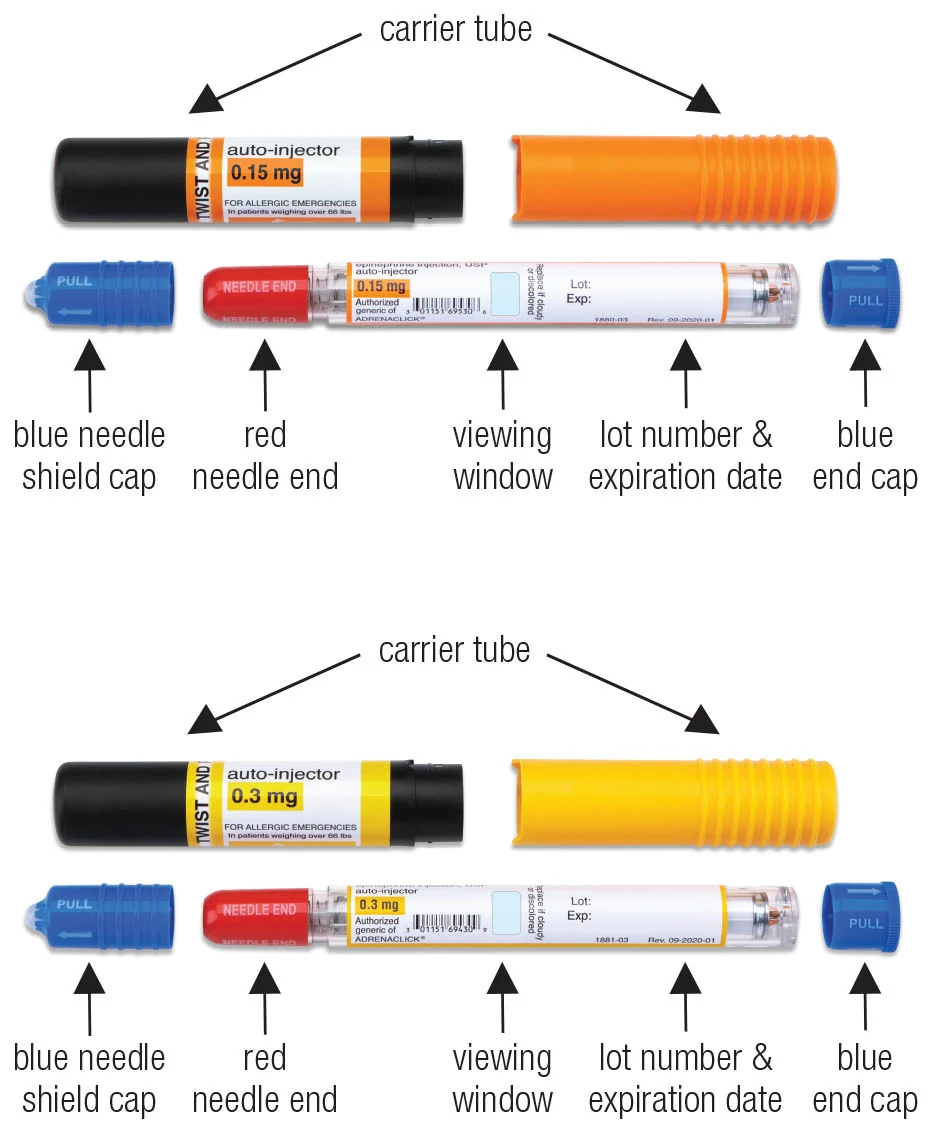
Figure A. Epinephrine Injection, USP 0.3 mg (yellow label) and
Epinephrine Injection, USP 0.15 mg (orange label), showing the auto-injector and carrier tube components
Important Information You Need to Know Before Administering Epinephrine Injection
- Epinephrine Injection is a single-dose auto-injector used for allergic emergencies (anaphylaxis) and should be used right away.
- Before you need to use your Epinephrine Injection, make sure your healthcare provider shows you the right way to use it. Anyone who may be able to administer Epinephrine Injection should also understand how to use it.
- Check the expiration date on your Epinephrine Injection, as shown in Figure A. Replace it before the expiration date.
- Read this Instructions for Use carefully in a non-emergency situation and make sure you understand them before using your Epinephrine Injection. If you have any questions, ask your healthcare provider.
- It is very important to hold Epinephrine Injection firmly in place for a full 10 seconds. If you do not hold it in place long enough, Epinephrine Injection may not have time to deliver the full dose of medicine.
- Always carry 2 Epinephrine Injection devices. One dose may not be enough to treat an allergic emergency. You may need to use a second Epinephrine Injection if symptoms continue or come back after the first dose. A second dose may be administered starting 5 minutes after the first dose while you wait for emergency medical help, or if the first Epinephrine Injection is activated before the dose can be given.
- Inject Epinephrine Injection into the muscle (intramuscular) or under the skin (subcutaneous) in the middle of the outer thigh (upper leg) (see Figure B). Do not inject Epinephrine Injection into any other part of the body.
- If you accidentally inject Epinephrine Injection into the fingers, toes, hands or feet, administer a second dose of Epinephrine Injection into the middle of the outer thigh (upper leg).
- Epinephrine Injection can be administered through clothing if needed.
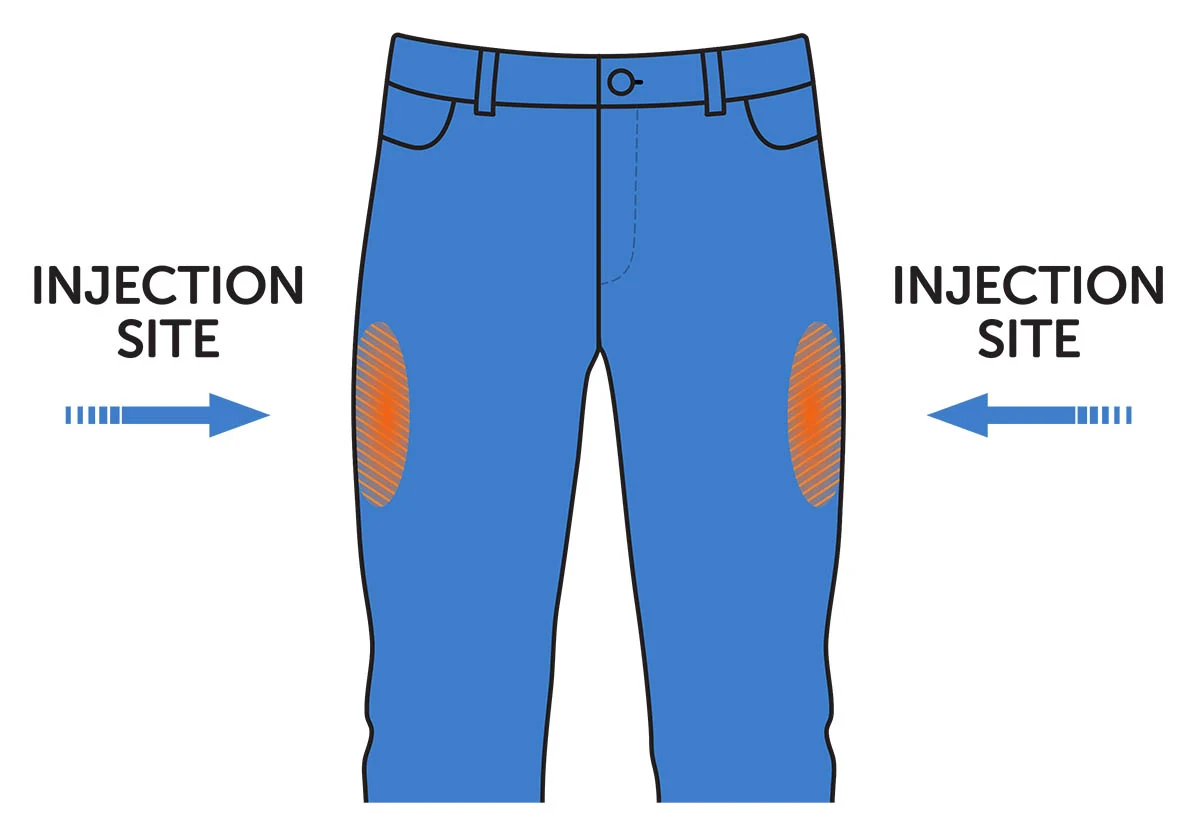
Figure B. Inject Epinephrine Injection into the middle of the outer thigh (upper leg)
Each Epinephrine Injection is for single use only.
The dose has been delivered if you see the needle sticking out of the red needle end after use. It is normal for most of the medicine to remain in the auto-injector after the dose is injected.
- Do not take the Epinephrine Injection apart.
- Do not remove the blue needle shield cap and blue end cap until you are ready to use Epinephrine Injection.
- Always point the red needle end downward (see Figure C). Never put your thumb, fingers, or hand over the red needle end. The needle comes out of the red needle end.
- Accidental injection into the fingers, hands, or feet may cause loss of blood flow to these areas. If an accidental injection happens, get emergency medical help right away.
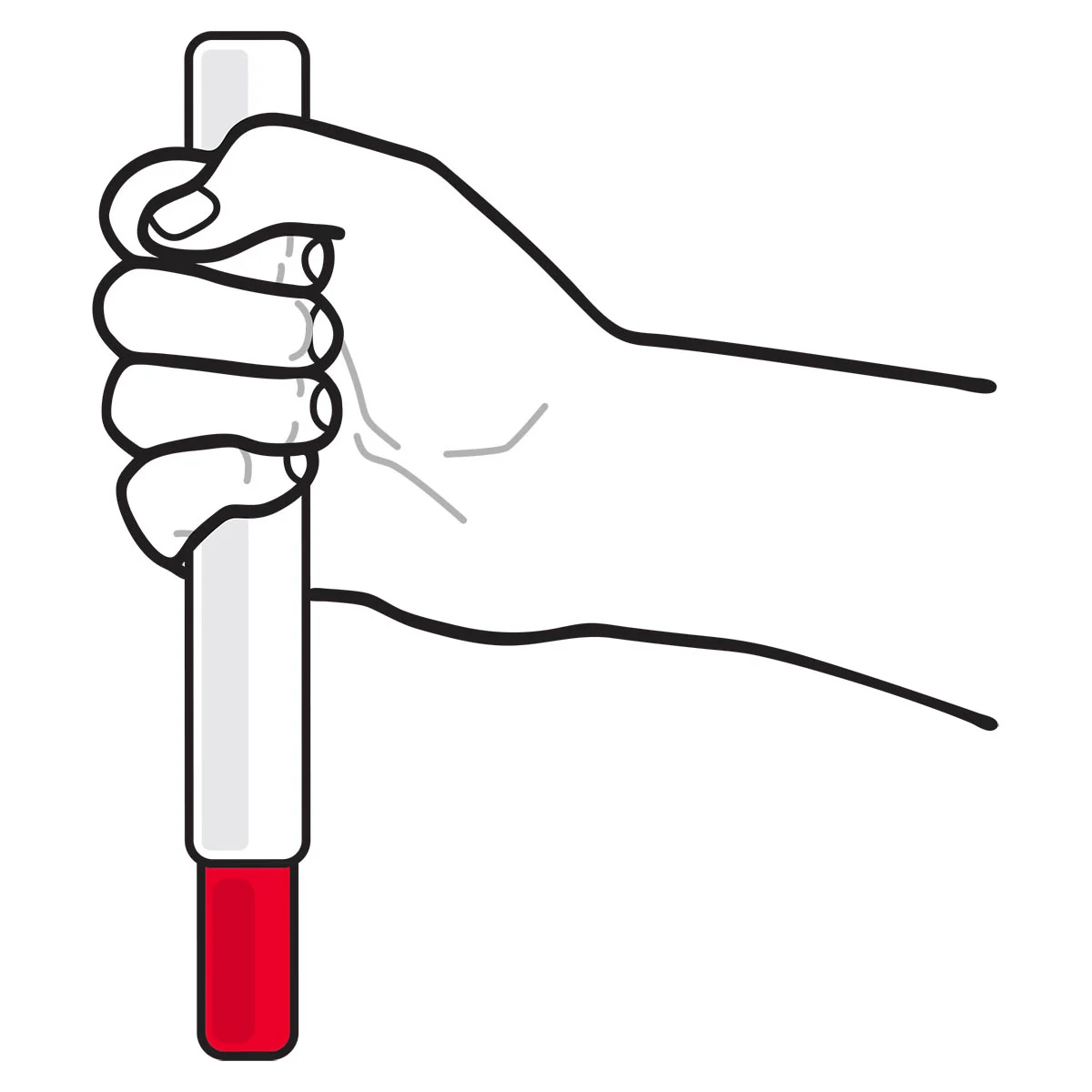
Figure C. Correct way to hold the Epinephrine Injection with red needle end pointing down
Preparing to Inject Epinephrine Injection
Read the following information while preparing to inject Epinephrine Injection:
- Epinephrine Injection can be administered through clothing. Remove any objects or clothing that may block access to the injection site.
- Check Epinephrine Injection before use. If the auto-injector appears damaged or broken, do not use it. Throw away (dispose of it) and use a new Epinephrine Injection.
- A separate Epinephrine Injection Trainer is available. The Trainer is beige in color and contains no medicine and no needle. Practice using the Trainer, but always carry your real Epinephrine Injection in case of an allergic emergency.
- You may request a separate Trainer at www.epinephrineautoinject.com or call 1-855-374-6374. Instructions for use of the Trainer device are provided on the Trainer label. Additional video instructions are available at www.epinephrineautoinject.com.
- Before injection, make sure you know where to inject (see Figure B) and how to hold the Epinephrine Injection (see Figure C).
Make sure Epinephrine Injection has not been used.
Epinephrine Injection has already been used if:
- the needle is sticking out of the red needle end, and
- the viewing window is blocked
Preparing to Inject a Child
- If you are administering Epinephrine Injection to a young child, hold their leg firmly in place before and during the 10 second injection to reduce the risk of injury.
- Ask your healthcare provider to show you how to:
- 1. Remove the blue needle shield cap first and then the blue end cap (see Figure D)
- 2. Hold the young child firmly in place (restrain movement).
- 3. With 1 hand, grip the auto-injector with the RED needle end pointing down.
- 4. Inject in the middle of the outer thigh (upper leg) (see Figure B).
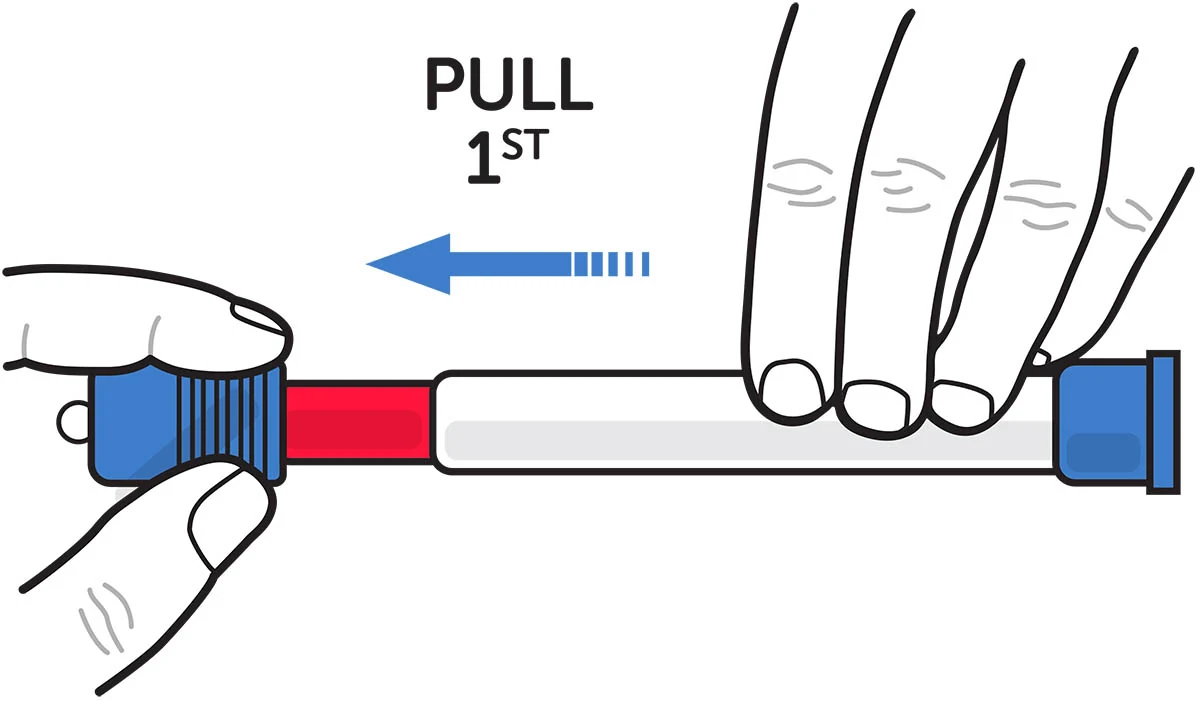
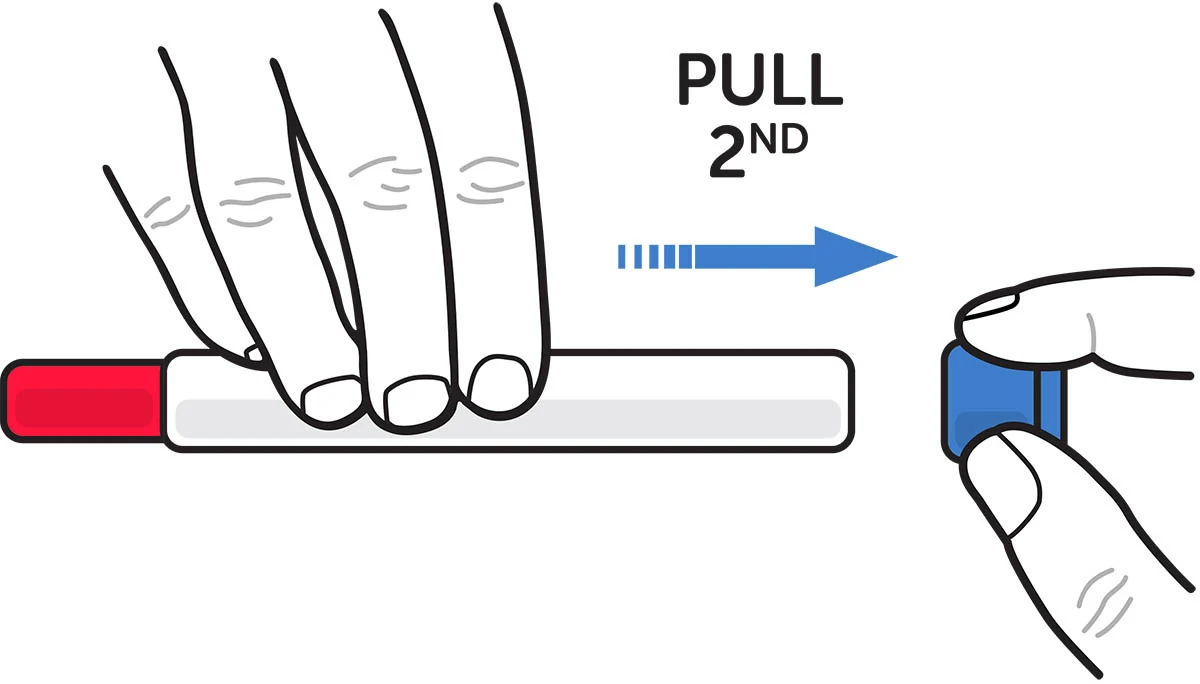
Figure D. Pull off the blue needle shield cap first and then the blue end cap
- Keep the Epinephrine Injection away from young children. The Epinephrine Injection is not a toy. Use by young children should be supervised by an adult.
- After the Epinephrine Injection is used, throw away both the blue needle shield cap and blue end cap immediately. These parts may pose a choking hazard for young children.
Checking the Solution Color
Examine the solution in the viewing window of your Epinephrine Injection regularly. See the information below:
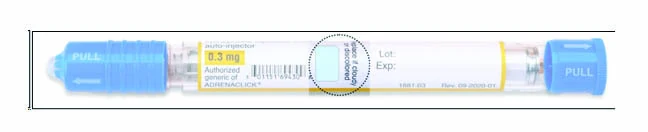
Figure E. Solution Viewing Window
How to check the Solution Color:
- Remove Epinephrine Injection from the carrier tube. See Figure F.
- The solution can be seen through the viewing window located near the middle of the Epinephrine Injection. See Figure E.
- To check the solution color, hold the auto-injector in a well-lit area and look into the viewing window.
Solution Appearance
- Use Epinephrine Injection if the solution is clear and colorless.
X Do not use the Epinephrine Injection if the solution is discolored (pinkish or brown color), cloudy, or contains solid particles. Throw away (dispose of it) and use a new Epinephrine Injection (see “Disposing of an Expired, Unused or Used Epinephrine Injection” on the Patient Information).
Injecting Epinephrine Injection
Step 1. Remove Epinephrine Injection from the carrier tube. See Figure F.
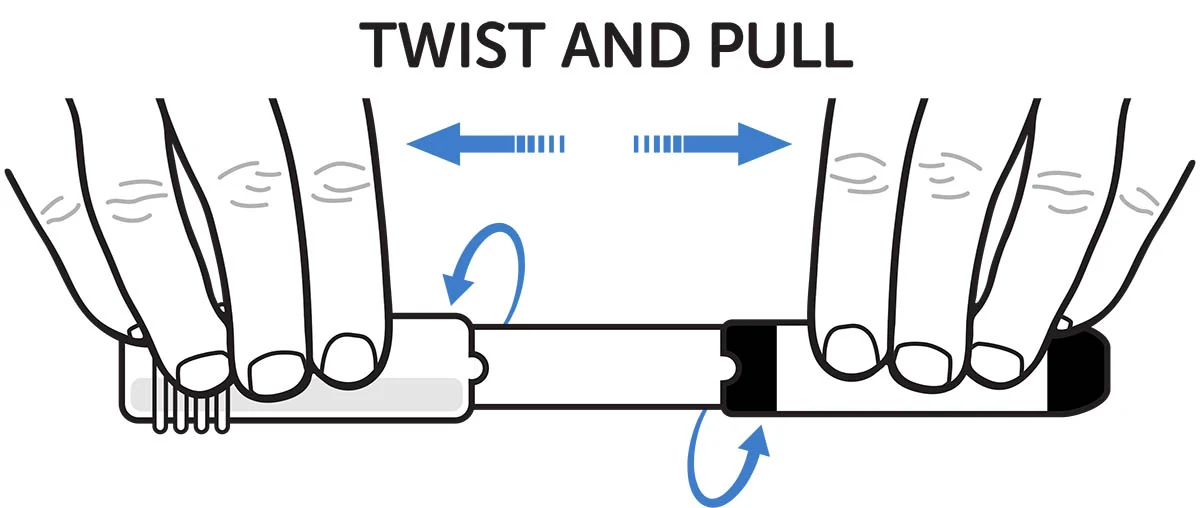
Figure F
Step 2. Pull off the blue needle shield cap first by grasping at the ribbed area and pulling. You will now see a red needle end. Then pull off the blue end cap. See Figure G.
Important:
- The needle comes out of the red needle end.
- To avoid an accidental injection, never put your thumb, fingers or hand over the red needle end.
- If an accidental injection occurs, administer a second dose of Epinephrine Injection into the middle of the outer thigh (upper leg) and get emergency medical help right away.
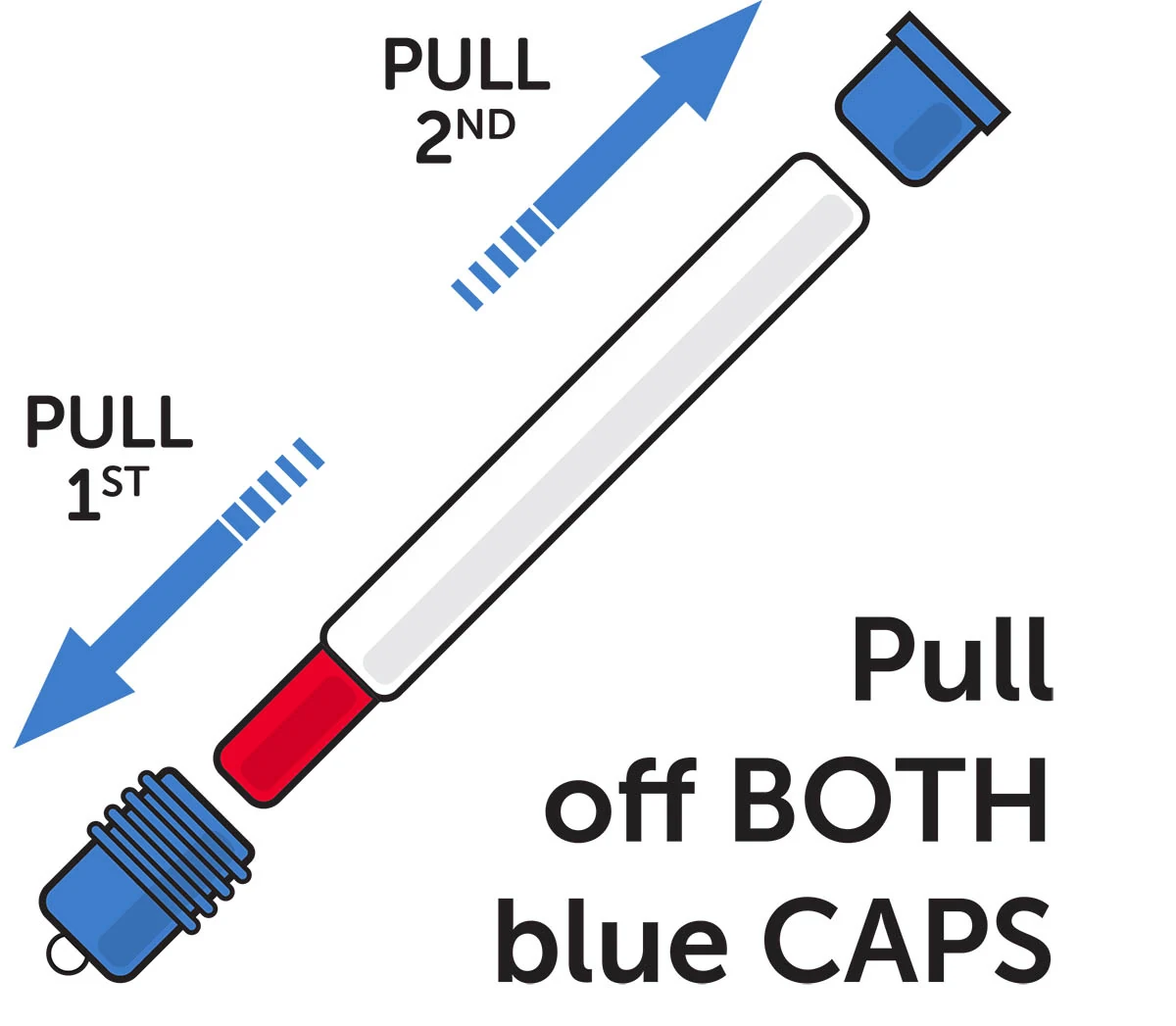
Figure G
Step 3. Inject the Epinephrine Injection
Self Administration (see Figure H) or Caregiver Administration (see Figure I)
- Grasp the Epinephrine Injection firmly in your fist with the red needle end pointing downward. See Figure C.
- Place the red needle end against the middle of the outer thigh (upper leg) at a 90° angle (perpendicular) to the thigh. The injection may be given through clothing if necessary.
- Press Down Hard and hold Epinephrine Injection firmly against the thigh for a full 10 seconds to deliver the medicine. See Figure H and Figure I.
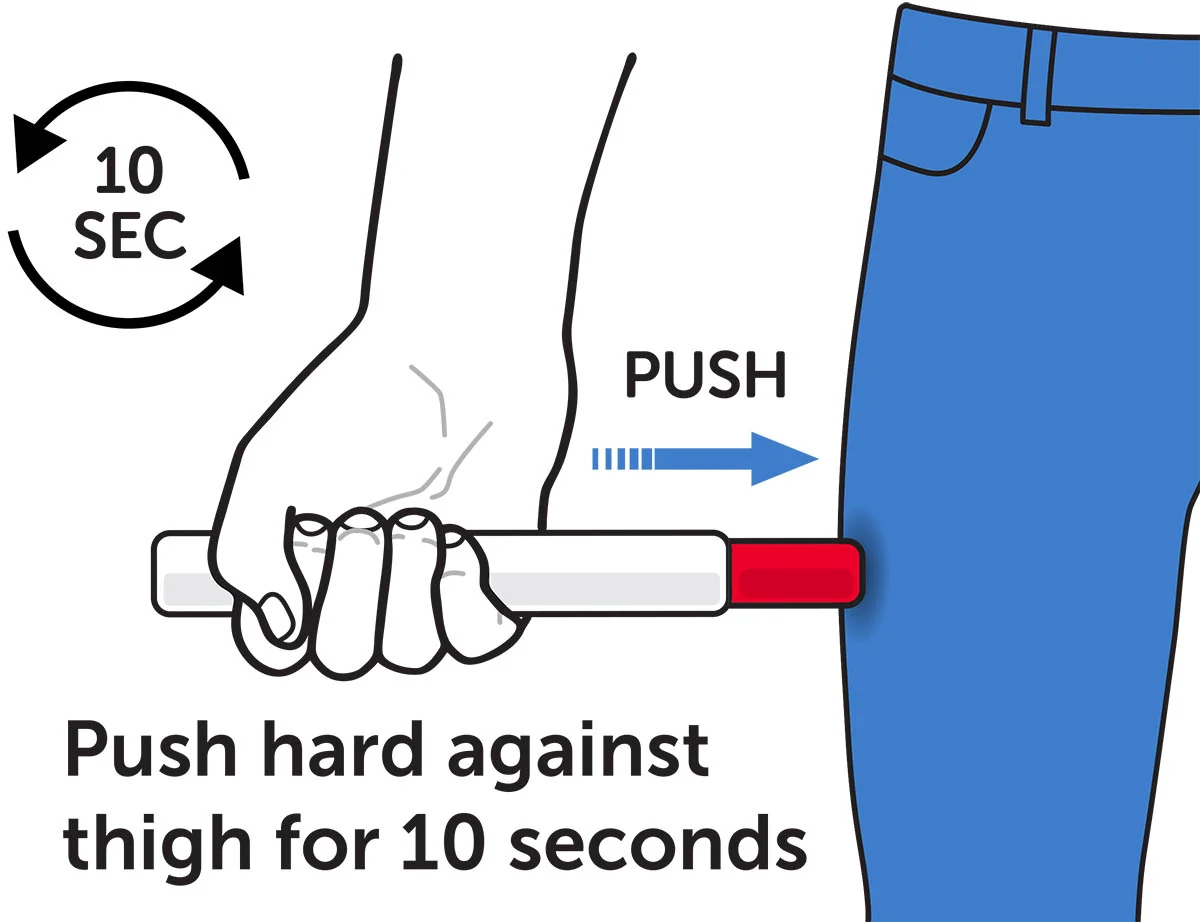
Figure H – Self Administration
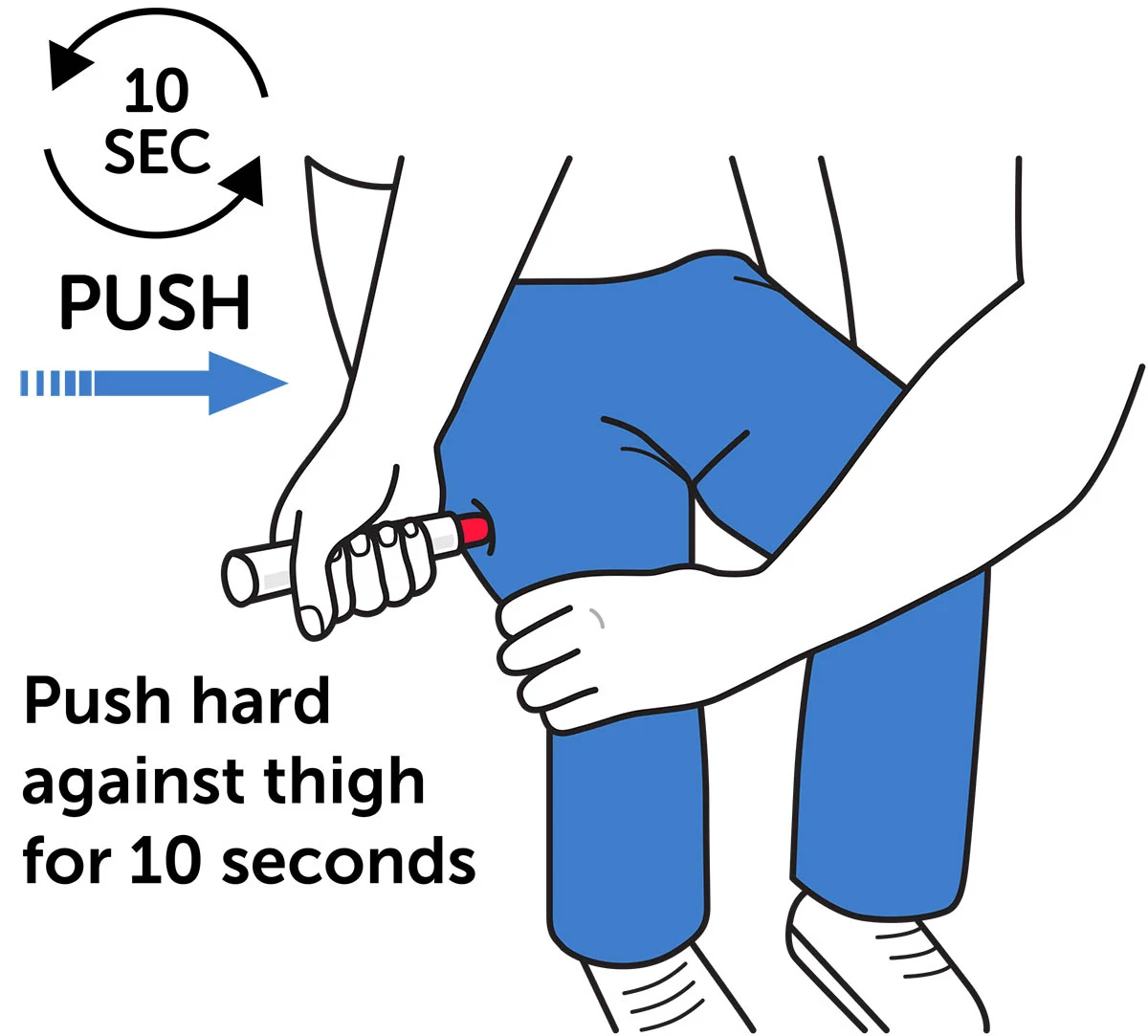
Figure I – Caregiver Administration
- Only inject into the middle of the outer thigh (upper leg). Do not inject into any other part of the body.
Step 4. Remove the Auto-Injector
Pull Epinephrine Injection straight out at a 90° angle (perpendicular) from the outer thigh (upper leg).
- Massage the injection area for 10 seconds.
- Check the red needle end. The injection is complete and the correct dose has been delivered if you see the needle sticking out of the red needle end.
- If you do not see the needle, use a new Epinephrine Injection and repeat Step 3.
Do not reuse the same Epinephrine Injection.
Step 5. Get emergency medical help if needed.
Get emergency medical help for further treatment of the allergic emergency (anaphylaxis), if needed, after using Epinephrine Injection. Before you receive Epinephrine Injection, your healthcare provider should talk to you about when to get emergency medical help.
Step 6. After use
Warning: After Epinephrine Injection is activated, the needle does not retract back into the device.
After use, carefully place the used Epinephrine Injection back into the carrier tube to cover the needle.
- Place the labeled half of the carrier tube on a flat surface, with the opening facing upward.
- Using 1 hand, carefully slide the red needle end of Epinephrine Injection into the labeled half of the carrier tube until the needle is fully covered. See Figure J.
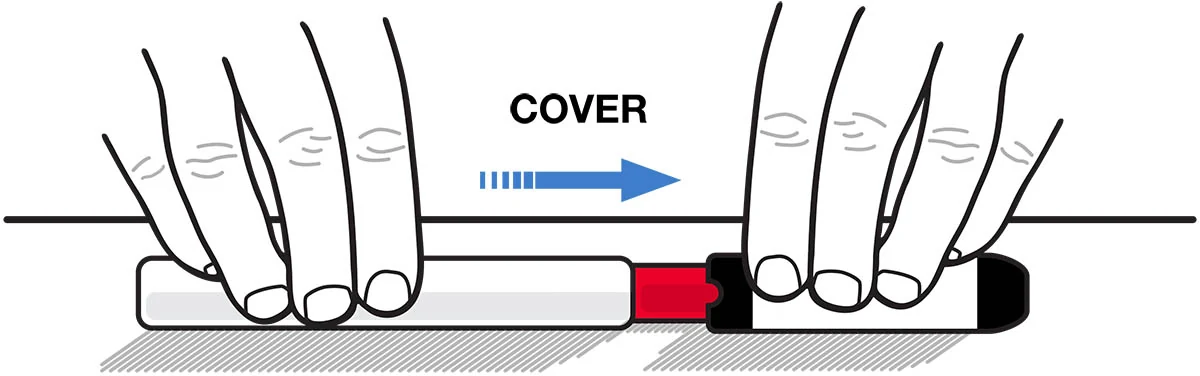
Figure J
- After the needle is inside the labeled half of the carrier tube, firmly push the unlabeled half of the carrier tube over the non-needle end of Epinephrine Injection until it is securely closed. See Figure K.
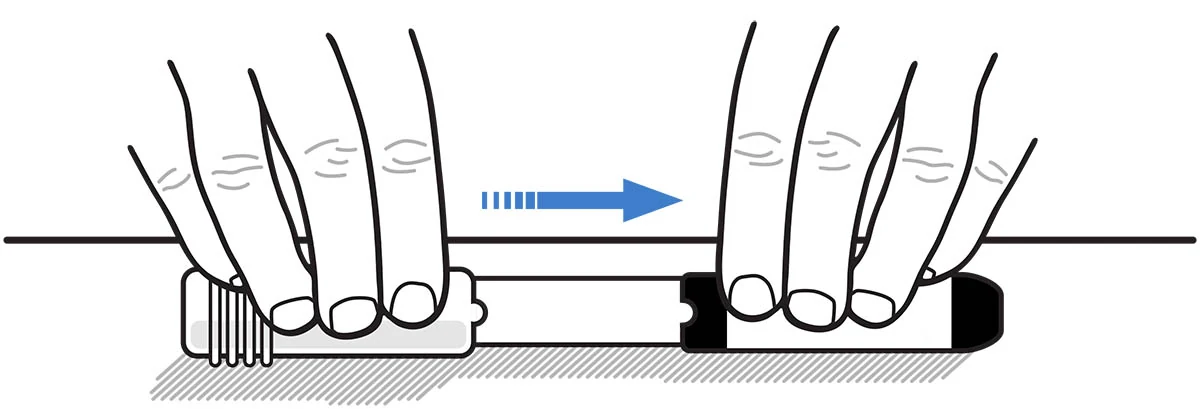
Figure K
- Take your used Epinephrine Injection with you when you go to see a healthcare provider.
- Tell the healthcare provider that you have received an injection of epinephrine. Show the healthcare provider where you received the injection.
- Give the used Epinephrine Injection to the healthcare provider for inspection and proper disposal.
- Ask your healthcare provider if you need a new prescription.
Storing Epinephrine Injection
- Store Epinephrine Injection at room temperature between 68°F to 77°F (20°C to 25°C).
- Keep Epinephrine Injection in the carrier tube to protect it from light and damage. The carrier tube is not waterproof.
- Do not expose Epinephrine Injection to extreme heat or cold. For example, do not store in your vehicle’s glove box and do not store it in the refrigerator or freezer.
- Keep Epinephrine Injection and all medicines out of the reach of children.
Disposing of Epinephrine Injection
Important: The blue needle shield cap and blue end cap are small parts and may pose a choking hazard for children. Throw away the blue needle shield cap and blue end cap immediately after using Epinephrine Injection.
- Epinephrine Injection has an expiration date. Replace it before the expiration date.
- For instructions on how to throw away (dispose of) expired, unused, or used Epinephrine Injection, see the section titled “Disposing of an Expired, Unused or Used Epinephrine Injection” on the Patient Information side of this leaflet.
For more information and video instructions on the use of Epinephrine Injection, visit www.epinephrineautoinject.com or call 1-877-835-5472.
© 2025 Amneal Pharmaceuticals LLC. All rights reserved.
Manufactured for and Distributed by:
Amneal Pharmaceuticals LLC
Bridgewater, NJ 08807
1872-06
This Patient Information and Instructions for Use has been approved by the U.S. Food and Drug Administration.
Revised 03/2026