


Patient information: uses, side effects, how to take - Brimonidine Topical
What is brimonidine topical gel?
Brimonidine topical gel is a prescription medicine that is used on your skin (topical) to treat facial redness due to rosacea that does not go away (persistent) in adults who are 18 years of age or older.
It is not known if brimonidine topical gel is safe and effective in children.
Who should not use brimonidine topical gel?
Do not use brimonidine topical gel if you have had a serious allergic reaction to any of the ingredients in brimonidine topical gel. See the end of this Patient Information leaflet for a list of ingredients in brimonidine topical gel. See “What are the possible side effects of brimonidine topical gel?”
What should I tell my doctor before using brimonidine topical gel?
Before using brimonidine topical gel, tell your doctor about all of your medical conditions including if you:
- have depression
- have heart or blood vessel problems
- have dizziness or blood pressure problems
- have problems with blood circulation or have had a stroke
- have dry mouth or Sjögren’s Syndrome
- have skin tightening or scleroderma
- have Raynaud’s phenomenon
- have irritated skin or open sores
- plan to have any laser procedures
are pregnant or plan to become pregnant. It is not known if brimonidine topical gel will harm your unborn baby.
- are breastfeeding. It is not known if brimonidine passes into your breast milk. You and your doctor should decide if you will use brimonidine topical gel or breastfeed. You should not do both.
Tell your doctor about all the medicines you take, including prescription and over-the-counter medicines, skin products, vitamins, and herbal supplements. Using brimonidine topical gel with certain other medicines may affect each other and can cause serious side effects.
How should I use brimonidine topical gel?
See the detailed Instructions for Use that comes with your brimonidine topical gel tube or pump for information about how to apply brimonidine topical gel correctly.
- Use brimonidine topical gel exactly as your doctor tells you. Do not use more brimonidine topical gel than prescribed. Call your doctor if you are not sure.
- You should not apply brimonidine topical gel to irritated skin or open wounds.
- Brimonidine topical gel is for use on your skin only. Do not use brimonidine topical gel in your eyes, mouth, or vagina. Avoid contact with your lips and eyes.
What are the possible side effects of brimonidine topical gel?
Brimonidine topical gel may cause serious side effects, including:
- See “Important information” at the beginning of this Patient Information leaflet.
- Problems with blood circulation. People who use brimonidine topical gel can have problems with blood circulation, including a slow heart rate, low blood pressure, and dizziness. These problems may sometimes be serious and lead to hospitalization. See “What should I tell my doctor before using brimonidine topical gel?”
- Serious allergic (hypersensitivity) reactions have happened in people who use brimonidine topical gel. Stop using brimonidine topical gel and go to the nearest hospital emergency room right away if you have any of the following signs and symptoms of a serious allergic reaction including:
- swelling of your face, lips, tongue, or throat
- hives
- trouble breathing
The most common side effects of brimonidine topical gel include:
- redness
- flushing
- burning sensation of the skin
- skin reactions (contact dermatitis).
Skin redness is common after applying brimonidine topical gel, and may be worse than before you applied it. You may also develop redness on areas of your face that were not affected by rosacea, as well as on your neck and chest.
Skin flushing is common and may happen off and on after applying brimonidine topical gel. In some cases, the flushing may be new, may happen more often, or you may have increased redness with flushing.
Pale colored skin or very white skin (excessive whitening) can happen at or outside the treated area.
Tell your doctor if you get skin redness, flushing, and pale colored skin that is uncomfortable for you.
These are not all the possible side effects of brimonidine topical gel.
Call your doctor for medical advice about side effects. You may report side effects to FDA at 1-800-FDA-1088.
General information about the safe and effective use of brimonidine topical gel
Medicines are sometimes prescribed for purposes other than those listed in a Patient Information leaflet. You can ask your pharmacist or doctor for information about brimonidine topical gel that is written for health professionals. Do not use brimonidine topical gel for a condition for which it was not prescribed. Do not give brimonidine topical gel to other people, even if they have the same symptoms that you have. It may harm them.
What are the ingredients in brimonidine topical gel?
Active ingredient: brimonidine
Inactive ingredients: benzalkonium chloride, carbomer homopolymer type B, glycerin, propylene glycol, purified water, sodium hydroxide, talc.
This Patient Information has been approved by the U.S. Food and Drug Administration.
Manufactured by Padagis®, Yeruham, Israel
www.padagis.com
Rev 07-24
7M15B RC PH3
Instructions for Use
Instructions for Use
Brimonidine (bri-MOE-ni-deen) Topical Gel, 0.33%
Pump
Important: Brimonidine topical gel is for use on the face only. Do not use brimonidine topical gel in your eyes, mouth, or vagina.
Keep brimonidine topical gel out of the reach of children.
If anyone, especially a child, accidentally swallows brimonidine topical gel, they may have serious side effects and need to be treated in a hospital. Get medical help right away if you, a child, or anyone else swallows brimonidine topical gel and has any of these symptoms:
- lack of energy, trouble breathing or stops breathing, a slow heart beat, confusion, sweating, restlessness, muscle spasms, or twitching.
Read and follow the steps below so that you use your brimonidine topical gel pump correctly:
- 1.
Push the cap down and turn it counter-clockwise until the cap can be removed. See Figures A and B.
The sticker will break when opening for the first time.
Note: when the cap is removed, the pump is not child-resistant.
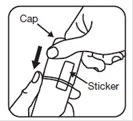 Figure A
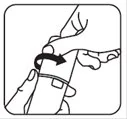 Figure B
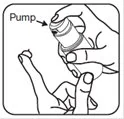 Figure C
Before the first use, prime the pump by pressing down several times until the medicine is dispensed onto your fingertip.
- 2. To apply brimonidine topical gel to your face, dispense a pea-sized amount of brimonidine topical gel from the pump onto your fingertip. See Figure C.
- 3. Apply a pea-sized amount of brimonidine topical gel onto each of the five areas of your face (forehead, chin, nose, each cheek) 1 time each day. You will use a total of 5 pea-sized amounts of brimonidine topical gel. Spread the gel smoothly and evenly in a thin layer over your face. Avoid contact with your eyes and lips. Do not apply brimonidine topical gel to irritated skin or open wounds.
- 4. To close your brimonidine topical gel pump, place the cap back on the pump. Push down and turn the cap to the right (clockwise) until it stops. This pump is child-resistant again. See Figure D.
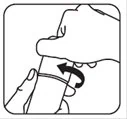 Figure D
- 5. Wash your hands right away after applying brimonidine topical gel.
How should I store brimonidine topical gel?
- Store brimonidine topical gel at room temperature between 68°F to 77°F (20°C to 25°C).
Keep brimonidine topical gel and all medicines out of the reach of children.
This Instructions for Use has been approved by the U.S. Food and Drug Administration.
Manufactured by Padagis®, Yeruham, Israel
www.padagis.com
Rev 07-24
7M15B RC PH3