


Patient information: uses, side effects, how to take - Calcium Acetate
Calcium acetate, USP acts as a phosphate binder. Its chemical name is Calcium acetate, USP. Its molecular formula is C 4H 6CaO 4, and its molecular weight is 158.17. Its structural formula is:
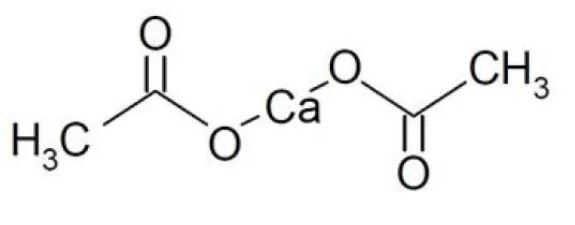
Each opaque capsule with a blue cap and white body is spin printed in blue and white ink with “SUVEN” printed on the cap and “667” printed on the body. Each capsule contains 667 mg calcium acetate, USP (anhydrous; Ca(CH 3COO) 2; MW=158.17 grams) equal to 169 mg (8.45 mEq) calcium, and water as the inert binder, crospovidone and sodium stearyl fumarate . The gelatin cap and body have the following inactive ingredients: FD&C blue 1, D&C red 28, titanium dioxide and gelatin. Imprinting ink on capsule body contains shellac and FD&C 2 Aluminum Lake and imprinting ink on capsule cap contains shellac, titanium dioxide and potassium hydroxide. Calcium acetate capsules are administered orally for the control of hyperphosphatemia in end-stage renal failure. Meets USP Dissolution Test 4
12 CLINICAL PHARMACOLOGY
Patients with ESRD retain phosphorus and can develop hyperphosphatemia. High serum phosphorus can precipitate serum calcium resulting in ectopic calcification. Hyperphosphatemia also plays a role in the development of secondary hyperparathyroidism in patients with ESRD.
12.1 Mechanism of Action
Calcium acetate, when taken with meals, combines with dietary phosphate to form an insoluble calcium phosphate complex, which is excreted in the feces, resulting in decreased serum phosphorus concentration.
12.2 Pharmacodynamics
Orally administered calcium acetate from pharmaceutical dosage forms is systemically absorbed up to approximately 40% under fasting conditions and up to approximately 30% under non-fasting conditions. This range represents data from both healthy subjects and renal dialysis patients under various conditions.
13 NONCLINICAL TOXICOLOGY
13.1 Carcinogenesis, Mutagenesis, Impairment of Fertility
No carcinogenicity, mutagenicity, or fertility studies have been conducted with calcium acetate.
14 CLINICAL STUDIES
Effectiveness of calcium acetate in decreasing serum phosphorus has been demonstrated in two studies of the calcium acetate solid oral dosage form.
Ninety-one patients with end-stage renal disease who were undergoing hemodialysis and were hyperphosphatemic (serum phosphorus >5.5 mg/dL) following a 1-week phosphate binder washout period contributed efficacy data to an open-label, non-randomized study.
The patients received calcium acetate 667 mg tablets at each meal for a period of 12 weeks. The initial starting dose was 2 tablets per meal for 3 meals a day, and the dose was adjusted as necessary to control serum phosphorus levels. The average final dose after 12 weeks of treatment was 3.4 tablets per meal. Although there was a decrease in serum phosphorus, in the absence of a control group the true magnitude of effect is uncertain.
The data presented in Table 2 demonstrate the efficacy of calcium acetate in the treatment of hyperphosphatemia in end-stage renal disease patients. The effects on serum calcium levels are also presented.
Table 2: Average Serum Phosphorous and Calcium Levels at Pre-Study, Interim, and Study Completion Time points
| Parameter | Pre-Study | Week 4 b | Week 8 | Week 12 | p-value c |
| Phosphorous (mg/dL) a | 7.4 ± 0.17 | 5.9 ± 0.16 | 5.6 ± 0.17 | 5.2 ± 0.17 | ≤0.01 |
| Calcium | 8.9 ± 0.09 | 9.5 ± 0.10 | 9.7 ± 0.10 | 9.7 ± 0.10 | ≤0.01 |
a Values expressed as mean ± SE.
b Ninety-one patients completed at least 6 weeks of the study.
c ANOVA of difference in values at pre-study and study completion.
There was a 30% decrease in serum phosphorus levels during the 12-week study period (p<0.01). Two-thirds of the decline occurred in the first month of the study. Serum calcium increased 9% during the study mostly in the first month of the study.
Treatment with the phosphate binder was discontinued for patients from the open-label study, and those patients whose serum phosphorus exceeded 5.5 mg/dL were eligible for entry into a double-blind, placebo-controlled, cross-over study. Patients were randomized to receive calcium acetate or placebo, and each continued to receive the same number of tablets as had been individually established during the previous study. Following 2 weeks of treatment, patients switched to the alternative therapy for an additional 2 weeks.
The phosphate binding effect of calcium acetate is shown in the Table 3.
Table 3: Serum Phosphorous and Calcium Levels at Study Initiation and After Completion of Each Treatment Arm
| Parameter | Pre-Study | Post Treatment | p-value b | |
| Calcium Acetate | Placebo | |||
| Phosphorous (mg/dL) a | 7.3 ± 0.18 | 5.9 ± 0.24 | 7.8 ± 0.22 | <0.01 |
| Calcium (mg/dL)a | 8.9 ± 0.11 | 9.5 ± 0.13 | 8.8 ± 0.12 | <0.01 |
a Values expressed as mean ± SEM
b ANOVA of calcium acetate vs. placebo after 2 weeks of treatment.
Overall, 2 weeks of treatment with calcium acetate statistically significantly (p<0.01) decreased serum phosphorus by a mean of 19% and increased serum calcium by a statistically significant (p<0.01) but clinically unimportant mean of 7%.
16 HOW SUPPLIED/STORAGE AND HANDLING
Calcium Acetate capsules USP, 667 mg are hard gelatin capsules with blue opaque cap imprinted with “SUVEN” in white color ink and a white opaque body imprinted with “667” blue color ink. Each capsule contains 667 mg calcium acetate (anhydrous Ca(CH 3COO) 2; MW=158.17 grams) equal to 169 mg (8.45 mEq) calcium.
NDC 16571-813-20 Bottles of 200 with child-resistant closure.
STORAGE
Store at 20°-25°C (68°-77°F); excursions permitted to 15° to 30°C (59° to 86°F) [See USP Controlled Room Temperature].
17 PATIENT COUNSELING INFORMATION
Inform patients to take calcium acetate capsules with meals, adhere to their prescribed diets, and avoid the use of calcium supplements including nonprescription antacids. Inform the patients about the symptoms of hypercalcemia [ see Warnings and Precautions (5.1) and Adverse Reactions (6.1)].
Advise patients who are taking an oral medication where reduction in the bioavailability of that medication would have clinically significant effect on its safety or efficacy to take the drug one hour before or three hours after calcium acetate capsules.
Manufactured by:
Cohance Lifesciences Limited
Pashamylaram, Telangana, 502307, India
ML No: 24/MD/AP/2009/F/CC
Distributed by:
Rising Pharma Holdings, Inc.
East Brunswick, NJ 08816
Revised: 01/2026
LB0318-3-03