


Patient information: uses, side effects, how to take - Syndros
What is the most important information I should know about SYNDROS?
SYNDROS can cause serious side effects, including:
- Worsening mental (psychiatric) symptoms. Psychiatric symptoms can worsen in people who have mania, depression, or schizophrenia and who take SYNDROS. SYNDROS taken with medicines that cause psychiatric symptoms can worsen psychiatric symptoms. Elderly people who take SYNDROS may have a greater risk of having psychiatric symptoms. Tell your doctor if you have new or worsening mood symptoms, including symptoms of mania, depression, or schizophrenia.
- Problems thinking clearly. Tell your doctor if you have trouble remembering things, concentrating, have increased sleepiness, or confusion. Elderly people may have a greater risk of having problems thinking clearly.
- Changes in your blood pressure. SYNDROS may increase or decrease your blood pressure, especially when you start taking SYNDROS or when your dose is changed. Tell your doctor if you have signs or symptoms of changes in your blood pressure including: headaches, vision problems, dizziness, feeling lightheaded, fainting, or a fast heartbeat. Elderly people, especially those with dementia, and people with heart problems may have an increased risk of changes in blood pressure and an increased risk of falls.
- Interactions with disulfiram or metronidazole. SYNDROS contains alcohol, which can cause you to have a reaction to medicines that contain disulfiram or metronidazole. You should not use any medicine that contains disulfiram (Antabuse) or metronidazole (Pylera, Flagyl, Flagyl ER, Nuvessa, Vandazole) if you take SYNDROS. You should not use a medicine that contains disulfiram or metronidazole for at least 14 days before you start taking SYNDROS and within 7 days after your last dose of SYNDROS. Tell your doctor if you have signs or symptoms of a reaction to disulfiram or metronidazole including: stomach-area (abdominal) cramping, nausea, vomiting, headache, and flushing.
What is SYNDROS?
SYNDROS is a prescription medicine used in adults to treat:
- loss of appetite (anorexia) in people with AIDS (Acquired Immune Deficiency Syndrome) who have lost weight.
- nausea and vomiting caused by anti-cancer medicine (chemotherapy) in people whose nausea and vomiting have not improved with usual anti-nausea medicines.
SYNDROS is a controlled substance (CII) because it contains dronabinol which can be a target for people who abuse prescription medicines or street drugs. Keep your SYNDROS in a safe place to protect it from theft. Never give your SYNDROS to anyone else because it may cause death or harm them. Selling or giving away this medicine is against the law.
It is not known if SYNDROS is safe and effective in children.
Do not take SYNDROS if you:
- had an allergic reaction to dronabinol. Signs and symptoms of an allergic reaction to dronabinol include: swelling of the lips, hives, a rash over your whole body, mouth sores, skin burning, flushing, and throat tightness.
- had an allergic reaction to alcohol.
- are using a medicine that contains disulfiram (Antabuse) or metronidazole (Pylera, Flagyl, Flagyl ER, Nuvessa, Vandazole) or have taken or received a medicine that contains disulfiram or metronidazole in the last 14 days.
Before taking SYNDROS, tell your doctor about all of your medical conditions, including if you:
- have or had heart problems.
- have or had problems with drug abuse or dependence.
- have or had problems with alcohol abuse or dependence.
- have or had mental health problems including mania, depression or schizophrenia.
- have had a seizure or have a medical condition that may increase your risk of having a seizure.
are pregnant or plan to become pregnant. SYNDROS may harm your unborn baby. Avoid the use of SYNDROS if you are pregnant.
- are breastfeeding or plan to breastfeed. The Centers for Disease Control and Prevention recommends that mothers with HIV not breastfeed because they can pass the HIV through their breast milk to the baby. It is not known if SYNDROS passes into your breast milk. Talk to your doctor about the best way to feed your baby if you take SYNDROS. Do not breastfeed while taking SYNDROS and for 9 days after your last dose of SYNDROS if you are being treated for nausea and vomiting caused by anti-cancer medicine.
Tell your doctor about all the medicines you take or have taken in the last 14 days, including prescription and over-the-counter medicines, vitamins, and herbal supplements. SYNDROS and certain other medicines can affect each other, causing serious side effects.
How should I take SYNDROS?
- See the “ Instructions for Use” at the end of the Patient Information for detailed instructions about the right way to take SYNDROS by mouth or through a feeding tube, including the types and sizes of feeding tubes that can be used.
- Always use the oral syringe that comes with your SYNDROS oral solution to measure your prescribed dose. Ask your doctor or pharmacist to show you how to measure your prescribed dose.
- Take SYNDROS exactly as your doctor tells you to. Your doctor may change your dose after seeing how it affects you. Do not change your dose unless your doctor tells you to change it.
- If you take SYNDROS oral solution by mouth, drink a full glass of water (6 to 8 ounces) right after you take your prescribed dose.
- If you take SYNDROS oral solution through a feeding tube, flush the feeding tube with 1 ounce (30 mL) of water using a catheter-tip syringe right after you take your prescribed dose.
If you are an adult with AIDS with loss of appetite and weight loss:
- SYNDROS is usually taken 2 times each day, 1 hour before lunch and 1 hour before dinner. If you are elderly, or unable to tolerate this dose of SYNDROS, your doctor may prescribe SYNDROS to be taken 1 time each day, 1 hour before dinner or bedtime.
If you are an adult with nausea and vomiting caused by anti-cancer medicine:
- SYNDROS is usually taken 1 to 3 hours before your chemotherapy treatment and then every 2 to 4 hours after chemotherapy for up to 4 to 6 doses each day. If you are elderly, your doctor may prescribe SYNDROS to be taken 1 to 3 hours before your chemotherapy, 1 time each day.
Take your first dose of SYNDROS on an empty stomach at least 30 minutes before eating. After your first dose of SYNDROS, you can take SYNDROS with or without food.
- After your doctor has decided the dose of SYNDROS that is right for you, take SYNDROS exactly at the same time before or after meals during future chemotherapy treatment.
- If you take too much SYNDROS, call your Poison Control Center at 1-800-222-1222 right away or go to the nearest emergency room.
What should I avoid while taking SYNDROS?
- Do not drive, operate machinery, or do other dangerous activities until you know how SYNDROS affects you. SYNDROS taken with medicines that cause dizziness, confusion, and sleepiness may make these symptoms worse.
What are the possible side effects of SYNDROS?
SYNDROS may cause serious side effects, including:
- See “ What is the most important information I should know about SYNDROS?”
- Seizures. SYNDROS may increase your risk of seizures. Stop taking SYNDROS and call your doctor and get medical care right away if you have a seizure during treatment with SYNDROS.
- Drug and alcohol abuse. You may have an increased risk of abusing SYNDROS if you have a history of drug or alcohol abuse or dependence, including marijuana. Tell your doctor if you develop abuse behaviors such as increased irritability, nervousness, restlessness or want more or higher doses of SYNDROS during your treatment.
- Nausea, vomiting, or stomach-area (abdominal) pain. Tell your doctor if you have nausea, vomiting, or abdominal pain or if your nausea, vomiting, or abdominal pain gets worse during treatment with SYNDROS.
The most common side effects of SYNDROS include:
- stomach-area (abdominal) pain
- dizziness
- feeling extremely happy (euphoria)
- nausea
- overly suspicious or feeling people want to harm you (paranoid reaction)
- sleepiness
- abnormal thoughts
- vomiting
These are not all the possible side effects of SYNDROS. Tell your doctor if you have any side effect that bothers you or does not go away. Call your doctor for medical advice about side effects. You may report side effects to FDA at 1-800-FDA-1088.
General information about the safe and effective use of SYNDROS
Medicines are sometimes prescribed for purposes other than those listed in a Patient Information leaflet. Do not use SYNDROS for a condition for which it was not prescribed. Do not give SYNDROS to other people, even if they have the same symptoms that you have. It may harm them. You can ask your doctor or pharmacist for information about SYNDROS that is written for health professionals.
What are the ingredients in SYNDROS?
Active ingredient: dronabinol
Inactive ingredients: dehydrated alcohol, polyethylene glycol 400, propylene glycol, sucralose, methyl paraben, propyl paraben, butylated hydroxyanisole, and water.
INSTRUCTIONS FOR USE
SYNDROS (sin dros)
(dronabinol)
oral solution, CII
Read this Instructions for Use before you start taking SYNDROS oral solution and each time you get a refill. There may be new information. This information does not take the place of talking to your doctor about your medical condition or your treatment.
Important information about measuring SYNDROS oral solution:
- Always use the oral syringe that comes with your SYNDROS oral solution to measure your prescribed dose. Ask your doctor or pharmacist to show you how to measure your prescribed dose.
Important information about giving SYNDROS oral solution through a feeding tube:
- Give SYNDROS oral solution through feeding tubes that are made with silicone and that are size 14 French or larger. Do not give SYNDROS oral solution through feeding tubes that are not made with silicone or that are smaller than size 14 French.
- Do not use feeding tubes made with polyurethane.
- SYNDROS oral solution can be given through a naso-gastric tube (NG tube), gatrostomy tube (G-tube), percutaneous endoscopic gastrostomy tube (PEG-tube), and gastro-jejunostomy tube (GJ-tube).
Call Wellhouse Pharma at 1-844-558-8289 if:
| 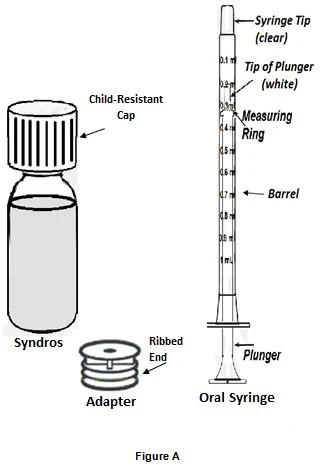 |
How to prepare a bottle of SYNDROS oral solution before using for the first time: Step 1: Remove the plastic wrap from the bottle and throw it away. Step 2: Open the bottle by pushing down firmly on the child-resistant cap and turning it counter-clockwise (See Figure B). Do not throw away the child-resistant cap. | 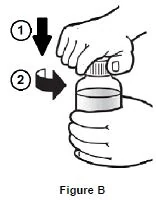 |
Step 3: Remove the adapter from the plastic wrap. You may need to use a pair of scissors. Step 4: Place the open bottle upright on a flat surface. Firmly push down on the adapter until the ribbed end of the adapter fits into the neck of the bottle as far as it will go and is firmly in place (See Figure C). The top edge of the adapter should be in full contact with the top rim of the bottle. Do not remove the adapter from the bottle after it is inserted. Step 5: Follow the instructions in “ How to prepare a dose of SYNDROS oral solution after the adapter is inserted.” | 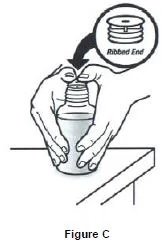 |
| How to prepare a dose of SYNDROS oral solution after the adapter is inserted: | |
| Step 1: Open the bottle by pushing down firmly on the child-resistant cap and turning it counter-clockwise (See Figure D). Do not throw away the child-resistant cap. | 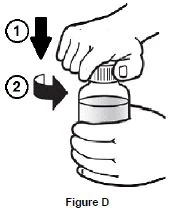 |
Step 2: If you are using the oral syringe for the first time, remove the oral syringe from the plastic wrap. You may need to use a pair of scissors. Step 3: Hold the oral syringe in one hand. With your other hand, fully push down (depress) the plunger (See Figure E). | 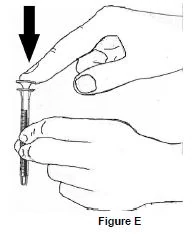 |
| Step 4: Keeping the bottle in an upright position, insert the syringe tip firmly into the adapter (See Figure F). | 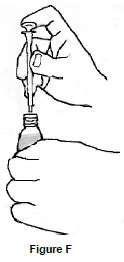 |
| Step 5: Carefully turn the bottle upside down with the syringe tip firmly inserted into the adapter (See Figure G). | 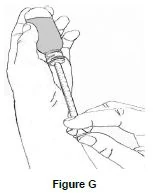 |
Step 6: Slowly pull back on the plunger until the measuring ring is at the line marking for the dose prescribed by your doctor. The measuring ring is the widest part of the plunger at the bottom of the tip of plunger. (See Figures H(a) and H(b)). Figure H(a) shows a dose of 0.4 mL as an example. If you see air bubbles in the oral syringe, fully push in the plunger so that the oral solution flows back into the bottle. Then, withdraw your prescribed dose of oral solution. If your prescribed dose is more than 1 mL, you will need to draw up two or more doses. For example, if your dose is 1.2 mL, you will need to draw up a 1 mL dose followed by a 0.2 mL dose. | 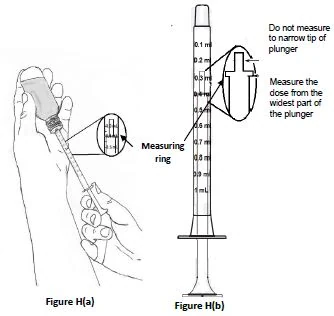 |
| Step 7: Leave the oral syringe in the adapter and turn the bottle to an upright position. Place the bottle onto a flat surface. Remove the oral syringe from the bottle adapter by gently pulling straight up on the oral syringe (See Figure I). | 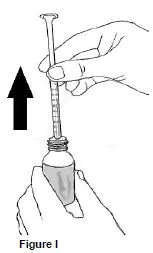 |
Step 8: Check that the correct dose of SYNDROS oral solution was drawn up into the oral syringe. If the dose is not correct, insert the syringe tip firmly into the bottle adapter. Fully push in the plunger so that the oral solution flows back into the bottle (See Figure J). Repeat Steps 5-8. If you are taking your dose of SYNDROS by mouth, follow the instructions in “How to take a dose of SYNDROS oral solution by mouth.” If you are taking your dose of SYNDROS through a feeding tube, follow the instructions in “How to take a dose of SYNDROS oral solution through a feeding tube.” | 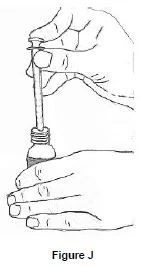 |
| How to take a dose of SYNDROS oral solution by mouth: | |
Step 1: Open your mouth. Place the oral syringe tip in the back of your mouth on top of your tongue. Tilt your head back slightly and close your lips around the barrel of the oral syringe. Slowly push down the plunger until the oral syringe is empty (See Figure K). Swallow the oral solution. If your prescribed dose is more than 1 mL, repeat Steps 4-8 in “How to prepare a dose of SYNDROS oral solution after the adapter is inserted” to draw up the remaining dose until the prescribed dose is given. For example, if your prescribed dose is 1.6 mL, take a 1 mL dose first, then an additional dose of 0.6 mL. Take your SYNDROS oral solution right away after it is drawn up into the oral syringe. | 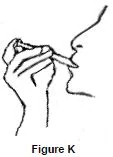 |
| Step 2: Drink a full glass of water (6 to 8 ounces) right after you take your prescribed dose of SYNDROS oral solution (See Figure L). | 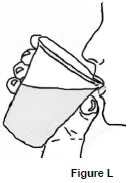 |
| Step 3: Leave the adapter in the bottle. Put the child-resistant cap back on the bottle (See Figure M). | 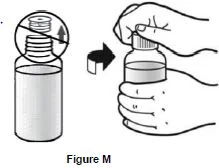 |
| Step 4: Remove the plunger from the oral syringe barrel. Rinse the oral syringe barrel and plunger with warm water after each use and let them air dry. When the oral syringe barrel and plunger are dry, put the plunger back into the oral syringe barrel for the next use. Keep SYNDROS oral solution and the oral syringe in the carton that it comes in. Do not throw away the oral syringe. | |
| How to take a dose of SYNDROS oral solution through a feeding tube: | |
See “Important information about giving SYNDROS oral solution through a feeding tube.” Step 1: Place the oral syringe into the feeding tube. Slowly push down the plunger until the oral syringe is empty (See Figure N). If your prescribed dose is more than 1 mL, repeat Steps 4-8 in “How to prepare a dose of SYNDROS oral solution after the adapter is inserted” to draw up the remaining dose until the prescribed dose is given. For example, if your prescribed dose is 1.6 mL, take a 1 mL dose first, then an additional dose of 0.6 mL. | 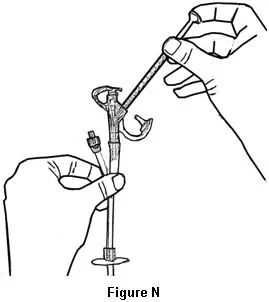 |
| Take your SYNDROS oral solution right away after it is drawn up into the oral syringe. | |
| Step 2: Using a catheter-tip syringe, flush the feeding tube with 1 ounce (30 mL) of water (See Figure O). | 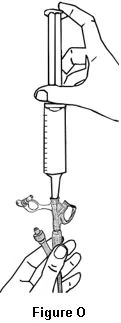 |
| Step 3: Leave the adapter in the bottle. Put the child-resistant cap back on the bottle (See Figure P). | 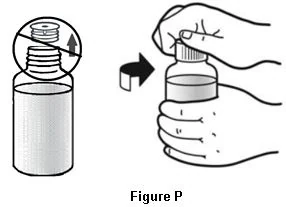 |
Step 4: Remove the plunger from the oral syringe barrel. Rinse the oral syringe barrel and plunger with warm water after each use and let them air dry. When the oral syringe barrel and plunger are dry, put the plunger back into the oral syringe barrel for the next use. Keep SYNDROS oral solution and the oral syringe in the carton that it comes in.
Do not throw away the oral syringe.
How should I store SYNDROS?
- Store SYNDROS in the refrigerator between 36°F and 46°F (2°C and 8°C).
- After the bottle is opened, SYNDROS can be stored at room temperature, between 68°F and 77°F (20°C and 25°C), for up to 42 days.
- Do not use SYNDROS that has been stored in the refrigerator or at room temperature 42 days after opening the bottle. Write the date that you open the bottle of SYNDROS on the bottle and carton it comes in. See “How should I dispose of unused SYNDROS?”
Keep SYNDROS and all medicines out of the reach of children.
How should I dispose of unused SYNDROS?
- Dispose of unused SYNDROS as soon as you no longer need it or 42 days after opening the bottle.
Talk to your doctor or pharmacist if you have questions about how to use SYNDROS oral solution.
For more information, go to www.syndros.com or call 1-844-558-8289.
This Patient Information and Instructions for Use have been approved by the U.S. Food and Drug Administration.
Wellhouse Pharma, LLC
Round Rock, TX 78665
Revised: April 2026