


Patient information: uses, side effects, how to take - Previfem
What is the most important information I should know about Previfem® or Tri-Previfem®?
Do not use Previfem ® or Tri-Previfem ® if you smoke cigarettes and are over 35 years old. Smoking increases your risk of serious cardiovascular side effects from hormonal birth control pills, including death from heart attack, blood clots or stroke. This risk increases with age and the number of cigarettes you smoke.
What is Previfem ® or Tri-Previfem ® ?
Previfem® or Tri-Previfem® is a birth control pill (oral contraceptive) used by women to prevent pregnancy.
Tri-Previfem® is also used to treat moderate acne vulgaris in females 15 years of age and older, who have no known history of allergies or problems taking birth control pills, and have started their menstrual cycle ("period"). Tri-Previfem ® should only be used to treat acne in women who want to take birth control pills to prevent pregnancy.
How does Previfem ® or Tri-Previfem ® work for contraception?
Your chance of getting pregnant depends on how well you follow the directions for taking your birth control pills. The better you follow the directions, the less chance you have of getting pregnant.
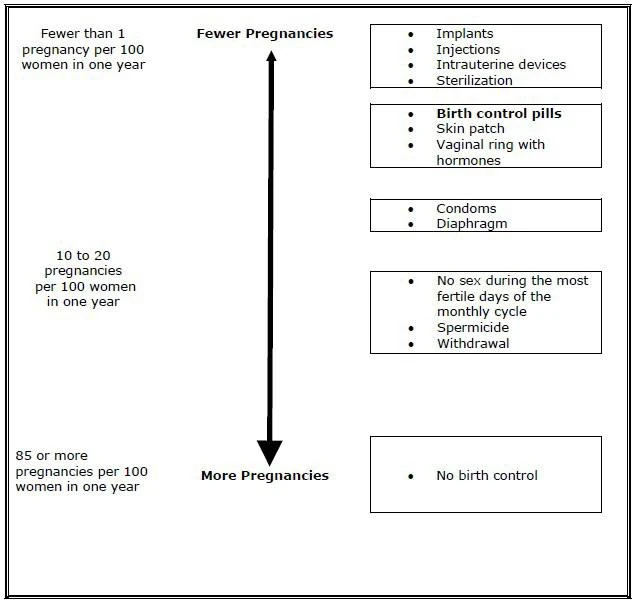
Based on the results of clinical studies, about 1 out of 100 women may get pregnant during the first year they use Previfem® or Tri-Previfem®.
The following chart shows the chance of getting pregnant for women who use different methods of birth control. Each box on the chart contains a list of birth control methods that are similar in effectiveness. The most effective methods are at the top of the chart. The box on the bottom of the chart shows the chance of getting pregnant for women who do not use birth control and are trying to get pregnant.
Who should not take Previfem ® or Tri-Previfem ® ?
Do not take Previfem ® or Tri-Previfem ® if you:
- smoke and are over 35 years of age
- had blood clots in your arms, legs, lungs, or eyes
- had a problem with your blood that makes it clot more than normal
- have certain heart valve problems or irregular heart beat that increases your risk of having blood clots
- had a stroke
- had a heart attack
- have high blood pressure that cannot be controlled by medicine
- have diabetes with kidney, eye, nerve, or blood vessel damage
- have certain kinds of severe migraine headaches with aura, numbness, weakness or changes in vision, or any migraine headaches if you are over 35 years of age
- have liver problems, including liver tumors
- have any unexplained vaginal bleeding
- are pregnant
- had breast cancer or any cancer that is sensitive to female hormones
If any of these conditions happen while you are taking Previfem ® or Tri-Previfem ® , stop taking Previfem ® or Tri-Previfem ® right away and talk to your healthcare provider. Use non-hormonal contraception when you stop taking Previfem ® or Tri-Previfem ® .
What should I tell my healthcare provider before taking Previfem ® or Tri-Previfem ® ?
Tell your healthcare provider if you:
- are pregnant or think you may be pregnant
- are depressed now or have been depressed in the past
- had yellowing of your skin or eyes (jaundice) caused by pregnancy (cholestasis of pregnancy)
- are breastfeeding or plan to breastfeed. Previfem® or Tri-Previfem® may decrease the amount of breast milk you make. A small amount of the hormones in Previfem® or Tri-Previfem® may pass into your breast milk. Talk to your healthcare provider about the best birth control method for you while breastfeeding.
Tell your healthcare provider about all the medicines you take, including prescription and over-the-counter medicines, vitamins and herbal supplements.
Previfem® or Tri-Previfem® may affect the way other medicines work, and other medicines may affect how well Previfem® or Tri-Previfem® works.
Know the medicines you take. Keep a list of them to show your healthcare provider and pharmacist when you get a new medicine.
How should I take Previfem ® or Tri-Previfem ® ? Read the Instructions for Use at the end of this Patient Information.
What are the possible serious side effects of Previfem ® or Tri-Previfem ® ?
- Like pregnancy, Previfem ® or Tri-Previfem ® may cause serious side effects, including blood clots in your lungs, heart attack, or a stroke that may lead to death. Some other examples of serious blood clots include blood clots in the legs or eyes.
Serious blood clots can happen especially if you smoke, are obese, or are older than 35 years of age. Serious blood clots are more likely to happen when you:
- first start taking birth control pills
- restart the same or different birth control pills after not using them for a month or more
Call your healthcare provider or go to a hospital emergency room right away if you have:
- leg pain that will not go away ◦ a sudden, severe headache unlike your usual headaches
- sudden severe shortness of breath ◦ weakness or numbness in your arm or leg
- sudden change in vision or blindness ◦ trouble speaking
- chest pain
Other serious side effects include:
liver problems, including:
- rare liver tumors
- jaundice (cholestasis), especially if you previously had cholestasis of pregnancy. Call your healthcare provider if you have yellowing of your skin or eyes.
- high blood pressure. You should see your healthcare provider for a yearly check of your blood pressure.
- gallbladder problems
- changes in the sugar and fat (cholesterol and triglycerides) levels in your blood
- new or worsening headaches including migraine headaches
- irregular or unusual vaginal bleeding and spotting between your menstrual periods, especially during the first 3 months of taking Previfem ® or Tri-Previfem ® .
- depression
- possible cancer in your breast and cervix
- swelling of your skin especially around your mouth, eyes, and in your throat (angioedema). Call your healthcare provider if you have a swollen face, lips, mouth tongue or throat, which may lead to difficulty swallowing or breathing. Your chance of having angioedema is higher if you have a history of angioedema.
- dark patches of skin around your forehead, nose, cheeks and around your mouth, especially during pregnancy (chloasma). Women who tend to get chloasma should avoid spending a long time in sunlight, tanning booths, and under sun lamps while taking Previfem® or Tri-Previfem®. Use sunscreen if you have to be in the sunlight.
What are the most common side effects of Previfem ® or Tri-Previfem ® ?
- headache (migraine)
- breast pain or tenderness, enlargement or discharge
- stomach pain, discomfort, and gas
- vaginal infections and discharge
- mood changes, including depression
- nervousness
- changes in weight
- skin rash
These are not all the possible side effects of Previfem® or Tri-Previfem®. For more information, ask your healthcare provider or pharmacist.
You may report side effects to the FDA at 1-800-FDA-1088.
What else should I know about taking Previfem ® or Tri-Previfem ® ?
- If you are scheduled for any lab tests, tell your healthcare provider you are taking Previfem® or Tri-Previfem®. Certain blood tests may be affected by PREVIFEM® or Tri-Previfem®.
- Previfem® or Tri-Previfem® does not protect against HIV infection (AIDS) and other sexually transmitted infections.
How should I store Previfem ® or Tri-Previfem ® ?
- Store Previfem® or Tri-Previfem® at room temperature between 68°F to 77°F (20°C to 25°C).
- Keep Previfem® or Tri-Previfem® and all medicines out of the reach of children.
- Store away from light.
General information about the safe and effective use of Previfem ® or Tri-Previfem ® .
Medicines are sometimes prescribed for purposes other than those listed in a Patient Information leaflet. Do not use PREVIFEM® or Tri-Previfem® for a condition for which it was not prescribed. Do not give Previfem® or Tri-Previfem® to other people, even if they have the same symptoms that you have.
This Patient Information summarizes the most important information about Previfem® or Tri-Previfem®. You can ask your pharmacist or healthcare provider for information about Previfem® or Tri-Previfem® that is written for health professionals.
For more information, call Qualitest Pharmaceuticals at 1-800-444-4011.
Do birth control pills cause cancer?
Birth control pills do not seem to cause breast cancer. However, if you have breast cancer now, or have had it in the past, do not use birth control pills because some breast cancers are sensitive to hormones.
Women who use birth control pills may have a slightly higher chance of getting cervical cancer. However, this may be due to other reasons such as having more sexual partners.
What if I want to become pregnant?
You may stop taking the pill whenever you wish. Consider a visit with your healthcare provider for a pre-pregnancy checkup before you stop taking the pill.
What should I know about my period when taking Previfem ® or Tri-Previfem ® ?
Your periods may be lighter and shorter than usual. Some women may miss a period. Irregular vaginal bleeding or spotting may happen while you are taking Previfem® or Tri-Previfem®, especially during the first few months of use. This usually is not a serious problem. It is important to continue taking your pills on a regular schedule to prevent a pregnancy.
What are the ingredients in Previfem ® or Tri-Previfem ® ?
Previfem®
Active ingredients: Each blue tablet contains norgestimate and ethinyl estradiol.
Inactive ingredients:
Blue tablets: FD&C Blue No. 1 HT Aluminum Lake, hypromellose, lactose monohydrate, magnesium stearate, polyethylene glycol and pregelatinized starch.
Light-green tablets: FD&C Blue No. 2, hypromellose, iron oxide yellow, lactose monohydrate, magnesium stearate, polyethylene glycol and pregelatinized starch.
Tri-Previfem®
Active ingredients: Each white, light blue and blue tablet contains norgestimate and ethinyl estradiol.
Inactive ingredients:
White tablets: hypromellose, lactose monohydrate, magnesium stearate, polyethylene glycol, and pregelatinized starch.
Light-blue tablet: FD&C Blue No. 1 Aluminum Lake, hypromellose, lactose monohydrate, magnesium stearate, polyethylene glycol and pregelatinized starch.
Blue tablet: FD&C Blue No. 1 Aluminum Lake, hypromellose, lactose monohydrate, magnesium stearate, polyethylene glycol and pregelatinized starch.
Light-green tablet: FD&C Blue No. 2, hypromellose, iron oxide yellow, lactose monohydrate, magnesium stearate, polyethylene glycol and pregelatinized starch.
Instructions For Use
Previfem®
Tri- Previfem®
(norgestimate and ethinyl estradiol tablets, USP)
(nor-JES-ti-mate, ETH-i-nil es-tra-DYE-ol)
Important Information about taking Previfem ® or Tri-Previfem ®
- Take 1 pill every day at the same time. Take the pills in the order directed on your blister pack pill dispenser.
- Do not skip your pills, even if you do not have sex often. If you miss pills (including starting the pack late) you could get pregnant. The more pills you miss, the more likely you are to get pregnant.
- If you have trouble remembering to take Previfem® or Tri-Previfem®, talk to your healthcare provider. When you first start taking Previfem® or Tri-Previfem®, spotting or light bleeding in between your periods may occur. Contact your healthcare provider if this does not go away after a few months.
- You may feel sick to your stomach (nauseous), especially during the first few months of taking Previfem® or Tri-Previfem®. If you feel sick to your stomach, do not stop taking the pill. The problem will usually go away. If your nausea does not go away, call your healthcare provider.
- Missing pills can also cause spotting or light bleeding, even when you take the missed pills later. On the days you take 2 pills to make up for missed pills (see What should I do if I miss any Previfem ® or Tri-Previfem ® pills? below), you could also feel a little sick to your stomach.
- It is not uncommon to miss a period. However, if you miss a period and have not taken Previfem® or Tri-Previfem® according to directions, or miss 2 periods in a row, or feel like you may be pregnant, call your healthcare provider. If you have a positive pregnancy test, you should stop taking Previfem® or Tri-Previfem®.
- If you have vomiting or diarrhea within 3-4 hours of taking your pill, take another pill of the same color from your extra blister pack pill dispenser. If you do not have an extra blister pack pill dispenser, take the next pill in your blister pack pill dispenser. Continue taking all your remaining pills in order. Start the first pill of your next blister pack pill dispenser the day after finishing your current blister pack pill dispenser. This will be 1 day earlier than originally scheduled. Continue on your new schedule.
- If you have vomiting or diarrhea for more than 1 day, your birth control pills may not work as well. Use an additional birth control method, like condoms and a spermicide, until you check with your healthcare provider.
- Stop taking Previfem® or Tri-Previfem® at least 4 weeks before you have major surgery and do not restart after the surgery without asking your healthcare provider. Be sure to use other forms of contraception (like condoms and spermicide) during this time period.
Before you start taking Previfem ® or Tri-Previfem ® :
- Decide what time of day you want to take your pill. It is important to take it at the same time every day and in the order as directed on your blister pack pill dispenser.
- Have backup contraception (condoms and spermicide) available and if possible, an extra full blister pack of pills as needed.
When should I start taking Previfem ® or Tri-Previfem ® ?
If you start taking Previfem ® or Tri-Previfem ® and you have not used a hormonal birth control method before:
- There are 2 ways to start taking your birth control pills. You can either start on a Sunday (Sunday Start) or on the first day (Day 1) of your natural menstrual period (Day 1 Start). Your healthcare provider should tell you when to start taking your birth control pill.
- If you use the Sunday Start, use non-hormonal back-up contraception such as condoms and spermicide for the first 7 days that you take Previfem® or Tri-Previfem®. You do not need back-up contraception if you use the Day 1 Start.
If you start taking Previfem ® or Tri-Previfem ® and you are switching from another birth control pill:
- Start your new Previfem® or Tri-Previfem® pack on the same day that you would start the next pack of your previous birth control method.
- Do not continue taking the pills from your previous birth control pack.
If you start taking Previfem ® or Tri-Previfem ® and previously used a vaginal ring or transdermal patch:
- Start using Previfem® or Tri-Previfem® on the day you would have reapplied the next ring or patch.
If you start taking Previfem ® or Tri-Previfem ® and you are switching from a progestin-only method such as an implant or injection:
- Start taking Previfem® or Tri-Previfem® on the day of removal of your implant or on the day when you would have had your next injection.
If you start taking Previfem ® or Tri-Previfem ® and you are switching from an intrauterine device or system (IUD or IUS):
- Start taking Previfem® or Tri-Previfem® on the day of removal of your IUD or IUS.
- You do not need back-up contraception if your IUD or IUS is removed on the first day (Day 1) of your period. If your IUD or IUS is removed on any other day, use non-hormonal back-up contraception such as condoms and spermicide for the first 7 days that you take Previfem® or Tri-Previfem®.
Keep a calendar to track your period:
If this is the first time you are taking birth control pills, read, "When should I start taking Previfem ® or Tri-Previfem ® ?" above. Follow these instructions for either a Sunday Start or a Day 1 Start.
Sunday Start:
You will use a Sunday Start if your healthcare provider told you to take your first pill on a Sunday.
- Take pill 1 on the Sunday after your period starts.
- If your period starts on a Sunday, take the first pill that day and refer to Day 1 Start instructions below.
- Take 1 pill every day in the order on the blister pack pill dispenser at the same time each day for 28 days.
- After taking the last pill on Day 28 from the blister pack pill dispenser, start taking the first pill from a new blister pack, on the same day of the week as the first blister pack (Sunday). Take the first pill in the new blister pack whether or not you are having your period.
- Use non-hormonal back-up contraception such as condoms and spermicide for the first 7 days of the first cycle that you take Previfem® or Tri-Previfem®.
Day 1 Start:
You will use a Day 1 Start if your doctor told you to take your first pill (Day 1) on the first day of your period.
- Take 1 pill every day in the order of the blister pack pill dispenser, at the same time each day, for 28 days.
- After taking the last pill on Day 28 from the blister pack pill dispenser, start taking the first pill from a new blister pack, on the same day of the week as the first blister pack. Take the first pill in the new blister pack whether or not you are having your period.
Previfem ® and Tri-Previfem ® come in a blister pack pill dispenser. Read the instructions below for using your blister pack pill dispenser.
Your blister package consists of three parts, the calendar label, the sleeve and the blister pack containing 28 individually sealed pills. Note that the pills are arranged in four numbered rows of 7 pills, with the pre-printed days of the week printed above them. Refer to the sample of the blister pack below:
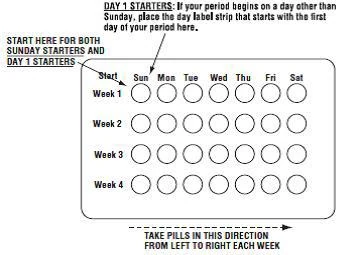
Previfem® consists of 21 blue "active" birth control pills and 7 light green "reminder" pills.
Tri-Previfem® consists of 7 white "active" pills, 7 light-blue "active" pills, 7 blue "active" pills and 7 light green "reminder" pills.
There are two ways to start taking birth-control pills, Sunday Start or Day 1 Start. Your healthcare professional will tell you which to use.
How to use Blister Cards for the 28 tablets
- 1. If Sunday Start, discard the sticker and take the first active pill on the first Sunday after your menstrual period begins. Due to the potential risk of becoming pregnant, use additional non-hormonal contraception (such as condom and spermicide) for the first seven days of your first cycle pack of Previfem® or Tri-Previfem®.
- 2. If Day 1 Start, pick the Days of the Week Sticker that starts the first day of your period. (This is the day you begin bleeding or spotting, even if it is midnight when bleeding begins.)When you have picked the right sticker, throw away the others and place the sticker on the blister card over the preprinted days of the week and make sure it lines up with the pills.
- 3. Remove the first pill by pushing down on the pill. Swallow the pill. You will take 1 pill every day, at the same time each day. Wait 24 hours to take your next pill. Continue to take 1 pill each day until all the pills have been taken.
- 4. It is important to take the correct pill each day and not miss any pills. To help you remember, take your pill at the same time as another daily activity, like turning off your alarm clock or brushing your teeth.
- 5. After taking the last pill, start a new blister pack the very next day, no matter when your next period starts.
- 6. Take the pills in each new package as before. Start with the pill on row #1 and take one pill each day, left to right, until the last pill has been taken.
Three Ways to Remember in What Order to Take the Pills
- 1. Follow the sticker with the days of the week (placed above the pills).
- 2. Always go from left to right.
- 3. Always finish all your pills.
What should I do if I miss any Previfem ® or Tri-Previfem ® pills?
If you miss 1 pill in Weeks 1, 2, or 3, follow these steps:
- Take it as soon as you remember. Take the next pill at your regular time. This means you may take 2 pills in 1 day.
- Then continue taking 1 pill every day until you finish the pack.
- You do not need to use a back-up birth control method if you have sex.
If you miss 2 pills in Week 1 or Week 2 of your pack, follow these steps:
- Take the 2 missed pills as soon as possible and the next 2 pills the next day.
- Then continue to take 1 pill every day until you finish the pack.
- Use a non-hormonal birth control method (such as a condom and spermicide) as a back-up if you have sex during the first 7 days after missing your pills.
If you miss 2 pills in a row in Week 3, or you miss 3 or more pills in a row during Weeks 1, 2, or 3 of the pack, follow these steps:
If you are a Day 1 Starter:
- Throw out the rest of the pill pack and start a new pack that same day.
- You may not have your period this month but this is expected. However, if you miss your period 2 months in a row, call your healthcare provider because you might be pregnant.
- You could become pregnant if you have sex during the first 7 days after you restart your pills. You MUST use a non-hormonal birth control method (such as a condom and spermicide) as a back-up if you have sex during the first 7 days after you restart your pills.
If you are a Sunday Starter:
- Keep taking 1 pill every day until Sunday. On Sunday, throw out the rest of the pack and start a new pack of pills that same day.
- Use a non-hormonal birth control method (such as a condom and spermicide) as a back-up if you have sex during the first 7 days after you restart your pills.
If you have any questions or are unsure about the information in this leaflet, call your healthcare provider.
This Patient Information and Instructions for Use has been approved by the U.S. Food and Drug Administration.
All brand names listed are registered trademarks of their respective owners and are not trademarks of Qualitest Pharmaceuticals.
Manufactured In Canada By:
Patheon Inc.
Ontario, Canada L5N 7K9
Manufactured For:
QUALITEST PHARMACEUTICALS USA
Huntsville, AL 35811
Revised 7/2015