Patient information: uses, side effects, how to take - Pliaglis
Instructions for Use
Pliaglis® [Ply-uh-gliss]
(lidocaine and tetracaine) Cream
Read and follow this Instructions for Use before applying PLIAGLIS Cream.
PLIAGLIS Cream is a prescription medicine used on adults to numb your skin to reduce the pain associated with medical procedures on the skin. After PLIAGLIS Cream is applied to your skin, it will form a film (or mask) that is removed before your procedure.
Important Information:
Keep PLIAGLIS Cream out of the reach of children and away from pets.
- Do not apply PLIAGLIS Cream to skin that is broken, cut, scratched, irritated (red) or has a rash.
- Do not apply PLIAGLIS to a procedure site after the procedure has been performed.
- Do not use more PLIAGLIS Cream than prescribed.
- Do not leave PLIAGLIS Cream on your skin for longer than 120 minutes (2 hours).
- Avoid getting PLIAGLIS Cream in your eyes or on your lips. If contact occurs, rinse immediately with water and if irritation occurs, seek medical advice.
- Always wash your hands after handling PLIAGLIS Cream.
- Do not cover PLIAGLIS Cream with waterproof (occlusive) dressing or overdosage may occur.
- Store PLIAGLIS Cream in the refrigerator. PLIAGLIS Cream may be stored at room temperature for up to 3 months
Step 1: Check the skin where the cream will be applied.
Check the skin area to be treated to make sure the skin is intact.
Read and follow Important Information notices in grey box above.
Step 2: Estimate the amount of PLIAGLIS Cream to apply.
Apply PLIAGLIS Cream exactly as your healthcare provider tells you to. Your healthcare provider will tell you the area to be treated, when to apply the cream, and how long to leave it on your skin.
Estimate the area of the skin to be treated and the amount of PLIAGLIS Cream to apply using the table below and the ruler on the applicator included in the carton. Break the cream length into smaller segments that fit inside the treatment area.
| Approximate size of area to be treated | Length of cream (inches) based on 30-gram tube |
| 1 inch × 1 inch | ¾ inch |
| 2 inches × 2 inches | 3 inches |
| 2 inches × 3 inches (size of a credit card) | 5 inches |
| 3 inches × 5 inches (size of a 3 inch × 5 inch photo) | 12 inches (½ tube) |
| 4 inches × 6 inches (size of a 4 inch × 6 inch postcard) | 18 inches (⅔ tube) |
| Half of your face | 1 tube |
| 6 inches × 8 inches (size of two 4 inch × 6 inch postcards) | 1½ tubes |
| Full face | 2 tubes |
Step 3: Open the tube and apply PLIAGLIS Cream to your skin.
Open the tube by pushing down the cap while turning counter-clockwise.
Using the table above and the ruler on the applicator included in the carton as a guide, squeeze out the amount of PLIAGLIS Cream needed for your prescribed dose directly onto your treatment area.
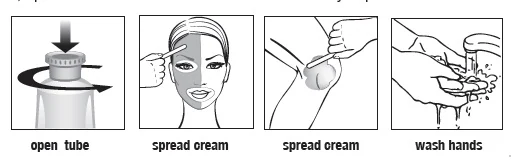
| open tube spread cream spread cream wash hands |
Step 4: Leave PLIAGLIS Cream on your skin for the recommended time.
- Your healthcare provider will tell you how long to leave PLIAGLIS Cream on your skin. Ask your healthcare provider if you are not sure how long to leave PLIAGLIS Cream on your skin.
- If skin irritation or a burning sensation happens after applying PLIAGLIS Cream, remove the PLIAGLIS Cream right away. Wash the cream off with soap and water. Tell your healthcare provider if your skin irritation does not go away.
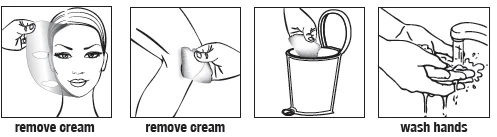
Step 5: Remove and throw away (discard) the dried PLIAGLIS Cream.
| remove cream remove cream discard cream wash hands |
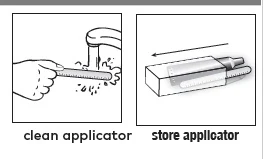
Step 6: Clean and Store Applicator
| clean applicator store applicator |
| This Instructions for Use has been approved by the U.S. Food and Drug Administration | Revised: August 2020 |