


Patient information: uses, side effects, how to take - Pheburane
What is PHEBURANE?
- PHEBURANE is a prescription medicine, used along with a specific diet, for the long-term management of adults and children with urea cycle disorders (UCDs), involving deficiencies of carbamylphosphate synthetase (CPS), ornithine transcarbamylase (OTC) or argininosuccinate synthetase (AS).
- Episodes of sudden, rapid increase of ammonia in the blood (acute hyperammonemia) may happen in people during treatment with PHEBURANE. PHEBURANE is not used for the treatment of acute hyperammonemia, which can be life-threatening and requires emergency medical treatment.
Before taking PHEBURANE, tell your or your child’s healthcare provider about all of your medical conditions, including if you:
- have heart problems.
- have kidney or liver problems.
- have diabetes (PHEBURANE contains sucrose), or have a history of fructose intolerance, glucose-galactose malabsorption, or sucrase-isomaltase insufficiency.
are pregnant or plan to become pregnant. It is not known if PHEBURANE will harm your unborn baby.
- are breastfeeding or plan to breastfeed. It is not known if PHEBURANE passes into your breastmilk. Talk to your healthcare provider about the best way to feed your baby during treatment with PHEBURANE.
Tell your healthcare provider about all the medicines you or your child take, including prescription and over-the-counter medicines, vitamins, and herbal supplements.
Certain medicines may increase the level of ammonia in your blood or cause serious side effects when taken during treatment with PHEBURANE. Especially tell your healthcare provider if you or your child take:
- corticosteroids
- valproic acid
- haloperidol
- probenecid
Know the medicines you take. Keep a list of them to show your or your child’s healthcare provider and pharmacist when you get a new medicine.
How should I take PHEBURANE?
Read the detailed Instructions for Use that comes with PHEBURANE for information about the right way to prepare and take a dose of PHEBURANE.
- Take PHEBURANE exactly as prescribed by your healthcare provider.
- Your healthcare provider may change your dose if needed. Do not change your dose unless your healthcare provider tells you to.
- Your healthcare provider will prescribe PHEBURANE based on your or your child’s weight.
- Schedule your PHEBURANE dose at the same time you eat a meal or snack.
- Use the calibrated dosing spoon to measure PHEBURANE oral pellets.
- PHEBURANE oral pellets should be taken with a drink such as water, fruit juices or protein-free infant formulas, or soft food, such as apple sauce or carrot puree. It is not recommended to use other foods to take your dose of PHEBURANE oral pellets.
- Do not chew PHEBURANE oral pellets directly or mix PHEBURANE oral pellets into liquids.
- If you miss a dose of PHEBURANE, take it as soon as possible. Each dose of PHEBURANE should be taken at least 3 hours apart. If you have missed a dose within 3 hours of the next dose, take only one dose the next time it is scheduled.
- Do not give or take PHEBURANE through a gastrotomy or nasogastric tube.
- If you take too much PHEBURANE, call your healthcare provider or Poison Help line at 1-800-222-1222, or go to the nearest hospital emergency room right away.
What are the possible side effects of PHEBURANE?
PHEBURANE can cause serious side effects, including:
Nervous system problems (neurotoxicity). Call your healthcare provider right away if you get any of the following symptoms during treatment with PHEBURANE:
- sleepiness
- tiredness
- lightheadedness
- vomiting
- nausea
- headache
- confusion
Low potassium levels in your blood (hypokalemia). Your healthcare provider will monitor your blood potassium levels during treatment with PHEBURANE and treat if needed.
Conditions related to swelling (edema). PHEBURANE contains salt (sodium), which can cause swelling from salt and water retention. Your healthcare provider will decide if PHEBURANE is right for you if you have certain medical conditions that can cause swelling, such as heart failure, liver problems or kidney problems.
The most common side effects of PHEBURANE include:
- absent or irregular menstrual periods
- decreased appetite
- body odor
- bad taste or avoiding foods that you ate prior to getting sick (taste aversion)
Your healthcare provider may do certain blood tests to check you or your child for side effects during treatment with PHEBURANE.
These are not all of the possible side effects of PHEBURANE.
Call your doctor for medical advice about side effects. You may report side effects to FDA at 1-800-FDA-1088.
How should I store PHEBURANE?
- Store PHEBURANE at room temperature between 68°F and 77°F (20°C and 25°C).
- PHEBURANE comes in a child-resistant bottle. The bottle cap contains a desiccant to help keep PHEBURANE dry.
- Throw away (discard) any remaining PHEBURANE 45 days after first opening of the bottle.
Keep PHEBURANE and all medicines out of the reach of children.
General information about the safe and effective use of PHEBURANE.
Medicines are sometimes prescribed for purposes other than those listed in a Patient Information leaflet. Do not use PHEBURANE for a condition for which it was not prescribed. Do not give PHEBURANE to other people, even if they have the same symptoms that you have. It may harm them. You can ask your healthcare provider or pharmacist for information about PHEBURANE that is written for health professionals.
What are the ingredients in PHEBURANE?
Active ingredient: sodium phenylbutyrate
Inactive Ingredients: ethylcellulose, hypromellose, polyethylene glycol 1500, povidone K25, and sugar spheres.
Distributed by: Medunik USA, Inc., 2 Research Way, Suite 1B, Princeton, NJ 08540
For more information, go to www.medunikusa.com
| This Patient Information has been approved by the U.S. Food and Drug Administration. | Issued: August 2023 |
INSTRUCTIONS FOR USE PHEBURANE ®(FE bue rayne) (sodium phenylbutyrate) oral pellets |
Read this Instructions for Use before taking PHEBURANE oral pellets and each time you get a refill. There may be new information. This Instructions for Use does not take the place of talking to your healthcare provider about your medical condition or treatment. Talk to your healthcare provider or pharmacist if you have any questions about how to take a dose of PHEBURANE.
This Instructions for Use contains information on how to measure and take PHEBURANE.
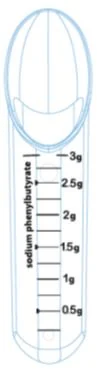 |
Figure A: Calibrated dosing spoon provided with PHEBURANE |
Important information you need to know before taking PHEBURANE
- The total daily dose of PHEBURANE must be given in divided doses and taken with food (meal or snack). Your healthcare provider will tell you when to take PHEBURANE and the dose to take.
- Schedule PHEBURANE doses at the same time as eating a meal or snack.
- Only use the calibrated dosing spoon provided with PHEBURANE to measure the dose (See Figure A).
Supplies needed for measuring and taking PHEBURANE
- Bottle of PHEBURANE oral pellets.
- Calibrated dosing spoon provided with PHEBURANE.
- A drink such as water, fruit juices or protein-free infant formulas, or soft food, such as apple sauce or carrot puree. It is not recommended to use other foods to take your dose of PHEBURANE oral pellets.
Measuring PHEBURANE
Repeat Steps 1 through 3 throughout the day as prescribed by your healthcare provider to get the total daily dose.
Step 1
- Use the calibrated dosing spoon to measure the prescribed divided dose of PHEBURANE oral pellets (See Figure A).
The calibrated dosing spoon measures PHEBURANE oral pellets as grams (g) of sodium phenylbutyrate. The calibrated dosing spoon dispenses up to 3 g of sodium phenylbutyrate, in increments of 0.25 g.
- Pour the oral pellets directly into the calibrated dosing spoon until it reaches the black line for the prescribed dose of sodium phenylbutyrate in grams (See Figure B).
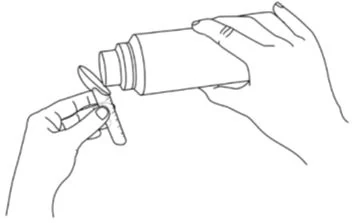 |
Figure B: Pour the PHEBURANE oral pellets directly into the calibrated dosing spoon. |
Taking PHEBURANE
Step 2
- Tap the bottom of the calibrated dosing spoon 1 time on a hard surface to give a flat level of oral pellets and continue filling until you reach the prescribed dose.
Step 3
- Swallow PHEBURANE oral pellets with a drink such as water, fruit juices, or protein-free infant formulas.
or
- Sprinkle PHEBURANE oral pellets onto a spoonful of apple sauce or carrot puree and swallow right away. It is important to swallow right away to prevent coating from dissolving.
Do not chew PHEBURANE oral pellets directly or mix PHEBURANE oral pellets into liquids.
If the prescribed divided dose is more than 3 grams, repeat Steps 1 through 3 to get the prescribed divided dose of sodium phenylbutyrate.
Storing PHEBURANE
- Store PHEBURANE at room temperature between 68°F and 77°F (20°C and 25°C).
- PHEBURANE comes in a child-resistant bottle. The bottle cap contains a desiccant to help keep PHEBURANE dry.
- Throw away (discard) any remaining PHEBURANE 45 days after first opening of the bottle.
- Keep PHEBURANE and all medicines out of the reach of children.
Disposing of PHEBURANE
Throw away (dispose of) the bottle of PHEBURANE 45 days after first opening by dropping off the medicine at a drug take back site or following the steps below.
- Mix medicine with an unappealing substance such as dirt, cat litter, or used coffee grounds
- Place the mixture in a container such as a sealed plastic bag
- Throw away the container in your trash at home, and
- Delete all personal information on the prescription label of the empty medicine bottle, then throw away or recycle the empty bottle.
- Throw away (dispose of) used calibrated dosing spoon in the household trash.
- Do not use the calibrated dosing spoon to measure any other medicine.
If cleaning is necessary, rinse the calibrated dosing spoon with water and dry it completely.
To replace the calibrated dosing spoon, contact Medunik USA at 1-844-884-5520.
Distributed by: Medunik USA, Inc. 2 Research Way, Suite 1B, Princeton, NJ 08540

PHEBURANE® is a registered trademark of Lucane Pharma.
| This Instructions for Use has been approved by the U.S. Food and Drug Administration. | Issued: August 2023 |