


Patient information: uses, side effects, how to take - Gattex
What is the most important information I should know about GATTEX?
GATTEX may cause serious side effects, including:
Making abnormal cells grow faster.
- GATTEX can make abnormal cells that are already in your body grow faster. There is an increased risk that abnormal cells could become cancer. If you get cancer of the bowel (intestines), liver, gallbladder, or pancreas while using GATTEX, your healthcare provider should stop GATTEX.
- If you get other types of cancers, you and your healthcare provider should discuss the risks and benefits of using GATTEX.
- Polyps in the intestines. Polyps are growths on the inside of the intestines.
Before you start using GATTEX, your healthcare provider will:
For Adult Patients
- Have your colon and upper intestines checked for polyps within 6 months before starting GATTEX.
- Have any polyps removed.
For Pediatric Patients
- Check for blood in the stool within 6 months before starting GATTEX.
- If there is blood found in the stool, have your colon and upper intestines checked for polyps.
- Have any polyps removed.
To keep using GATTEX, your healthcare provider should:
For Adult Patients
- Have your colon and upper intestines checked for new polyps at the end of 1 year of using GATTEX. If no polyp is found, your healthcare provider should check you for polyps as needed and at least every 5 years.
- Have any new polyps removed.
For Pediatric Patients
- Check for blood in the stool every year while using GATTEX.
- If there is blood found in the stool, have your colon and upper intestines checked for polyps.
- Have your colon checked for new polyps at the end of 1 year of using GATTEX. If no polyp is found, your healthcare provider should check you for polyps as needed and at least every 5 years.
- Have any new polyps removed.
If cancer is found in a polyp, your healthcare provider should stop GATTEX.
Blockage of the bowel (intestines).
A bowel blockage keeps food, fluids, and gas from moving through the bowels in the normal way. Tell your healthcare provider right away if you have any of these symptoms of a bowel or stomal blockage:
- trouble having a bowel movement or passing gas
- stomach area (abdomen) pain or swelling
- nausea
- vomiting
- swelling and blockage of your stoma opening, if you have a stoma
If a blockage is found, your healthcare provider may temporarily stop GATTEX.
Swelling (inflammation) or blockage of your gallbladder or pancreas.
Your healthcare provider will do tests to check your gallbladder and pancreas within 6 months before starting GATTEX and at least every 6 months while you are using GATTEX.
Tell your healthcare provider right away if you get:
- stomach area (abdomen) pain and tenderness
- chills
- fever
- a change in your stools
- nausea
- vomiting
- dark urine
- yellowing of your skin or the whites of eyes
These are not all the side effects of GATTEX. For more information, see "What are the possible side effects of GATTEX?"
What is GATTEX?
- GATTEX is a prescription medicine used in adults and children 1 year of age and older with Short Bowel Syndrome (SBS) who need additional nutrition or fluids from intravenous (IV) feeding (parenteral support).
It is not known if GATTEX is safe and effective in children under 1 year of age.
What should I tell my healthcare provider before using GATTEX?
Before using GATTEX, tell your healthcare provider about all your medical conditions, including if you or your child:
- have cancer or a history of cancer.
- have or had polyps anywhere in your bowel (intestines) or rectum.
- have heart problems.
- have high blood pressure.
- have problems with your gallbladder, pancreas, or kidneys.
are pregnant or plan to become pregnant. It is not known if GATTEX will harm your unborn baby. Tell your healthcare provider right away if you become pregnant while using GATTEX.
- are breastfeeding or plan to breastfeed. It is not known if GATTEX passes into your breast milk. Talk to your healthcare provider about the best way to feed your baby while using GATTEX. Breastfeeding is not recommended during treatment with GATTEX.
Tell your healthcare providers about all the medicines you take, including prescription and over-the-counter medicines, vitamins, and herbal supplements. Using GATTEX with certain other medicines may affect each other causing side effects. Your other healthcare providers may need to change the dose of any oral medicines (medicines taken by mouth) you take while using GATTEX. Tell the healthcare provider who gives you GATTEX if you will be taking a new oral medicine.
Know the medicines you take. Keep a list of them to show your healthcare provider and pharmacist when you get a new medicine.
How should I use GATTEX?
- Use GATTEX exactly as your healthcare provider tells you to.
- Your healthcare provider or nurse should show you how to prepare, measure your dose, and give your injection of GATTEX. Self-administration is not recommended in pediatric patients.
- GATTEX comes as a 5 mg kit. Use of the GATTEX 5 mg kit is not recommended in pediatric patients weighing less than 22 pounds (10 kg).
- GATTEX is given 1 time each day at the same time.
- Inject your dose of GATTEX under the skin (subcutaneous injection) in your stomach area (abdomen), upper legs (thighs), or upper arms. Do not inject GATTEX into a vein or muscle.
- Use a different injection site each time you use GATTEX.
- GATTEX comes as a powder for injection in a vial that is used only 1 time (single dose vial). The powder must be mixed with Sterile Water for Injection (a diluent) provided in a prefilled syringe before you inject it.
- GATTEX must be injected within 3 hours after you mix it with the diluent.
- If you miss a dose, take it as soon as you remember that day. Take your next dose the next day at the same time you take it every day.
- Do not take 2 doses on the same day.
- If you use more than 1 dose, call your healthcare provider right away.
- Do not stop taking GATTEX without consulting your healthcare provider.
- Read the Instructions for Use for detailed instructions for preparing and injecting a dose of GATTEX.
What are the possible side effects of GATTEX?
GATTEX may cause serious side effects, including:
- See "What is the most important information I should know about GATTEX?"
- Fluid overload. Your healthcare provider will check you for too much fluid in your body. Too much fluid in your body may lead to heart failure, especially if you have heart problems. Tell your healthcare provider right away if you get swelling in your feet and ankles, you gain weight very quickly (water weight), or you have trouble breathing.
The most common side effects of GATTEX in adults include:
- stomach area (abdomen) pain or swelling
- nausea
- cold or flu symptoms
- skin reaction where the injection was given (such as redness, pain, swelling, itching, or hives)
- vomiting
- swelling of the hands or feet
- allergic reactions
The side effects of GATTEX in pediatric patients are similar to those seen in adults.
Tell your healthcare provider if you have any side effect that bothers you or that does not go away.
These are not all of the possible side effects of GATTEX.
Call your doctor for medical advice about side effects. You may report side effects to FDA at 1-800-FDA-1088.
How should I store GATTEX?
- Store GATTEX powder at room temperature up to 77°F (25°C).
- Do not freeze GATTEX.
- Use the GATTEX powder by the expiration date on the "Use By" sticker on the kit.
- Use GATTEX within 3 hours after mixing it.
- Throw away any unused GATTEX that has been mixed, even if there is medicine left in the vial.
- Do not store any GATTEX you have mixed.
Keep GATTEX and all medicines out of the reach of children.
General information about the safe and effective use of GATTEX.
Medicines are sometimes prescribed for purposes other than those listed in a Medication Guide. Do not use GATTEX for a condition for which it was not prescribed. Do not give GATTEX to other people, even if they have the same symptoms that you have. It may harm them.
If you would like more information about GATTEX talk with your healthcare provider. You can ask your healthcare provider or pharmacist for information about GATTEX that is written for health professionals.
What are the ingredients in GATTEX?
Active ingredient: teduglutide
Inactive ingredients: dibasic sodium phosphate heptahydrate, L-histidine, mannitol, and monobasic sodium phosphate monohydrate. Sterile Water for Injection is provided as a diluent.
Distributed by:
Takeda Pharmaceuticals America, Inc.
Cambridge, MA 02142
GATTEX and  are registered trademarks of Takeda Pharmaceuticals U.S.A., Inc.
©2025 Takeda Pharmaceutical Company Limited. All rights reserved.
Patented: see www.takeda.com/en-us/patents.
Instructions for Use
GATTEX®(Ga'-tex)
(teduglutide)
for injection, for subcutaneous use
5 mg per vial
This Instructions for Use contains information on how to inject GATTEX.
Read this Instructions for Use before you start using GATTEX and each time you get a refill. There may be new information. Your healthcare provider or nurse should show you how to prepare, measure your dose, and give your injection of GATTEX the right way.
If you cannot give yourself the injection:
- ask your healthcare provider or nurse to help you, or
- ask someone who has been trained by a healthcare provider or nurse to give your injections.
Self-administration is not recommended in pediatric patients. In pediatric patients, GATTEX should be injected by:
- a healthcare provider or nurse, or
- a parent or adult caregiver who has been trained by a healthcare provider or nurse to give injections of GATTEX to pediatric patients.
Important information:
- Use of the GATTEX 5 mg kit is not recommended in pediatric patients weighing less than 22 pounds (10 kg).
- Before you start, check the "Use By" date on your GATTEX kit. Make sure that the "Use By" date has not passed. Do not use anything in the GATTEX kit after the "Use By" date on the kit.
- Give GATTEX within 3 hours after you mix the powder with the Diluent (Sterile Water for Injection).
- Use the syringes and needles provided in the GATTEX kit.
- Do not use a GATTEX vial more than 1 time, even if there is medicine left in the vial.
- Throw away (dispose of) any unused GATTEX after you give your injection.
- Safely throw away GATTEX vials after use.
- Do not re-use syringes or needles. See "Step 7: Dispose of syringes and needles" for information about how to safely throw away needles and syringes.
- To help avoid needle-stick injuries, do not recap needles.
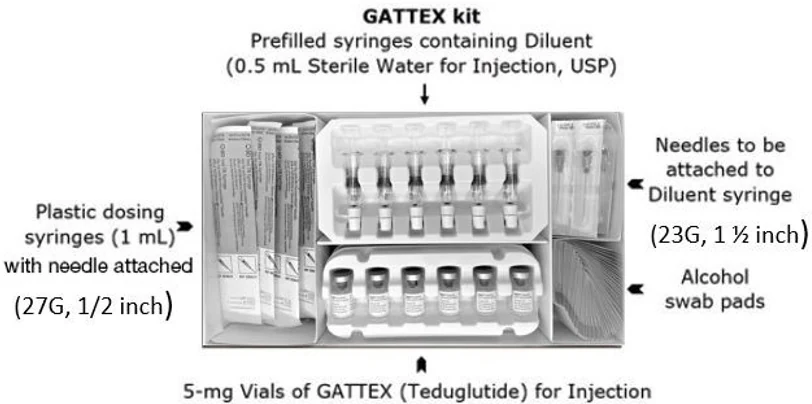
Gather the supplies you will need to prepare GATTEX and to give your injection (See Figure A).
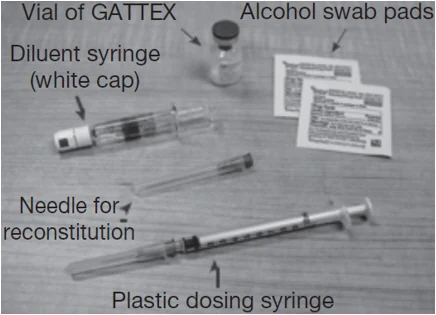 Figure A | From your GATTEX kit you will need:
You may also need an adhesive bandage (not included in your GATTEX kit). |
Step 1: Prepare the injection.
- Choose a well-lit, clean, flat work surface.
- Wash your hands with soap and water.
Step 2: Preparing the Diluent syringe.
- Put the Diluent syringe (See Figure B1) and the 23G, 1½ inch needle in front of you on your work surface.
| Figure B1 | 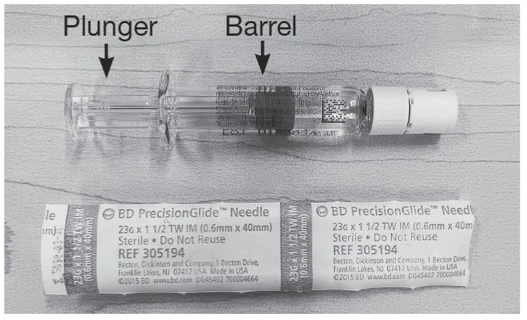 |
- Hold the Diluent syringe by the barrel. Snap off the white cap (bend the cap sideways until the cap comes off). Only the top portion of the white cap should be snapped off. The lower portion of the cap will remain in place (See Figure B2). Throw the cap away.
| Figure B2 | 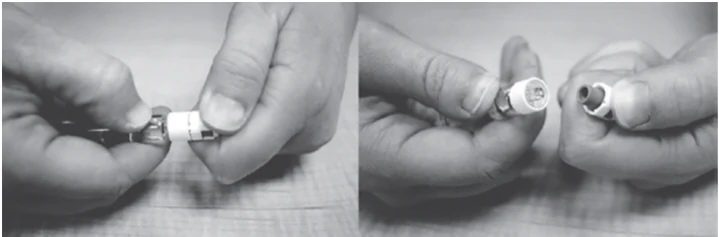 |
- Remove the 23G, 1½ inch needle from the package. Use the fold in the package to peel back the plastic cover (See Figure C). Leave the plastic cap on the needle.
| Figure C | 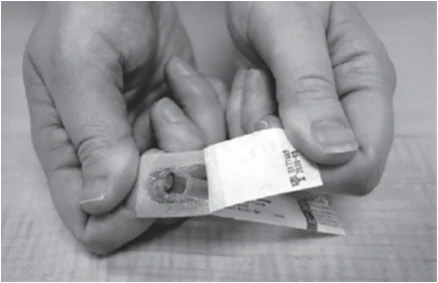 |
Push the open end of the needle onto the end of the Diluent syringe (See Figure D).
Twist the needle clockwise (to the right) until it stops turning.
| Figure D | 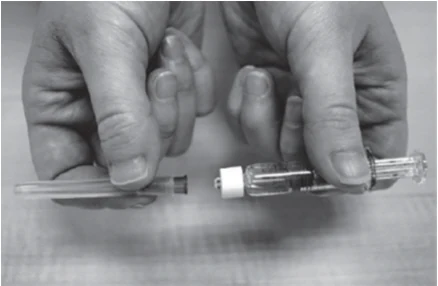 |
- When the needle is tightly in place, put the Diluent syringe and needle on your work surface.
Step 3: Mix GATTEX powder with Diluent.
- Remove the green cap from the GATTEX vial. Throw away the green cap.
- Find the gray rubber seal on top of the GATTEX vial (See Figure E).
| Figure E | 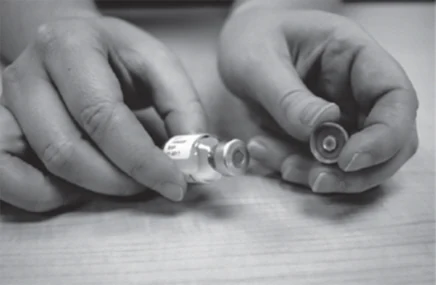 |
- Use an alcohol swab pad to clean the gray rubber seal (See Figure F).
- Do not touch the gray rubber seal after you clean it.
| Figure F | 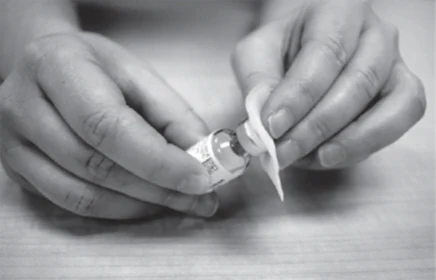 |
- Pick up the Diluent syringe with the needle attached.
- Remove the plastic cap that covers the needle (See Figure G). Throw the cap away.
| Figure G | 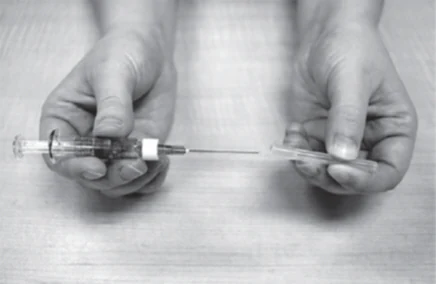 |
- Hold the GATTEX vial between your thumb and index (pointer) finger (See Figure H). Be careful not to touch the gray rubber seal.
- Push the needle down through the center of the gray rubber seal.
- Slowly push down on the plunger of the Diluent syringe. Empty all the Diluent into the GATTEX vial.
- Leave the needle and Diluent syringe in place.
| Figure H | 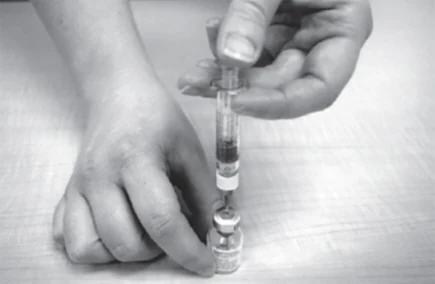 |
- Gently tap the barrel of the Diluent syringe with a finger (See Figure I).
- Make sure all the Diluent has gone into the GATTEX vial.
| Figure I | 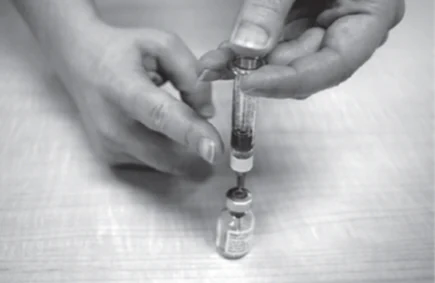 |
- Remove the Diluent syringe and needle from the GATTEX vial. Let the vial sit for about 30 seconds.
- Do not put the needle cap back on the needle.
- Throw away (dispose of) the Diluent syringe and needle in your sharps disposal container.
- After 30 seconds, place the GATTEX vial between the palms of your hands. Gently roll the vial for about 15 seconds (See Figure J).
- Do not shake the GATTEX vial.
- Do not touch the gray rubber seal. If you do, clean it again with a new alcohol pad.
- Let the GATTEX vial stand on your work surface for about 2 minutes.
| Figure J | 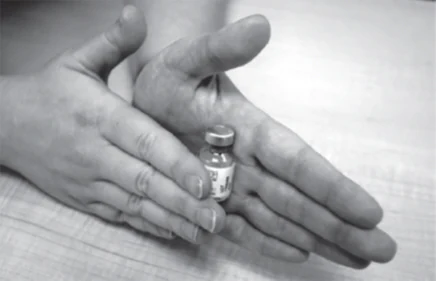 |
Step 4: Check the mixed GATTEX.
- After 2 minutes, look at the vial of GATTEX. The liquid in the vial should be clear and colorless to pale yellow, and should not have any particles in it.
- If there is any powder in the GATTEX vial that did not dissolve, gently roll the vial between your hands for 15 seconds more.
- Do not shake the GATTEX vial.
- Check the GATTEX vial again for anything that did not dissolve.
- Do not use the GATTEX vial if there is anything in it that did not dissolve. Start from the beginning of this Instructions for Use to prepare a new vial. Use a new GATTEX vial, new Diluent syringe, and a new needle.
Step 5: Draw up your dose of GATTEX.
- Remove the plastic dosing syringe from the package. Use the fold in the package to peel back the plastic cover (See Figure K).
| Figure K | 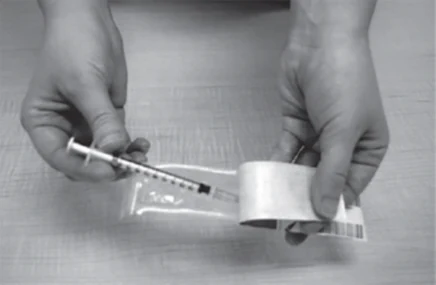 |
- Remove the needle cap from the plastic dosing syringe (See Figure L ).
- Throw the needle cap away. Do not touch the needle or allow it to touch anything.
| Figure L | 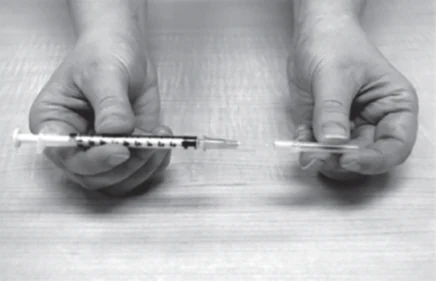 |
- Carefully pull back on the plunger to the line that matches the dose prescribed by your healthcare provider.
- Use 1 hand to hold the GATTEX vial steady. Use your other hand to insert the needle straight down into the middle of the gray rubber seal on the GATTEX vial (See Figure M). You may feel some resistance as the needle passes through the rubber seal.
- Gently push down the plunger until all of the air has gone from the plastic dosing syringe into the GATTEX vial.
- Turn the GATTEX vial and plastic dosing syringe upside down (See Figure N).
| Figure M | 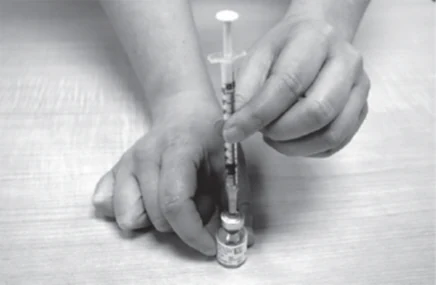 |
| Figure N | 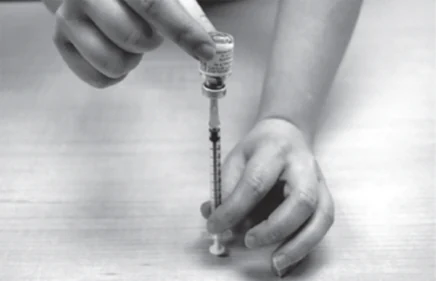 |
- Hold the GATTEX vial with 1 hand.
- Slowly pull back the plunger of the plastic dosing syringe with your other hand.
- Fill the plastic dosing syringe until the black tip of the plunger lines up with the mark that matches your prescribed dose (See Figure O).
- Keep the plastic dosing syringe and needle in the GATTEX vial.
| Figure O | 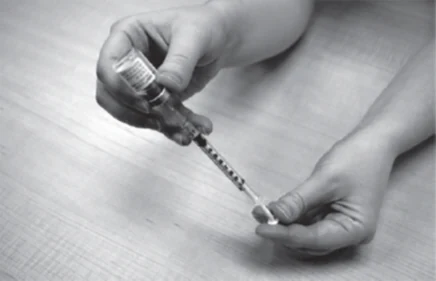 |
- You may see some bubbles inside the GATTEX vial when the plastic dosing syringe is filled. This is normal. With the needle still in the vial, gently tap the side of the plastic dosing syringe with a finger to make any air bubbles rise to the top (See Figure P).
| Figure P | 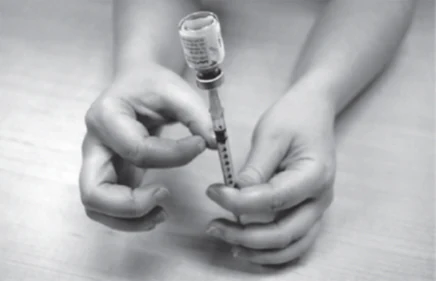 |
- Slowly push the plunger up until all air bubbles are out of the plastic dosing syringe. Make sure the tip of the needle is in the fluid. Slowly pull back the plunger to draw up the right dose of GATTEX into the plastic dosing syringe.
- Remove the plastic dosing syringe and needle from the GATTEX vial (See Figure Q). Do not touch the needle or allow it to touch anything.
| Figure Q | 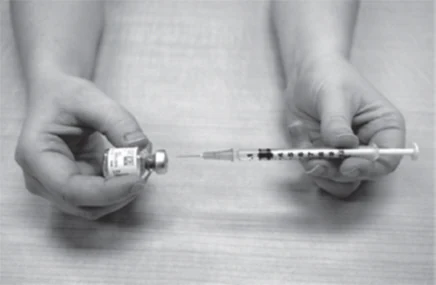 |
Step 6: Inject GATTEX.
- Choose an injection site on the stomach area (abdomen), thighs, or upper arms.
- Choose a different site to give the injection each day. Do not inject into areas where the skin is tender, bruised, red, or hard. (See Figure R and Figure S)
| Figure R | 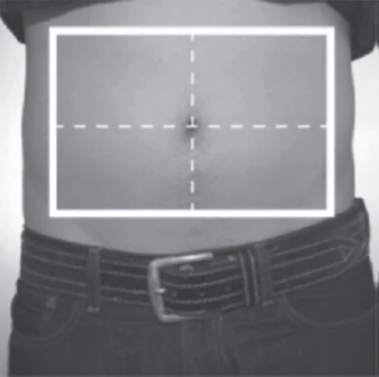 |
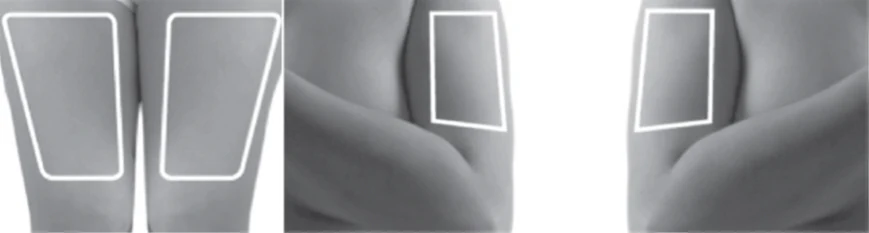 Figure S | |
- Clean the skin where you plan to give the injection with a new alcohol swab pad. Do not touch this area again before giving the injection.
- Use 1 hand to gently pinch up a fold of skin around the injection site (See Figure T).
| Figure T | 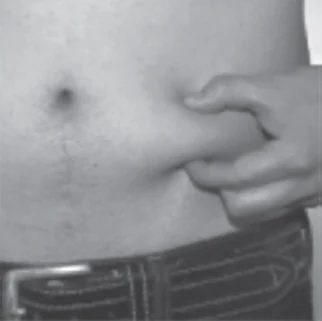 |
- Use your other hand to hold the plastic dosing syringe. Insert the full length of the needle into the skin at a 45-degree angle with a quick, "dart-like" motion (See Figure U).
| Figure U | 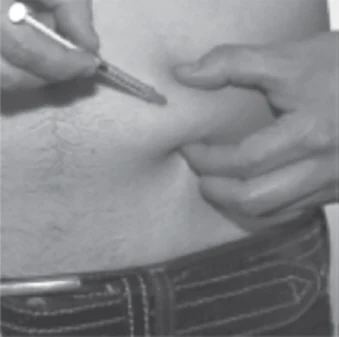 |
- Let go of the skin. Hold the syringe barrel with 1 hand while you slowly push down the plunger until the plastic dosing syringe is empty (See Figure V).
| Figure V | 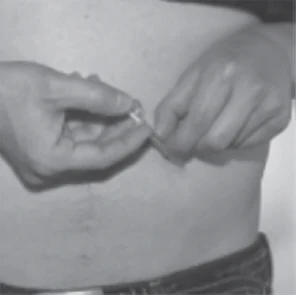 |
- When the plastic dosing syringe is empty, quickly pull the needle out of your skin. There may be a little bleeding at the injection site. Apply an adhesive bandage to the injection site if needed.
Step 7: Dispose of syringes and needles.
- Do not re-use a syringe or needle.
- To help avoid needle-stick injuries, do not recap a needle.
- Put your needles and syringes in an FDA-cleared sharps disposal container right away after use. Do not throw away (dispose of) loose needles and syringes in your household trash.
If you do not have an FDA-cleared sharps disposal container, you may use a household container that is:
- made of heavy-duty plastic,
- can be closed with a tight-fitting, puncture-resistant lid, without sharp items being able to come out,
- upright and stable during use,
- leak-resistant, and
- properly labeled to warn of hazardous waste inside the container.
When your sharps disposal container is almost full, you will need to follow your community guidelines for the right way to dispose of your sharps disposal container.
There may be local or state laws about how to throw away syringes and needles. For more information about safe sharps disposal, and for specific information about sharps disposal in the state that you live in, go to the FDA's website at: http://www.fda.gov/safesharpsdisposal.
- Do not dispose of your sharps disposal container in your household trash unless your community guidelines permit this. Do not recycle your sharps disposal container.
- Throw away the GATTEX vial into the container where you put the syringes and needles.
- If you have any questions, talk to your healthcare provider or pharmacist.
How should I store GATTEX?
- Store GATTEX powder at room temperature up to 77°F (25°C).
- Do not freeze GATTEX.
- Use the GATTEX powder by the expiration date on the "Use By" sticker on the kit.
- Use GATTEX within 3 hours after mixing it.
- Throw away any unused GATTEX that has been mixed, even if there is medicine left in the vial.
- Do not store any GATTEX you have mixed.
Keep GATTEX and all medicines out of the reach of children.
Distributed by:
Takeda Pharmaceuticals America, Inc.
Cambridge, MA 02142
USA
1-877-825-3327
GATTEX and are registered trademarks of Takeda Pharmaceuticals U.S.A., Inc.
©2025 Takeda Pharmaceutical Company Limited. All rights reserved.
This Instructions for Use has been approved by the U.S. Food and Drug Administration.
Revised: 09/2025