


Patient information: uses, side effects, how to take - Ojemda
What is OJEMDA?
OJEMDA is a prescription medicine used to treat certain types of brain tumors (cancers) called gliomas in people 6 months and older:
- that is a pediatric low-grade glioma (LGG), and
- that has come back after previous treatment or has not responded to previous treatment and
- that has a certain type of abnormal BRAF gene.
Your healthcare provider will perform a test to make sure that OJEMDA is right for you.
It is not known if OJEMDA is safe and effective in children younger than 6 months of age.
Before taking or giving OJEMDA, tell your healthcare provider about all of your or your child's medical conditions, including if you:
- have bleeding problems
- have skin problems
- have liver problems
are pregnant or plan to become pregnant. OJEMDA can harm your unborn baby.
Females who are able to become pregnant:
- Your healthcare provider will do a test to see if you are pregnant before starting treatment with OJEMDA.
- You should use effective nonhormonal birth control (contraception) during treatment with OJEMDA and for 28 days after your last dose of OJEMDA.
- Birth control methods that contain hormones (such as birth control pills, injections, or transdermal systems) may not work as well during treatment with OJEMDA and you could become pregnant. You should use another nonhormonal, effective method of birth control during treatment with OJEMDA.
- Talk to your healthcare provider about birth control methods that may be right for you during this time.
- Tell your healthcare provider right away if you become pregnant or think you might be pregnant during treatment with OJEMDA.
Males with female partners who are able to become pregnant should use effective nonhormonal birth control (contraception) during treatment with OJEMDA and for 2 weeks after your last dose of OJEMDA.
- are breastfeeding or plan to breastfeed. It is not known if OJEMDA passes into your breast milk. Do not breastfeed during treatment and for 2 weeks after your last dose of OJEMDA. Talk to your healthcare provider about the best way to feed your baby during this time.
Tell your healthcare provider about all the medicines you take, including prescription and over-the-counter medicines, vitamins, and herbal supplements.
Taking certain other medicines can affect how OJEMDA works and may increase your risk of side effects. OJEMDA may also affect how other medicines work.
Know the medicines you take. Keep a list of them to show your healthcare provider and pharmacist when you get any new medicine.
How should I take or give OJEMDA?
- Take or give OJEMDA exactly as your healthcare provider tells you to. Do not change your or your child's dose or stop taking OJEMDA unless your healthcare provider tells you.
- Your healthcare provider may change your or your child's dose of OJEMDA, temporarily stop, or completely stop your treatment with OJEMDA if you develop certain side effects.
- Your healthcare provider will either prescribe you or your child OJEMDA tablets or OJEMDA for oral suspension.
- Take or give OJEMDA 1 time each week.
Take or give OJEMDA with or without food.
If you miss a weekly dose of OJEMDA by:
- 3 days or less, take or give the missed dose as soon as you remember. Take or give the next dose of OJEMDA on the next regularly scheduled day.
- more than 3 days, skip the missed dose and take or give the next dose of OJEMDA on the next regularly scheduled day.
- If vomiting happens right after taking a dose of OJEMDA, take or give the dose again. If you are not sure if you should take or give another dose, contact your healthcare provider.
OJEMDA tablets:
- Swallow tablets whole with water. Do not chew, cut, or crush the tablets.
OJEMDA for oral suspension:
- See the Instructions for Use for instructions on how to prepare, measure and take or give a dose of OJEMDA for oral suspension. If you have any questions, talk to your healthcare provider or pharmacist.
- The OJEMDA oral suspension can be taken or given by mouth, or through a feeding tube (minimum 12 French).
- Your or your child's dose may require preparing 2 bottles of OJEMDA for oral suspension.
What should I avoid while taking OJEMDA?
Limit the amount of time you spend in sunlight. OJEMDA can make your skin sensitive to the sun (photosensitivity). Use sun protection measures, such as sunscreen, sunglasses and wear protective clothes that cover your skin during your treatment with OJEMDA.
What are the possible side effects of OJEMDA?
OJEMDA may cause serious side effects, including:
bleeding problems (hemorrhage) are common during treatment with OJEMDA and can also be serious. Tell your healthcare provider if you develop any signs or symptoms of bleeding, including:
- headache, dizziness or feeling weak
- coughing up blood or blood clots
- vomiting blood or your vomit looks like "coffee grounds"
- red or black stools that look like tar
- skin reactions, including sensitivity to sunlight (photosensitivity). OJEMDA can cause skin reactions that can become severe. Tell your healthcare provider if you get new or worsening skin reactions, including:
- rash
- bumps or tiny papules
- acne
- peeling, redness, or irritation
- blisters
See "What should I avoid while taking OJEMDA?"
- liver problems. Your healthcare provider will do blood tests to check your liver function before and during treatment with OJEMDA. Tell your healthcare provider right away if you develop any of the following symptoms:
- yellowing of your skin or your eyes
- dark or brown (tea-colored) urine
- nausea or vomiting
- loss of appetite
- feeling tired
- bruising
- bleeding
- pain in your upper right stomach area
- slowed growth in children. Growth will be checked routinely during treatment with OJEMDA.
The most common side effects of OJEMDA include:
- rash
- hair color changes
- feeling tired
- viral infection
- vomiting
- headache
The most common severe abnormal blood tests include:
- fever
- dry skin
- constipation
- nausea
- acne
- upper respiratory tract infection
- decreased phosphate
- decreased red and white blood cells
- increased creatine phosphokinase
- increase in liver function test
- decreased albumin
- decreased potassium
- decreased sodium
OJEMDA may cause fertility problems in males and females, which may affect your ability to have children. Talk to your healthcare provider if this is a concern for you.
These are not all the possible side effects of OJEMDA.
Call your doctor for medical advice about side effects. You may report side effects to FDA at 1-800-FDA-1088.
You may also report side effects to Day One Biopharmaceuticals at 1-877-204-2820.
How should I store OJEMDA?
OJEMDA tablets:
- Store OJEMDA tablets at room temperature between 68˚F to 77˚F (20˚C to 25˚C).
- Keep OJEMDA tablets in its original package. Tablets should not be removed from blister cards until right before use.
OJEMDA for oral suspension:
- Store the glass bottle containing OJEMDA for oral suspension at room temperature between 68˚F to 77˚F (20˚C to 25˚C).
- Do not use OJEMDA for oral suspension if the safety seal under the cap is broken or missing.
- Throw away your bottle(s), including any unused or expired OJEMDA for oral suspension, and oral dosing syringe after taking or giving a dose.
Keep OJEMDA and all medicines out of the reach of children.
General information about the safe and effective use of OJEMDA.
Medicines are sometimes prescribed for purposes other than those listed in a Patient Information leaflet. Do not use OJEMDA for a condition for which it was not prescribed. Do not give OJEMDA to other people, even if they have the same symptoms that you have. It may harm them. You can ask your pharmacist or healthcare provider for more information about OJEMDA that is written for health professionals.
What are the ingredients in OJEMDA?
Active ingredient: tovorafenib
Inactive ingredients:
Tablet: copovidone, colloidal silicon dioxide, croscarmellose sodium, magnesium stearate, microcrystalline cellulose, and orange film coating (hypromellose, polyethylene glycol 8000, titanium dioxide, ferric oxide yellow, ferric oxide red).
For oral suspension: artificial strawberry flavor, colloidal silicon dioxide, copovidone, maltodextrin, mannitol, microcrystalline cellulose, simethicone, sodium lauryl sulfate, and sucralose.
Manufactured for:
Day One Biopharmaceuticals, Inc.,
Brisbane CA 94005
For more information, go to www.OJEMDA.com or call 1-855-DAY-1BIO (1-855-329-1246).
© 2025 Day One Biopharmaceuticals, Inc. All rights reserved. OJEMDA is a trademark of Day One Biopharmaceuticals Inc.
INSTRUCTIONS FOR USE
OJEMDA (oh-JEM-dah)
(tovorafenib)
for oral suspension
This Instructions for Use has been approved by the U.S. Food and Drug Administration.
Revised: 08/2025
This Instructions for Use contains information on how to prepare, measure, and take or give a dose of OJEMDA for oral suspension.
Important information you need to know before preparing, measuring, and taking or giving a dose of OJEMDA for oral suspension.
- Read this Instructions for Use carefully before you prepare, measure, and take or give a dose of OJEMDA for oral suspension for the first time and each time you get a refill. There may be new information. This information does not take the place of talking with your or your child's healthcare provider about your or your child's medical treatment or condition.
- Your healthcare provider or pharmacist should show you how to prepare, measure, and take or give a dose of OJEMDA for oral suspension correctly. Talk to your healthcare provider or pharmacist if you have questions.
- Take or give OJEMDA for oral suspension exactly as your healthcare provider tells you to.
- You will receive the OJEMDA prescription in a box that contains a bottle with powder, a 20 mL oral dosing syringe, and a bottle adaptor. Contact your healthcare provider or pharmacist if you do not have one or more of these items.
- The bottle is made of glass. Do not use the bottle if it is broken or damaged. Contact your healthcare provider or pharmacist for a new bottle.
- Check the expiration date on the bottle and box. Contact your pharmacist if the expiration date has passed. Expired or unused product can be thrown away (disposed of) in your household trash.
- Only use room temperature water for preparing OJEMDA for oral suspension.
- Each dose of OJEMDA for oral suspension must be given within 15 minutes after the medicine has been prepared.
- Each bottle of OJEMDA for oral suspension is for single use only.
- See " How to throw away used bottles, expired or unused OJEMDA for oral suspension, and oral dosing syringes ?" at the end of this Instructions for Use.
The OJEMDA box contains:
Included in the box: 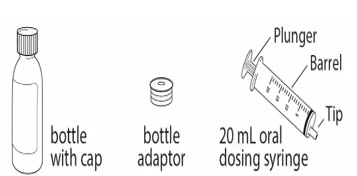
Not included in the box:
- 1 empty clean cup
- room temperature water
- ENFIT syringe and ENFIT adaptor (if taking or giving OJEMDA oral suspension through a feeding tube)
- Always use the oral dosing syringe provided to make sure that you correctly measure your prescribed dose.
- The 20 mL oral dosing syringe is marked to help you correctly measure your prescribed dose of OJEMDA for oral suspension. The barrel of the oral dosing syringe has markings in milliliters (mL).
- Add exactly 14 mL of room temperature water to the bottle to prepare the OJEMDA for oral suspension. Only 12 mL of OJEMDA oral suspension will be taken or given from each prepared bottle.
Note: Your prescribed dose of OJEMDA for oral suspension may require preparing 2 bottles of the powder to give your prescribed dose of OJEMDA for oral suspension. If 2 bottles are required:
- always add exactly 14 mL of room temperature water to each bottle, and
- prepare, take or give the dose of OJEMDA for oral suspension from the first bottle and then repeat the same steps to prepare, take or give the dose of OJEMDA for oral suspension from the second bottle.
OJEMDA for oral suspension can be taken or given by mouth using the 20 mL oral dosing syringe, or through a feeding tube with a minimum size of 12 French using an ENFIT syringe.
- If you are taking or giving OJEMDA for oral suspension by mouth, follow Section A, Steps 1 to 19.
- If taking or giving OJEMDA for oral suspension by a feeding tube, follow Section B, Steps 20 to 25.
Section A: Preparing, measuring, and taking or giving a dose of OJEMDA for oral suspension
Step 1. Wash and dry your hands before preparing, measuring, and taking or giving a dose of OJEMDA for oral suspension.
Step 2. Place your supplies on a clean, flat work surface.
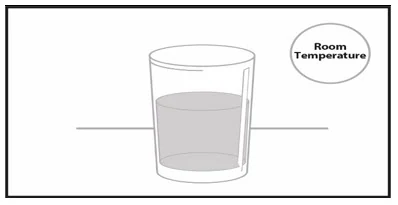
Step 3. Fill a cup half-way with room temperature water. Do not use cold water.
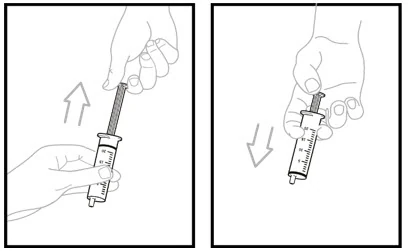
Step 4. Remove air from the oral dosing syringe.
Pull the plunger up into the oral dosing syringe as far as it will go, and then push the plunger back down into the oral dosing syringe as far as it will go. This will help to remove all the air inside.
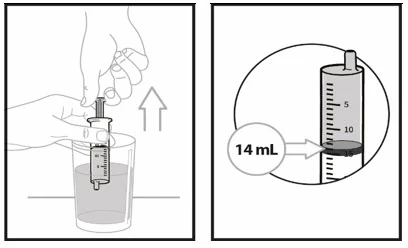
Step 5. Place the oral dosing syringe tip in the water. Pull up on the plunger to draw water into the oral dosing syringe to the 14 mL mark.
Note: Add exactly 14 ml of water to the bottle with powder.
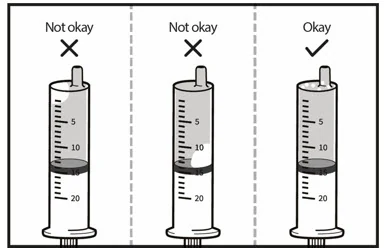
Step 6. Remove the oral dosing syringe from the cup. Turn the oral dosing syringe tip upward and check for air bubbles.
If large air bubbles appear in the oral dosing syringe, push the water back into the cup and then pull up on the plunger again to draw up the water to the 14 mL mark.
Repeat Step 6 until there are no large air bubbles present. Small air bubbles are ok.
Set the oral dosing syringe aside.
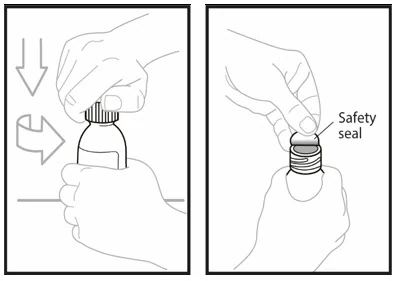
Step 7. Open the bottle with powder by pushing down firmly on the cap and turning it to the left (counter-clockwise).
- Do not throw away the cap.
- Remove the Safety seal.
Do not use the bottle with powder if the safety seal under the cap is broken or missing. Call your healthcare provider or pharmacist if the safety seal is broken.
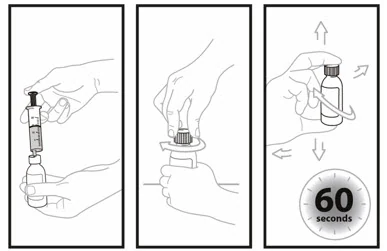
Step 8. Insert the tip of the oral dosing syringe into the opening of the bottle. Push down on the plunger and inject 14 mL of water into the bottle.
- Remove the tip of the emptied oral dosing syringe from the bottle and set it aside.
- Right away, replace the cap back onto the bottle by pushing down while twisting the cap to the right (clockwise).
- Shake the bottle well for 60 seconds in all directions.
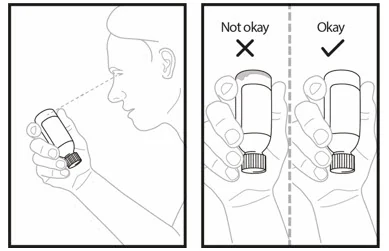
Step 9: Turn bottle upside down to check for any powder stuck to the inside of the bottle.
- If you still see powder in the bottle, continue to shake the bottle for another 15 seconds until you no longer see the powder inside the bottle.
- Do not shake the bottle for more than 2 minutes total time.
- Check the bottle to make sure all of the powder is no longer visible.
- If you still see powder in the bottle, contact your healthcare provider or pharmacist and ask for a new bottle.
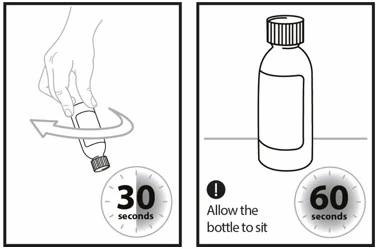
Step 10. Turn the bottle upside down again and swirl for 30 seconds.
- Place the bottle on a flat, clean, work surface.
- Remove the cap and check that no solids are stuck in the bottle neck.
- If you see solids in the bottle neck, recap the bottle, turn the bottle upside down, and swirl for an additional 15 seconds.
- Allow the bottle to sit for 60 seconds to allow most of the foam to settle.
Note: Foaming in the bottle will reduce the amount of OJEMDA for oral suspension.
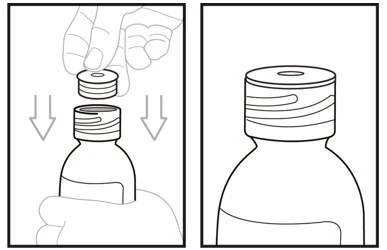
Step 11. Open the bottle by firmly pressing down on the cap and turning it to the left (counterclockwise). Do not throw away the cap.
Firmly insert the bottle adaptor into the bottle by pushing it tightly into the top of the bottle. The top edge of the bottle adaptor should be even with the bottle top.
Do not remove the bottle adaptor after it is inserted into the bottle.
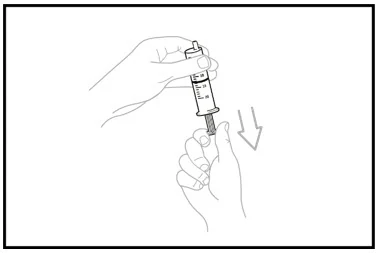
Step 12. Check your or your child's dose in milliliters (mL) as prescribed by your healthcare provider. Pick up the oral dosing syringe again. Each mark on the oral dosing syringe is equal to 1 mL. Draw air into the oral dosing syringe by pulling the plunger out to your prescribed dose. For example, if your prescribed dose is 12 mL, you would draw the oral dosing syringe by pulling the plunger out to the 12 mL mark.
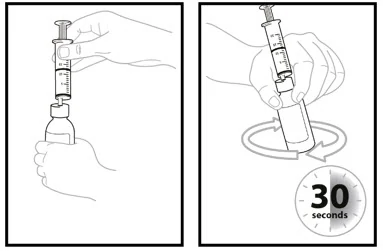
Step 13. Insert the tip of the oral dosing syringe into the bottle adaptor.
- The tip of the oral dosing syringe should fit snugly into the hole of the bottle adaptor.
- Keep the oral dosing syringe attached to the bottle. With the oral dosing syringe in place and holding the bottle where the oral dosing syringe tip inserts into bottle adaptor, swirl the oral suspension for 30 seconds.
Step 14. Inject the air from the oral dosing syringe into the bottle. Hold the oral dosing syringe in place and turn the bottle upside down. To measure the prescribed dose, keep the tip of the oral dosing syringe facing up and pull down on the plunger until the top of the plunger lines up with the prescribed dose in mLs.
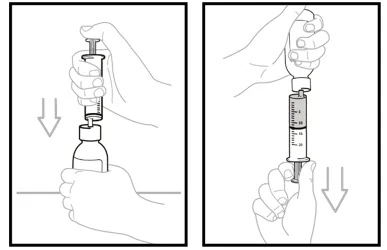
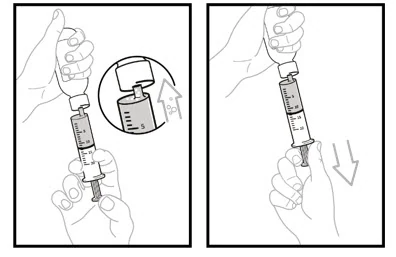
Step 15. While the syringe is still in the bottle, remove any air bubbles in the oral dosing syringe by gently pushing the OJEMDA oral suspension back into the bottle and then pulling down on the plunger again to draw up your prescribed dose.
Repeat Step 15 until you see that few or no air bubbles remain or if you draw up the wrong dose in the oral dosing syringe.
Note: Only use up to 12 mL of OJEMDA oral suspension from each prepared bottle.
- If the prescribed dose is more than 12 mL (300 mg), split the dose as equally as possible between each prepared bottle.
- For example, if your dose is 13 mL, draw 6 mL from the first prepared bottle, and 7 mL from the second prepared bottle.
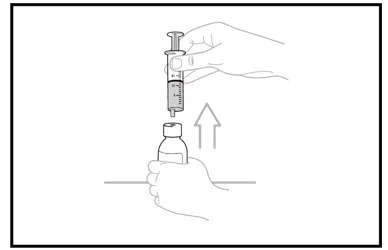
Step 16: Leave the tip of the oral dosing syringe in the bottle adaptor and carefully turn the bottle upright. Put the bottle onto your flat work surface again.
Slowly remove the oral dosing syringe tip from the bottle adaptor by gently pulling straight up. Do not hold the oral dosing syringe by the plunger because the plunger may come out.
Step 17: Check again to be sure the top of the black stopper on the barrel of the oral dosing syringe is at your prescribed mL dose mark. If you do not have the correct prescribed mL dose, repeat Steps 15 to 17.
If you are taking or giving a dose of OJEMDA for oral suspension by mouth, continue to Step 18.
If you are taking or giving a dose of OJEMDA for oral suspension through a feeding tube, go to Section B.
OJEMDA for oral suspension must be given within 15 minutes after prepared for use.
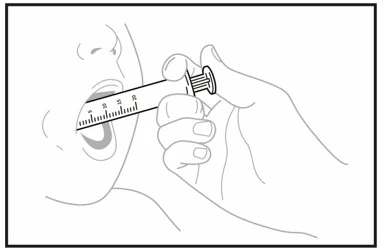
Step 18. You or your child should sit upright to take or give a dose of OJEMDA oral suspension. Place the tip of the oral dosing syringe towards the inside of the cheek in your or your child's mouth.
- Slowly push the medicine into the mouth by pressing down on the plunger.
- Do not forcefully push the plunger. This may cause choking.
- Allow the child to swallow while giving OJEMDA. You or your child may drink liquids right away after swallowing the OJEMDA for oral suspension.
- Be sure to take or give the entire dose of OJEMDA for oral suspension.
- If 2 bottles of OJEMDA for oral suspension are required to take or give your prescribed dose, repeat Section A, Steps 1 to 18 for the second bottle.
- Throw away the prepared OJEMDA for oral suspension if it is not taken or given within 15 minutes.
Step 19: See Section C for instructions on "How to throw away used bottles, expired or unused OJEMDA for oral suspension, and oral dosing syringes"
Section B: Taking or giving a dose of OJEMDA or oral suspension through a feeding tube
Before giving a dose of OJEMDA for oral suspension through a feeding tube, read the following information and talk to your or your child's healthcare provider before continuing to STEP 20:
- OJEMDA for oral suspension may be given through a feeding tube, as directed by your healthcare provider.
- Only use a feeding tube with a minimum size of 12 French.
- Always use the 20 mL oral dosing syringe (included in the box) to prepare each dose of OJEMDA for oral suspension in the bottle.
- Always use a 20 mL ENFIT syringe and an ENFIT adaptor (neither included in the box) to measure and give each dose of OJEMDA for oral suspension through the feeding tube.
Step 20. Flush the feeding tube according to the manufacturer's instructions before giving a dose of OJEMDA for oral suspension.
Step 21: Follow Steps 1 to 11 in Section A to prepare the OJEMDA oral suspension using the 20 mL oral dosing syringe.
Follow Steps 12 to 17 in Section A to draw up your or your child's dose of OJEMDA for oral suspension using the ENFIT syringe and ENFIT adaptor.
Step 22: Connect the 20 mL ENFIT syringe containing OJEMDA for oral suspension to the feeding tube.
Step 23: Apply steady pressure to the plunger to give the entire dose of OJEMDA for oral suspension through the feeding tube.
Step 24: Flush the feeding tube after giving each dose of OJEMDA for oral suspension according to the manufacturer's instructions. If 2 bottles are required, repeat Step 21 and give the remainder of the dose right away.
Step 25: Go to Section C for instructions on "How to throw away used bottles, expired or unused OJEMDA for oral suspension, and oral dosing syringes"
Section C: How to throw away used bottles, expired or unused OJEMDA for oral suspension, and oral dosing syringes
- Throw away your used bottle(s), expired or unused OJEMDA for oral suspension, and oral dosing syringe(s) in your household trash.
- Do not re-use the oral dosing syringe(s).
How should I store OJEMDA?
- Store the glass bottle containing OJEMDA for oral suspension at room temperature between 68˚F to 77˚F (20˚C to 25˚C).
Keep OJEMDA for oral suspension, the oral dosing syringe, and all medicines out of the reach of children.
Manufactured for:
Day One Biopharmaceuticals, Inc.,
Brisbane CA 94005
For more information, go to www.OJEMDA.com or call 1-855-DAY-1BIO (1-855-329-1246).
© 2025 Day One Biopharmaceuticals, Inc. All rights reserved. OJEMDA is a trademark of Day One Biopharmaceuticals Inc.
DAY101-IFU-082025v04