Medication-info.com Search Menu

Nucala (Mepolizumab): Uses, Side Effects and Dosage

Updated:
Facts
Status:
Prescription (Rx)
Strength:
100 mg/mL, 40 mg/0.4 mL
Active ingredient:

Patient information: uses, side effects, how to take - Nucala

What is NUCALA?

  • NUCALA is a prescription medicine:

    • for the add-on maintenance treatment of severe asthma in people 6 years of age and older whose asthma is not controlled with their current asthma medicines. NUCALA helps prevent severe asthma attacks (exacerbations).

      NUCALA is not used to treat sudden breathing problems that occur with asthma.

    • for add-on maintenance treatment of chronic rhinosinusitis with nasal polyps (CRSwNP) in adults whose disease is not controlled with nasal corticosteroids. NUCALA helps reduce symptoms (e.g., nasal congestion, nasal discharge, mucus in the throat, loss of smell). NUCALA helps reduce the size of your nasal polyps and the use of oral corticosteroid medicines. NUCALA helps prevent surgery for your nasal polyps.
    • for add-on maintenance treatment of chronic obstructive pulmonary disease (COPD) in adults whose disease is not controlled and who are at risk of flare-ups and increasing symptoms. NUCALA helps prevent flare-ups of COPD symptoms (exacerbations).

      NUCALA is not used to treat sudden breathing problems that can occur with COPD.

    • for the treatment of adults with eosinophilic granulomatosis with polyangiitis (EGPA). NUCALA helps reduce symptoms and flares, and it may allow your healthcare provider to reduce your oral corticosteroid medicine.
    • for the treatment of people 12 years of age and older with hypereosinophilic syndrome (HES) for 6 months or more. NUCALA helps reduce symptoms and prevent flares.
  • NUCALA works by targeting inflammation that plays a major role in severe asthma, CRSwNP, COPD, EGPA and HES. NUCALA reduces blood eosinophils. Eosinophils are a type of white blood cells that may contribute to your disease.

It is not known if NUCALA is safe and effective in:

  • children with severe asthma under 6 years of age.

  • children and adolescents with CRSwNP, COPD or EGPA under 18 years of age; or
  • children with HES under 12 years of age.

Do not use NUCALA if you are allergic to mepolizumab or any of the ingredients in NUCALA. See the end of this leaflet for a complete list of ingredients in NUCALA.

Before receiving NUCALA, tell your healthcare provider about all of your medical conditions, including if you:

  • have a parasitic (helminth) infection.
  • are taking oral or inhaled corticosteroid medicines. Do not stop taking your corticosteroid medicines unless instructed by your healthcare provider. This may cause other symptoms that were controlled by the corticosteroid medicine to come back.
  • are pregnant or plan to become pregnant. It is not known if NUCALA may harm your unborn baby.

  • are breastfeeding or plan to breastfeed. You and your healthcare provider should decide if you will use NUCALA and breastfeed. You should not do both without talking with your healthcare provider first.
  • Tell your healthcare provider about all the medicines you take, including prescription and over-the-counter medicines, vitamins, and herbal supplements.

  • Do not stop taking your other medicines unless instructed to do so by your healthcare provider.

How will I receive NUCALA?

Your healthcare provider will prescribe the dose that is right for you depending on what you are being treated for.

When injection is given by a healthcare provider:

  • A healthcare provider will inject NUCALA under your skin (subcutaneously) every 4 weeks.

When injection is given by a patient or patient caregiver with a prefilled syringe or prefilled autoinjector:

  • NUCALA may be prescribed as a single-dose prefilled autoinjector for people 12 years of age and older or as a single-dose prefilled syringe for people 6 years of age and older.
  • Use NUCALA every 4 weeks exactly as your healthcare provider tells you to.
  • Before you use NUCALA, your healthcare provider will show you or your caregiver how to give the injections.
  • Read the Instructions for Use that comes with NUCALA for instructions about the right way to give your injections at home.
  • You should inject NUCALA under your skin (subcutaneously) into your thigh or stomach (abdomen). Also, a caregiver may give the injection in the upper arm.
  • If you miss a dose, inject a dose as soon as possible. Then continue (resume) your injection on your regular dosing schedule. If you do not notice that you have missed a dose until it is time for your next scheduled dose, then inject the next scheduled dose as planned. If you are not sure when to inject NUCALA, call your healthcare provider.

What are the possible side effects of NUCALA?

NUCALA can cause serious side effects, including:

  • allergic (hypersensitivity) reactions, including anaphylaxis. Serious allergic reactions can happen after you get your NUCALA injection. Allergic reactions can sometimes happen hours or days after you get a dose of NUCALA. Tell your healthcare provider or get emergency help right away if you have any of the following symptoms of an allergic reaction:
  • swelling of your face, mouth, and tongue
  • fainting, dizziness, feeling lightheaded (low blood pressure)
  • hives
  • breathing problems
  • rash
  • herpes zoster infections. Herpes zoster infections that can cause shingles have happened in people who received NUCALA.

The most common side effects of NUCALA include: headache, injection site reactions (pain, redness, swelling, itching, or a burning feeling at the injection site), back pain, and tiredness (fatigue). Mouth/throat pain and joint pain have been reported with CRSwNP. Diarrhea and cough have been reported with COPD.

These are not all of the possible side effects of NUCALA.

Call your doctor for medical advice about side effects. You may report side effects to FDA at 1-800-FDA-1088.

How should I store NUCALA?

  • Store prefilled autoinjectors and prefilled syringes in the refrigerator between 36°F to 46°F (2°C to 8°C).
  • Keep prefilled autoinjectors and prefilled syringes in the original carton until time of use to protect from light.
  • Do not freeze. Do not shake. Keep away from heat.
  • If necessary, an unopened carton can be stored outside the refrigerator at up to 86°F (30°C) for up to 7 days.
  • Safely throw away prefilled autoinjectors and prefilled syringes if the unopened carton is left out of the refrigerator for more than 7 days.
  • Prefilled autoinjectors and prefilled syringes must be used within 8 hours after you take them out of the carton. Safely throw away if not used within 8 hours.
  • Safely throw away medicine that is out of date or no longer needed.

Keep NUCALA and all medicines out of the reach of children.

General information about the safe and effective use of NUCALA.

Medicines are sometimes prescribed for purposes other than those listed in a Patient Information Leaflet. Do not give NUCALA to other people, even if they have the same symptoms that you have. It may harm them. You can ask your pharmacist or healthcare provider for information about NUCALA that is written for health professionals.

What are the ingredients in NUCALA?

Active Ingredient: mepolizumab.

Inactive Ingredients (vials): polysorbate 80, sodium phosphate dibasic heptahydrate, and sucrose.

Inactive Ingredients (prefilled autoinjectors and prefilled syringes): citric acid monohydrate, EDTA disodium dihydrate, polysorbate 80, sodium phosphate dibasic heptahydrate, and sucrose.

For more information about NUCALA, call 1-888-825-5249 or visit our website at www.NUCALA.com.

Trademarks are owned by or licensed to the GSK group of companies.

Manufactured by:

GlaxoSmithKline LLC, Philadelphia, PA 19104, U.S. License No. 1727

Distributed by:

GlaxoSmithKline, Durham, NC 27701

©2025 GSK group of companies or its licensor.

NCL:10PIL

  • This Patient Information has been approved by the U.S. Food and Drug Administration. Revised: May 2025
Instructions for Use

NUCALA

(mepolizumab)

injection, for subcutaneous use

100 mg/mL

Prefilled Autoinjector

Important information

NUCALA is a prescription medicine that is injected under the skin (subcutaneous) from a single-dose prefilled autoinjector. You and your caregiver should be trained on how to prepare and perform your injection before trying to do it yourself.

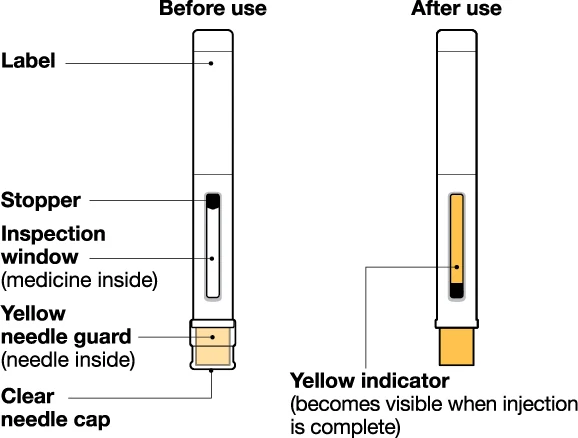
The following instructions provide the information you need to correctly use the prefilled autoinjector with yellow needle guard.

Before starting your injection, it is important that you read and understand these instructions and then carefully follow them so that you complete each step successfully.

Storage information
  • Store in the refrigerator between 36°F to 46°F (2°C to 8°C).
  • Keep in the original carton until time of use to protect from light.
  • Do not freeze. Do not shake. Keep away from heat.
  • If necessary, an unopened carton can be stored outside the refrigerator at up to 86°F (30°C) for up to 7 days.
  • Safely throw away the prefilled autoinjector if it is left out of the refrigerator in the unopened carton for more than 7 days.
  • The prefilled autoinjector must be used within 8 hours after you take it out of the carton. Safely throw it away if it is not used within 8 hours.
  • Safely throw away medicine that is out of date or no longer needed.

Keep NUCALA and all medicines out of the reach of children.

Warnings
  • Do not use the prefilled autoinjector more than 1 time. Throw away the autoinjector in an FDA-cleared sharps disposal container after your injection.
  • Do not share the prefilled autoinjector with other people. You may give other people a serious infection, or you may get a serious infection from them.
  • Do not use the prefilled autoinjector if it was dropped or looks damaged.
Know your prefilled autoinjector
Supplies in carton
1 Prefilled autoinjector
Supplies not in carton
  • Alcohol swab
  • Cotton ball or gauze
  • Adhesive bandage
  • Sharps disposal container

    (See Step 8 “Throw away your used autoinjector” at the end of this Instructions for Use for proper disposal instructions.)

Prepare
    1. 1. Take out the prefilled autoinjector
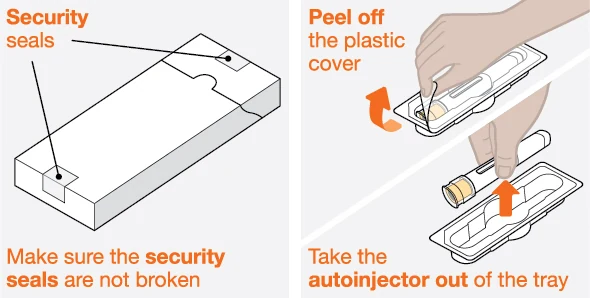
  • Take the carton out of the refrigerator and make sure the security seals are not broken.
  • Remove the tray from the carton.
  • Peel off the clear plastic cover from the corner of the tray.
  • Holding the middle of the prefilled autoinjector (near the inspection window), carefully take the prefilled autoinjector out of the tray.
  • Place the prefilled autoinjector on a clean, flat surface at room temperature away from direct sunlight and out of the reach of children.

    • Do not use the prefilled autoinjector if the security seal on the carton is broken. Contact GSK for more information at 1-888-825-5249.
    • Do not remove the clear needle cap at this step.
    1. 2. Inspect and wait 30 minutes before use
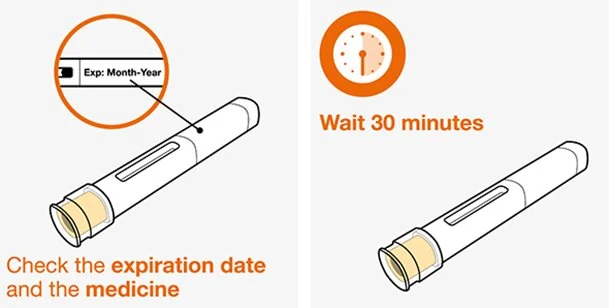
  • Check that the expiration date on the label of the prefilled autoinjector has not passed.
  • Look at the medicine in the inspection window. It should be clear to pale yellow to pale brown in color and without cloudiness or particles.
  • It is normal to see 1 or more air bubbles.
  • Wait 30 minutes (and no more than 8 hours) before use.

    • Do not use if the expiration date has passed.
    • Do not warm your prefilled autoinjector in a microwave, hot water, or direct sunlight.
    • Do not use if the medicine is cloudy or discolored, or has particles. Contact GSK for more information at 1-888-825-5249.
    • Do not use the prefilled autoinjector if it has been left out of the carton for more than 8 hours.
    1. 3. Choose your injection site
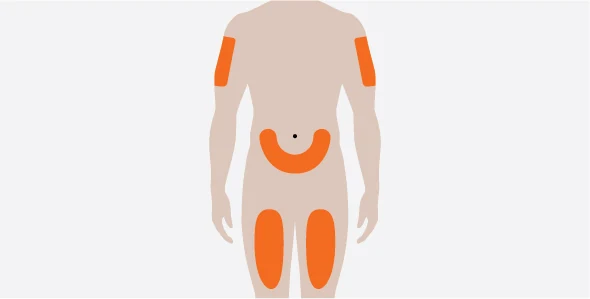
  • You can inject in your thighs or abdomen.
  • If you are giving the injection to someone else as a caregiver or healthcare provider, you can also inject into their upper arm.
  • If you need more than 1 injection to complete your dose, leave at least 2 inches between each injection site.

    • Do not inject where your skin is bruised, tender, red, or hard.
    • Do not inject within 2 inches of your belly button.
    1. 4. Clean your injection site
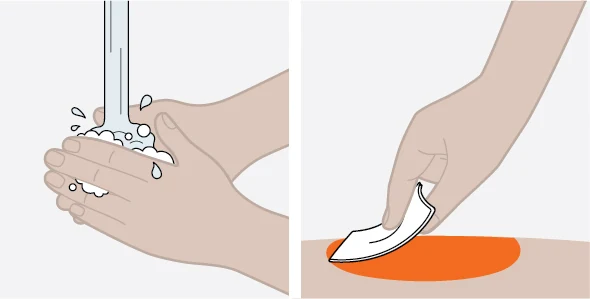
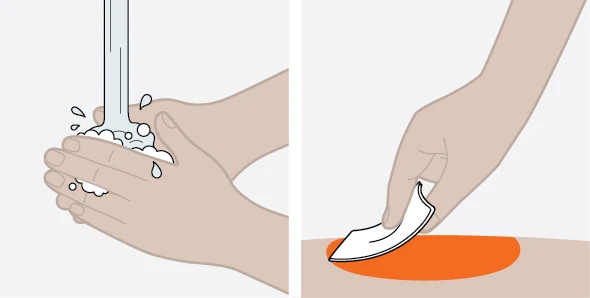
  • Wash your hands with soap and water.
  • Clean your injection site by wiping your skin with an alcohol swab and allowing your skin to air dry.

    • Do not touch your cleaned injection site again until you have finished your injection.
Inject
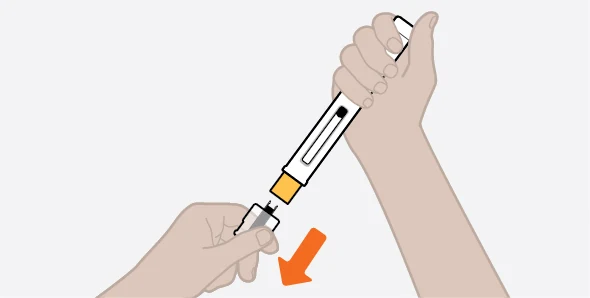
    1. 5. Remove the clear needle cap
  • Remove the clear needle cap from the prefilled autoinjector by pulling it straight off, away from the yellow needle guard (as shown). It may take some force to remove the clear needle cap.
  • You may see a drop of medicine at the end of the needle. This is normal.
  • Make sure you inject within 5 minutes after you remove the clear needle cap.

    • Do not press the yellow needle guard with your fingers. This could activate the prefilled autoinjector too soon and cause a needle injury.
    • Do not put the clear needle cap back onto the prefilled autoinjector. This could accidentally start the injection.
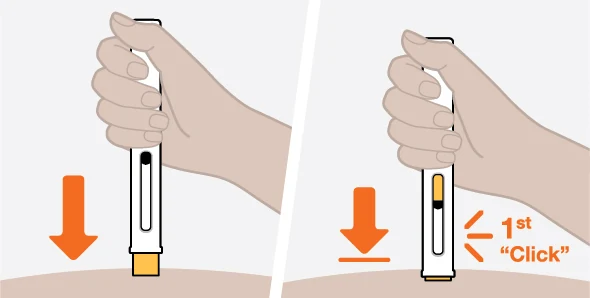
    1. 6. Start your injection
  • Hold the prefilled autoinjector with its inspection window facing you.
  • Place the prefilled autoinjector straight onto your injection site with the yellow needle guard flat on the surface of your skin, as shown.
  • To start your injection, push the autoinjector all the way down and keep the autoinjector held down against your skin. This will make the yellow needle guard slide up into the autoinjector.
  • You should hear the 1st click to let you know your injection has started.
  • The yellow indicator will move down through the inspection window as you receive your dose.

    • Do not lift the autoinjector at this step as it may result in an incomplete injection.
    • Do not use the autoinjector if the yellow needle guard does not slide up into the autoinjector. Throw it away in an FDA-cleared sharps container.
    • Do not try to use the autoinjector upside down with the yellow needle guard facing upward against your thumb.
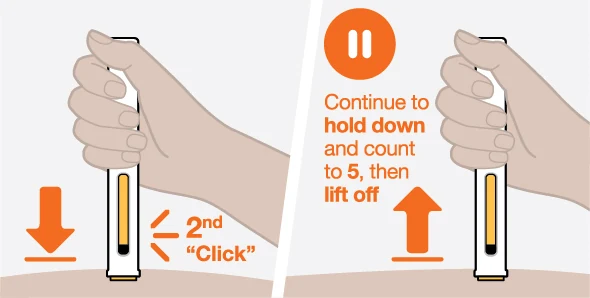
    1. 7. Complete your injection
  • Your injection may take up to 15 seconds to complete.
  • Continue to hold the autoinjector down until you hear the 2nd click, the stopper has stopped moving, and the inspection window is filled with the yellow indicator.
  • After you hear the 2nd click, continue to hold and count to 5 before you lift the autoinjector away from your skin.
  • If you do not hear the 2nd click:

    • check that the inspection window is filled with the yellow indicator, or
    • hold the autoinjector down for 15 seconds to make sure the injection is complete.
  • There may be a small drop of blood at the injection site. This is normal. Press a cotton ball or gauze on the area and apply an adhesive bandage if you need it.

    • Do not lift the autoinjector until you have heard the 2nd click, the window has been filled with the yellow indicator, and you have counted to 5.
    • Do not rub your injection site.
    • Do not put the clear needle cap back onto the autoinjector.
Dispose
    1. 8. Throw away your used autoinjector

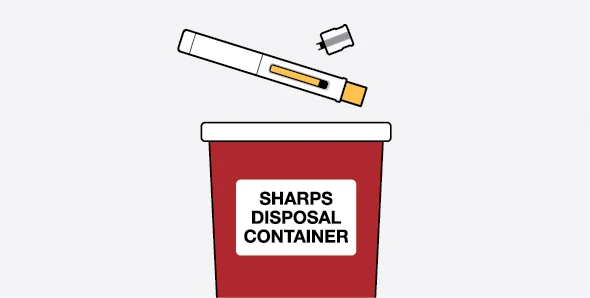
Put your used autoinjector and clear needle cap in an FDA-cleared sharps disposal container right away after use.

If you do not have an FDA-cleared sharps disposal container, you may use a household container that is:

  • made of heavy-duty plastic;
  • able to close with a tight-fitting, puncture-resistant lid, without sharps being able to come out;
  • upright and stable during use;
  • leak-resistant; and
  • properly labeled to warn of hazardous waste inside the container.

When your sharps disposal container is almost full, you will need to follow your community guidelines for the right way to dispose of it. There may be state or local laws about how you should throw away used autoinjectors.

For more information about safe sharps disposal, and for specific information about sharps disposal in the state that you live in, go to the FDA’s website at:

www.fda.gov/safesharpsdisposal.

  • Do not throw away your used sharps disposal container in your household trash unless your community guidelines permit this.
  • Do not recycle your used sharps disposal container.

Keep your sharps disposal container out of the reach of children.

Frequently asked questions
  1. 1.

    What happens if the medicine looks cloudy, the expiration date has passed, or the prefilled autoinjector looks damaged?

    Contact GSK for more information at 1-888-825-5249.

  2. 2.

    Can I change (rotate) the injection site for the prefilled autoinjector?

    You may change (rotate) the site (thigh, abdomen, or upper arm) or move the autoinjector as long as you have not started pressing down. When the yellow needle guard is pressed, your injection will start right away.

  3. 3.

    Why do I need to inject within 5 minutes of removing the clear needle cap?

    This prevents the medicine from drying in the needle. It could affect how much medicine you get.

  4. 4.

    What happens if I remove the autoinjector before the 2nd click, the stopper has stopped moving, or the inspection window is not filled with the yellow indicator?

    If this happens, you may not have received your full dose. Contact GSK for more information at 1-888-825-5249.

  5. 5.

    Who do I contact if I need help with my injection?

    Your healthcare provider will be able to help you with any more questions you might have.

For more information about NUCALA, call 1-888-825-5249 or visit our website at www.NUCALA.com.

Trademarks are owned by or licensed to the GSK group of companies.

Manufactured by:

GlaxoSmithKline LLC, Philadelphia, PA 19104, U.S. License No. 1727

Distributed by:

GlaxoSmithKline, Durham, NC 27701

©2023 GSK group of companies or its licensor.

NCL:4IFU-A

This Instructions for Use has been approved by the U.S. Food and Drug Administration.

Revised: March 2023

Instructions for Use

NUCALA

(mepolizumab)

injection, for subcutaneous use

100 mg/mL

Prefilled Syringe

Important information

NUCALA is a prescription medicine that is injected under the skin (subcutaneous) from a single-dose prefilled syringe. You and your caregiver should be trained on how to prepare and perform your injection before trying to do it yourself.

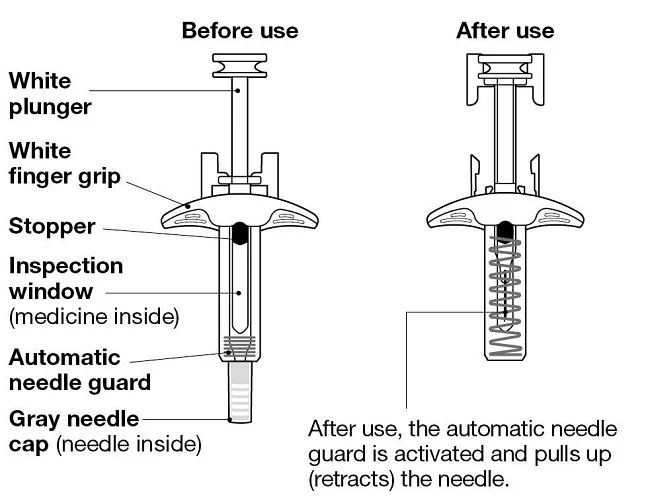
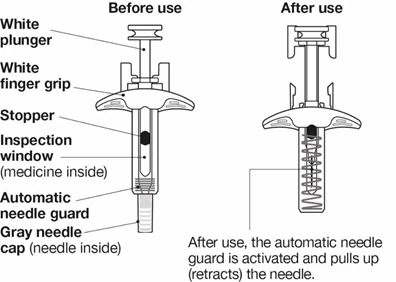
The following instructions provide the information you need to correctly use the prefilled syringe with automatic needle guard.

Before starting your injection, it is important that you read and understand these instructions and then carefully follow them so that you complete each step successfully.

Storage information
  • Store in the refrigerator between 36°F to 46°F (2°C to 8°C).
  • Keep in the original carton until time of use to protect from light.
  • Do not freeze. Do not shake. Keep away from heat.
  • If necessary, an unopened carton can be stored outside the refrigerator at up to 86°F (30°C) for up to 7 days.
  • Safely throw away the prefilled syringe if it is left out of the refrigerator in the unopened carton for more than 7 days.
  • The prefilled syringe must be used within 8 hours after you take it out of the carton. Safely throw it away if it is not used within 8 hours.
  • Safely throw away medicine that is out of date or no longer needed.

Keep NUCALA and all medicines out of the reach of children.

Warnings
  • Do not use the prefilled syringe more than 1 time. Throw away the syringe in an FDA-cleared sharps disposal container after your injection.
  • Do not share the prefilled syringe with other people. You may give other people a serious infection, or you may get a serious infection from them.
  • Do not use the prefilled syringe if it was dropped or looks damaged.
Know your prefilled syringe
Supplies in carton
1 Prefilled syringe
Supplies not in carton
  • Alcohol swab
  • Cotton ball or gauze
  • Adhesive bandage
  • Sharps disposal container

    (See Step 8 “Throw away your used syringe” at the end of this Instructions for Use for proper disposal instructions.)

Prepare
    1. 1. Take out the prefilled syringe
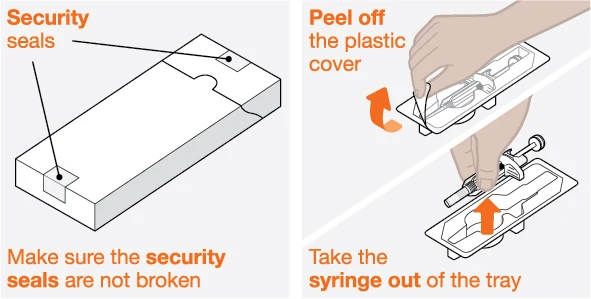
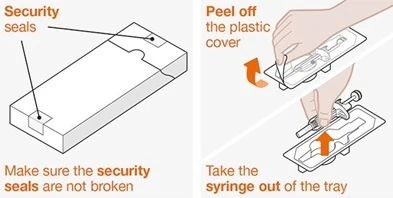
  • Take the carton out of the refrigerator and make sure the security seals are not broken.
  • Remove the tray from the carton.
  • Peel off the clear plastic cover from the corner of the tray.
  • Holding the middle of the prefilled syringe (near the inspection window), carefully take the prefilled syringe out of the tray.
  • Place the prefilled syringe on a clean, flat surface at room temperature away from direct sunlight and out of the reach of children.

    • Do not use the prefilled syringe if the security seal on the carton is broken. Contact GSK for more information at 1-888-825-5249.
    • Do not remove the gray needle cap at this step.
    1. 2. Inspect and wait 30 minutes before use
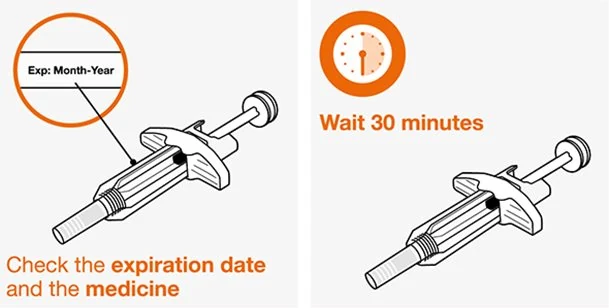
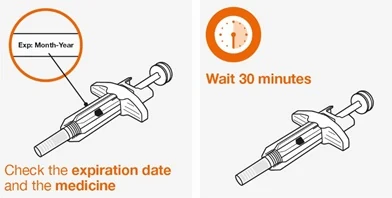
  • Check that the expiration date on the label of the prefilled syringe has not passed.
  • Look at the medicine in the inspection window. It should be clear to pale yellow to pale brown in color and without cloudiness or particles.
  • It is normal to see 1 or more air bubbles.
  • Wait 30 minutes (and no more than 8 hours) before use.

    • Do not use if the expiration date has passed.
    • Do not warm your prefilled syringe in a microwave, hot water, or direct sunlight.
    • Do not use if the medicine is cloudy or discolored, or has particles. Contact GSK for more information at 1-888-825-5249.
    • Do not use the prefilled syringe if it has been left out of the carton for more than 8 hours.
    1. 3. Choose your injection site
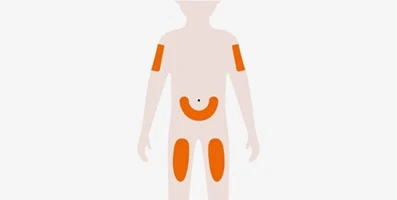
  • You can inject in your thighs or abdomen.
  • If you are giving the injection to someone else as a caregiver or healthcare provider, you can also inject into their upper arm.
  • If you need more than 1 injection to complete your dose, leave at least 2 inches between each injection site.

    • Do not inject where your skin is bruised, tender, red, or hard.
    • Do not inject within 2 inches of your belly button.
    1. 4. Clean your injection site
  • Wash your hands with soap and water.
  • Clean your injection site by wiping your skin with an alcohol swab and allowing your skin to air dry.

    • Do not touch your cleaned injection site again until you have finished your injection.
Inject
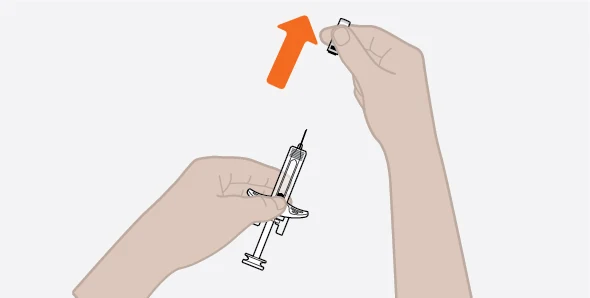
    1. 5. Remove the gray needle cap
  • Remove the gray needle cap from the prefilled syringe by pulling it straight off, away from the needle (as shown). It may take some force to remove the gray needle cap.
  • You may see a drop of medicine at the end of the needle. This is normal.
  • Make sure you inject within 5 minutes after you remove the gray needle cap.

    • Do not let the needle touch any surface.
    • Do not touch the needle.
    • Do not touch the white plunger at this step. This could accidentally push medicine out, and you will not get your full dose.
    • Do not try to remove any air bubbles from the prefilled syringe.
    • Do not put the gray needle cap back onto the prefilled syringe. This could cause a needle injury.
    1. 6. Start your injection
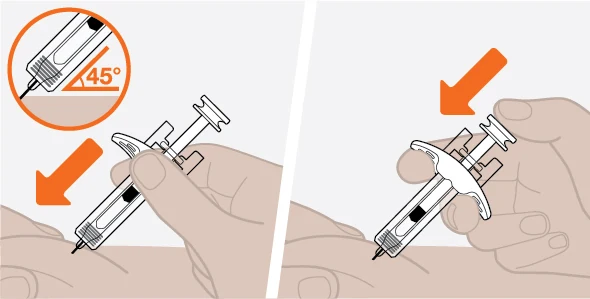
  • Use your free hand to pinch the skin around your injection site. Keep pinching the skin throughout your injection.
  • Insert the entire needle into the pinched skin at a 45° angle, as shown.
  • Move your thumb to the white plunger and use your other fingers to hold onto the white finger grip.
  • Slowly push down on the white plunger to inject your full dose.
    1. 7. Complete your injection
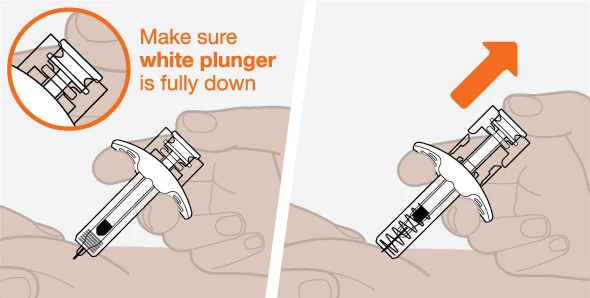
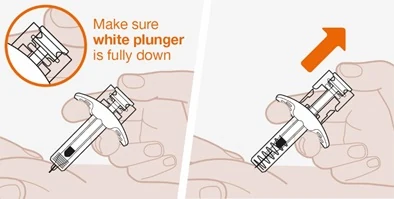
  • Make sure the white plunger is pushed all the way down until the stopper reaches the bottom of your syringe and all of the medicine is injected.
  • Slowly lift your thumb up. This will allow the white plunger to come up and the needle to automatically retract (pull up) into the body of your syringe.
  • After your injection is complete, release the pinched skin.
  • There may be a small drop of blood at the injection site. This is normal. Press a cotton ball or gauze on the area and apply an adhesive bandage if you need it.

    • Do not rub your injection site.
    • Do not put the gray needle cap back onto the syringe.
Dispose
    1. 8. Throw away your used syringe

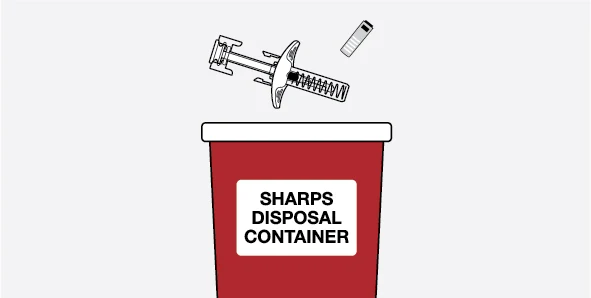
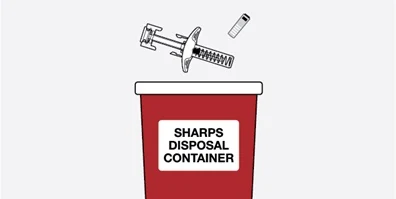
Put your used syringe and gray needle cap in an FDA-cleared sharps disposal container right away after use.

If you do not have an FDA-cleared sharps disposal container, you may use a household container that is:

  • made of heavy-duty plastic;
  • able to close with a tight-fitting, puncture-resistant lid, without sharps being able to come out;
  • upright and stable during use;
  • leak-resistant; and
  • properly labeled to warn of hazardous waste inside the container.

When your sharps disposal container is almost full, you will need to follow your community guidelines for the right way to dispose of it. There may be state or local laws about how you should throw away used syringes.

For more information about safe sharps disposal, and for specific information about sharps disposal in the state that you live in, go to the FDA’s website at:

www.fda.gov/safesharpsdisposal.

  • Do not throw away your used sharps disposal container in your household trash unless your community guidelines permit this.
  • Do not recycle your used sharps disposal container.

Keep your sharps disposal container out of the reach of children.

Frequently asked questions
  1. 1.

    What happens if the medicine looks cloudy, the expiration date has passed, or the prefilled syringe looks damaged?

    Contact GSK for more information at 1-888-825-5249.

  2. 2.

    Can I change (rotate) the injection site for the prefilled syringe?

    You may change (rotate) the site (thigh, abdomen, or upper arm) as long as you have not started injecting the medicine.

  3. 3.

    Why do I need to inject within 5 minutes of removing the gray needle cap?

    This prevents the medicine from drying in the needle. It could affect how much medicine you get.

  4. 4.

    What happens if the needle does not retract (pull up) into the needle guard?

    Right away and carefully put the syringe and needle cap in the FDA-cleared sharps disposal container and contact GSK for more information at 1-888-825-5249.

  5. 5.

    Who do I contact if I need help with my injection?

    Your healthcare provider will be able to help you with any more questions you might have.

For more information about NUCALA, call 1-888-825-5249 or visit our website at www.NUCALA.com.

Trademarks are owned by or licensed to the GSK group of companies.

Manufactured by:

GlaxoSmithKline LLC, Philadelphia, PA 19104, U.S. License No. 1727

Distributed by:

GlaxoSmithKline, Durham, NC 27701

©2023 GSK group of companies or its licensor.

NCL:4IFU-S

This Instructions for Use has been approved by the U.S. Food and Drug Administration.

Revised: March 2023

Instructions for Use

NUCALA

(mepolizumab)

injection, for subcutaneous use

40 mg/0.4 mL

Prefilled Syringe

Important information

NUCALA is a prescription medicine that is injected under the skin (subcutaneous) from a single-dose prefilled syringe. You should be trained on how to prepare and perform the injection before trying to do it yourself.

The following instructions provide the information you need to correctly use the prefilled syringe with automatic needle guard.

Before starting the injection, it is important that you read and understand these instructions and then carefully follow them so that you complete each step successfully.

Storage information
  • Store in the refrigerator between 36°F to 46°F (2°C to 8°C).
  • Keep in the original carton until time of use to protect from light.
  • Do not freeze. Do not shake. Keep away from heat.
  • If necessary, an unopened carton can be stored outside the refrigerator at up to 86°F (30°C) for up to 7 days.
  • Safely throw away the prefilled syringe if it is left out of the refrigerator in the unopened carton for more than 7 days.
  • The prefilled syringe must be used within 8 hours after you take it out of the carton. Safely throw it away if it is not used within 8 hours.
  • Safely throw away medicine that is out of date or no longer needed.

Keep NUCALA and all medicines out of the reach of children.

Warnings
  • Do not use the prefilled syringe more than 1 time. Throw away the syringe in an FDA-cleared sharps disposal container after the injection.
  • Do not share the prefilled syringe with other people. You may give other people a serious infection, or you may get a serious infection from them.
  • Do not use the prefilled syringe if it was dropped or looks damaged.
Know the prefilled syringe
Supplies in carton
1 Prefilled syringe
Supplies not in carton
  • Alcohol swab
  • Cotton ball or gauze
  • Adhesive bandage
  • Sharps disposal container

    (See Step 8 “Throw away the used syringe” at the end of this Instructions for Use for proper disposal instructions.)

Prepare
  1. 1. Take out the prefilled syringe
  • Take the carton out of the refrigerator and make sure the security seals are not broken.
  • Remove the tray from the carton.
  • Peel off the clear plastic cover from the corner of the tray.
  • Holding the middle of the prefilled syringe (near the inspection window), carefully take the prefilled syringe out of the tray.
  • Place the prefilled syringe on a clean, flat surface at room temperature away from direct sunlight and out of the reach of children.

    • Do not use the prefilled syringe if the security seal on the carton is broken. Contact GSK for more information at 1‑888‑825‑5249.
    • Do not remove the gray needle cap at this step.
  1. 2. Inspect and wait 30 minutes before use
  • Check that the expiration date on the label of the prefilled syringe has not passed.
  • Look at the medicine in the inspection window. It should be clear to pale yellow to pale brown in color and without cloudiness or particles.
  • It is normal to see 1 or more air bubbles.
  • Wait 30 minutes (and no more than 8 hours) before use.

    • Do not use if the expiration date has passed.
    • Do not warm the prefilled syringe in a microwave, hot water, or direct sunlight.
    • Do not use if the medicine is cloudy or discolored, or has particles. Contact GSK for more information at 1-888-825-5249.
    • Do not use the prefilled syringe if it has been left out of the carton for more than 8 hours.
  1. 3. Choose the injection site
  • You can inject in the thighs, abdomen, or upper arm.

    • Do not inject where the skin is bruised, tender, red, or hard.
    • Do not inject within 2 inches of the belly button.
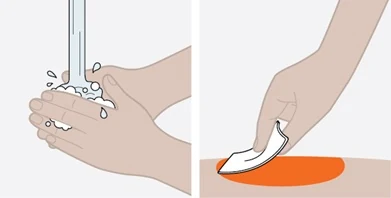
  1. 4. Clean the injection site
  • Wash your hands with soap and water.
  • Clean the injection site by wiping the skin with an alcohol swab and allowing the skin to air dry.

    • Do not touch the cleaned injection site again until you have finished the injection.
Inject
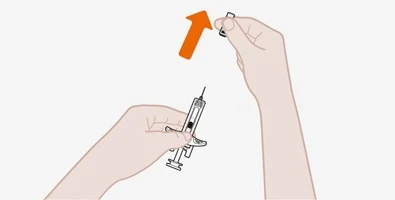
  1. 5. Remove the gray needle cap
  • Remove the gray needle cap from the prefilled syringe by pulling it straight off, away from the needle (as shown). It may take some force to remove the gray needle cap.
  • You may see a drop of medicine at the end of the needle. This is normal.
  • Make sure you inject within 5 minutes after you remove the gray needle cap.

    • Do not let the needle touch any surface.
    • Do not touch the needle.
    • Do not touch the white plunger at this step. This could accidentally push medicine out, and the full dose will not be given.
    • Do not try to remove any air bubbles from the prefilled syringe.
    • Do not put the gray needle cap back onto the prefilled syringe. This could cause a needle injury.
  1. 6. Start the injection
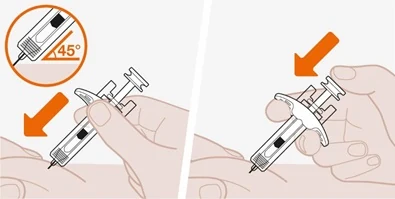
  • Use your free hand to pinch the skin around the injection site. Keep pinching the skin throughout the injection.
  • Insert the entire needle into the pinched skin at a 45° angle, as shown.
  • Move your thumb to the white plunger and use your other fingers to hold onto the white finger grip.
  • Slowly push down on the white plunger to inject the full dose.
  1. 7. Complete the injection
  • Make sure the white plunger is pushed all the way down until the stopper reaches the bottom of the syringe and all of the medicine is injected.
  • Slowly lift your thumb up. This will allow the white plunger to come up and the needle to automatically retract (pull up) into the body of the syringe.
  • After the injection is complete, release the pinched skin.
  • There may be a small drop of blood at the injection site. This is normal. Press a cotton ball or gauze on the area and apply an adhesive bandage if you need it.

    • Do not rub the injection site.
    • Do not put the gray needle cap back onto the syringe.
Dispose
  1. 8. Throw away the used syringe

Put the used syringe and gray needle cap in an FDA-cleared sharps disposal container right away after use.

If you do not have an FDA-cleared sharps disposal container, you may use a household container that is:

  • made of heavy-duty plastic;
  • able to close with a tight-fitting, puncture-resistant lid, without sharps being able to come out;
  • upright and stable during use;
  • leak-resistant; and
  • properly labeled to warn of hazardous waste inside the container.

When the sharps disposal container is almost full, you will need to follow your community guidelines for the right way to dispose of it. There may be state or local laws about how you should throw away used syringes.

For more information about safe sharps disposal, and for specific information about sharps disposal in the state that you live in, go to the FDA’s website at:

www.fda.gov/safesharpsdisposal.

  • Do not throw away the used sharps disposal container in your household trash unless your community guidelines permit this.
  • Do not recycle the used sharps disposal container.

Keep the sharps disposal container out of the reach of children.

Frequently asked questions
  1. 1.

    What happens if the medicine looks cloudy, the expiration date has passed, or the prefilled syringe looks damaged?

    Contact GSK for more information at 1-888-825-5249.

  2. 2.

    Can I change (rotate) the injection site for the prefilled syringe?

    You may change (rotate) the site (thigh, abdomen, or upper arm) as long as you have not started injecting the medicine.

  3. 3.

    Why do I need to inject within 5 minutes of removing the gray needle cap?

    This prevents the medicine from drying in the needle. It could affect how much medicine you get.

  4. 4.

    What happens if the needle does not retract (pull up) into the needle guard?

    Right away and carefully put the syringe and needle cap in the FDA-cleared sharps disposal container and contact GSK for more information at 1-888-825-5249.

  5. 5.

    Who do I contact if I need help with the injection?

    The healthcare provider will be able to help you with any more questions you might have.

For more information about NUCALA, call 1-888-825-5249 or visit our website at www.NUCALA.com.

Trademarks are owned by or licensed to the GSK group of companies.

Manufactured by:

GlaxoSmithKline LLC, Philadelphia, PA 19104, U.S. License No. 1727

Distributed by:

GlaxoSmithKline, Durham, NC 27701

©2023 GSK group of companies or its licensor.

NCL:2IFU-S40

This Instructions for Use has been approved by the U.S. Food and Drug Administration.

Revised: March 2023

About this document

Source: FDA drug labeling via NLM DailyMed · Application number: BLA 125526 · View the label on DailyMed

Revision date stated in the text: May 2025

Found a mistake? Write to us via the contact page.

The information on this site does not replace the advice of a doctor or pharmacist.

Drug information for Nucala

Rx or OTC
Prescription (Rx)?
  • This drug is available only with a prescription from a licensed healthcare provider.
  • Rx
Drug class Interleukin-5 Antagonist
Active ingredient Mepolizumab
Dosage form Injection, powder, for solution, Injection, solution
Route Subcutaneous
Marketing status not in the current FDA NDC Directory
Company (applicant) GLAXOSMITHKLINE LLC
FDA approval BLA 125526Biologics License Application (BLA) Approved November 4, 2015
Manufacturers 1 labelers list this drug on DailyMed
Packages (NDC)
Package
100 mg/mL – 1 ml in 1 vial / 1 in 1 carton NDC 0173-0881-01
100 mg/mL – 1 ml in 1 vial / 1 in 1 carton NDC 0173-0881-61
100 mg/mL – 1 ml in 1 syringe / 1 in 1 carton NDC 0173-0892-01
100 mg/mL – 1 ml in 1 syringe / 1 in 1 carton NDC 0173-0892-42
100 mg/mL – 1 ml in 1 syringe / 1 in 1 carton NDC 0173-0892-61
100 mg/mL – 1 ml in 1 syringe / 1 in 1 carton NDC 0173-0892-63
40 mg/0.4 mL – 0.4 ml in 1 syringe / 1 in 1 carton NDC 0173-0904-42

Source: FDA drug labeling via NLM DailyMed, data as of October 31, 2026. FDA data (DailyMed, Orange Book, Drug Shortages, enforcement reports). Not a substitute for the advice of a doctor or pharmacist.