


Prescribing information (package insert) - Mydcombi
1 INDICATIONS AND USAGE
MYDCOMBI (tropicamide and phenylephrine hydrochloride ophthalmic spray) 1% / 2.5% is indicated to induce mydriasis for diagnostic procedures and in conditions where short term pupil dilation is desired.
2 DOSAGE AND ADMINISTRATION
2.1 Recommended Dosage
Administer one metered spray to the cornea of each eye to be dilated. Repeat after 5 minutes.
Pediatric Patients Younger Than 1 Year Old
In pediatric patients younger than 1 year old, administer one metered spray to the cornea of each eye to be dilated, up to a maximum of 3 sprays per eye per day.
2.2 Administration Instructions
The following steps should be followed sequentially:
- 1.
Load the MYDCOMBI dispenser by depressing the FILL BUTTON at the top of the dispenser once.
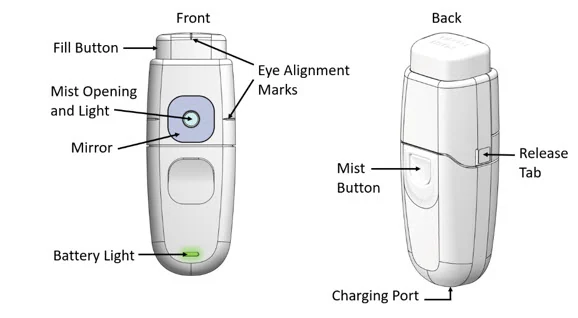
Figure 1: MYDCOMBI Dispenser Front (L) and Back (R) View
- 2. Hold MydCombi™ dispenser with thumb over Mist Button, wrapping other fingers around base.
- 3.
Bring MydCombi™ dispenser to patient's eye with Mirror facing the eye.
- The dispenser should be as close as patient's nose.
- To prevent blinking, use your other hand to gently pull lower eyelid down or ask patient to pull her/his lid down.
- 4. Aim Mist Opening toward the center of eye.
- 5.
Confirm Alignment Marks (on the Fill Button and the cartridge side) align with the center of eye.
- Ask patient to confirm when their eye is centered on the BLUE Mirror.
If patient is having trouble centering their eye on the blue light, ask that they look up, then look at the BLUE Mirror.
- 6.
Firmly press and release Mist Button.
- The drug solution should gently wet the eye. Repeat steps A to F if needed.
- 7. Administer a second metered spray after 5 minutes to each dilated eye.
- 8. Repeat steps A to G for the contralateral eye if it is to be dilated.
3 DOSAGE FORMS AND STRENGTHS
MYDCOMBI is a sterile, clear, colorless, topical ophthalmic spray containing tropicamide 1% (w/w) and phenylephrine hydrochloride 2.5% (w/w). Each metered spray delivers 0.008 mL which contains 0.08 mg tropicamide and 0.2 mg phenylephrine hydrochloride.
4 CONTRAINDICATIONS
4.1 Known Hypersensitivity
Contraindicated in persons showing known hypersensitivity to any component of the formulation.
5 WARNINGS AND PRECAUTIONS
5.1 Topical Ophthalmic Use
MYDCOMBI is not indicated for injection.
5.2 Blood Pressure Elevation
Caution should be exercised with the use of MYDCOMBI in pediatric patients less than 5 years of age and patients with hyperthyroidism, or cardiovascular disease. The post-treatment blood pressure of patients with cardiac and endocrine diseases and any patients who develop symptoms should be carefully monitored.
5.3 Central Nervous System Disturbances
Tropicamide in MYDCOMBI may cause CNS disturbances which may be dangerous in pediatric patients. The possibility of psychotic reactions and behavioral disturbances due to hypersensitivity to anticholinergic drugs should be considered.
5.4 Intraocular Pressure
Mydriatics may produce a transient elevation of intraocular pressure.
5.5 Rebound Miosis
Rebound miosis has been reported one day after receiving phenylephrine hydrochloride ophthalmic solution, and re-administration of the drug produced a lesser mydriatic effect.
6 ADVERSE REACTIONS
Because clinical trials are conducted under widely varying conditions, adverse reaction rates observed in the clinical trials of a drug cannot be directly compared to rates in the clinical trials of another drug and may not reflect the rates observed in practice. The most common adverse reactions (incidence < 2%) were transient blurred vision, reduced visual acuity, photophobia, and mild eye discomfort.
6.1 Ocular Adverse Reactions
Transient blurred vision, reduced visual acuity, photophobia, superficial punctate keratitis, and mild eye discomfort may occur. Increased intraocular pressure has been reported following the use of mydriatics.
6.2 Systemic Adverse Reactions
Dryness of the mouth, tachycardia, headache, allergic reactions, nausea, vomiting, pallor, central nervous system disturbances and muscle rigidity have been reported with the use of tropicamide. Psychotic reactions, behavioral disturbances, and vasomotor or cardiorespiratory collapse in children have been reported with the use of anticholinergic drugs.
A marked increase in blood pressure has been reported with the use of phenylephrine, particularly, but not limited to, low weight premature neonates, infants, and hypertensive patients.
7 DRUG INTERACTIONS
7.1 Agents That May Exaggerate Pressor Responses
Phenylephrine in MYDCOMBI may enhance the pressor effects of atropine-like drugs and induce tachycardia in some patients.
7.2 Cholinergic Agonists and Ophthalmic Cholinesterase Inhibitors
Tropicamide in MYDCOMBI may interfere with the antihypertensive action of carbachol, pilocarpine, or ophthalmic cholinesterase inhibitors.
7.3 Potent Inhalation Anesthetic Agents
Phenylephrine in MYDCOMBI may potentiate the cardiovascular depressant effects of some inhalation anesthetic agents.
8 USE IN SPECIFIC POPULATIONS
8.1 Pregnancy
Risk Summary
There are no available data on MYDCOMBI use in pregnant women or animals to inform any drug-associated risks. It is also not known whether tropicamide or phenylephrine can cause fetal harm when administered to a pregnant woman or can affect reproduction capacity. MYDCOMBI should be given to a pregnant woman only if clearly needed.
8.2 Lactation
Risk Summary
There are no data on the presence of tropicamide or phenylephrine in human milk from the administration of MYDCOMBI, the effects on the breastfed infant, or the effects on milk production. The developmental and health benefits of breastfeeding should be considered along with the mother's clinical need for MYDCOMBI and any potential adverse effects on the breastfed child from MYDCOMBI.
8.4 Pediatric Use
Tropicamide in MYDCOMBI may rarely cause CNS disturbances which may be dangerous in pediatric patients. Psychotic reactions, behavioral disturbances, and vasomotor or cardiorespiratory collapse in children have been reported with the use of anticholinergic drugs [see Warnings and Precautions (5.3)].
8.5 Geriatric Use
No overall differences in safety or effectiveness of MYDCOMBI have been observed between patients 65 years of age and older and younger adult patients.
10 OVERDOSAGE
Overdosage of MYDCOMBI may cause a rapid rise in blood pressure. It may also cause headache, anxiety, nausea and vomiting, and ventricular arrhythmias. Prompt injection of a rapidly acting alpha- adrenergic blocking agent such as phentolamine has been recommended.
11 DESCRIPTION
MYDCOMBI is a sterile, clear, colorless fixed dose combination of an anticholinergic (tropicamide) and an alpha-adrenergic receptor agonist (phenylephrine hydrochloride) for topical ophthalmic use. The 2 active ingredients are represented by the chemical structures below.
Tropicamide:
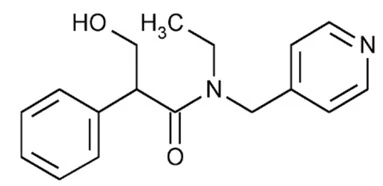
Chemical Name: Benzeneacetamide, N-ethyl-α-(hydroxymethyl)-N-(4-pyridinylmethyl)-
Molecular Formula: C17H20N2O2
Molecular Weight: 284.35 g/mol
Phenylephrine Hydrochloride:
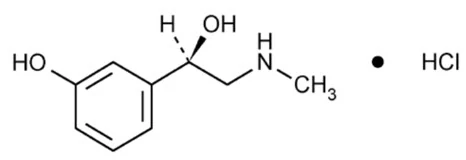
Chemical Name: (R)-3-hydroxy-α[(methylamino)methyl]benzenemethanol hydrochloride
Molecular Formula: C9H13NO2∙HCl
Molecular Weight: 203.67 g/mol
Each mL of MYDCOMBI ophthalmic spray (sterile) contains: ACTIVES: Phenylephrine Hydrochloride 2.5% (25 mg) equivalent to 20.6 mg of phenylephrine base, Tropicamide 1% (10 mg); INACTIVE: Hydrochloric Acid and/or Sodium Hydroxide may be added to adjust pH (pH 4.8–5.2), Water for Injection; PRESERVATIVE: Benzalkonium Chloride 0.01% (0.1 mg).
12 CLINICAL PHARMACOLOGY
12.1 Mechanism of Action
Tropicamide, the anticholinergic component of MYDCOMBI, blocks the responses of the sphincter muscle of the iris, dilating the pupil (mydriasis). Phenylephrine hydrochloride, the alpha-1 adrenergic agonist component of MYDCOMBI, acts as a mydriatic agent by contracting the dilator muscle of the iris.
12.2 Pharmacodynamics
MYDCOMBI acts in 15 to 30 minutes with maximal mydriasis occurring in 20 to 90 minutes. Darker irides tend to dilate slower than lightly pigmented irides and to achieve maximal effect may require more doses than lighter irides.
Mydriasis will reverse spontaneously with time, with recovery after 3 to 8 hours. Complete recovery from mydriasis in some individuals may require 24 hours.
13 CLINICAL STUDIES
Two Phase 3 clinical trials were conducted to evaluate the efficacy of MYDCOMBI for achievement of mydriasis. The MIST-1 study was a prospective, double-masked, active-controlled, 3-period cross-over, superiority study to compare the pupil dilating effect of MYDCOMBI to tropicamide 1% and to phenylephrine 2.5%, with all solutions topically administered by the Optejet® Dispenser (N = 64 subjects; 128 eyes). The MIST-2 study was a prospective, multicenter, double-masked, placebo-controlled, 3-period crossover, superiority study to compare the pupil dilating effect of MYDCOMBI to placebo (eyewash solution), with both solutions topically administered by the Optejet Dispenser (N = 70 subjects; 140 eyes).
The primary efficacy endpoint for both studies was the mean change in 35-minute pupil diameter compared to baseline as measured by digital pupillometry in highly photopic conditions. Data from the 2 studies are presented in Table 1. At 35 minutes post-dose, the mean change in pupil diameter was 4.7 mm with MYDCOMBI, 4.1 mm with tropicamide, and 0.9 mm with phenylephrine in MIST-1, and was 4.8 mm with MYDCOMBI and 0.1 mm with placebo in MIST-2. MYDCOMBI was statistically superior to tropicamide administered alone and phenylephrine administered alone.
Table 1 Pupil Size and Change in Diameter from Baseline at 35 Minutes Post-Dose (MIST-1 and MIST-2) (Per-Protocol Population The per-protocol (PP) population included all randomized subjects who received at least one dose of study medication and completed all planned assessments (related to the primary endpoint) without major protocol violations. Two subjects in MIST-1 and one subject in MIST-2 who withdrew consent after their first treatment visit were not included in the PP populations which resulted in 62 completed subjects (124 eyes) in MIST-1 and 69 completed subjects (138 eyes) in MIST-2 comprised the PP populations. Sensitivity analysis performed on the intent-to-treat (ITT) population including all randomized subjects resulted in consistent efficacy results. )
| MIST-1 | MIST-2 | ||||
|---|---|---|---|---|---|
| Visit | MYDCOMBI (N = 124) | Tropicamide Alone (N = 124) | Phenylephrine Alone (N = 124) | MYDCOMBI (N = 138) | Placebo (N = 138) |
| SD=Standard Deviation | |||||
| Mean Baseline (SD) | 2.6 (0.05) | 2.6 (0.05) | 2.6 (0.05) | 2.6 (0.04) | 2.6 (0.04) |
| 35-Minutes Post-Dose (SD) | 7.3 (0.08) | 6.7 (0.08) | 3.5 (0.08) | 7.3 (0.07) | 2.7 (0.05) |
| Change from Baseline (SD) | 4.7 (0.07) | 4.1 (0.06) | 0.9 (0.08) | 4.8 (0.07) | 0.1 (0.04) |
Difference from MYDCOMBI (95% CI) Treatment differences and 95% confidence interval estimates were based on a mixed model including treatment, eye, baseline diameter, and carryover effect (for MIST-2 study only). In both studies, an unstructured covariance structure was used to account for within-subject correlation between eyes. | -- | 0.6 (0.4, 0.8) | 3.9 (3.7, 4.1) | -- | 4.7 (4.5, 4.8) |
MYDCOMBI provided a clinically significant effect in the proportion of eyes achieving pupil diameter of ≥ 6 mm at 35-minute post-dose in 94% of eyes compared to 78% of eyes administered tropicamide alone and 1.6% of eyes administered phenylephrine alone, and 0% of eyes administered placebo. As shown in Figure 2, peak effect was measured at the 80-minute evaluation when the mean change from baseline was 5.2 mm. Treatment differences in mydriasis were observed as early as 20 minutes and still present at 180 minutes post-dose, the end of the protocol-specified observation period.
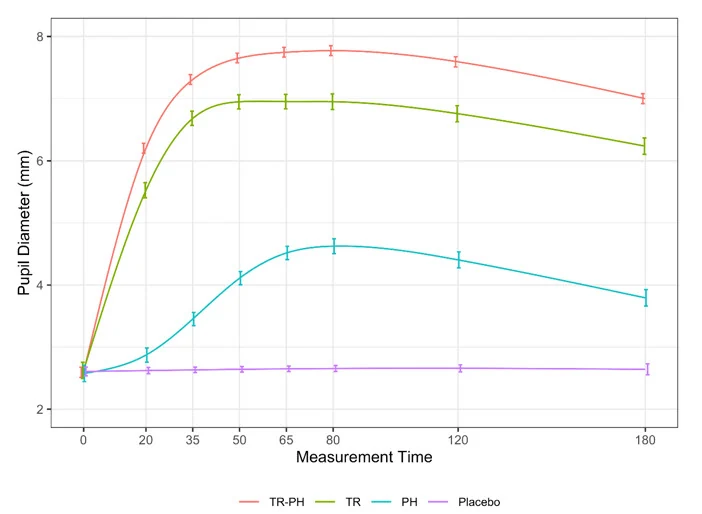
Figure 2: MIST-1 and MIST-2 pooled, mean pupil diameter vs measurement time, by treatment group. Vertical bars show 95% confidence interval for the mean at each point. Smooth curves are based on an 8 degrees of freedom (df) generalized additive model (GAM) smooth through time, adjusting for baseline pupil diameter. Confidence intervals are not adjusted for correlation.
14 HOW SUPPLIED/STORAGE AND HANDLING
MYDCOMBI is supplied as sterile, clear, colorless solution in a 2 mL vial enclosed in a dispenser cartridge. Each MYDCOMBI cartridge holds approximately 180 sprays.
Do not tamper with or attempt to open the MYDCOMBI cartridge. Such action may damage the dispenser causing an incorrect medication discharge volume; additionally, the dispenser base may not function properly.
Only use the MYDCOMBI cartridge with the MYDCOMBI Dispenser base which may be supplied separately. The MYDCOMBI base will not work with any other cartridges.
NDC 81046-0111-1. Carton containing one replacement sterile drug cartridge
NDC 81046-0111-2. Box containing one carton with one sterile drug cartridge, and one carton with one base unit
NDC 81046-0111-5. Box containing five cartons, each with one replacement sterile drug cartridge
The MYDCOMBI cartridge must be used prior to the expiration date on the cartridge.
Storage: Store at room temperature 15°C to 25°C (59°F to 77°F).
Manufactured for Eyenovia, Inc. by Alcami Corporation
15 PATIENT COUNSELING INFORMATION
Advise patients that they may experience sensitivity to light and blurred vision while their pupils are dilated.
Advise patients not to drive, use machinery, or do any activity that requires clear vision until they are sure they can perform such activities safely.