


Patient information: uses, side effects, how to take - Minivelle
What is the most important information I should know about MINIVELLE (an estrogen hormone)?
- Using estrogen-alone may increase your chance of getting cancer of the uterus (womb).
- Report any unusual vaginal bleeding right away while you are using MINIVELLE. Vaginal bleeding after menopause may be a warning sign of cancer of the uterus (womb). Your healthcare provider should check any unusual vaginal bleeding to find out the cause.
- Do not use estrogen-alone to prevent heart disease, heart attacks, strokes, or dementia (decline in brain function).
- Using estrogen-alone may increase your chances of getting strokes or blood clots.
- Using estrogen-alone may increase your chance of getting dementia, based on a study of women 65 years of age and older.
- Do not use estrogens with progestogens to prevent heart disease, heart attacks, strokes, or dementia.
- Using estrogens with progestogens may increase your chances of getting heart attacks, strokes, breast cancer, or blood clots.
- Using estrogens with progestogens may increase your chance of getting dementia, based on a study of women 65 years of age and older.
- Only one estrogen-alone product and dose have been shown to increase your chances of getting strokes, blood clots, and dementia. Only one estrogen with progestogen product and dose have been shown to increase your chances of getting heart attacks, strokes, breast cancer, blood clots, and dementia.
Because other products and doses have not been studied in the same way, it is not known how the use of MINIVELLE will affect your chances of developing these conditions. You and your healthcare provider should talk regularly about whether you still need treatment with MINIVELLE.
What is MINIVELLE?
MINIVELLE is a prescription medicine patch (transdermal system) that contains the estrogen hormone estradiol. When applied to the skin, estradiol is absorbed through the skin into the bloodstream.
What is MINIVELLE® used for?
MINIVELLE is used after menopause to:
Reduce moderate to severe hot flashes
Estrogens are hormones made by a woman’s ovaries. The ovaries normally stop making estrogens when a woman is between 45 and 55 years old. This drop in body estrogen levels causes the “change of life” or menopause (the end of monthly menstrual periods). Sometimes, both ovaries are removed during an operation before natural menopause takes place. The sudden drop in estrogen levels causes “surgical menopause.”
When estrogen levels begin dropping, some women develop very uncomfortable symptoms, such as feelings of warmth in the face, neck, and chest or sudden intense feelings of heat and sweating (“hot flashes” or “hot flushes”). In some women, the symptoms are mild and they will not need estrogens. In other women, symptoms can be more severe.
Help reduce your chances of getting osteoporosis (thin weak bones)
Osteoporosis from menopause is a thinning of the bones that makes them weaker and easier to break. If you use MINIVELLE only to prevent osteoporosis due to menopause, talk with your healthcare provider about whether a different treatment or medicine without estrogens might be better for you.
You and your healthcare provider should talk regularly about whether you should continue treatment with MINIVELLE.
Who should not use MINIVELLE?
Do not start using MINIVELLE if you:
have unusual vaginal bleeding
Vaginal bleeding after menopause may be a warning sign of cancer of the uterus (womb). Your healthcare provider should check any unusual vaginal bleeding to find out the cause.
- have been diagnosed with a bleeding disorder
currently have or have had certain cancers
Estrogens may increase the chances of getting certain types of cancers, including cancer of the breast or uterus (womb). If you have or have had cancer, talk with your healthcare provider about whether you should use MINIVELLE.
- had a stroke or heart attack
- currently have or have had blood clots
- currently have or have had liver problems
- are allergic to MINIVELLE or the ingredients in it. See the list of ingredients in MINIVELLE at the end of this leaflet.
Before you use MINIVELLE, tell your healthcare provider about all of your medical conditions, including if you:
have any unusual vaginal bleeding
Vaginal bleeding after menopause may be a warning sign of cancer of the uterus (womb). Your healthcare provider should check any unusual vaginal bleeding to find out the cause.
have any other medical conditions that may become worse while you are using MINIVELLE
Your healthcare provider may need to check you more carefully if you have certain conditions such as asthma (wheezing), diabetes, epilepsy (seizures), migraine, endometriosis, lupus, angioedema (swelling of the face and tongue), problems with your heart, liver, thyroid, kidneys, or have high calcium levels in your blood.
are going to have surgery or will be on bed rest
Your healthcare provider will let you know if you need to stop using MINIVELLE.
are pregnant or think you may be pregnant.
MINIVELLE is not for pregnant women.
are breast feeding
The hormone in MINIVELLE can pass into your breast milk.
Tell your healthcare provider about all the medicines you take, including prescription and over-the-counter medicines, vitamins and herbal supplements. Some medicines may affect how MINIVELLE works. MINIVELLE may also affect how your other medicines work. Keep a list of your medicines and show it to your healthcare provider and pharmacist when you get a new medicine.
How should I use MINIVELLE?
For detailed instructions, see the step-by-step instructions for using MINIVELLE at the end of this Patient Information
- Use MINIVELLE exactly as your healthcare provider tells you to use it
- MINIVELLE is for skin use only
- Change your MINIVELLE patch 2 times a week or every 3 to 4 days
- Apply your MINIVELLE patch to a clean, dry area on your lower abdomen or buttocks. This area must be clean, dry, and free of powder, oil or lotion for your patch to stick to your skin
- Apply your MINIVELLE patch to a different area of your abdomen or your buttocks each time. Do not use the same application site 2 times in the same week.
- Do not apply MINIVELLE to your breasts
- If you forget to apply a new MINIVELLE patch, apply a new patch as soon as possible.
- You and your healthcare provider should talk regularly (every 3 to 6 months) about your dose and whether you still need treatment with MINIVELLE.
How to Change MINIVELLE
- When changing the patch, peel off the used patch slowly from the skin.
- After removal of MINIVELLE if any adhesive residue remains on your skin, allow the area to dry for 15 minutes. Then, gently rub the area with oil or lotion to remove the adhesive from your skin
- Apply the new patch to a different area of your abdomen or buttocks. This area must be clean, dry, cool and free of powder, oil or lotion.
What are the possible side effects of MINIVELLE?
Side effects are grouped by how serious they are and how often they happen when you are treated.
Serious, but less common side effects include:
- heart attack
- stroke
- blood clots
- breast cancer
- cancer of the lining of the uterus (womb)
- cancer of the ovary
- dementia
- high or low blood calcium
- gallbladder disease
- visual abnormalities
- high blood pressure
- high levels of fat (triglyceride) in your blood
- liver problems
- changes in your thyroid hormone levels
- fluid retention
- cancer changes of endometriosis
- enlargement of benign tumors of the uterus (“fibroids”)
- worsening of swelling of face and tongue (angioedema) in women with a history of angioedema
Call your healthcare provider right away if you get any of the following warning signs or any other unusual symptoms that concern you:
- new breast lumps
- unusual vaginal bleeding
- changes in vision or speech
- sudden new severe headaches
- severe pains in your chest or legs with or without shortness of breath, weakness and fatigue
- swelling of face and tongue with or without red, itchy bumps
Common side effects of MINIVELLE include:
- headache
- breast pain
- irregular vaginal bleeding or spotting
- stomach or abdominal cramps, bloating
- nausea and vomiting
- hair loss
- fluid retention
- vaginal yeast infection
- redness and/or irritation at patch placement site
These are not all the possible side effects of MINIVELLE. For more information, ask your healthcare provider or pharmacist. Tell your healthcare provider if you have any side effects that bother you or do not go away. You may report side effects to Noven at 1-800-455-8070 or to FDA at 1-800-FDA-1088.
What can I do to lower my chances of a serious side effect with MINIVELLE?
- Talk with your healthcare provider regularly about whether you should continue using MINIVELLE.
- If you have a uterus, talk to your healthcare provider about whether the addition of a progestogen is right for you. In general, the addition of a progestogen is generally recommended for a woman with a uterus to reduce the chance of getting cancer of the uterus (womb).
- See your healthcare provider right away if you get vaginal bleeding while using MINIVELLE.
- Have a pelvic exam, breast exam and mammogram (breast X-ray) every year unless your healthcare provider tells you something else. If members of your family have had breast cancer or if you have ever had breast lumps or an abnormal mammogram, you may need to have breast exams more often.
- If you have high blood pressure, high cholesterol (fat in the blood), diabetes, are overweight, or if you use tobacco, you may have higher chances of getting heart disease. Ask your healthcare provider for ways to lower your chances of getting heart disease.
How should I store and throw away used MINIVELLE patches?
- Store MINIVELLE at room temperature 68°F to 77°F (20°C to 25°C)
- Do not store MINIVELLE patches outside of their pouches. Apply immediately upon removal from the protective pouch
- Used patches still contain estrogen. To throw away the patch, fold the sticky side of the patch together, place it in a sturdy child-proof container, and place this container in the trash. Used patches should not be flushed in the toilet
KEEP MINIVELLE and all other medicines out of the reach of children
General information about safe and effective use of MINIVELLE
Medicines are sometimes prescribed for purposes other than those listed in Patient Information leaflets. Do not use MINIVELLE for conditions for which it was not prescribed. Do not give MINIVELLE to other people, even if they have the same symptoms you have. It may harm them.
You can ask your healthcare provider or pharmacist for information about MINIVELLE that is written for health professionals. You can get more information by calling Noven Pharmaceuticals, Inc. at 1-800-455-8070.
What are the ingredients in MINIVELLE?
Active ingredient: estradiol
Inactive ingredients: Polyolefin laminate backing, acrylic and silicone adhesives, oleyl alcohol, NF, povidone, USP and dipropylene glycol and a polyester release liner
INSTRUCTIONS FOR USE
MINIVELLE® (MIN-ee-vell)
(estradiol transdermal system)
Read this PATIENT INFORMATION before you start using MINIVELLE and each time you get a refill. There may be new information. This information does not take the place of talking to your healthcare provider about your menopausal symptoms or your treatment.
You will need the following supplies (See Figure A).
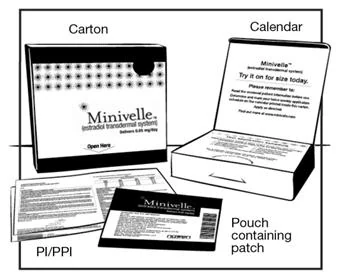
Figure A
Step 1: Pick the days you will change your patch.
- You will need to change your patch 2 times a week or every 3 to 4 days. Use the calendar printed inside your carton to choose the 2 days you will change your patch (See Figure B).
- Remember to change your patch on the same 2 days you marked on your calendar. If you forget to change your patch on the correct date, apply a new patch as soon as you remember, and continue to follow your original schedule
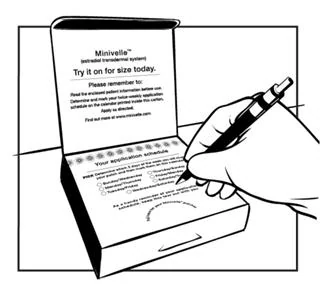
Figure B
Step 2. Remove the MINIVELLE patch from the pouch.
- Remove the patch from its protective pouch by tearing at the notch (do not use scissors, See Figure C).
- Do not remove your patch from the protective pouch until you are ready to apply it
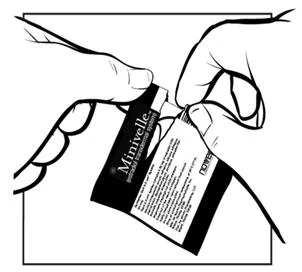
Figure C
Step 3. Remove half of the adhesive liner (See Figure D).
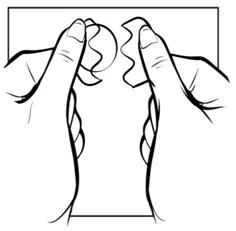
Figure D
Step 4. Placing the patch on your skin.
- Hold the part of the patch that still has the adhesive liner on it
- Avoid touching the sticky half of the patch with your fingers
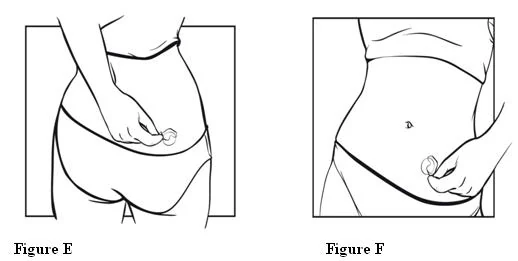
- Apply the exposed sticky half of the patch to 1 of the areas of skin shown below (See Figures E and F).
Note:
- Avoid the waistline, since clothing and belts may cause the patch to be rubbed off
- Do not apply the patch to your breasts
- Only apply the patch to skin that is clean, dry, and free of any powder, oil, or lotion
- You should not apply the patch to injured, burned, or irritated skin, or areas with skin conditions (such as birth marks, tattoos, or that is very hairy)
Step 5: Press the patch firmly onto your skin.
- Remove the remaining half of the adhesive liner and press the entire patch into place with the palm of your hand for 10 seconds
- Rub the edges of the patch with your fingers to make sure that it will stick to your skin (See Figure G).
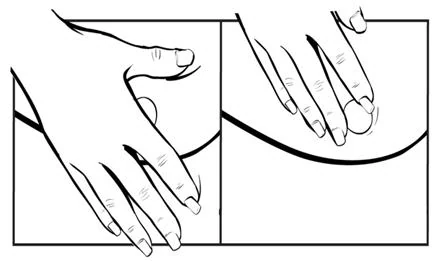
Figure G
Note:
- Showering will not cause your patch to fall off
- If your patch falls off reapply it. If you cannot reapply the patch, apply a new patch to another area (See Figures E and D) and continue to follow your original placement schedule
- If you stop using your MINIVELLE patch or forget to apply a new patch as scheduled, you may have spotting, or bleeding, and recurrence of symptoms
Step 6: Throwing away your used patch.
- When it is time to change your patch, remove the old patch before you apply a new patch
- To throw away the patch, fold the sticky side of the patch together, place it in a sturdy child-proof container, and place this container in the trash. Used patches should not be flushed in the toilet
This Patient Information and Instructions for Use have been approved by the U.S. Food and Drug Administration.
Manufactured by:
Noven Pharmaceuticals Inc.
Miami, FL 33186
Approved (02/2024)