


Patient information: uses, side effects, how to take - Estring
What is ESTRING?
ESTRING (estradiol vaginal system) is an off-white, soft, flexible ring with a center that contains 2 mg of estradiol (an estrogen hormone). ESTRING releases estradiol into the vagina in a consistent, stable manner for 90 days. The soft, flexible ring is placed in the upper third of the vagina (by the physician or the patient). ESTRING should be removed after 90 days of continuous use. If continuation of therapy is indicated, the flexible ring should be replaced.
What is ESTRING used for?
ESTRING is used after menopause to treat moderate to severe menopausal changes in and around the vagina.
You and your healthcare provider should talk regularly about whether you still need treatment with ESTRING to control these problems.
Who should not use ESTRING?
Do not start using ESTRING if you:
- have unusual vaginal bleeding
- Vaginal bleeding after menopause may be a warning sign of cancer of the uterus (womb). Your healthcare provider should check any unusual vaginal bleeding to find out the cause.
- currently have or have had certain cancers
- Estrogens may increase the chance of getting certain types of cancers. If you have or had an estrogen-dependent cancer, talk with your healthcare provider about whether you should use ESTRING.
- had a stroke or heart attack
- currently have or have had blood clots
- currently have liver problems
- have been diagnosed with a bleeding disorder
- are allergic to ESTRING or any of its ingredients
- See the list of ingredients in ESTRING at the end of this leaflet.
- think you may be pregnant
- ESTRING is not for pregnant women. If you think you may be pregnant, you should have a pregnancy test and know the results. Do not use ESTRING if the test is positive and talk to your healthcare provider.
What should I tell my healthcare provider before I use ESTRING?
Before you use ESTRING, tell your healthcare provider if you:
- have any unusual vaginal bleeding
- Vaginal bleeding after menopause may be a warning sign of cancer of the uterus (womb). Your healthcare provider should check any unusual vaginal bleeding to find out the cause.
- have any other medical conditions
- Your healthcare provider may need to check you more carefully if you have certain conditions, such as asthma (wheezing), epilepsy (seizures), diabetes, migraine, endometriosis, lupus, angioedema (swelling of face and tongue), or problems with your heart, liver, thyroid, kidneys, or have high calcium levels in your blood.
- are going to have surgery or will be on bed rest
- Your healthcare provider will let you know if you need to stop using ESTRING.
- are breast feeding
- The hormone in ESTRING can pass into your breast milk.
Tell your healthcare provider about all the medicines you take including prescription and nonprescription medicines, vitamins, and herbal supplements. Some medicines may affect how ESTRING works. ESTRING may also affect how your other medicines work.
What are the possible side effects of ESTRING?
If you experience any of the following side-effects, immediately remove ESTRING if possible and contact your healthcare provider. If you experience difficulty or pain when trying to remove the ring please do not continue and contact your healthcare provider:
- Cases of toxic shock syndrome (TSS) have been reported in women using vaginal rings. Toxic shock syndrome is a rare but serious illness caused by a bacterial infection. Symptoms of TSS include fever, nausea, vomiting, diarrhea, muscle pain, dizziness, faintness, or a sunburn-like rash on face and body.
- Cases of the vaginal ring becoming attached to the vaginal wall, making ring removal difficult, have occurred. Some women have needed surgery to remove vaginal rings.
- Cases of erosion (wearing away) and ulceration (holes) of the vaginal lining have also occurred. Symptoms of vaginal erosion and ulceration can include vaginal pain or soreness, vaginal bleeding, and redness, swelling, or scrapes in the vagina.
- Cases of bowel obstruction have been reported.
- Severe allergic reactions have been reported including skin rash, giant hives, swelling of the eyelids, face, lips, tongue or throat.
The most frequently reported side effect with ESTRING use is increased vaginal secretions. Many of these vaginal secretions are like those that occur normally prior to menopause and indicate that ESTRING is working. Vaginal secretions that are associated with a bad odor, vaginal itching, or other signs of vaginal infection are NOT normal and may indicate a risk or a cause for concern. Other side effects may include vaginal discomfort, abdominal pain, or genital itching.
What are the possible side effects of estrogens?
Side effects are grouped by how serious they are and how often they happen when you are treated.
Serious, but less common side effects include:
- heart attack
- stroke
- blood clots
- dementia
- breast cancer
- cancer of the lining of the uterus (womb)
- cancer of the ovary
- high blood pressure
- high blood sugar
- gallbladder disease
- liver problems
- changes in your thyroid hormone levels
- enlargement of benign tumors of the uterus ("fibroids")
Call your healthcare provider right away if you get any of the following warning signs or any other unusual symptoms that concern you:
- new breast lumps
- unusual vaginal bleeding
- changes in vision or speech
- sudden new severe headaches
- severe pains in your chest or legs with or without shortness of breath, weakness and fatigue
- memory loss or confusion
Less serious, but common side effects include:
- headache
- breast pain
- irregular vaginal bleeding or spotting
- stomach or abdominal cramps, bloating
- nausea and vomiting
- fluid retention
- vaginal yeast infection
These are not all the possible side effects of ESTRING. For more information, ask your healthcare provider or pharmacist for advice about side effects. Tell your healthcare provider if you have any side effect that bothers you or does not go away.
Call your healthcare provider for medical advice about side effects. You may report side effects to FDA at 1-800-FDA-1088. You may report side effects to Pfizer at 1-800-438-1985.
What can I do to lower my chances of getting a serious side effect with ESTRING?
- Follow carefully the instructions for use.
- Talk with your healthcare provider regularly about whether you should continue using ESTRING.
- See your healthcare provider right away if you get vaginal bleeding while using ESTRING.
- If you have fever, nausea, vomiting, diarrhea, muscle pain, dizziness, faintness, or a sunburn-like rash on face and body, remove ESTRING and contact your healthcare provider.
- Contact your healthcare provider if you have difficulty removing the vaginal ring.
- Have a breast exam and mammogram (breast X-ray) every year unless your healthcare provider tells you something else. If members of your family have had breast cancer or if you have ever had breast lumps or an abnormal mammogram, you may need to have breast examinations more often.
- If you have high blood pressure, high cholesterol (fat in the blood), diabetes, are overweight, or if you use tobacco, you may have higher chances for getting heart disease. Ask your healthcare provider for ways to lower your chances for getting heart disease.
General information about safe and effective use of ESTRING
Medicines are sometimes prescribed for conditions that are not mentioned in patient information leaflets. Do not use ESTRING for conditions for which it was not prescribed. Do not give ESTRING to other people, even if they have the same symptoms you have. It may harm them.
Keep ESTRING out of the reach of children.
This leaflet provides a summary of the most important information about ESTRING. If you would like more information, talk with your healthcare provider or pharmacist. You can ask for information about ESTRING that is written for health professionals. You can get more information by calling the toll free number 1-888-691-6813.
What are the ingredients in ESTRING?
ESTRING (estradiol vaginal system) is a slightly opaque ring with a whitish core containing a drug reservoir of 2 mg estradiol (an estrogen hormone). Estradiol, silicone polymers, barium sulfate and silicone fluid (as dispersing agent) are combined to form the ring.
Storage: Store at controlled room temperature 15° to 25 °C (59 °F to 77 °F).
INSTRUCTIONS FOR USE:
How should I use ESTRING?
ESTRING is a local estrogen therapy used after menopause to treat moderate to severe menopausal changes in and around the vagina. ESTRING PROVIDES RELIEF OF LOCAL SYMPTOMS OF MENOPAUSE ONLY.
Estrogens should be used only as long as needed. You and your healthcare provider should talk regularly (for example, every 3 to 6 months) about whether you still need treatment with ESTRING.
ESTRING INSERTION
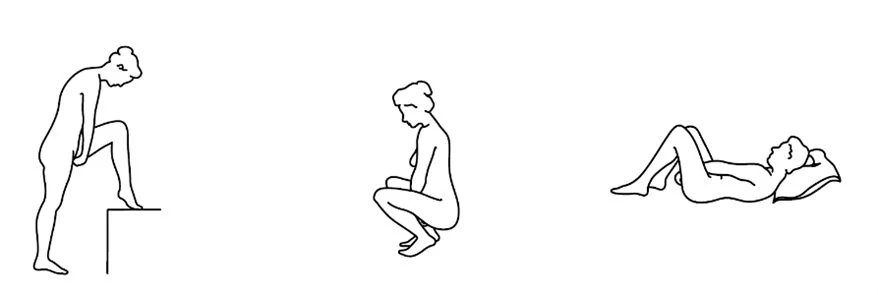
ESTRING can be inserted and removed by you or your doctor or healthcare provider. To insert ESTRING yourself, choose the position that is most comfortable for you: standing with one leg up, squatting, or lying down.
- 1. After washing and drying your hands, remove ESTRING from its pouch using the tear-off notch on the side. (Since the ring becomes slippery when wet, be sure your hands are dry before handling it.)
- 2. Hold ESTRING between your thumb and index finger and press the opposite sides of the ring together as shown.
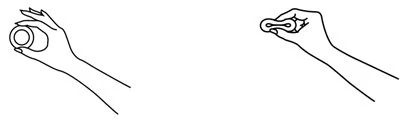
- 3. Gently push the compressed ring into your vagina as far as you can.
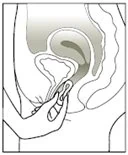
ESTRING PLACEMENT
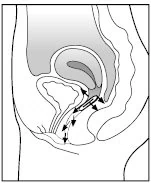
The exact position of ESTRING is not critical, as long as it is placed in the upper third of the vagina.
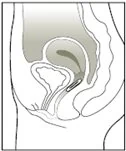
When ESTRING is in place, you should not feel anything. If you feel uncomfortable, ESTRING is probably not far enough inside. Use your finger to gently push ESTRING further into your vagina.
There is no danger of ESTRING being pushed too far up in the vagina or getting lost. ESTRING can only be inserted as far as the end of the vagina, where the cervix (the narrow, lower end of the uterus) will block ESTRING from going any further (See diagram of Female Anatomy).
ESTRING USE
Once inserted, ESTRING should remain in place in the vagina for 90 days.
Most women and their partners experience no discomfort with ESTRING in place during intercourse, so it is NOT necessary that the ring be removed. If ESTRING should cause you or your partner any discomfort, you may remove it prior to intercourse (See ESTRING Removal, below). Be sure to reinsert ESTRING as soon as possible afterwards.
ESTRING may slide down into the lower part of the vagina as a result of the abdominal pressure or straining that sometimes accompanies constipation. If this should happen, gently guide ESTRING back into place with your finger.
There have been rare reports of ESTRING falling out in some women following intense straining or coughing. If this should occur, simply wash ESTRING with lukewarm (NOT hot) water and reinsert it.
ESTRING DRUG DELIVERY
Once in the vagina, ESTRING begins to release estradiol immediately. ESTRING will continue to release a low, continuous dose of estradiol for the full 90 days it remains in place.
It will take about 2 to 3 weeks to restore the tissue of the vagina and urinary tract to a healthier condition and to feel the full effect of ESTRING in relieving vaginal and urinary symptoms. If your symptoms persist for more than a few weeks after beginning ESTRING therapy, contact your doctor or healthcare provider.
One of the most frequently reported effects associated with the use of ESTRING is an increase in vaginal secretions. These secretions are like those that occur normally prior to menopause and indicate that ESTRING is working. However, if the secretions are associated with a bad odor or vaginal itching or discomfort, be sure to contact your doctor or healthcare provider.
ESTRING REMOVAL
After 90 days there will no longer be enough estradiol in the ring to maintain its full effect in relieving your vaginal or urinary symptoms. ESTRING should be removed at that time and replaced with a new ESTRING, if your doctor determines that you need to continue your therapy.
To remove ESTRING:
- 1. Wash and dry your hands thoroughly.
- 2. Assume a comfortable position, either standing with one leg up, squatting, or lying down.
- 3. Loop your finger through the ring and gently pull it out.
- 4. Discard the used ring in a waste receptacle. (Do not flush ESTRING.)
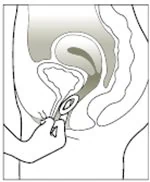
If you have any additional questions about removing ESTRING, contact your doctor or healthcare provider.

LAB-1533-4.0
Revised 4/2026