


Patient information: uses, side effects, how to take - Kirsty
What is KIRSTY?
KIRSTY is a man-made insulin that is used to control high blood sugar in adults and children with diabetes mellitus.
Who should not take KIRSTY?
Do not take KIRSTY if you:
- are having an episode of low blood sugar (hypoglycemia).
- have an allergy to insulin aspart products or any of the ingredients in KIRSTY.
Before taking KIRSTY, tell your healthcare provider about all your medical conditions, including if you are:
- pregnant, planning to become pregnant, or are breastfeeding.
- taking new prescription or over-the-counter medicines, vitamins, or herbal supplements.
Before you start taking KIRSTY, talk to your healthcare provider about low blood sugar and how to manage it.
How should I take KIRSTY?
- Read the Instructions for Use that come with your KIRSTY.
- Take KIRSTY exactly as your healthcare provider tells you to.
- KIRSTY starts acting fast. You should eat a meal within 5 to 10 minutes after you take your dose of KIRSTY.
- Know the type and strength of insulin you take. Do not change the type of insulin you take unless your healthcare provider tells you to. The amount of insulin and the best time for you to take your insulin may need to change if you take different types of insulin.
- Check your blood sugar levels. Ask your healthcare provider what your blood sugars should be and when you should check your blood sugar levels.
- Do not reuse or share your needles with other people. You may give other people a serious infection or get a serious infection from them.
- KIRSTY can be injected under the skin (subcutaneously) of your stomach area (abdomen), buttocks, upper legs (thighs), or upper arms or by continuous infusion under the skin (subcutaneously) through an insulin pump into an area of your body recommended in the instructions that come with your insulin pump.
Change (rotate) your injection sites within the area you choose with each dose to reduce your risk of getting lipodystrophy (pits in skin or thickened skin) and localized cutaneous amyloidosis (skin with lumps) at the injection sites.
- Do not use the exact same spot for each injection.
- Do not inject where the skin has pits, is thickened, or has lumps.
- Do not inject where the skin is tender, bruised, scaly or hard, or into scars or damaged skin.
What should I avoid while taking KIRSTY?
While taking KIRSTY do not:
- Drive or operate heavy machinery, until you know how KIRSTY affects you.
- Drink alcohol or use prescription or over-the-counter medicines that contain alcohol.
What are the possible side effects of KIRSTY?
KIRSTY may cause serious side effects that can lead to death, including:
Low blood sugar (hypoglycemia). Signs and symptoms that may indicate low blood sugar include:
- dizziness or light-headedness
- sweating
- confusion
- headache
- blurred vision
- slurred speech
- shakiness
- fast heartbeat
- anxiety, irritability or mood changes
- hunger
Your insulin dose may need to change because of:
- change in level of physical activity or exercise
- weight gain or loss
- increased stress
- illness
- change in diet
Other common side effects of KIRSTY may include:
- low potassium in your blood (hypokalemia), reactions at the injection site, itching, rash, serious allergic reactions (whole body reactions), skin thickening or pits at the injection site (lipodystrophy), weight gain, and swelling of your hands and feet.
Get emergency medical help if you have:
- trouble breathing, shortness of breath, fast heartbeat, swelling of your face, tongue, or throat, sweating, extreme drowsiness, dizziness, confusion.
These are not all the possible side effects of KIRSTY. Call your doctor for medical advice about side effects. You may report side effects to FDA at 1-800-FDA-1088.
General information about the safe and effective use of KIRSTY.
Medicines are sometimes prescribed for purposes other than those listed in a Patient Information leaflet. Do not use KIRSTY for a condition for which it was not prescribed. Do not give KIRSTY to other people, even if they have the same symptoms that you have. It may harm them.
You can ask your pharmacist or healthcare provider for information about KIRSTY that is written for health professionals.
What are the ingredients in KIRSTY?
Active ingredient: insulin aspart-xjhz
Inactive Ingredients: dibasic sodium phosphate , glycerin, m-cresol, phenol, sodium chloride, zinc, and Water for Injection, USP. Hydrochloric acid 1% and/or sodium hydroxide 1% may be added to adjust pH.
Manufactured by: Biocon Biologics Inc. 685 Route 202/206, Suite 204, Bridgewater, NJ 08807, U.S.A.
U.S License No. 2324, Product of Malaysia
This Patient Information has been approved by the U.S. Food and Drug Administration.
Revised: 01/2026
INSTRUCTIONS FOR USE
KIRSTY™ (kir-Stee)
(insulin aspart-xjhz)
injection, for subcutaneous use
10 mL multiple-dose vial: 100 units/mL (U-100)
Read this Instructions for Use before you start taking KIRSTY and each time you get a refill.
There may be new information. This information does not take the place of talking to your healthcare provider about your medical condition or your treatment.
Supplies you will need to give your KIRSTY injection:
- 10 mL KIRSTY vial
- insulin syringe and needle
- alcohol swabs
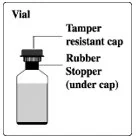
Preparing your KIRSTY dose:
- Wash your hands with soap and water.
- Before you start to prepare your injection, check the KIRSTY label to make sure that you are taking the right type of insulin. This is especially important if you use more than 1 type of insulin.
- KIRSTY should look clear and colorless. Do not use KIRSTY if it is thick, cloudy, or is colored.
- Do not use KIRSTY past the expiration date printed on the label.
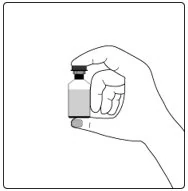
Step 1: Pull off the tamper resistant cap (See Figure A). Step 2: Wipe the rubber stopper with an alcohol swab (See Figure B). | 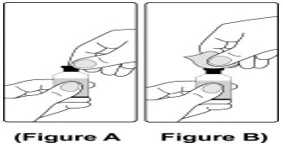 | |
| Step 3: Hold the syringe with the needle pointing up. Pull down on the plunger until the black tip reaches the line for the number of units for your prescribed dose (See Figure C). | 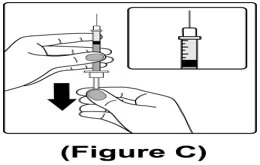 | |
| Step 4: Push the needle through the rubber stopper of the KIRSTY vial (See Figure D). | 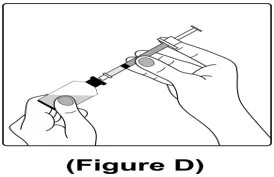 | |
| Step 5: Push the plunger all the way in. This puts air into the KIRSTY vial (See Figure E). | 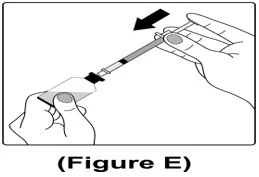 | |
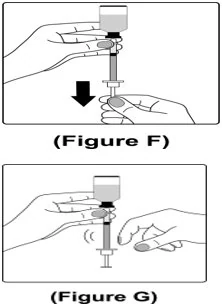
Step 6: Turn the KIRSTY vial and syringe upside down and slowly pull the plunger down until the black tip is a few units past the line for your dose (See Figure F).
|  | |
| Step 7: Slowly push the plunger up until the black tip reaches the line for your KIRSTY dose (See Figure H). | 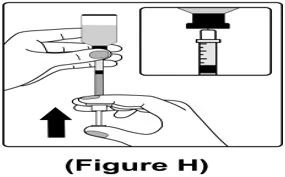 | |
| Step 8: Check the syringe to make sure you have the right dose of KIRSTY. | ||
| Step 9: Pull the syringe out of the vial’s rubber stopper (See Figure I). | 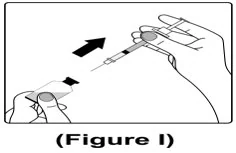 | |
Giving your injection:
- Inject your KIRSTY exactly as your healthcare provider has shown you. Your healthcare provider should tell you if you need to pinch the skin before injecting.
- KIRSTY can be injected under the skin (subcutaneously) of your stomach area, buttocks, upper legs or upper arms, infused in an insulin pump (continuous subcutaneous infusion into an area of your body recommended in the instructions that come with your insulin pump), or given through a needle in your arm (intravenously) by your healthcare provider.
- If you inject KIRSTY, change (rotate) your injection sites within the area you choose for each dose to reduce your risk of getting lipodystrophy (pits in skin or thickened skin) and localized cutaneous amyloidosis (skin with lumps) at the injection sites. Do not use the same injection site for each injection. Do not inject where the skin has pits, is thickened, or has lumps. Do not inject where the skin is tender, bruised, scaly or hard, or into scars or damaged skin.
- If you use KIRSTY in an insulin pump, you should change your infusion set and insertion site according to the manufacturer’s user manual. KIRSTY can be used with the continuous subcutaneous insulin infusion pumps labeled for use with KIRSTY or NOVOLOG. Read the insulin pump user manual to see if KIRSTY or NOVOLOG can be used. KIRSTY should be given into an area of your body recommended in the instructions that come with your insulin pump. Change (rotate) your insertion sites within the area you choose for each insertion to reduce your risk of getting lipodystrophy (pits in skin or thickened skin) and localized cutaneous amyloidosis (skin with lumps) at the insertion sites. Do not insert into the exact same spot for each insertion. Do not insert where the skin has pits, is thickened, or has lumps. Do not insert where the skin is tender, bruised, scaly or hard, or into scars or damaged skin. The insulin in the reservoir should be changed at least every 7 days or according to the pump user manual, whichever is shorter, even if you have not used all of the insulin.
- If you use KIRSTY in an insulin pump, see your insulin pump manual for instructions or talk to your healthcare provider.
- NPH insulin is the only type of insulin that can be mixed with KIRSTY. Do not mix KIRSTY with any other type of insulin.
- KIRSTY should only be mixed with NPH insulin if it is going to be injected right away under your skin (subcutaneously).
- KIRSTY should be drawn up into the syringe before you draw up your NPH insulin.
- Talk to your healthcare provider if you are not sure about the right way to mix KIRSTY and NPH insulin.
| Step 10: Choose your injection site (stomach area, buttocks, upper legs or upper arms) and wipe the skin with an alcohol swab. Let the injection site dry before you inject your dose (See Figure J). |  |
| Step 11: Insert the needle into your skin. Push down on the plunger to inject your dose (See Figure K). The needle should remain in the skin for at least 6 seconds to make sure you have injected all the insulin. | 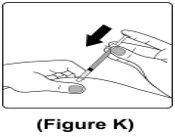 |
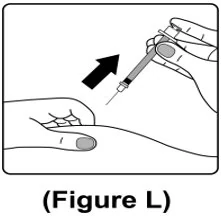
Step 12: Pull the needle out of your skin. After that, you may see a drop of KIRSTY at the needle tip. This is normal and does not affect the dose you just received (See Figure L).
|  |
After your injection:
- Do not recap the needle. Recapping the needle can lead to a needle stick injury.
- Put the empty insulin vials, used needles and syringes in a FDA-cleared sharps disposal container right away after use. Do not throw away (dispose of) loose needles and syringes in your household trash.
If you do not have a FDA-cleared sharps disposal container, you may use a household container that is:
- made of a heavy-duty plastic,
- can be closed with a tight-fitting, puncture-resistant lid, without sharps being able to come out,
- upright and stable during use,
- leak-resistant, and properly labeled to warn of hazardous waste inside the container.
- When your sharps disposal container is almost full, you will need to follow your community guidelines for the right way to dispose of your sharps disposal container. There may be state or local laws about how you should throw away used needles and syringes. For more information about safe sharps disposal, and for specific information about sharps disposal in the state that you live in, go to the FDA’s website at: http://www.fda.gov/safesharpsdisposal.
- Do not dispose of your used sharps disposal container in your household trash unless your community guidelines permit this. Do not recycle your used sharps disposal container.
How should I store KIRSTY?
- Do not freeze KIRSTY. Do not use KIRSTY if it has been frozen.
- Keep KIRSTY away from heat or light.
All unopened vials:
- Store unopened KIRSTY vials in the refrigerator at 36°F to 46°F (2°C to 8°C).
- Unopened vials may be used until the expiration date printed on the label, if they have been stored in the refrigerator.
- Unopened vials should be thrown away after 28 days, if they are stored at room temperature up to 86°F (30°C).
After vials have been opened:
- Opened KIRSTY vials can be stored in the refrigerator at 36°F to 46°F (2°C to 8°C) or at room temperature up to 86°F (30°C).
- Throw away all opened KIRSTY vials after 28 days, even if they still have insulin left in them.
- If using KIRSTY in a pump, throw away all opened KIRSTY vials after 19 days.
General information about the safe and effective use of KIRSTY
- Always use a new syringe and needle for each injection.
- Do not share syringes or needles.
- Keep KIRSTY vials, syringes, and needles out of the reach of children.
This Instructions for Use has been approved by the U.S. Food and Drug Administration.
KIRSTY™ is a trademark of Biocon Biologics UK PLC; a Biocon Biologics company.
Copyright © 2025 Biocon Biologics Inc. All rights reserved.
Manufactured by:
Biocon Biologics Inc.
685 Route 202/206, Suite 204,
Bridgewater, NJ 08807, U.S.A.
U.S. License No. 2324
Product of Malaysia
Revised: 01/2026
INSTRUCTIONS FOR USE
KIRSTY (kir-Stee)
(insulin aspart-xjhz) injection, for subcutaneous use
Prefilled Pen
Introduction
Please read the following instructions carefully before using your KIRSTY Prefilled Pen.
Do not share your KIRSTY Prefilled Pen with other people, even if the needle has been changed. You may give other people a serious infection, or get a serious infection from them.
KIRSTY Prefilled Pen is a disposable, single-patient-use, dial-a-dose insulin pen.
You can select doses from 1 to 80 units in increments of 1 unit.
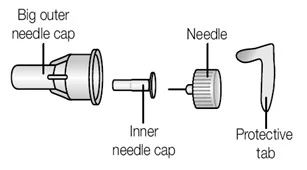
Only use needles that are compatible for use with KIRSTY Prefilled Pen which are sold separately, including needles from Embecta (such as Embecta UltraFine),
People who are blind or have vision problems should not use this Pen without help from a person trained to use the Pen.
Getting ready
Make sure you have the following items:
- KIRSTY Prefilled Pen
- a new sterile needle (see Step B)
- Alcohol swabs
KIRSTY Prefilled Pen
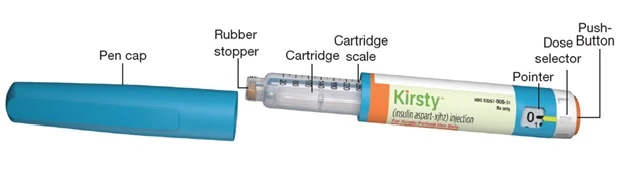
Needle (example)
Preparing your KIRSTY Prefilled Pen
- Wash your hands with soap and water.
- Before you start to prepare your injection, check the label to make sure that you are taking the right type of insulin. This is especially important if you take more than 1 type of insulin.
- KIRSTY should look clear and colorless. Do not use your KIRSTY Prefilled Pen if the liquid contains particles or is colored.
| 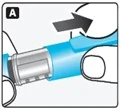 |
| 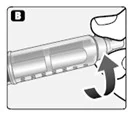 |
| 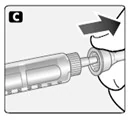 |
|  |
| |
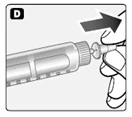
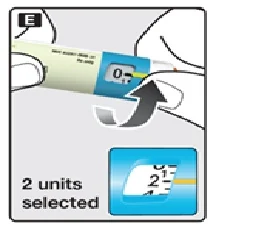
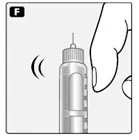
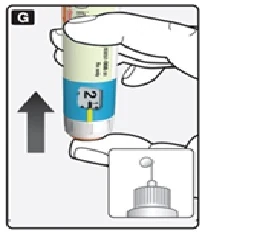
Giving the airshot before each injection Before each injection small amounts of air may collect in the cartridge during normal use. To avoid injecting air and to ensure proper dosing: | |
|  |
|  |
|  |
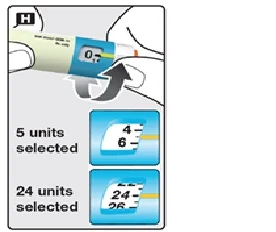
Selecting your dose Check and make sure that the dose selector is set at 0. | |
|  |
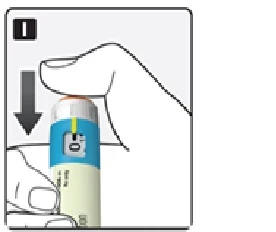
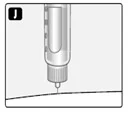
Giving the injection Do the injection exactly as shown to you by your healthcare provider. Your healthcare provider should tell you if you need to pinch the skin before injecting. Wipe the skin with an alcohol swab and let the area dry. KIRSTY can be injected under the skin (subcutaneously) of your stomach area, buttocks, upper legs (thighs), or upper arms.
| |
|  |
|  |
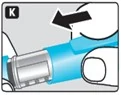
After the injection Do not recap the needle. Recapping can lead to a needle stick injury. Remove the needle from the KIRSTY Prefilled Pen after each injection and dispose of it. This helps to prevent infection, leakage of insulin, and will help to make sure you inject the right dose of insulin. If you do not have a sharps container, carefully slip the needle into the outer needle cap. Safely remove the needle and throw it away as soon as you can.
The KIRSTY Prefilled Pen prevents the cartridge from being completely emptied. It is designed to deliver 300 units. | |
|  |
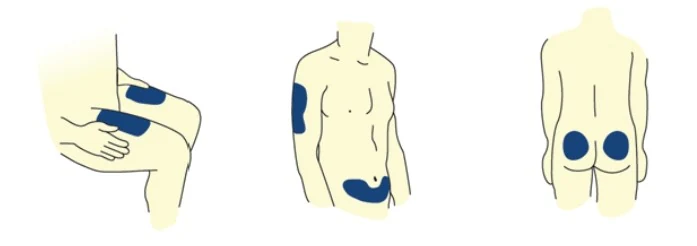 Change (rotate) your injection sites within the area you choose for each dose to reduce your risk of getting lipodystrophy (pits in skin or thickened skin) and localized cutaneous amyloidosis (skin with lumps) at the injection sites. Do not use the same injection site for each injection. Do not inject where the skin has pits, is thickened, or has lumps. Do not inject where the skin is tender, bruised, scaly or hard, or into scars or damaged skin.
How should I store KIRSTY Prefilled Pen?
- Do not freeze KIRSTY. Do not use KIRSTY if it has been frozen.
- Keep KIRSTY away from heat or light.
- Store the KIRSTY Prefilled Pen without the needle attached.
Until first use:
- Store unused KIRSTY Prefilled Pen in the refrigerator at 36°F to 46°F (2°C to 8°C).
- Unused KIRSTY Prefilled Pen may be used until the expiration date printed on the label, if kept in the refrigerator.
- Unused KIRSTY Prefilled Pen stored at room temperature up to 86°F (30°C) should be thrown away after 28 days.
In-use:
- Store the KIRSTY Prefilled Pen you are currently using out of the refrigerator at room temperature up to 86°F (30°C) for up to 28 days.
- The KIRSTY Prefilled Pen you are using should be thrown away after 28 days, even if it still has insulin left in it.
Maintenance
For the safe and proper use of your Prefilled Pen be sure to handle it with care. Avoid dropping your Prefilled Pen as it may damage it. If you are concerned that your Prefilled Pen is damaged, use a new one. You can clean the outside of your Prefilled Pen by wiping it with a damp cloth. Do not soak or wash your Prefilled Pen as it may damage it. Do not refill your Prefilled Pen.
- Remove the needle from the KIRSTY Prefilled Pen after each injection. This helps to ensure sterility, prevent leakage of insulin, and will help to make sure you inject the right dose of insulin for future injections.
- Be careful when handling used needles to avoid needle sticks and transfer of infectious diseases.
- Keep your KIRSTY Prefilled Pen and needles out of the reach of children.
- Use KIRSTY Prefilled Pen as directed to treat your diabetes.
- Do not share your KIRSTY Prefilled Pen or needles with other people.
- You may give other people a serious infection, or get a serious infection from them.
- Always use a new needle for each injection.
- Biocon Biologics Inc. is not responsible for harm due to using this insulin pen with products not recommended by Biocon Biologics Inc.
- As a precautionary measure, always carry a spare insulin delivery device in case your KIRSTY Prefilled Pen is lost or damaged.
- Remember to keep the disposable KIRSTY Prefilled Pen with you. Do not leave it in a car or other location where it can get too hot or too cold.
This Instructions for Use has been approved by the U.S. Food and Drug Administration.
KIRSTY™ is a trademark of Biocon Biologics UK PLC; a Biocon Biologics company.
Copyright © 2025 Biocon Biologics Inc. All rights reserved.
Manufactured by:
Biocon Biologics Inc.
685 Route 202/206, Suite 204,
Bridgewater, NJ 08807, U.S.A.
U.S. License No. 2324
Product of Malaysia
Revised: 01/2026