


Patient information: uses, side effects, how to take - Hydroxyurea
What is the most important information I should know about Hydroxyurea tablets?
Hydroxyurea tablets can cause serious side effects including:
- Low blood cell counts are common with hydroxyurea tablets, including low red blood cells, white blood cells, and platelets, and can be severe and life-threatening. If your white blood cell count becomes very low, you are at increased risk for infection. Your healthcare provider will check your blood cell counts before and every 2 weeks during treatment with hydroxyurea tablets. Your healthcare provider may change your dose or tell you to stop taking hydroxyurea tablets if you have low blood cell counts. Tell your healthcare provider right away if you get any of the following symptoms:

- Cancer. Some people have developed cancer, such as leukemia and skin cancer, after taking hydroxyurea tablets for a long time. Your healthcare provider will check you for cancer. You should protect your skin from the sun using sunblock, hats, and sun-protective clothing.
- Hydroxyurea tablets can harm your unborn baby.
For females taking hydroxyurea tablets who can become pregnant:
- You should talk with your healthcare provider about the risks of hydroxyurea tablets to your unborn baby.
- You should use effective birth control during treatment with hydroxyurea tablets and for at least 6 months after treatment with hydroxyurea tablets.
- Your healthcare provider will perform a pregnancy test before you start treatment with hydroxyurea tablets. Tell your healthcare provider right away if you become pregnant or think you may be pregnant.
For males taking hydroxyurea tablets: hydroxyurea tablets can affect your sperm. If you have a female sexual partner who can become pregnant, you should use effective birth control during treatment with hydroxyurea tablets and for at least 6 months after treatment.
Hydroxyurea tablets may cause fertility problems in males. Talk to your healthcare provider if this is a concern for you.
See “What are the possible side effects of hydroxyurea tablets?” for more information about side effects.
What are hydroxyurea tablets?
Hydroxyurea Tablets is a prescription medicine that is used to reduce the frequency of painful crises and reduce the need for blood transfusions in adults and children, 2 years of age and older, with sickle cell anemia with recurrent moderate to severe painful crises. It is not known if hydroxyurea tablets are safe and effective in children less than 2 years of age.
Do not take hydroxyurea tablets if you are allergic to hydroxyurea or any of the ingredients in hydroxyurea tablets. See the end of this Medication Guide for a list of the ingredients in hydroxyurea tablets.
Before taking hydroxyurea tablets, tell your healthcare provider about all of your medical conditions, including if you:
- have kidney problems or are receiving hemodialysis
- have liver problems
- have human immunodeficiency virus (HIV) or take HIV medicines. Taking hydroxyurea tablets with certain HIV medicines can cause serious reactions and may lead to death.
- have increased levels of uric acid in your blood (hyperuricemia)
- have a history of receiving interferon therapy or are currently receiving interferon therapy
- have leg wounds or ulcers
- plan to receive any vaccinations. You should not receive “live vaccines” during treatment with hydroxyurea tablets.
are pregnant or plan to become pregnant. See “What is the most important information I should know about hydroxyurea tablets?”
- are breastfeeding or plan to breastfeed. It is not known if hydroxyurea can pass into your breast milk. Do not breastfeed during treatment with hydroxyurea tablets.
- are using a continuous glucose monitor (CGM) to test your blood glucose. Hydroxyurea may affect your sensor glucose results and may lead to low blood sugar (hypoglycemia). Talk to the healthcare provider that prescribed your CGM about whether it is safe to use while you are taking hydroxyurea tablets.
Tell your healthcare provider about all the medicines you take, including prescription and over-the-counter medicines, vitamins, and herbal supplements.
How should I take hydroxyurea tablets?
Read the Instructions for Use at the end of this Medication Guide for step-by-step instructions on how to prepare a dose of hydroxyurea tablets. If you have any questions, talk to your healthcare provider or pharmacist.
- Take hydroxyurea tablets exactly as your healthcare provider tells you to take it.
- Take hydroxyurea 1 time a day at the same time each day.
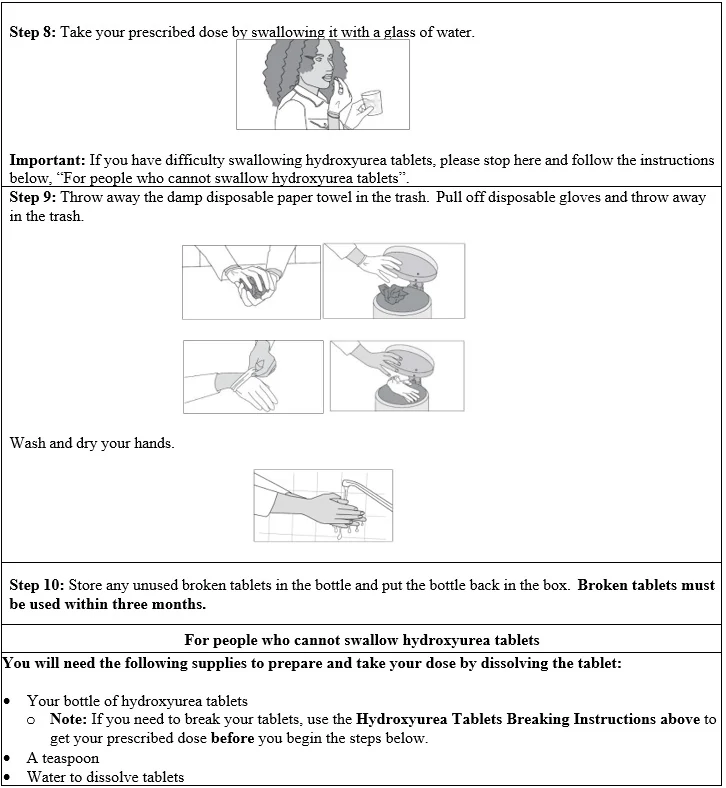
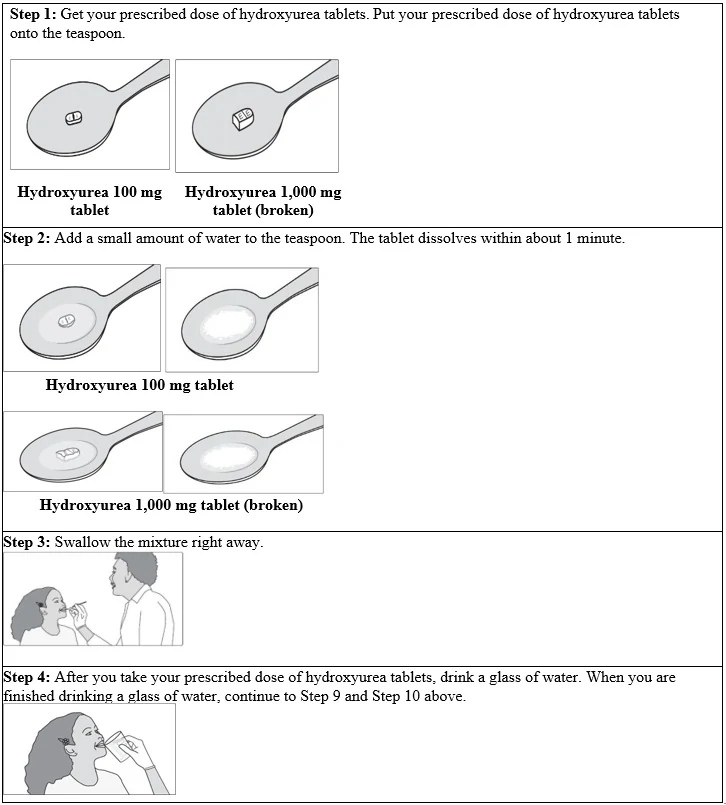
- Swallow the tablet(s) with a glass of water. If you are not able to swallow hydroxyurea tablets, you can dissolve your prescribed dose in a small amount of water in a teaspoon and swallow right away.
Hydroxyurea tablets are supplied as 100 mg tablets and 1,000 mg tablets. The hydroxyurea tablets have separation lines (score lines) and can be broken at these score lines to provide smaller doses.
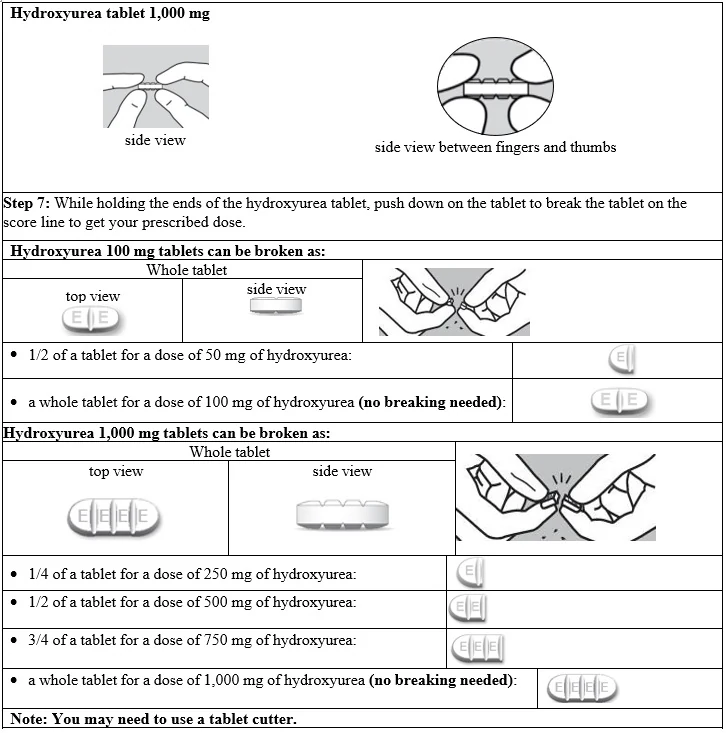
- Each 100 mg tablet can be divided into 2 equal parts (each part is 50 mg).
- Each 1,000 mg tablet can be divided into 4 equal parts (each part is 250 mg).
- Your healthcare provider will tell you how many tablets or parts of a tablet you should take.
Hydroxyurea tablets must be handled with care. To decrease the risk of exposure, you or your caregivers should do the following when handling hydroxyurea tablets:
- Wear disposable gloves when handling hydroxyurea tablets or bottles containing hydroxyurea tablets. Wash your hands with soap and water before and after handling hydroxyurea tablets or bottles containing hydroxyurea tablets.
- Avoid contact with crushed tablets. If contact with crushed tablets happens on the skin, wash the skin area right away and thoroughly with soap and water. If contact with crushed tablets happens in the eyes, flush the eyes thoroughly with water or isotonic eyewash used for that purpose for at least 15 minutes.
- Powder spilled from the broken tablet should be wiped up with a damp disposable towel which must be thrown away in a closed container such as a plastic bag to avoid ingestion of powder by other people. The spill areas should then be cleaned using a detergent solution followed by clean water.
- If you take too much hydroxyurea tablets, call your healthcare provider or go to the nearest hospital emergency room right away.
What are the possible side effects of hydroxyurea tablets?
Hydroxyurea tablets may cause serious side effects, including:
See “What is the most important information I should know about hydroxyurea tablets?”
- Skin ulcers, including leg ulcers, and death of skin tissue (gangrene) have happened in people who take hydroxyurea tablets. This has happened most often in people who receive interferon therapy or have a history of interferon therapy. Your healthcare provider will decrease your dose or stop treatment with hydroxyurea tablets if you develop any skin ulcers.
- Enlarged red blood cells (macrocytosis). Macrocytosis is common in people who take hydroxyurea tablets and can make it difficult to detect a decrease of folic acid. Your healthcare provider may prescribe a folic acid supplement for you.
- Hemolytic Anemia, the fast breakdown of red blood cells, has happened in people who take hydroxyurea tablets. Tell your healthcare provider if you develop yellowing of your skin (jaundice) or blood in your urine. Your healthcare provider may do blood tests if you have persistent or worsening anemia not related to sickle cell anemia.
The most common side effects of hydroxyurea tablets in children include:
- infections
- low white blood cells
The most common side effects of hydroxyurea tablets in adults include:
- infections
- headache
- dry skin
These are not all the possible side effects of hydroxyurea tablets.
Call your doctor for medical advice about side effects. You may report side effects to FDA at 1-800-FDA-1088.
How should I store hydroxyurea tablets?
- Store hydroxyurea tablets at room temperature between 68°F to 77°F (20°C to 25°C).
- Keep the hydroxyurea tablets bottle tightly closed.
- Broken hydroxyurea tablets must be stored in the bottle and must be used within three months.
Keep hydroxyurea tablets and all medicines out of the reach of children.
General information about the safe and effective use of hydroxyurea tablets.
Medicines are sometimes prescribed for purposes other than those listed in a Medication Guide. Do not use hydroxyurea tablets for a condition for which it was not prescribed. Do not give hydroxyurea tablets to other people, even if they have the same symptoms you have. It may harm them. You can ask your healthcare provider or pharmacist for information about hydroxyurea tablets that is written for health professionals.
What are the ingredients of hydroxyurea tablets? Active ingredient: hydroxyurea
Inactive ingredients: microcrystalline cellulose, colloidal silicon dioxide, sodium stearyl fumarate, film-coating agent amino methacrylate copolymer.
Manufactured by:
Esjay Pharma Private Limited,
Sipcot Industrial Park, Kancheepuram,
Tamilnadu, India – 602117
Distributed by:
ANI Pharmaceuticals, Inc.
Baudette, MN 56623
This Medication Guide has been approved by the U.S. Food and Drug Administration.
P3580/00/26
Issued: 10/2026
INSTRUCTIONS FOR USE
HYDROXYUREA (hye drox″ ee ure ee′ a)
tablets
Read this Instructions for Use before you start taking hydroxyurea tablets and each time you get a refill. There may be new information. This Instructions for Use does not take the place of talking to your healthcare provider about your medical condition or treatment. You and your healthcare provider should talk about hydroxyurea tablets when you start taking it and at regular checkups.
Important Information:
- Wash your hands with soap and water before and after handling hydroxyurea tablets or bottles containing hydroxyurea tablets.
- Wear disposable gloves when handling hydroxyurea tablets or bottles containing hydroxyurea tablets.
- Take hydroxyurea tablet 1 time a day at the same time each day.
- Powder spilled from a broken tablet should be wiped up right away with a damp disposable paper towel and thrown away in a closed container, such as a plastic bag to avoid harm to other people. The spill area should then be cleaned using a detergent solution followed by clean water.
- When the tablet is broken, avoid touching the broken surfaces.
- If contact with crushed tablets happens on the skin, wash the skin area right away and thoroughly with soap and water.
- If contact with crushed tablets happens in the eyes, flush the eyes thoroughly with water or isotonic eyewash used for that purpose for at least 15 minutes.
Hydroxyurea tablets are supplied in 2 different strengths:
Hydroxyurea tablets 100 mg 
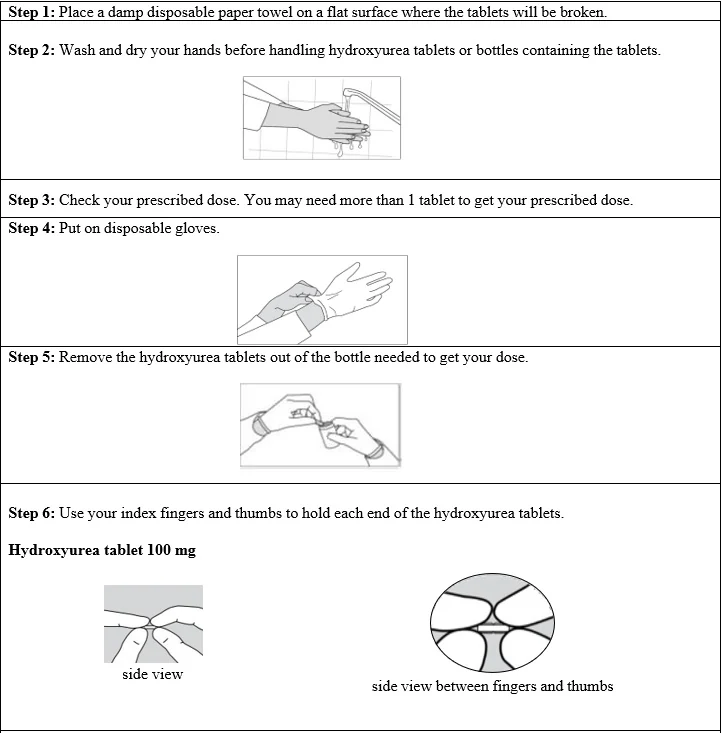
Hydroxyurea 100 mg tablet has one separation line (score line) and can be broken at this score line to provide smaller doses. Each 100 mg tablet can be divided into 2 equal parts (each part is 50 mg).
Hydroxyurea tablets 1000 mg 
Hydroxyurea 1,000 mg tablet has three separation lines (score lines) and can be broken at these score lines to provide smaller doses. Each 1,000 mg tablet can be divided into 4 equal parts (each part is 250 mg).
Hydroxyurea Tablets Breaking Instructions
You will need the following supplies to break a hydroxyurea tablets:
- Hydroxyurea tablets
- A damp disposable paper towel
- A tablet cutter
- Disposablegloves
Storing your hydroxyurea tablets:
- Store hydroxyurea tablets at room temperature between 68°F to 77°F (20°C to 25°C).
- Keep the hydroxyurea tablets bottle tightly closed.
Keep hydroxyurea tablets and all medicines out of the reach of children.
Manufactured by:
Esjay Pharma Private Limited,
Sipcot Industrial Park, Kancheepuram,
Tamilnadu, India – 602117
Distributed by:
ANI Pharmaceuticals, Inc.
Baudette, MN 56623
This Instructions for Use has been approved by the U.S. Food and Drug Administration.
P3580/00/26
Issued: 10/2026