


Prescribing information (package insert) - Enlicitide
1 INDICATIONS AND USAGE
LIPFENDRA® is indicated as an adjunct to diet and exercise to reduce low-density lipoprotein cholesterol (LDL-C) in adults with hypercholesterolemia, including heterozygous familial hypercholesterolemia (HeFH).
Cardiovascular outcomes trials have demonstrated that reducing LDL-C lowers the risk for major adverse cardiovascular events (MACE) in adults at increased risk when treated with statins or monoclonal antibody proprotein convertase subtilisin kexin type 9 (PCSK9) inhibitors as an add-on to statin therapy.
2 DOSAGE AND ADMINISTRATION
2.1 Recommended Dosage
- The recommended dosage of LIPFENDRA is one 20 mg tablet taken orally once daily.
- Assess LDL-C when clinically appropriate. The LDL-C-lowering effect of LIPFENDRA may be measured as early as 4 weeks after initiation.
2.2 Important Administration Instructions
- Take LIPFENDRA on an empty stomach in the morning with water, black coffee, or plain tea.
- Swallow the tablet whole. Do not split, crush, or chew the tablet.
- After taking LIPFENDRA, wait at least 30 minutes before eating food or drinking beverages other than water, black coffee, or plain tea [see Clinical Pharmacology (12.3)].
- LIPFENDRA can be taken with other medications [see Clinical Pharmacology (12.3)].
- If a dose is missed, take the missed dose as soon as possible, at least 30 minutes before the next food or drink (other than water, black coffee, or plain tea). Do not take 2 doses on the same day.
3 DOSAGE FORMS AND STRENGTHS
Tablets: 20 mg enlicitide, white to off-white with grey specks, oval-shaped, film-coated, debossed with “119” on one side and the corporate logo on the other side
4 CONTRAINDICATIONS
None.
6 ADVERSE REACTIONS
6.1 Clinical Trials Experience
Because clinical trials are conducted under widely varying conditions, adverse reaction rates observed in the clinical trials of a drug cannot be directly compared to rates in the clinical trials of another drug and may not reflect the rates observed in practice.
Adverse Reactions in Adults with Hypercholesterolemia
The safety of LIPFENDRA was evaluated in Trial 1 (CORALreef Lipids, NCT05952856), a 52-week, multicenter, double-blind, randomized, placebo-controlled trial in 2,904 patients with hypercholesterolemia (including those with and without HeFH) and a history of a major atherosclerotic cardiovascular disease (ASCVD) event or increased risk for development of a first major ASCVD event [see Clinical Studies (14)]. In Trial 1, the frequencies of adverse reactions in adults with hypercholesterolemia were similar between those treated with LIPFENDRA and those receiving placebo. Similar proportions of LIPFENDRA-treated patients and placebo-treated patients discontinued treatment because of an adverse reaction.
Adverse Reactions in Adults with HeFH
The safety of LIPFENDRA was evaluated in Trial 2 (CORALreef HeFH, NCT05952869), a 52-week multicenter, double-blind, randomized, placebo-controlled trial in 303 patients with HeFH [see Clinical Studies (14)]. In Trial 2, the most common adverse reactions in adults with HeFH treated with LIPFENDRA that occurred at higher frequencies compared to placebo were diarrhea (LIPFENDRA 7%, placebo 2%) and dizziness (LIPFENDRA 9%, placebo 4%). Similar proportions of LIPFENDRA-treated patients and placebo-treated patients discontinued treatment because of an adverse reaction. The safety profile observed in adults with HeFH in Trial 2 was otherwise generally consistent with that observed in adults with hypercholesterolemia in Trial 1.
8 USE IN SPECIFIC POPULATIONS
8.1 Pregnancy
Risk Summary
Discontinue LIPFENDRA when pregnancy is recognized unless the benefits of therapy outweigh the potential risks to the fetus. Alternatively, consider the ongoing therapeutic needs of the individual patient. Enlicitide increases LDL-C uptake and lowers LDL-C levels in the circulation, thus decreasing cholesterol and possibly other biologically active substances derived from cholesterol; therefore, LIPFENDRA may cause fetal harm when administered to pregnant patients based on the mechanism of action [see Clinical Pharmacology (12.1)].
There are insufficient data on the use of LIPFENDRA in pregnant patients to evaluate for a drug-associated risk of major birth defects, miscarriage or adverse maternal or fetal outcomes. Consider the benefits and risks of LIPFENDRA when prescribing LIPFENDRA to pregnant women.
In animal reproduction studies, no adverse embryofetal developmental effects were observed in pregnant rats and rabbits administered enlicitide subcutaneously during organogenesis (up to 58- and 51-fold, respectively, the human exposure at the recommended human dose (RHD), based on AUC) (see Data).
The estimated background risk of major birth defects and miscarriage for the indicated population is unknown. In the U.S. general population, the estimated background risk of major birth defects and miscarriage in clinically recognized pregnancies is 2 to 4% and 15 to 20%, respectively.
Data
Animal Data
In the embryofetal developmental rat toxicity study, pregnant rats were administered enlicitide subcutaneously at 0.5, 3, or 10 mg/kg/day during the period of organogenesis (Gestational Days (GD) 6 through 17). No adverse embryofetal or maternal effects were observed up to 10 mg/kg/day (58-fold the human exposure at the RHD, based on AUC).
In the embryofetal developmental rabbit toxicity study, pregnant rabbits were administered enlicitide subcutaneously at 0.2, 0.5, or 3 mg/kg/day during the period of organogenesis (GD7 through 19). No adverse embryofetal or maternal effects were observed up to 3 mg/kg/day (51-fold the human exposure at the RHD, based on AUC).
In the rat pre- and postnatal developmental toxicity study, enlicitide was administered subcutaneously at 0.5, 3, or 10 mg/kg/day daily from GD 6 through lactation day (LD) 20. No adverse developmental or maternal effects were observed up to 10 mg/kg/day (58-fold the human exposure at the RHD, based on AUC).
Enlicitide crosses the placenta and was detected in rat fetal plasma at concentrations that were 3 to 5% of mean maternal plasma concentrations.
8.2 Lactation
Risk Summary
There is no information on the presence of enlicitide in human milk, the effects on the breastfed infant, or the effects on milk production. Enlicitide was detected at low concentrations in the plasma of nursing pups from lactating rats administered subcutaneous enlicitide (see Data).
The developmental and health benefits of breastfeeding should be considered along with the mother's clinical need for LIPFENDRA and any potential adverse effects on the breastfed child from LIPFENDRA or from the underlying maternal condition [see Clinical Pharmacology (12.1)].
Data
Animal Data
Enlicitide was detected in the plasma of nursing pups (LD 7) from lactating rats administered enlicitide subcutaneously at 0.5, 3, and 10 mg/kg/day from GD 6 to LD 7, with the majority of individual pup-to-maternal plasma concentrations ≤0.7% across doses.
8.4 Pediatric Use
The safety and effectiveness of LIPFENDRA have not been established in pediatric patients.
8.5 Geriatric Use
Of the 2,137 patients treated with LIPFENDRA in placebo-controlled trials, 960 (45%) patients were 65 years of age and older, and 252 (12%) patients were 75 years of age and older. No overall differences in safety or effectiveness were observed between patients 65 years of age and older and younger adult patients.
10 OVERDOSAGE
There is no specific treatment for overdose with LIPFENDRA. In the event of an overdose of LIPFENDRA, consider contacting the Poison Help line (1-800-222-1222) or a medical toxicologist for additional overdosage management recommendations.
11 DESCRIPTION
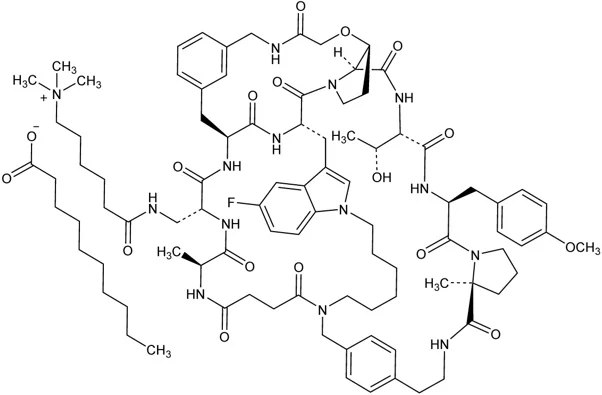
LIPFENDRA (enlicitide) tablets for oral use contain enlicitide decanoate, a PCSK9 inhibitor.
The chemical name of enlicitide decanoate is 6-({[(11S,17S,20S,23S,27S,39S,42S,63S,66R)-47-Fluoro-20-[(1R)-1-hydroxyethyl]-17-[(4-methoxyphenyl)methyl]-11,63-dimethyl-10,16,19,22,30,40,58,61,64,67,70-undecaoxo-28-oxa-1,9,15,18,21,24,31,41,51,62,65,68-dodecaazanonacyclo[37.18.11.23,6.124,42.133,37.144,51.011,15.023,27.045,50]triheptaconta-3,5,33(71),34,36,44(69),45,47,49,72-decaen-66-yl]methyl}amino)-N,N,N-trimethyl-6-oxohexan-1-aminium decanoate.
Enlicitide decanoate is a white to off-white powder that is slightly soluble in water. The molecular formula is C92H129FN14O17 and the molecular weight is 1722.12 g/mol. The chemical structure of enlicitide decanoate is:
 |
LIPFENDRA is available as film-coated tablets for oral administration, each containing 20 mg of enlicitide (equivalent to 22.21 mg enlicitide decanoate) and the following inactive ingredients: colloidal silicon dioxide, croscarmellose sodium, lactose monohydrate, magnesium stearate, microcrystalline cellulose, and sodium caprate.
The film coating contains calcium carbonate, ethylene glycol and vinyl alcohol graft copolymer, glyceryl mono and dicaprylocaprate, polyvinyl alcohol, and talc. Carnauba wax is added as a polishing agent.
12 CLINICAL PHARMACOLOGY
12.1 Mechanism of Action
Enlicitide is a macrocyclic peptide that binds to PCSK9. PCSK9 binds to the low-density lipoprotein receptors (LDLR) on the surface of hepatocytes to promote LDLR degradation within the liver. By inhibiting the binding of PCSK9 to LDLR, enlicitide increases the number of LDLRs available to clear LDL-C, thereby lowering LDL-C levels.
12.2 Pharmacodynamics
Administration of single doses of enlicitide ≥10 mg results in a maximum reduction in plasma levels of free PCSK9 >90% at Tmax for enlicitide (0.5–1 hour postdose). Exposure–response analysis across enlicitide daily doses ranging from 0.5 times to 1.5 times the recommended dose demonstrated that the 20 mg dose achieved near-maximal reductions in plasma LDL-C in participants with hypercholesterolemia.
Cardiac Electrophysiology
At four times that of the clinical Cmax at the maximum recommended enlicitide dose, clinically significant QTc interval prolongation was not observed.
12.3 Pharmacokinetics
The geometric means (% coefficient of variation) of steady-state enlicitide AUC and Cmax following once daily enlicitide 20 mg were 308 nM•h (28%) and 15.5 nM (29%), respectively, in participants with hypercholesterolemia. Enlicitide plasma exposures were less than dose-proportional between 0.25 times and 15 times the recommended dosage of 20 mg. Steady-state is achieved by approximately 7 days with an accumulation ratio of 1.42.
Absorption
Each LIPFENDRA tablet contains sodium caprate, which facilitates the oral absorption of enlicitide. The oral bioavailability of enlicitide is approximately 1%. When LIPFENDRA is orally administered on an empty stomach in the morning with a meal given at least 30 minutes after the enlicitide dose, enlicitide is rapidly absorbed with a Tmax of approximately 0.5–1 hour.
Effect of Food
LIPFENDRA administration on an empty stomach in the morning, at least 30 minutes before a meal, does not affect the exposure of enlicitide. LIPFENDRA administration 30 minutes after a meal reduces steady-state AUC and Cmax by 48% and 50%, respectively, and delays Tmax.
Effect of Beverages
The administration of LIPFENDRA with black coffee or plain tea does not result in a clinically meaningful change in enlicitide exposure.
Distribution
The apparent steady-state volume of distribution of enlicitide is 2,384 L. Enlicitide exhibits concentration dependent plasma protein binding, ranging from 93% bound at 2 nM to 32% bound at 1 µM. Enlicitide blood to plasma ratio is approximately 0.6.
Elimination
The steady-state apparent clearance in participants with hypercholesterolemia is approximately 41 L/h at the 20 mg once daily dose. Enlicitide clearance increases with increasing concentration, resulting in non-linear pharmacokinetics (PK). Enlicitide has an effective half-life of approximately 14 hours and a terminal half-life of approximately 244 hours.
Metabolism
Enlicitide is minimally metabolized. No major metabolites of enlicitide have been identified.
Excretion
Enlicitide is primarily eliminated via glomerular filtration following IV administration, with approximately 73% and 8% of the dose excreted in urine and feces, respectively.
Specific Populations
Age, Sex, and Race/Ethnicity
There is no clinically meaningful effect of age (18 to 88 years), body weight (40 to 174 kg), sex, race (American Indian or Alaskan Native, Asian, Black or African American, White, or multi-racial), or ethnicity (Hispanic or Latino) on the PK of enlicitide.
Patients with Renal Impairment
Patients with mild (eGFR 60 to 89 mL/min), moderate (eGFR 30 to 59 mL/min), and severe renal impairment (eGFR less than 30 mL/min) are expected to have 5%, 11%, and 26% higher enlicitide steady-state exposure compared to patients with normal renal function. These increases in exposure are not clinically meaningful.
Compared to participants with normal renal function, single dose enlicitide exposure (AUC0-inf) was 17% and 75% higher in participants with end-stage renal disease (ESRD) on hemodialysis when enlicitide was administered before hemodialysis and after hemodialysis, respectively. These increases in exposure are not clinically meaningful.
Patients with Hepatic Impairment
The PK of enlicitide is not impacted by moderate hepatic impairment (Child-Pugh Class B). The PK of enlicitide in participants with severe hepatic impairment (Child-Pugh Class C) was not evaluated.
Drug Interaction Studies
No clinically meaningful drug interactions have been observed with LIPFENDRA. LIPFENDRA (formulated with the permeation enhancer, sodium caprate) did not affect the exposure of lithium, levothyroxine, digoxin, warfarin, atorvastatin, alendronate, lisinopril, or oral semaglutide tablets. Oral semaglutide tablets (formulated with salcaprozate sodium to facilitate absorption) or atorvastatin did not affect the exposure of enlicitide. Based on in vitro studies, LIPFENDRA has very low drug interaction potential via cytochrome P450 enzymes or drug transporters at the therapeutic dose.
13 NONCLINICAL TOXICOLOGY
13.1 Carcinogenesis, Mutagenesis, Impairment of Fertility
Carcinogenesis
In a 26-week study in RasH2Tg mice, enlicitide was administered daily both by subcutaneous and oral routes at subcutaneous/oral dosages of 2.5/1, 10/2 or 30/4 mg/kg/day. Enlicitide was not carcinogenic in rasH2 transgenic mice up to the highest dose tested, corresponding to 59-fold the human exposure at the RHD, based on AUC.
Based on a comprehensive assessment of the available toxicology data and the PCSK9-specific target, enlicitide is not expected to be carcinogenic in humans.
Mutagenesis
Enlicitide was not mutagenic or genotoxic in a standard battery of genotoxicity tests that included a microbial mutagenicity assay, an in vitro chromosome aberration assay and an in vivo micronucleus assay in rats.
Impairment of Fertility
In fertility and early embryonic-development studies, male or female rats were administered enlicitide subcutaneously at doses of 1, 5, or 10 mg/kg/day for 14 days (female) or 15 days (male) prior to cohabitation, during cohabitation, until the day prior to scheduled sacrifice (male) or through GD 7 (female). There were no adverse effects on fertility, mating performance or early embryonic development up to the highest dose tested, corresponding to 45-fold the human exposure at the RHD, based on AUC.
14 CLINICAL STUDIES
Primary Hypercholesterolemia in Adults
Trial 1 (CORALreef Lipids, NCT05952856) was a multicenter, double-blind, randomized, placebo-controlled trial in which 2,904 patients with hypercholesterolemia (including those with and without HeFH) and a history of a major atherosclerotic cardiovascular disease (ASCVD) event or increased risk for development of a first major ASCVD event were randomized in a 2:1 ratio to receive LIPFENDRA 20 mg orally once daily (n=1,935) or placebo (n=969) for 52 weeks. Patients required additional LDL-C reduction despite stable lipid-lowering treatment with moderate- or high-intensity statins (unless statin intolerance was documented) with or without other lipid-modifying therapy. Patients taking other PCSK9 inhibitors were excluded.
The mean age at baseline was 63 years (range: 19 to 89 years), 47% were 65 years or older, 39% were female, 54% were White, 26% were Asian, 11% were multi-racial, 9% were Black or African American, and <1% were American Indian or Alaska Native; 28% were of Hispanic or Latino ethnicity. At baseline, 50% had diabetes mellitus (49% type 2 diabetes), 58% had a history of an ASCVD event, and 42% were at increased risk for an ASCVD event. At baseline, 97% were receiving statin therapy (54%, 41%, and 1% were receiving high-, moderate-, or low-intensity statin therapy, respectively). The mean baseline LDL-C was 96 mg/dL.
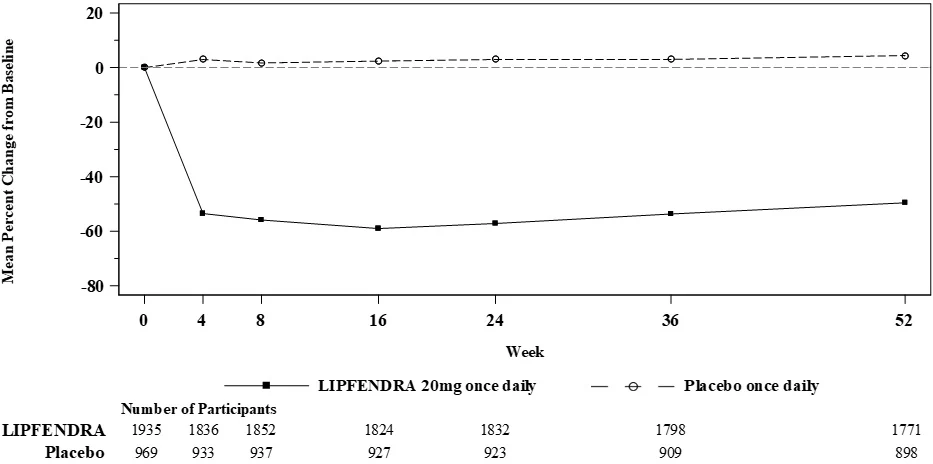
The primary efficacy outcome measure in Trial 1 was the percent change from baseline to Week 24 in LDL-C. The difference between the LIPFENDRA and placebo groups in mean percent change in LDL-C from baseline to Week 24 was -56% (95% CI: -61%, -51%; p<0.001). For additional results, see Table 1 and Figure 1.
Table 1: Percent Change in Lipid Parameters from Baseline to Week 24 in Trial 1 (Patients with Hypercholesterolemia and History of ASCVD Events or Increased Risk for First ASCVD Event)
| Treatment Group | LDL-C | Non-HDL-C | ApoB |
|---|---|---|---|
| ApoB = apolipoprotein B; CI = confidence interval; Non-HDL-C = non-high-density lipoprotein cholesterol; LDL-C = low-density lipoprotein cholesterol | |||
| Summary statistics shown for LIPFENDRA and placebo rows are raw values based on observed data and do not account for missing data. | |||
| The percent change from baseline for LDL-C at 24 weeks was -60% for LIPFENDRA and +3% for placebo, respectively, when LDL-C values ≤0 were set to missing according to revised data handling rules (post-hoc). The difference between the LIPFENDRA and placebo groups in percent change in LDL-C from baseline to Week 24 was -60% (95% CI: -62%, -57%). | |||
| Treatment-specific results are the mean percent changes from baseline at Week 24. The differences from placebo are estimated differences based on an analysis of covariance model with treatment and the stratification factors (renal function and geographic region) as fixed effects and baseline as a covariate. Missing data at Week 24 were handled via multiple imputation using a control-based imputation method. | |||
| LIPFENDRA (n=1,935) | -57 | -54 | -50 |
| Placebo (n=969) | 3 | 3 | 3 |
Difference from placebo (95% CI) | -56 (-61, -51) | -53 (-55, -51) | -50 (-52, -49) |
Figure 1: Observed Mean Percent Change in LDL-C from Baseline Over 52 Weeks in Trial 1 (Patients with Hypercholesterolemia and History of ASCVD or Increased Risk for First ASCVD Event)
 |
Heterozygous Familial Hypercholesterolemia in Adults
Trial 2 (CORALreef HeFH, NCT05952869) was a multicenter, double-blind, randomized, placebo-controlled trial in which 303 patients with HeFH were randomized 2:1 to receive either LIPFENDRA 20 mg orally once daily (n=202) or placebo (n=101) for 52 weeks. Patients required additional LDL-C reduction despite stable, lipid-lowering treatment with moderate- or high-intensity statins, with or without other lipid-modifying therapy. The diagnosis of HeFH was made by clinical criteria or genotyping.
The mean age at baseline was 52 years (range: 20 to 84 years), 20% were 65 years or older, 51% were female, 70% were White, 17% were Asian, 11% were multi-racial, and 3% were Black or African American; 21% were of Hispanic or Latino ethnicity. At baseline, 12% had type 2 diabetes mellitus, all patients were receiving statin therapy and 82% were receiving high-intensity statin therapy; 64% of patients were treated with cholesterol-absorption inhibitors (e.g., ezetimibe). The mean baseline LDL-C was 119 mg/dL.
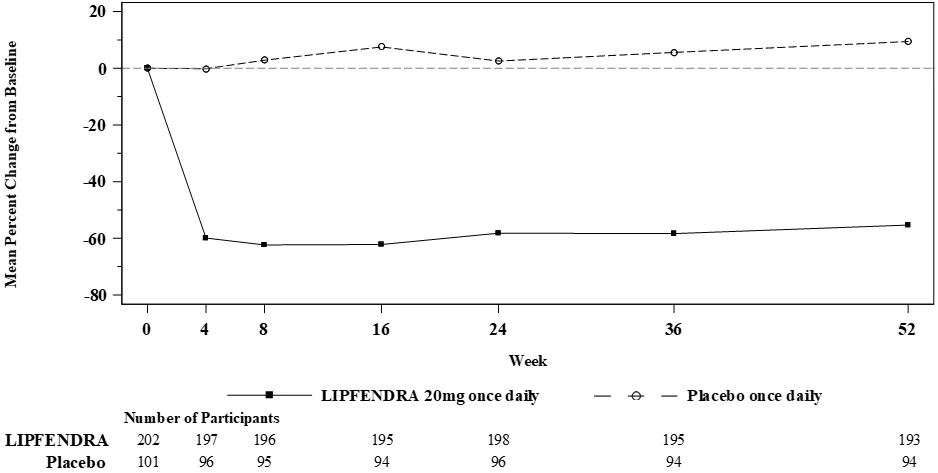
The primary efficacy outcome measure in Trial 2 was the percent change from baseline to Week 24 in LDL-C. The difference between the LIPFENDRA and placebo groups in mean percent change in LDL-C from baseline to Week 24 was -59% (95% CI: -66%, -53%; p<0.001). For additional results, see Table 2 and Figure 2.
Table 2: Percent Change in Lipid Parameters from Baseline to Week 24 in Trial 2 (Patients with HeFH on Statin Therapy)
| Treatment Group | LDL-C | Non-HDL-C | ApoB |
|---|---|---|---|
| ApoB = apolipoprotein B; CI = confidence interval; non-HDL-C = non-high-density lipoprotein cholesterol; LDL-C = low-density lipoprotein cholesterol | |||
| Summary statistics shown for LIPFENDRA and placebo rows are raw values based on observed data and do not account for missing data. | |||
| Treatment-specific results are the mean percent changes from baseline at Week 24. The differences from placebo are estimated differences based on an analysis of covariance model with treatment as a fixed effect and baseline as a covariate. Missing data at Week 24 were handled via multiple imputation using a control-based imputation method. | |||
| LIPFENDRA (n=202) | -58 | -52 | -48 |
| Placebo (n=101) | 3 | 2 | 2 |
Difference from placebo (95% CI) | -59 (-66, -53) | -53 (-59, -47) | -49 (-54, -44) |
Figure 2: Observed Mean Percent Change in LDL-C from Baseline Over 52 Weeks in Trial 2 (Patients with HeFH on Statin Therapy)
 |
16 HOW SUPPLIED/STORAGE AND HANDLING
- Each LIPFENDRA film-coated tablet contains 20 mg of enlicitide, is white to off-white with grey specks, oval-shaped, and debossed with “119” on one side and the corporate logo on the other side.
- Each bottle contains 30 tablets (NDC 0006-5084-01) with desiccant and child-resistant closure.
- Store LIPFENDRA at 20°C to 25°C (68°F to 77°F); excursions permitted between 15°C to 30°C (59°F to 86°F) [see USP Controlled Room Temperature].
- Store and dispense LIPFENDRA in the original bottle and keep the bottle tightly closed to protect from moisture. Do not remove the desiccant.
17 PATIENT COUNSELING INFORMATION
Advise the patient to read the FDA-approved patient labeling (Patient Information).
Dosage and Administration
Instruct patients to take their dose of LIPFENDRA on an empty stomach in the morning with water, black coffee, or plain tea and to wait at least 30 minutes before their next food or beverage (other than water, black coffee, or plain tea). Each tablet should be swallowed whole [see Dosage and Administration (2.2)]. LIPFENDRA can be taken with other medications [see Clinical Pharmacology (12.3)].
Missed Doses
Advise the patient that if a dose is missed, they should take the missed dose as soon as possible, at least 30 minutes before the next food or drink (other than water, black coffee, or plain tea). They should not take 2 doses on the same day [see Dosage and Administration (2.2)].
Manufactured for: Merck Sharp & Dohme LLC
Rahway, NJ 07065, USA
For patent information: www.msd.com/research/patent
Copyright © 2026 Merck & Co., Inc., Rahway, NJ, USA, and its affiliates.
All rights reserved.
uspi-mk0616-t-2607r000