


Patient information: uses, side effects, how to take - Apomorphine
How to Use the APOKYN® Pen
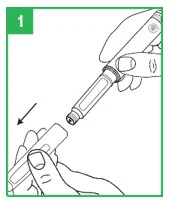 | 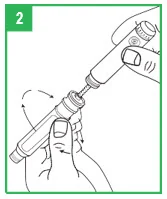 | Preparing the apomorphine hydrocloride Pen for Cartridge Loading Step 1. Remove the gray pen cap by pulling it straight off. Step 2. Unscrew the teal cartridge holder from the gray pen body by turning it clockwise. |
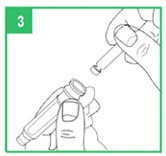 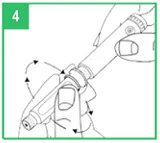 | Loading a Cartridge Step 3. Only use apomorphine hydrocloride that is clear and colorless. Do not use an apomorphine hydrocloride cartridge that contains medicine that is cloudy, green, or contains particles. Call your specialty pharmacy provider for replacement cartridges. Insert the apomorphine hydrocloride cartridge, metal cap first, into the teal cartridge holder. Step 4. Lower the gray pen body onto the teal cartridge holder so that the black rod presses against the cartridge plunger. Screw the teal cartridge holder onto the gray pen body. Tighten the pieces by turning the teal cartridge holder clockwise until no gap remains and 1 of the white arrows line up with the white marker on the gray pen body. |
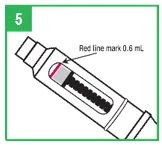 | Step 5. If you already have a cartridge in the pen and have used the pen, you should check the cartridge through the window in the teal cartridge holder to make sure there is enough apomorphine hydrocloride solution in the cartridge to provide your next dose. If the gray cartridge plunger has reached the red line on the cartridge, remove the cartridge and insert a new cartridge into the pen before attaching the pen needle and preparing the dose. |
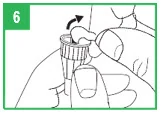 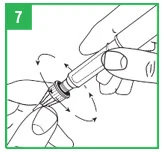 | Attaching the Pen Needle Step 6. Remove the pink paper tab from the back of a new pen needle. Use a new needle for each injection. Never reuse needles. Step 7. Holding the apomorphine hydrocloride Pen by the teal cartridge holder, push the pen needle unit onto the pen. Screw the threaded hub of the pen needle onto the teal cartridge holder counter-clockwise. When the needle unit is attached, remove the outer shield that protects the needle with a gentle pull. Save the outer shield. You will use it to remove the needle from the pen after the injection is finished. Do not remove the inner needle shield at this time. The needle is sterile and must stay clean. After opening, do not place the needle on a surface or let it touch anything. |
Preparing (Priming) the APOKYN® Pen for Use
| IMPORTANT – Prior to each injection, it is important that the APOKYN® Pen be properly primed. |
| For a new apomorphine hydrocloride cartridge (1 that has not been used before), repeat the priming procedure described on the next page (Steps 8-9) 3 or 4 times to make sure all the air has been removed from the needle and cartridge. |
| For an apomorphine hydrocloride cartridge you have used before (1 that has been previously primed), repeat the priming procedure described on the next page (Steps 8-9) 1 time to make sure all the air has been removed from the needle and cartridge. |
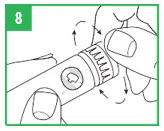 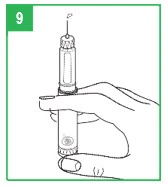 | Step 8. You must prepare (prime) the apomorphine hydrocloride Pen for use before injecting the medicine. To prime the APOKYN® Pen, set the dose by turning the dose knob to 0.1 mL. This is important so you can get rid of any air bubbles in the cartridge. Step 9. Remove the inner needle shield. Remember, do not let the needle touch any- thing. With the needle pointing up, firmly push the injection button in as far as it will go and hold for at least 5 seconds. A small stream of medicine must come out of the end of the needle. If it does not, reset the dose by repeating Step 8. Repeat these steps (Steps 8-9) until a small stream of medicine comes out the end of the needle. When medicine comes out of the end of the needle, the APOKYN® Pen is primed for injection and ready to use. Apomorphine hydrocloride medicine can cause staining to fabric and other surfaces it touches. Be careful where you prime the APOKYN® Pen. |
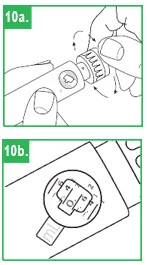 | Setting the Dose Step 10. To set the dose, turn the white dose knob until the correct dose (number of mLs) is shown in the window. The dose will appear as a red number between two black lines that will line up next to the letters "mL" on the pen body. Make sure the correct number (dose) appears in the window. |
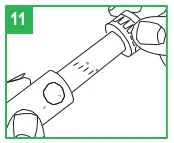 | Step 11. Dose Correction. If you turn the dose knob past your dose, do not dial backwards. If you dial backwards, apomorphine hydrocloride will be pushed through the needle and you will lose medicine. Continue to turn the dial until it is fully turned. Press the injection button fully. This will reset the dial to zero without pushing medicine out of the needle. Repeat Step 10 to redial your dose. |
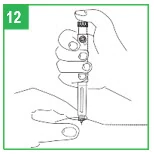 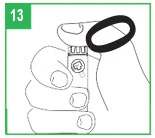 | Giving the Injection Step 12. apomorphine hydrocloride is only for injection under the skin (subcutaneous injection). Choose an injection site on your stomach area, upper arm or upper leg. Change the site with each injection. Do not inject apomorphine hydrocloride into skin that is red or sore. Clean the site with an alcohol swab and allow to air dry. Pinch about an inch of skin and fat tissue of your injection site between your thumb and forefinger. With the other hand, insert the needle all the way into the pinched skin. Step 13. Fully push the teal injection button on the APOKYN® Pen. A clicking sound will be heard while the dose is injected. Push the injection button firmly for 5 seconds. Remove the needle from your skin. If medicine keeps dripping from the needle, keep the needle in the skin longer the next time you inject apomorphine hydrocloride. |
| IMPORTANT – If you set your dose and cannot depress the teal injection button, the cartridge is empty. Remove the pen needle and cartridge and prepare the pen as described in Steps 2-9 with a new cartridge. Set the dose and give the injection. |
| If you set your dose and the injection button stops before you receive a complete dose, note the number in the window, remove the pen needle and cartridge, and prepare the pen as described in Steps 2-9 with a new cartridge. Set the dose to the number that last appeared in the window and administer the injection. This completes the dose. |
| Before attempting to replace a cartridge, be sure that a needle unit is not attached to the APOKYN® Pen. |
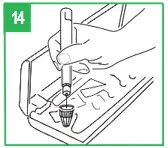 | Removing the Pen Needle Step 14. Carefully replace the outer needle shield. Be careful to avoid a needle-stick. Place the outer needle shield in the notch located on the far left side of your carrying case. The opening of the needle shield should be pointing up. Carefully insert the needle (attached to the pen) into the opening of the shield. Without holding onto the shield, push down firmly. |
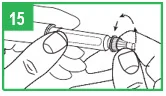 | Step 15. Hold the pen by the teal cartridge holder and unscrew the pen needle from the cartridge holder. Recap the pen. Never recap the pen with a needle attached. Safely dispose of used pen needles in a "sharps" container. Your specialty pharmacy provider will provide you with a "sharps" container. Do not throw used needles in a trash can. |
Storage Information
–Store apomorphine hydrocloride cartridges at room temperature, 68°F to 77°F (20°C to 25°C)
Excursions permitted between 59 to 86°F (15 to 30°C) [See USP Controlled Room Temperature]
Proper Disposal
♦Put your used needles and syringes in an FDA-cleared sharps disposal container right away after use. Do not throw away (dispose of) loose needles and syringes in your household trash.
♦If you do not have an FDA-cleared sharps disposal container, you may use a household container that is:–made of a heavy-duty plastic,–able to be closed with a tight-fitting, puncture-resistant lid, without sharps being able to come out,–upright and stable during use,–leak-resistant–properly labeled to warn of hazardous waste inside the container.
♦When your sharps disposal container is almost full, you will need to follow your community guidelines for the right way to dispose of your sharps disposal container. There may be state or local laws about how you should throw away used needles and syringes. For more information about safe sharps disposal, and for specific information about sharps disposal in the state that you live in, go to the FDA's website at: http://www.fda.gov/safesharpsdisposal.
♦Do not dispose of your used sharps disposal container in your household trash unless your community guidelines permit this. Do not recycle your used sharps disposal container.
Care and Storage
The APOKYN® Pen can now be stored in its carrying case. Never store or carry the APOKYN® Pen with a pen needle attached.
You must store and care for your pen the right way:
♦Avoid exposure to dust, moisture, and cold or hot temperatures.
♦Never wash the pen in water or use strong disinfectants. Only a clean, damp cloth should be used for cleaning.
♦Do not try to repair the pen if it is damaged or if you cannot solve a problem shown in the following "Troubleshooting" section.
♦Do not use pen for more than 1 year after the first use or after the expiration date on the carton.
For more information, call your specialty pharmacy provider.
Troubleshooting
| PROBLEM | POSSIBLE CAUSE | HOW TO FIX THE PROBLEM |
|---|---|---|
| For more information, call your specialty pharmacy provider. | ||
| No medicine comes out of the pen (the dosage dial moves freely, but no click is heard). | The pen is in dose correction mode. | Push the injection button all the way in so the dial returns to zero. |
| The dosage dial does not return to zero during an injection. | The cartridge is empty. | Replace the cartridge as described in Steps 3-5. |
| The pen needle is clogged. | Replace the pen needle as described in Steps 14 & 6-7. | |
| The dosage dial does not turn easily. | Dust or dirt is on the pen. | Turn the dial past the highest setting on the pen. Wipe all exposed pen surfaces with a clean, damp cloth. |
| Pen does not close. | Cartridge is inserted incorrectly. | Remove cartridge and reload it. See Steps 3 - 4. |
| Injection button will not depress. | Cartridge is empty. | Replace cartridge. See Steps 3-5. |
| Injection button stops before a complete dose is delivered. | Not enough medication in cartridge to complete the dose. | Replace cartridge. See Steps 3-5. |
| Pen does not work. | Mechanical failure. | Replace pen. Call your specialty pharmacy provider. |
| Dose numbers and/or white markers wear off. | Repeated use over extended period of time. | Replace pen. Call your specialty pharmacy provider. |
| Too much force needed to depress injection button. | Defective cartridge. | Replace cartridge. See Steps 3-5. |
| Unable to read the dose numbers through the dose window. | Incorrect cleaning or improper handling. | Replace pen. Call your specialty pharmacy provider. |
Patient Information
Apomorphine Hydrochloride Injection
(a”poe mor’ feen hye” droe klor’ ide)
Read this Patient Information before you start using apomorphine hydrocloride injection and each time you get a refill. There may be new information. This information does not take the place of talking to your healthcare provider about your medical condition or your treatment.
Use only with the APOKYN® Pen for subcutaneous (under the skin) administration.
What is apomorphine hydrocloride injection?
Apomorphine hydrocloride injection is a prescription medicine used to treat acute, intermittent episodes of poor mobility called "off " episodes (end-of-dose wearing "off " or unpredictable "on -off " episodes) in people with advanced Parkinson's disease (PD).
It is not known if apomorphine hydrocloride is safe and effective in children.
Who should not take apomorphine hydrocloride injection?
Do not take apomorphine hydrocloride injection if you are:
- taking certain medicines to treat nausea called 5HT3 antagonists including, ondansetron, granisetron, dolasetron, palonosetron, and alosetron. People taking ondansetron together with apomorphine, the active ingredient in apomorphine hydrocloride injection, have had very low blood pressure and lost consciousness or "blacked out."
- allergic to apomorphine hydrochloride injection or to any of the ingredients in apomorphine hydrocloride injection and experience hives, itching, rash, or swelling (e.g., eyes, tongue, etc.). apomorphine hydrocloride injection also contains a sulfite called sodium metabisulfite. Sulfites can cause severe, life-threatening allergic reactions in some people. An allergy to sulfites is not the same as an allergy to sulfa. People with asthma are more likely to be allergic to sulfites. Call your healthcare provider if you have hives, itching, rash, swelling of the eyes, tongue, lips, chest pain, trouble breathing or swallowing. See the end of this leaflet for a complete list of ingredients in apomorphine hydrocloride injection.
What should I tell my healthcare provider before taking apomorphine hydrocloride injection?
Before you start using apomorphine hydrocloride injection, tell your healthcare provider if you:
- have difficulty staying awake during the daytime
- have dizziness
- have fainting spells
- have low blood pressure
- have asthma
- are allergic to any medicines containing sulfites
- have liver problems
- have kidney problems
- have heart problems
- have had a stroke or other brain problems
- have a mental problem called a major psychotic disorder
- drink alcohol
are pregnant or plan to become pregnant. It is not known if apomorphine hydrocloride injection will harm your unborn baby.
- are breastfeeding or plan to breastfeed. It is not known if apomorphine hydrocloride passes into your breast milk. You and your healthcare provider should decide if you will take apomorphine hydrocloride injection or breastfeed. You should not do both.
Tell your healthcare provider about all the medicines you take, including prescription and non-prescription medicines, vitamins, and herbal supplements.
Using apomorphine hydrocloride injection with certain other medicines may affect each other. Using apomorphine hydrocloride injection with other medicines can cause serious side effects.
- If you take nitroglycerin under your tongue while using apomorphine hydrocloride injection, your blood pressure may decrease and cause dizziness. After taking nitroglycerin, you should lie down and try to continue lying down for at least 45 minutes. You should avoid standing for 45 minutes after taking nitroglycerin.
Know the medicines you take. Keep a list of them to show your healthcare provider or pharmacist when you get a new medicine.
How should I use apomorphine hydrocloride injection?
- Read the Instructions for Use starting on page 6 of this leaflet for specific information about the right way to use apomorphine hydrocloride injection.
- Use apomorphine hydrocloride injection exactly as your healthcare provider tells you to use it.
- Your healthcare provider will tell you how much apomorphine hydrocloride injection to use and teach you the right way to use it.
- Your healthcare provider may change your dose if needed.
- Do not change your dose of apomorphine hydrocloride injection or use it more often than prescribed unless your healthcare provider has told you to.
- Do not give another dose of apomorphine hydrocloride injection sooner than 2 hours after the last dose.
- Your healthcare provider will prescribe apomorphine hydrocloride injection that comes in prefilled glass cartridges, for single-patient-use, that are used with a special pen injector.
- Your APOKYN® pen is dosed in milliliters (mL), not milligrams (mg). Make sure your prescription tells you how many milliliters (mL) to use.
- Inject apomorphine hydrocloride injection under your skin (subcutaneously). Do not inject apomorphine hydrocloride injection into a vein.
- Keep a record of how much apomorphine hydrocloride injection you have used each time you inject or your care partner gives you an injection.
- Use a new needle with each injection. Never reuse a needle.
- apomorphine hydrocloride injection is a clear and colorless liquid. Do not use apomorphine hydrocloride injection if it appears cloudy, colored, or to contain particles, and call your pharmacist.
- Your healthcare provider may prescribe another medicine called an antiemetic to take while you are using apomorphine hydrocloride injection. Antiemetic medicines help to decrease the symptoms of nausea and vomiting that can happen with apomorphine hydrocloride injection.
- If you take too much apomorphine hydrocloride injection, call your healthcare provider. If you experience severe or serious side effects such as chest pain or prolonged erection lasting more than 4 hours, go to the nearest hospital emergency room.
What should I avoid while using apomorphine hydrocloride injection?
- Do not drink alcohol while you are using apomorphine hydrocloride injection. It can increase your chance of developing serious side effects.
- Do not take medicines that make you sleepy while you are using apomorphine hydrocloride injection.
- Do not drive, operate machinery, or do other dangerous activities until you know how apomorphine hydrocloride injection affects you.
- Do not change your body position too fast. Get up slowly from sitting or lying. apomorphine hydrocloride injection can lower your blood pressure and cause dizziness or fainting.
What are the possible side effects of apomorphine hydrocloride injection?
Apomorphine hydrocloride injection may cause serious side effects. Call your healthcare provider right away if you have any of the serious side effects, including:
- allergic reaction. An allergic reaction with side effects of hives, itching, rash, swelling (e.g., eyes, tongue, etc.); trouble breathing and/or swallowing may occur after injecting apomorphine hydrocloride injection.
- blood clots. Injecting apomorphine hydrocloride injection into a vein (intravenous) can cause blood clots. Do not inject apomorphine hydrocloride injection in your vein.
- nausea and vomiting. Severe nausea and vomiting can happen with apomorphine hydrocloride injection. Your healthcare provider may prescribe a medicine called trimethobenzamide (Tigan®) to help prevent nausea and vomiting. Some patients can stop taking Tigan after using apomorphine hydrocloride injection for several months. Some patients may need to keep taking Tigan to help prevent nausea and vomiting. Talk to your healthcare provider before you stop taking Tigan.
- sleepiness or falling asleep during the day. Some people treated with apomorphine hydrocloride injection may get sleepy during the day or fall asleep without warning while doing everyday activities such as talking, eating, or driving a car.
- dizziness. apomorphine hydrocloride injection can lower your blood pressure and cause dizziness. Dizziness can happen when apomorphine hydrocloride treatment is started or when the apomorphine hydrocloride injection dose is increased. Do not get up too fast from sitting or after lying down, especially if you have been sitting or lying down for a long period of time.
- falls. The changes that can happen with Parkinson's disease (PD), and the effects of some PD medicines, can increase the risk of falling. apomorphine hydrocloride may also increase your risk of falling.
- hallucinations or psychotic-like behavior. apomorphine hydrocloride injection can cause or worsen psychotic-like behavior including hallucinations (seeing or hearing things that are not real), confusion, excessive suspicion, aggressive behavior, agitation, delusional beliefs (believing things that are not real), and disorganized thinking.
- sudden uncontrolled movements (dyskinesias). Some people with PD may get sudden, uncontrolled movements after treatment with some PD medicines. apomorphine hydrocloride injection can cause or make dyskinesias worse.
- intense urges. Some people with PD have reported new or increased gambling urges, increased sexual urges, and other intense urges, while taking PD medicines, including apomorphine hydrocloride injection.
- heart problems. If you have shortness of breath, fast heartbeat, or chest pain while taking apomorphine hydrocloride injection, call your healthcare provider or get emergency help right away.
- serious heart rhythm changes (QT prolongation). Tell your healthcare provider right away if you have a change in your heartbeat (a fast or irregular heartbeat), or if you faint.
- injection site problems. Bruising, swelling, and itching can happen at the site where you inject apomorphine hydrocloride injection.
- fever and confusion. This can happen in some people when their PD medicine is stopped or there is a fast decrease in the dose of their PD medicine.
- tissue changes (fibrotic complications). Some people have had changes in the tissues of their pelvis, lungs, and heart valves when taking medicines called nonergot derived dopamine agonists like apomorphine hydrocloride injection.
- prolonged painful erections (priaprism). apomorphine hydrocloride injection may cause prolonged, painful erections in some people. If you have an erection that lasts more than 4 hours you should call your healthcare provider or go to the nearest hospital emergency room right away.
- swelling of ankles/legs. apomorphine hydrocloride injection may cause swelling, especially in the ankles or legs. Tell your healthcare provider if you notice any swelling.
Other common side effects of apomorphine hydrocloride injection include:
- yawning
- runny nose
- confusion
- swelling of your hands, arms, legs, and feet
Tell your healthcare provider if you have any side effect that bothers you or that does not go away.
These are not all the possible side effects of apomorphine hydrocloride injection. For more information, ask your healthcare provider or pharmacist.
Call your doctor for medical advice about side effects. You may report side effects to FDA at 1-800-FDA-1088.
You may also report side effects to TruPharma, LLC at 877-541-5504.
How should I store apomorphine hydrocloride injection?
- Store apomorphine hydrocloride injection at room temperature, 68°F to 77°F (20°C to 25°C).
- Safely throw away medicine that is out of date or no longer needed.
Keep apomorphine hydrocloride injection and all medicines out of the reach of children.
General information about the safe and effective use of apomorphine hydrocloride injection.
Medicines are sometimes prescribed for purposes other than those listed in a patient information leaflet. Do not use apomorphine hydrocloride injection for a condition for which it was not prescribed. Do not give apomorphine hydrocloride to other people, even if they have the same symptoms that you have. It may harm them.
This Patient Information leaflet summarizes the most important information about apomorphine hydrocloride injection. If you would like more information, talk with your healthcare provider. You can ask your pharmacist or healthcare provider for information about apomorphine hydrocloride injection that is written for health professionals.
What are the ingredients in apomorphine hydrocloride injection?
Active ingredient: apomorphine hydrochloride, USP
Inactive ingredients: sodium metabisulfite, NF, benzyl alcohol, NF, water for injection, USP. It may also contain sodium hydroxide, NF and/or hydrochloric acid, NF.
This Patient Information and Instructions for Use has been approved by the U.S. Food and Drug Administration.
Manufactured by:
Berkshire Sterile Manufacturing, Inc.
Lee, MA
Distributed by:
TruPharma, LLC
Tampa, FL 33609
APOKYN® is a registered trademark of BRITUSWIP.
BD and BD Logo are trademarks of Becton, Dickinson and Company.