


Patient information: uses, side effects, how to take - Winrevair
What is WINREVAIR?
WINREVAIR is a prescription medicine used to treat adults with pulmonary arterial hypertension (PAH). PAH is a type of high blood pressure in the arteries of your lungs.
WINREVAIR can:
- improve your ability to exercise and perform normal activities with fewer symptoms, and
- reduce the risk of your physical condition and symptoms worsening, including lowering your risk of hospitalization for PAH, lung transplant, and death.
It is not known if WINREVAIR is safe and effective in children under 18 years of age.
Who should not take WINREVAIR?
Do not take WINREVAIR if you have had a serious allergic reaction to sotatercept-csrk or any of the other ingredients in WINREVAIR. See the end of this Patient Information leaflet for a complete list of ingredients in WINREVAIR.
What should I tell my healthcare provider before taking WINREVAIR?
Tell your healthcare provider about:
- All of your medical conditions
- All of the medicines you take, including prescriptions and over-the-counter medicines, vitamins, or herbal supplements
If you are able to get pregnant:
- WINREVAIR may harm your unborn baby. Tell your healthcare provider if you are pregnant or planning to get pregnant.
- Tell your healthcare provider right away if you become pregnant or think you may be pregnant during treatment with WINREVAIR.
- Your healthcare provider should do a pregnancy test before you start taking WINREVAIR.
- You should use effective birth control during treatment with WINREVAIR and for at least 4 months after your final dose. Ask your healthcare provider about birth control methods that may be right for you.
- You or your healthcare provider should report any exposure to WINREVAIR during pregnancy by calling 1-877-888-4231.
If you are breastfeeding or planning to breastfeed:
- Tell your healthcare provider if you are breastfeeding or planning to breastfeed. It is not known if WINREVAIR passes into breast milk.
- Do not breastfeed during treatment with WINREVAIR and for 4 months after your final dose. Talk to your healthcare provider about the best way to feed your baby.
- You or your healthcare provider should report any exposure to WINREVAIR during breastfeeding by calling 1-877-888-4231.
Before you take WINREVAIR:
- If your healthcare provider decides that you or a caregiver can give your injections of WINREVAIR at home, you or your caregiver should receive training from your healthcare provider on the right way to prepare and inject WINREVAIR. Do not try to inject WINREVAIR until you have been shown how to inject WINREVAIR by your healthcare provider.
- Your healthcare provider will do a blood test before your first 5 doses of WINREVAIR, longer if needed, and then from time to time to check your levels of hemoglobin (a protein in red blood cells that carries oxygen) and platelets (blood cells that help blood clot). After each of these blood tests, your healthcare provider may delay treatment or change your dose if needed.
- See the detailed “Instructions for Use” booklet that comes with WINREVAIR for information on how to prepare and inject a dose of WINREVAIR.
How should I take WINREVAIR?
- Use WINREVAIR exactly as your healthcare provider tells you to.
You will give WINREVAIR every 3 weeks as an injection just under your skin (subcutaneous) in your:
- stomach (abdomen) at least 2 inches away from the belly button, or
- upper thigh
- You should inject WINREVAIR right away after mixing the medicine powder with the sterile water for injection, but no later than 4 hours after mixing.
Your prescribed dose:
- Your healthcare provider will tell you how much WINREVAIR to inject and when to inject it. This is because your prescribed dose depends on your body weight and blood tests.
- Do not change your dose or stop taking WINREVAIR without talking to your healthcare provider.
- Do not take WINREVAIR more often than your healthcare provider tells you to. If you are not sure when to take WINREVAIR, call your healthcare provider.
- Your healthcare provider may delay treatment, change your dose, or stop treatment depending on how you respond to WINREVAIR.
What if I take the wrong dose or miss my dose?
- If you give more than or less than your prescribed dose, call your healthcare provider right away.
If you miss your dose of WINREVAIR:
- If it has been 3 days or fewer, give it as soon as possible. You can then follow your usual schedule for your next dose.
- If it has been more than 3 days, call your healthcare provider for what to do.
What are the possible side effects of WINREVAIR?
WINREVAIR may cause serious side effects including:
Allergic (hypersensitivity) reactions. Allergic reactions, including anaphylaxis, can happen within hours or days after you use WINREVAIR. Call your healthcare provider or get medical help right away if you have any of these symptoms:
- hives
- swelling of your face, lips, tongue or throat
- sudden trouble breathing or swallowing
Before your next dose of WINREVAIR, tell your healthcare provider if you have had any symptoms of an allergic reaction.
- High level of hemoglobin in your blood. High levels of hemoglobin are common with WINREVAIR and can be severe and increase your risk for blood clots. Your healthcare provider will do blood tests to check your hemoglobin levels before starting and regularly during treatment with WINREVAIR.
- Severely low number of platelets in your blood. Low platelet counts are common with WINREVAIR and can be severe and increase your risk of bleeding. Your healthcare provider will do blood tests to check your platelet levels before starting and regularly during treatment with WINREVAIR. Tell your healthcare provider if you develop easy bruising or bleeding, bleeding that does not stop, or nosebleeds.
- Serious bleeding. Serious bleeding can happen with WINREVAIR. Tell your healthcare provider if you develop any signs or symptoms of bleeding, including:
- vomiting blood or your vomit looks like coffee-grounds
- pink or brown urine
- red or black stools that look like tar
- coughing up blood or blood clots
- persistent headaches
- nausea
- dizziness or feeling weak
- persistent abdominal cramps
- severe back pain
- abnormally heavy menstrual bleeding
- Decreased fertility. WINREVAIR may affect female and male fertility, which may affect your ability to have children. Talk to your healthcare provider if this is a concern for you.
The most common side effects of WINREVAIR include:
- infections
- headache
- nose bleeds
- rash
- tiny blood vessels that look like pink or red lines on the skin (spider veins)
- diarrhea
- dizziness
- redness
- bleeding gums
These are not all the possible side effects of WINREVAIR.
Call your doctor for medical advice about side effects. You may report side effects to FDA at 1-800-FDA-1088.
How should I store WINREVAIR?
- Store WINREVAIR in the refrigerator at 36°F to 46°F (2°C to 8°C). Do not freeze.
- Store in the original carton to protect from light.
Keep WINREVAIR and all medicines out of the reach of children and pets.
General information about the safe and effective use of WINREVAIR.
Medicines are sometimes prescribed for purposes other than those listed in a Patient Information leaflet. Do not use WINREVAIR for a condition for which it was not prescribed. Do not give WINREVAIR to other people, even if they have the same symptoms that you have. It may harm them. You can ask your pharmacist or healthcare provider for information about WINREVAIR that is written for healthcare professionals.
What are the ingredients in WINREVAIR?
Active ingredient: sotatercept-csrk
Inactive ingredient(s): citric acid monohydrate, polysorbate 80, sodium citrate, and sucrose.
Manufactured by: Merck Sharp & Dohme LLC, Rahway, NJ 07065, USA.
US License Number 0002
For patent information: www.msd.com/research/patent
Copyright © 2026 Merck & Co., Inc., Rahway, NJ, USA, and its affiliates.
All rights reserved.
usppi-mk7962-i-2609r002
For more information, call 1-877-888-4231, or go to www.WINREVAIR.com .
| Important: Read this booklet first | Important |
| INSTRUCTIONS FOR USE | Mix |
WINREVAIR™ (WIN-reh-vair) (sotatercept-csrk) for injection, for subcutaneous use How to use your WINREVAIR injection kit | Withdraw |
For subcutaneous injection only (inject directly under the skin) | Inject |
 For package containing 1 vial
In this booklet:
Before you start
Important information for patients or caregivers
Get to know the parts of your kit
Important information you need to know before injecting WINREVAIR
Storing your injection kit
Get started
 Mix powdered medicine into liquid form
 Withdraw your prescribed dose
 Inject your medicine
How to throw away WINREVAIR
Frequently asked questions
| Before you start: | |
 | Read this booklet Read this Instructions for Use from start to finish before using WINREVAIR and each time you get a refill. There may be new information. |
 | Start with your healthcare provider Do not use WINREVAIR until your healthcare provider has shown you or your caregiver the right way to prepare and inject it. Your healthcare provider should show you how to inject WINREVAIR before you use it for the first time. |
 | Questions? If you have questions about how to give WINREVAIR the right way or need more information, call your pharmacy or healthcare provider. For general product information visit www.WINREVAIR.com or call Merck Sharp & Dohme LLC at 1-800-672-6372. |
 Important information for patients or caregivers |
Before you prepare and inject WINREVAIR, you must be:
- trained by a healthcare provider following this Instructions for Use booklet step-by-step, and
- capable of independent administration of WINREVAIR as determined by a healthcare provider
Before using WINREVAIR, make sure you are trained to do the following correctly:
- 1. Reconstitute (mix) the medicine
- 2. Measure the correct amount of medicine according to your prescription
- 3. Select and prepare a proper injection site
- 4. Inject the medicine subcutaneously
Get to know the parts of your kit
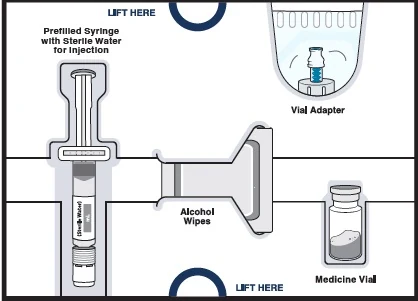
| Top Tray | Use to mix the medicine |
 | 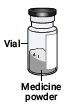 1 Vial of WINREVAIR medicine powder |
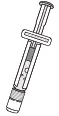 1 Prefilled syringe with sterile water for injection to mix medicine powder into liquid form | |
 1 Vial adapter to connect the vial and syringe |
| Bottom Tray | Use to inject the medicine |
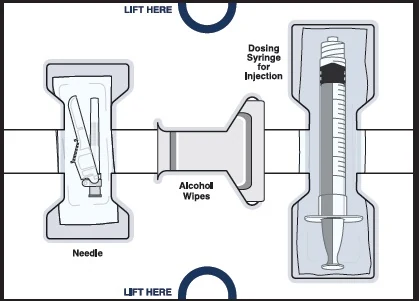 | 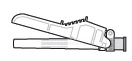 Needle for injection |
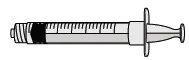 Empty dosing syringe to measure, withdraw, and inject your medicine |
Important information you need to know before injecting WINREVAIR
|  |
| Storing your injection kit | |
 | Store WINREVAIR injection kit in the refrigerator at 36°F to 46°F (2°C to 8°C). Do not freeze. |
 | Store in the original carton to protect from light. |
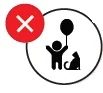 | Keep injection kit out of the reach of children and pets. |
Get started
Before you can prepare and inject WINREVAIR, you must first be trained and determined to be capable of independent administration of WINREVAIR by a healthcare provider.
1 Check WINREVAIR injection kit and expiration date
| Remove the WINREVAIR injection kit from the refrigerator. | |
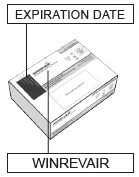 |
Call your pharmacy to get a new kit. |
 Check that you have the medicine that your healthcare provider prescribed. | |
2 Let your kit come to room temperature, gather supplies, and wash your hands
Wait 15 minutes to allow your kit to warm to room temperature. Cold medicine is more painful to inject. 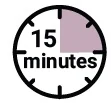 | Along with your kit, gather these items and find a clean, flat surface where you will prepare and inject your dose.
| Wash your hands with soap and water. 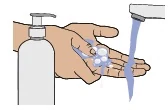 |
 Gauze, cotton ball, or bandage
Mix powdered medicine into liquid form
Start with the Top Tray
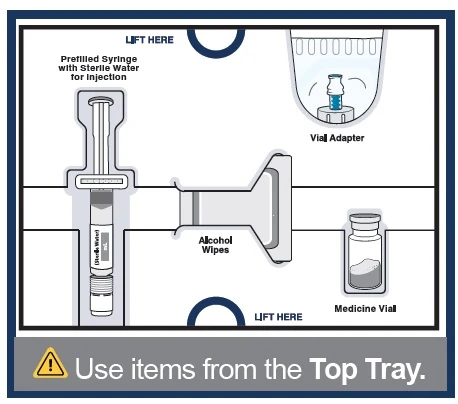
3 Remove medicine vial, prefilled syringe with sterile water for injection, alcohol wipes, and vial adapter from the kit.
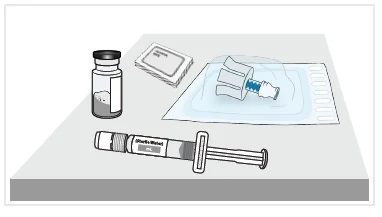
4a Check medicine vial
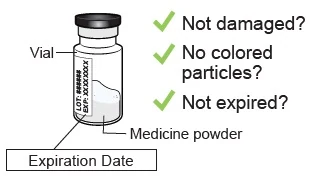 Check the vial label to confirm the medicine is not expired. Inspect the medicine powder. It should be white to off-white.
|
4b Remove plastic cap and clean vial
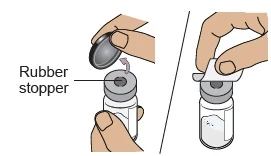 Flip off the plastic cap and clean the rubber stopper on top of the vial with an alcohol wipe.
Set vial aside on a clean, flat surface. |
5a Align vial adapter to vial
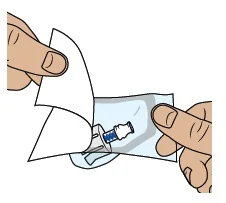 Peel open the vial adapter package and remove vial adapter from its package. | 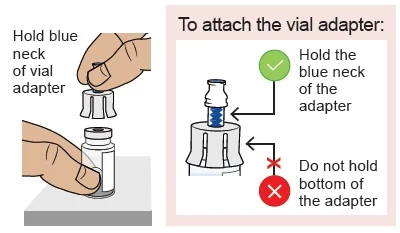 Hold the blue neck of the vial adapter and align the vial adapter on top of the vial.
|
5b Attach vial adapter to vial
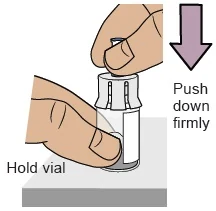 Hold the vial with one hand. Push down firmly so it snaps in place (you may feel some resistance). |
5c Clean vial adapter
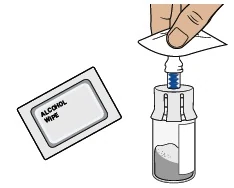 Clean the top of the vial adapter with an alcohol wipe. |
6 Check prefilled syringe
Confirm the sterile water inside the prefilled syringe is clear and the product is not expired or leaking. 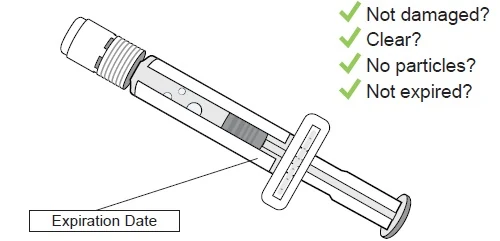
|
7 Snap off prefilled syringe white cap
Snap off the prefilled syringe cap along the perforation. 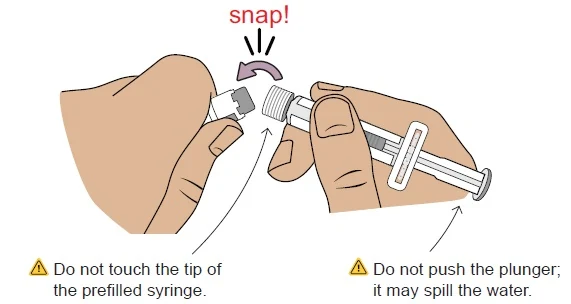 |
8 Connect prefilled syringe to vial adapter
Pick up the vial with the vial adapter attached. Align the prefilled syringe tip on the blue circle of the vial adapter. Push then twist the prefilled syringe onto the vial adapter until you cannot turn further. While twisting, be sure to hold onto the vial adapter. |
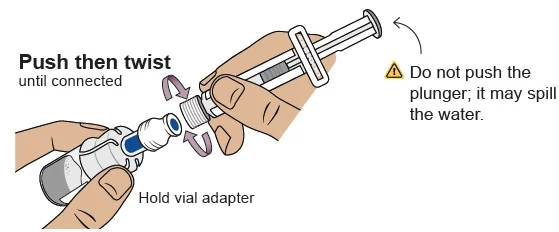 |
9 Transfer sterile water from prefilled syringe to vial
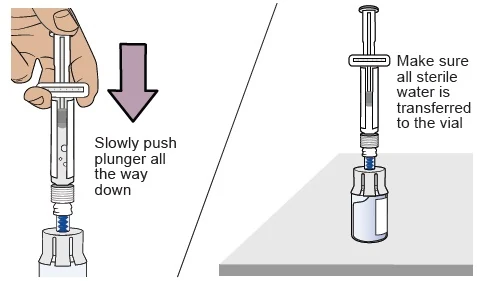 Slowly push the plunger all the way down to transfer all the sterile water into the vial (the plunger will move up; this is normal). |
10 Swirl to mix medicine
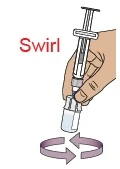
Hold the prefilled syringe and gently swirl the vial in a circular motion until the powder is fully dissolved. This may take up to 2 minutes. | 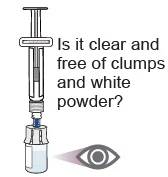 When the medicine is mixed well, it should be clear. If not, repeat this step until it is clear. | 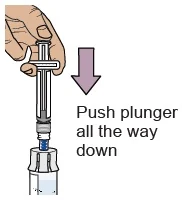 Press the plunger down to make sure all the liquid is in the vial (the plunger will move up; this is normal). |
11 Wait for large bubbles in the vial to go away
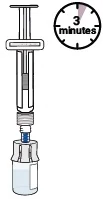 It is okay to have slight foam around edges of the vial | Set vial aside for large bubbles to go away. This may take up to 3 minutes. 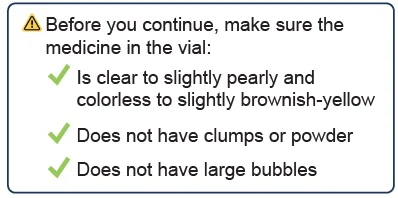 |
12 Prepare vial by removing extra air
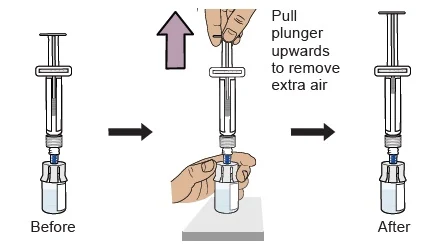 With the vial standing upright, gently pull the plunger upwards to the top of the barrel. Do not to pull the plunger out of the syringe. Note: Pulling extra air out of the vial will help to make sure you have the right dose. |
13 Remove prefilled syringe from vial
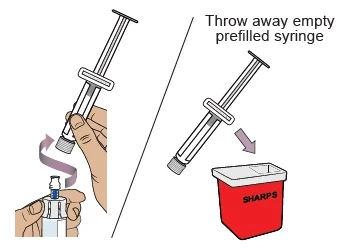 Hold the vial adapter and unscrew the prefilled syringe from the vial. Throw away the prefilled syringe in the sharps container. | 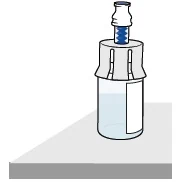 You should have a vial of medicine prepared and ready to be used in the next steps. |
Withdraw your prescribed dose
For the next steps, you will need:
- - Mixed vial of medicine
- - Items from the Bottom Tray (needle, dosing syringe for injection, and alcohol wipes).
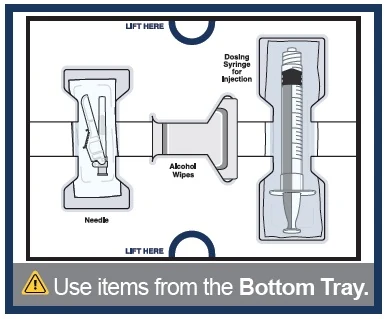
14 Clean top of vial adapter
With a new alcohol wipe from the bottom tray, clean the top of the vial adapter. 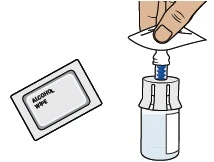 |
15 Remove empty dosing syringe from its package
Find the empty dosing syringe in the bottom tray and remove it from its package. You will use this dosing syringe to measure out the medicine you need (based on your prescribed dose). | 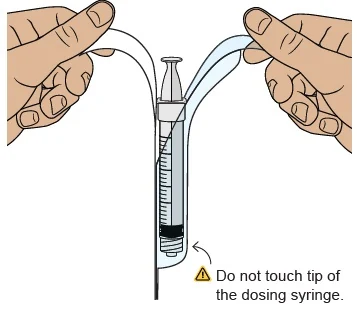 |
16 Pull air into the dosing syringe
 You must do this to make sure pressure in the vial is even and you get an accurate dose.
Hold the dosing syringe upright and pull down the plunger to draw air into the dosing syringe. Stop when top rim of plunger is at the amount in ‘mL’ that matches your prescribed dose. Your prescribed dose is on the prescription label on your kit. 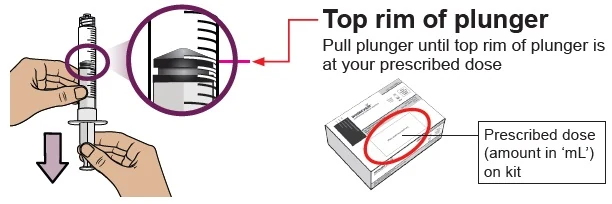 |
17 Connect dosing syringe to the vial
While holding the vial adapter, push then twist the dosing syringe onto the vial adapter until it stops. 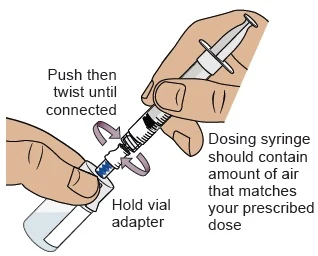 |
18 Push air into vial, then flip vial upside down
Push the plunger all the way down to transfer all the air into the vial. Then hold the plunger in place with your thumb and flip the vial upside down. 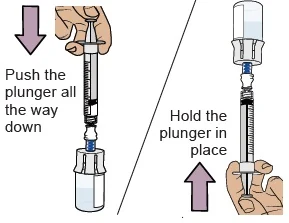 |
19 Pull plunger back to withdraw your prescribed dose
With the vial and dosing syringe upside down, slowly pull the plunger back. Stop when you get to the amount in ‘mL’ that matches your prescribed dose. 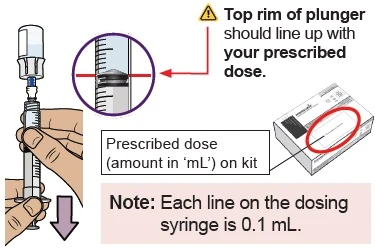 |
20 Check for large air bubbles and air pockets
Check to see if there are large air bubbles or an air pocket in the syringe. You will remove extra air in the next steps. 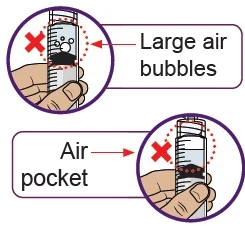 |
21 Remove air bubbles and air pockets from syringe
If you see large air bubbles or an air pocket, tap the side of the dosing syringe to move the air to the top. Slowly push the plunger up to remove extra air. 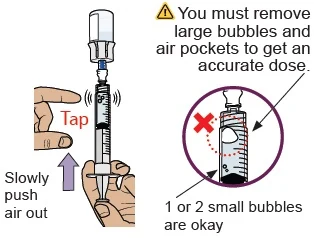 |
22 Compare amount to prescribed dose
After removing all extra air, compare the amount in your syringe to your prescribed dose. If you do not have your prescribed dose in your syringe, slowly pull the plunger back again to withdraw more medicine from the vial. Repeat Steps 19 to 21 until you get your prescribed dose and no large bubbles or air pockets remain. | 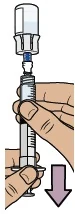 |
23 Confirm your prescribed dose
Before you continue, check to make sure you have the prescribed dose in the dosing syringe. 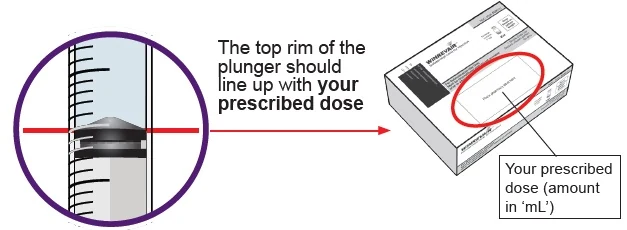
|
24 Remove the dosing syringe from the vial and set dosing syringe aside
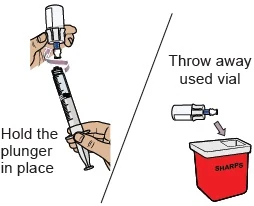 | Hold the plunger in place with one hand. With the other hand, hold the vial adapter and unscrew the filled dosing syringe from the vial. Throw away the used vial into the sharps container. |
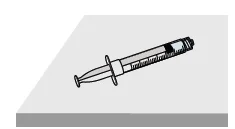 | Place the filled dosing syringe on a clean, flat surface.
|
25 Attach injection needle
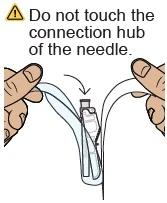 Find the needle in the bottom tray and open its package. | 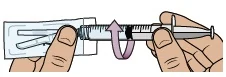 With the needle still in the package, grip the base of the needle and twist on the dosing syringe until it stops. Remove the needle package. | 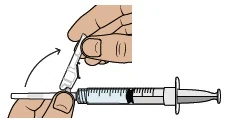 Move the safety shield away from the needle and toward the syringe. Place the dosing syringe on a clean, flat surface.
|
26 Choose and clean your injection site
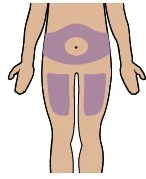 | Select an injection site on your stomach (abdomen) or your upper thigh. If injecting on your stomach, avoid a 2-inch area around your belly button. Choose a different site every time you inject.
|
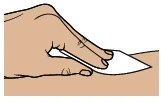 | Clean the injection site with a new alcohol wipe.
|
Now, you are ready to inject the medicine.
Inject your medicine
27 Inject your medicine
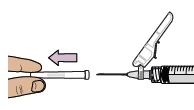 Pull the cap straight off the needle. Throw away the cap.
| 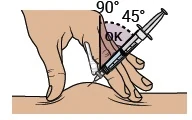 Gently pinch and hold a fold of skin where you will inject. Insert the needle with a dartlike motion at a 45° to 90° angle. | 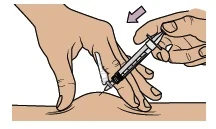 Push the plunger with slow, steady pressure all the way down until the dosing syringe is empty. Confirm all the medicine has been injected. You can let go of the skin fold now. |
| Keep your fingers away from the needle at all times. | ||
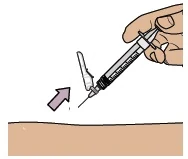 While keeping the plunger pushed in, remove the needle from your skin at the same angle you inserted it. | 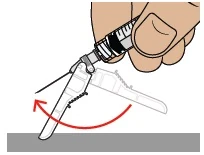 To reapply the safety shield, push the shield against a flat surface until you hear a “click” and see that the needle is covered. | 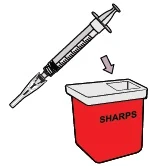 Throw away the dosing syringe and used items in a sharps disposal container.
|
How to throw away WINREVAIR
|  |
If you do not have an FDA-cleared sharps disposal container, you may use a household container that is:
| When your sharps disposal container is almost full, you will need to follow your community guidelines for the right way to throw away your sharps disposal container. There may be state or local laws about how you should throw away used needles, dosing syringes, and prefilled syringes. For more information about safe sharps disposal, and for specific information about sharps disposal in the state that you live in, go to the FDA’s website at: http://www.fda.gov/safesharpsdisposal .
|
Frequently asked questions
What should I do if I am bleeding at the injection site?
Place a cotton ball or bandage on your skin right away and apply a small amount of pressure. If the bleeding does not stop, call your healthcare provider right away.
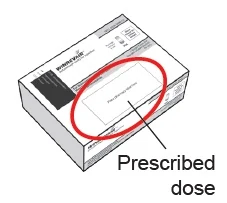
Where can I find my prescribed dose?
Your prescribed dose in ‘mL’ is on your prescription label on your kit. Contact your healthcare provider if you cannot find your prescribed dose.
What should I do if I accidentally get some medicine on my skin or my work surface?
Wash the area thoroughly with soap and water right away.
What should I do if I am not sure I administered my prescribed dose correctly?
Call your pharmacy or healthcare provider.
What should I do if the plunger of my dosing syringe moves automatically when I try to withdraw medicine from the vial?
Do not worry if your plunger moves slightly on its own when you are filling your dosing syringe with medicine.
With one hand, hold the plunger in place to stop the plunger from moving. With the other hand, unscrew the vial from the dosing syringe.
After unscrewed, it is safe to let go of the plunger.
You can avoid this automatic plunger movement by pushing air into the vial before filling your dosing syringe with medicine. Refer to Steps 16 to 23 for detailed instructions.
What should I do if my kit parts are damaged or are discolored, cloudy, or have particles?
Do not use your kit. Call your pharmacy to get a new kit.
What should I do if my medicine does not turn clear after mixing and swirling?
Do not use the medicine if you have swirled the medicine vial for about 2 minutes and let it stand for another 3 minutes but your medicine vial remains cloudy or has clumps, powder, or foreign particles. Call your pharmacy to get a new kit.
What should I do if the sterile water will not come out of the prefilled syringe?
Check that the vial adapter is attached to the vial securely. If not, hold the vial and press the vial adapter down firmly to make sure the vial adapter punctures the vial rubber stopper.
What should I do if I dropped my kit components?
Do not use if any items are damaged. If you are unsure, call your pharmacy to get a new kit.
Can I use my kit that has been left out of the refrigerator?
Store the injection kit in the refrigerator until ready to use it. If the unused injection kit has been out of the refrigerator up to 77°F (25°C) for more than 24 hours, please contact your pharmacy or healthcare provider.
Do I need to use mixed medicine right away?
We recommend you inject the medicine right away after mixing but no later than 4 hours after mixing. If it has been more than 4 hours, throw away unused mixed medicine. If you have questions, please contact your pharmacy or healthcare provider.
How can I get help preparing and giving my injection?
If you have questions about how to give WINREVAIR the correct way or need more information, you can call your pharmacy or healthcare provider.
Call your doctor for advice about side effects.
To report side effects or product quality complaints, please call Merck Sharp & Dohme LLC at 1-800-672-6372. You can also report side effects to FDA at 1-800-FDA-1088.
Manufactured by:
Merck Sharp & Dohme LLC
Rahway, NJ 07065, USA
U.S. License Number 0002
Copyright © 2024 Merck & Co., Inc., Rahway, NJ, USA, and its affiliates.
All rights reserved.
usifu1-mk7962-i-2403r000
This Instructions for Use has been approved by the U.S. Food and Drug Administration
Approved: March 2024
| Important: Read this booklet first | Important |
| INSTRUCTIONS FOR USE | Mix |
WINREVAIR™ (WIN-reh-vair) (sotatercept-csrk) for injection, for subcutaneous use How to use your WINREVAIR injection kit | Combine |
 For package containing 2 vials | Withdraw |
| For subcutaneous injection only (inject directly under the skin) | Inject |
In this booklet:
Important information for patients or caregivers
Before you start
Get to know the parts of your kit
Important information you need to know before injecting WINREVAIR
Storing your injection kit
Get started
 Mix powdered medicine into liquid form
Combine medicine from both vials
Withdraw your prescribed dose
Inject your medicine
How to throw away WINREVAIR
Frequently asked questions
| Important information for patients or caregivers |
Before you prepare and inject WINREVAIR, you must be:
- trained by a healthcare provider following this Instructions for Use booklet step-by-step, and
- capable of independent administration of WINREVAIR as determined by a healthcare provider
Before using WINREVAIR, make sure you are trained to do the following correctly:
- 1. Reconstitute (mix) the medicine
- 2. Combine medicine from both vials
- 3. Measure the correct amount of medicine according to your prescription
- 4. Select and prepare a proper injection site
- 5. Inject the medicine subcutaneously
| Before you start: | |
| Read this booklet Read this Instructions for Use from start to finish before using WINREVAIR and each time you get a refill. There may be new information. |
| Start with your healthcare provider Do not use WINREVAIR until your healthcare provider has shown you or your caregiver the right way to prepare and inject it. Your healthcare provider should show you how to inject WINREVAIR before you use it for the first time. |
| Questions? If you have questions about how to give WINREVAIR the right way or need more information, call your pharmacy or healthcare provider. For general product information visit www.WINREVAIR.com or call Merck Sharp & Dohme LLC at 1-800-672-6372. |
How to use WINREVAIR
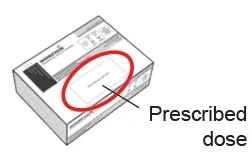
Before injecting WINREVAIR, make sure you read the full instructions in this booklet to get your prescribed dose.
Mix medicine in vial 1
Mix medicine in vial 2
Combine medicine mixture from vial 1 to vial 2
Withdraw your prescribed dose from vial 2
Then, inject your medicine
Proceed to the next pages for step-by-step directions.
Get to know the parts of your kit
| Top Tray | Use to mix the medicine |
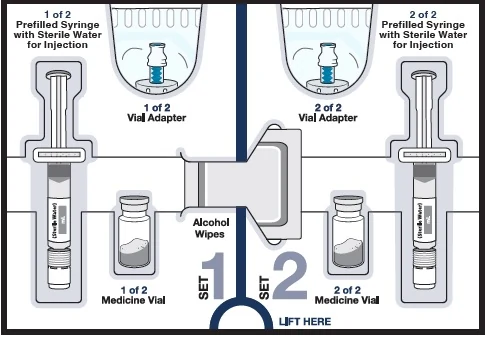 |  2 Vials of WINREVAIR medicine powder |
 2 Prefilled syringes with sterile water for injection to mix medicine powder into liquid form | |
 2 Vial adapters to connect the vial and syringe |
| Bottom Tray | Use to inject the medicine |
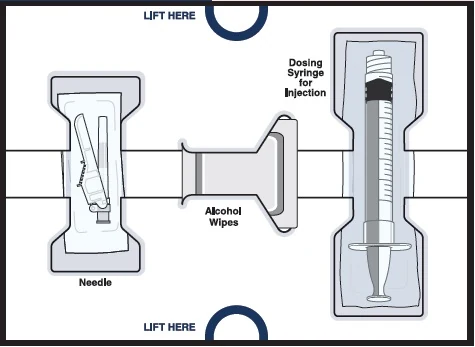 |  Needle for injection |
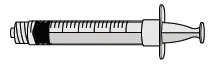 Empty dosing syringe to measure, withdraw, and inject your medicine |
Important information you need to know before injecting WINREVAIR
|  |
| Storing your injection kit | |
| Store WINREVAIR injection kit in the refrigerator at 36°F to 46°F (2°C to 8°C). Do not freeze. |
| Store in the original carton to protect from light. |
| Keep injection kit out of the reach of children and pets. |
Get started
| Before you can prepare and inject WINREVAIR, you must first be trained and determined to be capable of independent administration of WINREVAIR by a healthcare provider. |
1 Check WINREVAIR injection kit and expiration date
| Remove the WINREVAIR injection kit from the refrigerator. | |
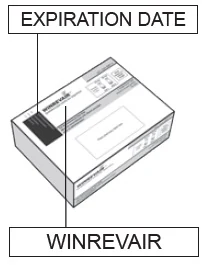 |
Call your pharmacy to get a new kit. |
| Check that you have the medicine that your healthcare provider prescribed. | |
2 Let your kit come to room temperature, gather supplies, and wash your hands
Wait 15 minutes to allow your kit to warm to room temperature. Cold medicine is more painful to inject. | Along with your kit, gather these items and find a clean, flat surface where you will prepare and inject your dose.
| Wash your hands with soap and water. |
Mix powdered medicine into liquid form
Start with the Top Tray
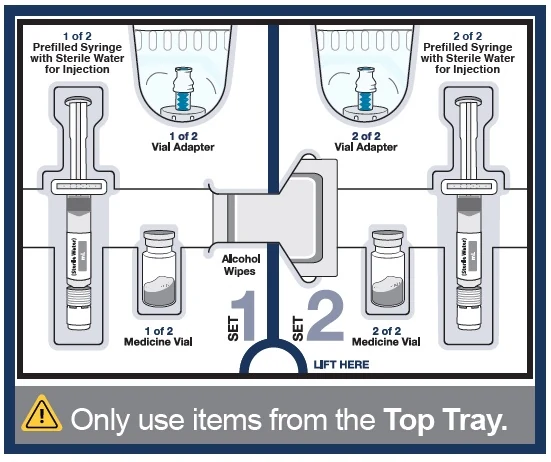
3 Remove medicine vial 1, prefilled syringe with sterile water for injection 1, alcohol wipes, and vial adapter 1 from the kit.
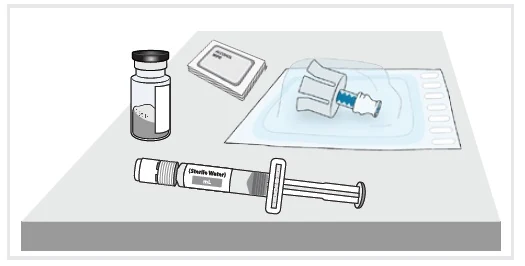
4a Check medicine vial
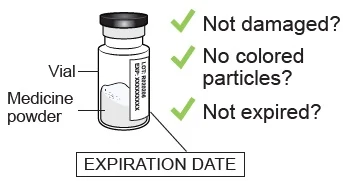 Check the vial label to confirm the medicine is not expired. Inspect the medicine powder. It should be white to off-white.
|
4b Remove plastic cap and clean vial
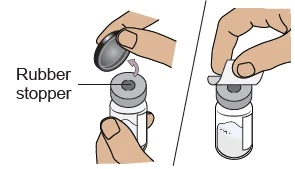 Flip off the plastic cap and clean the rubber stopper on top of the vial with an alcohol wipe.
Set vial aside on a clean, flat surface. |
5a Align vial adapter to vial
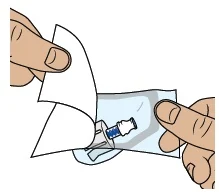 Peel open the vial adapter package and remove vial adapter from its package. | 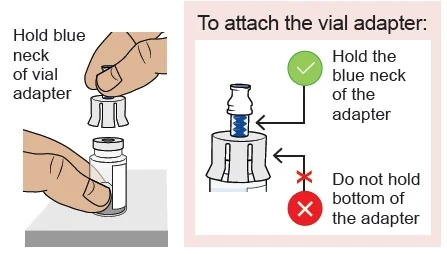 Hold the blue neck of the vial adapter and align the vial adapter on top of the vial.
|
5b Attach vial adapter to vial
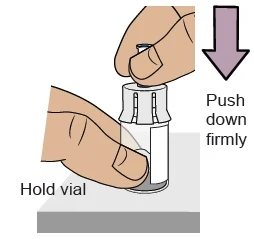 Hold the vial with one hand. Push down firmly so it snaps in place (you may feel some resistance). |
5c Clean vial adapter
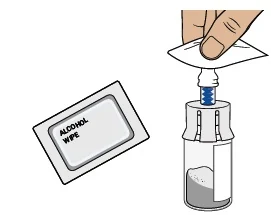 Clean the top of the vial adapter with an alcohol wipe. |
6 Check prefilled syringe
Confirm the sterile water inside the prefilled syringe is clear and the product is not expired or leaking. 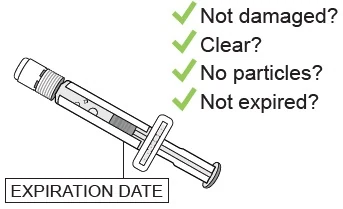
|
7 Snap off prefilled syringe white cap
Snap off the prefilled syringe cap along the perforation. 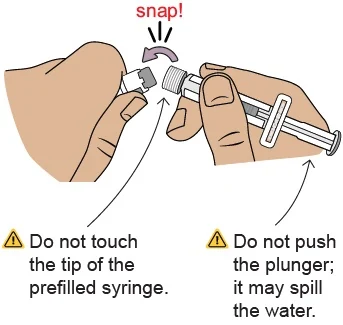 |
8 Connect prefilled syringe to vial adapter
Pick up the vial with the vial adapter attached. Align the prefilled syringe tip on the blue circle of the vial adapter. Push then twist the prefilled syringe onto the vial adapter until you cannot turn further. While twisting, be sure to hold onto the vial adapter. 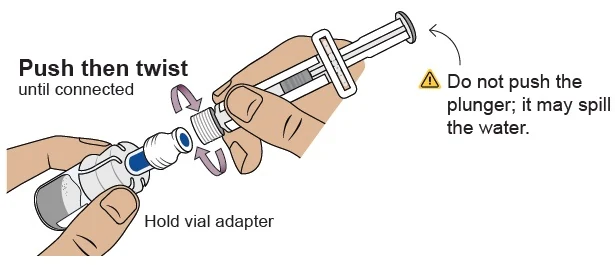 |
9 Transfer sterile water from prefilled syringe to vial
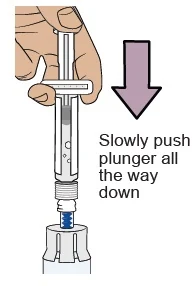 | 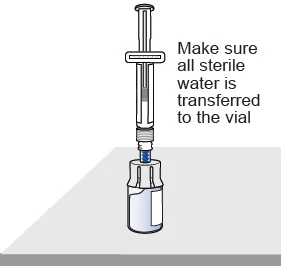 |
Slowly push the plunger all the way down to transfer all the sterile water into the vial (the plunger will move up; this is normal). | Leave the prefilled syringe attached to the vial and set aside on a flat surface. |
10 Prepare vial 2, prefilled syringe 2, and vial adapter 2
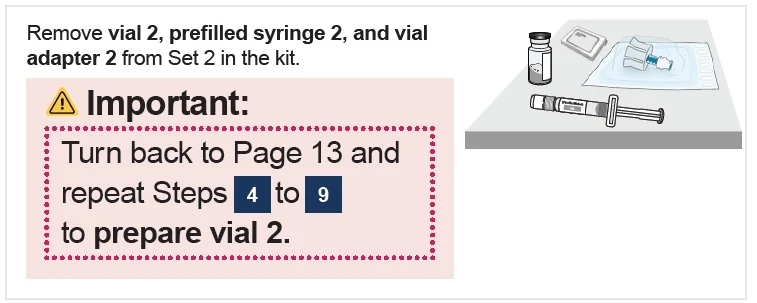
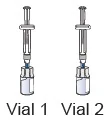 | Stop and check to make sure you have both vial 1 and vial 2 prepared. |
| You need both vials prepared before you can continue to Step 11. |
11 Swirl to mix medicine
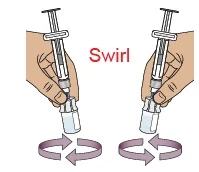
Hold 1 prefilled syringe in each hand and gently swirl both vials in a circular motion until the powder is fully dissolved. This may take up to 2 minutes. | 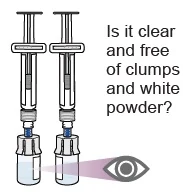 When the medicine is mixed well, it should be clear. If not, repeat this step until it is clear. | 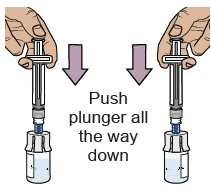 For each vial, press the plunger down to make sure all the liquid is in the vial (the plunger will move up; this is normal). |
12 Wait for large bubbles in the vials to go away
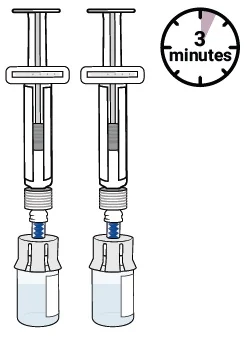 It is okay to have slight foam around edges of the vials | Set both vials aside for large bubbles to go away. This may take up to 3 minutes. 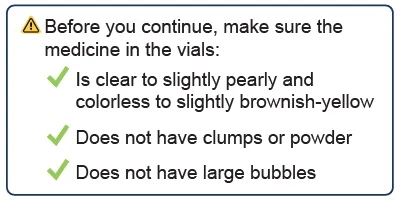 |
13 Prepare vials by removing extra air
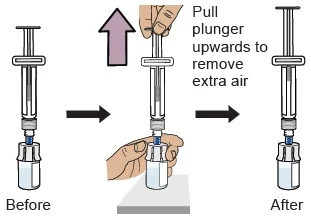 | Start with either vial. With the vial standing upright, gently pull the plunger upwards to the top of the barrel. Do not pull the plunger out of the syringe. Note: Pulling extra air out of the vials will help to make sure you have the right dose. |
 | |
14 Remove prefilled syringes from vials
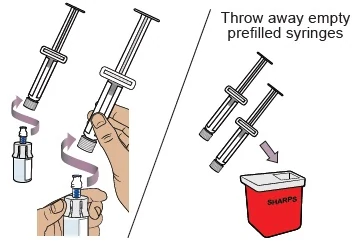 Hold the vial adapters and unscrew both prefilled syringes from the vials. Throw away both prefilled syringes in the sharps container. | 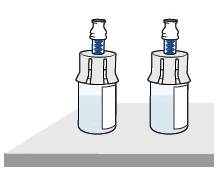 You should have 2 vials of medicine prepared and ready to be combined in the next steps. |
Combine medicine from both vials
For the next steps, you will need:
- - Mixed vial 1 and vial 2
- - Items from the Bottom Tray (needle, dosing syringe for injection, and alcohol wipes).
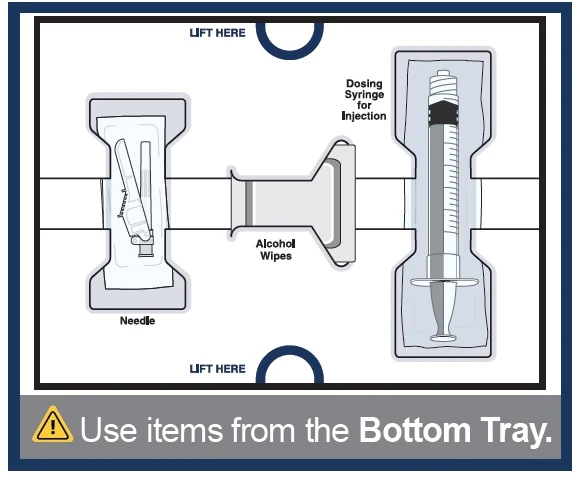
15 Clean top of both vial adapters
With 2 alcohol wipes from the bottom tray, clean the top of the vial adapters. Use a new wipe for each vial adapter. 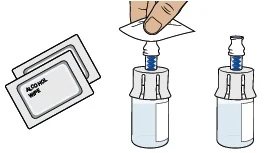 |
16 Remove empty dosing syringe from its package
Find the empty dosing syringe in the bottom tray and remove it from its package. You will use this dosing syringe to combine medicine from both vials and measure out the medicine you need (based on your prescribed dose). | 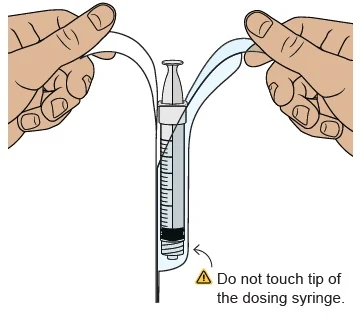 |
17 Pull air into the dosing syringe
You must do this to make sure pressure in the vial is even and you get an accurate dose.
Hold the dosing syringe upright and pull down the plunger to draw in 1.5 mL of air. 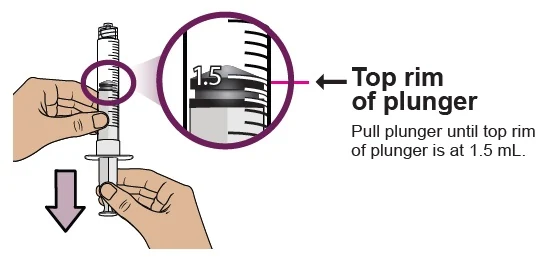 |
18 Connect dosing syringe to one of the vials
While holding the vial adapter, push then twist the dosing syringe onto the vial adapter until it stops. 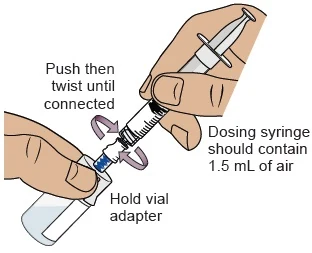 |
19 Push air into vial, then flip upside down
Push the plunger all the way down to transfer all the air into the vial. Then hold the plunger in place with your thumb and flip the vial upside down. 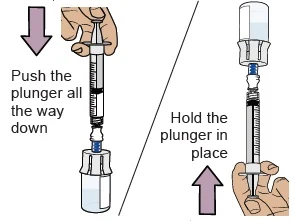 |
20 Withdraw all the medicine from 1st vial
With the vial and dosing syringe upside down, slowly pull the plunger back. Stop at 1.5 mL. This will make sure all the medicine from the vial is in the dosing syringe. 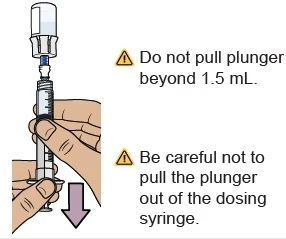 |
21 Remove 1st vial from the dosing syringe
Hold the vial adapter and unscrew the filled dosing syringe from the vial. Throw away the empty vial into the sharps container. 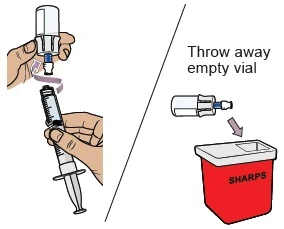 |
22 Connect the dosing syringe to the 2nd vial
While holding the vial adapter of the 2nd vial, push then twist the partially filled dosing syringe onto the vial adapter until it stops. 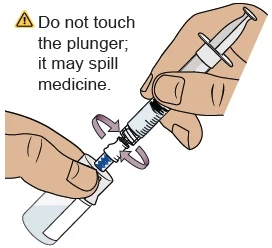 |
23 Push all the medicine into the 2nd vial, then flip vial upside down
Slowly push the plunger all the way down to transfer all of the medicine into the vial. This combines the medicine from both vials. Hold the plunger in place with your thumb and flip the vial upside down. 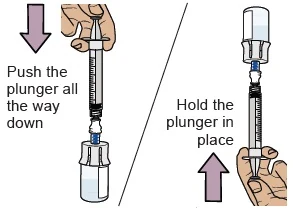 |
Withdraw your prescribed dose
24 Pull plunger back to withdraw your prescribed dose
With the vial and dosing syringe upside down, slowly pull the plunger back. Stop when you get to the amount in ‘mL’ that matches your prescribed dose. 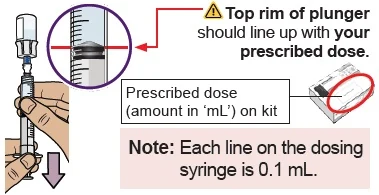 |
25 Check for large bubbles and air pockets
Check to see if there are large air bubbles or an air pocket in the syringe. You will remove extra air in the next steps. 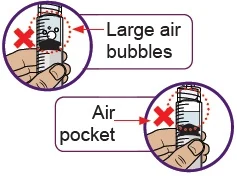 |
26 Remove air bubbles and air pockets from syringe
If you see large air bubbles or an air pocket, tap the side of the dosing syringe to move the air to the top. Slowly push the plunger up to remove extra air. 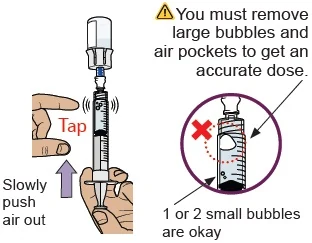 |
27 Compare amount to prescribed dose
After removing all extra air, compare the amount in your syringe to your prescribed dose. If you do not have your prescribed dose in your syringe, slowly pull the plunger back again to withdraw more medicine from the vial. Repeat Steps 24 to 26 until you get your prescribed dose and no large bubbles or air pockets are visible. | 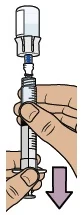 |
28 Confirm your prescribed dose
Before you continue, check to make sure you have the prescribed dose in the dosing syringe. 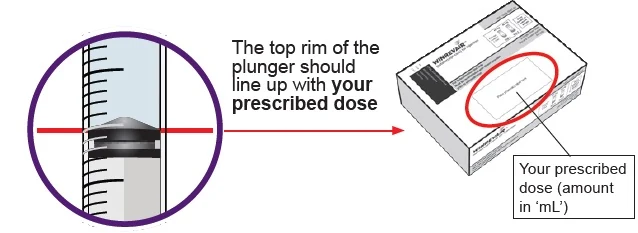
|
29 Remove the dosing syringe from the vial and set dosing syringe aside
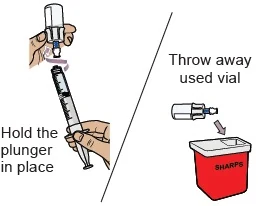 | Hold the plunger in place with one hand. With the other hand, hold the vial adapter and unscrew the filled dosing syringe from the vial. Throw away the used vial into the sharps container. |
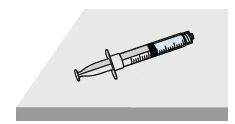 | Place the filled dosing syringe on a clean, flat surface.
|
30 Attach injection needle to dosing syringe
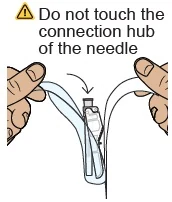 Find the needle in the bottom tray and open its package. | 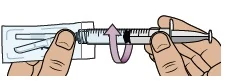 With the needle still in the package, grip the base of the needle and twist on the dosing syringe until it stops. Remove the needle package. | 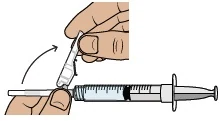 Move the safety shield away from the needle and toward the syringe. Place the dosing syringe on a clean, flat surface.
|
31 Choose and clean your injection site
| Select an injection site on your stomach (abdomen) or your upper thigh. If injecting on your stomach, avoid a 2-inch area around your belly button. Choose a different site every time you inject.
|
| Clean the injection site with a new alcohol wipe.
|
Now, you are ready to inject the medicine.
Inject your medicine
32 Inject your medicine
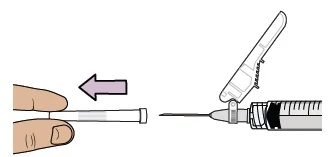 Pull the cap straight off the needle. Throw away the cap.
| 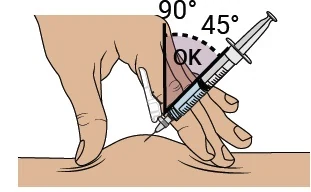 Gently pinch and hold a fold of skin where you will inject. Insert the needle with a dartlike motion at a 45° to 90° angle. | 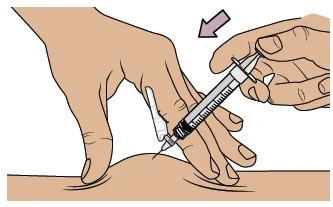 Push the plunger with slow, steady pressure all the way down until the dosing syringe is empty. Confirm all the medicine has been injected. You can let go of the skin fold now. |
| Keep your fingers away from the needle at all times. | ||
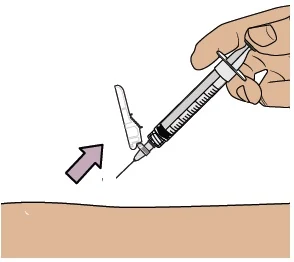 While keeping the plunger pushed in, remove the needle from your skin at the same angle you inserted it. | 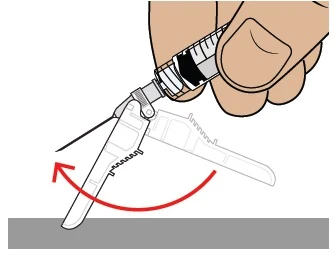 To reapply the safety shield, push the shield against a flat surface until you hear a “click” and see that the needle is covered. | 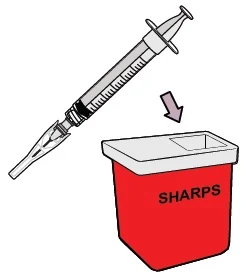 Throw away the dosing syringe and used items in a sharps container.
|
How to throw away WINREVAIR
| |
If you do not have an FDA-cleared sharps disposal container, you may use a household container that is:
| When your sharps disposal container is almost full, you will need to follow your community guidelines for the right way to throw away your sharps container. There may be state or local laws about how you should throw away used needles, dosing syringes, and prefilled syringes. For more information about safe sharps disposal, and for specific information about sharps disposal in the state that you live in, go to the FDA’s website at: http://www.fda.gov/safesharpsdisposal .
|
Frequently asked questions
What should I do if I am bleeding at the injection site?
Place a cotton ball or bandage on your skin right away and apply a small amount of pressure. If the bleeding does not stop, call your healthcare provider right away.
Where can I find my prescribed dose?
Your prescribed dose in ‘mL’ is on your prescription label on your kit. Contact your healthcare provider if you cannot find your prescribed dose.
What should I do if I accidentally get some medicine on my skin or my work surface?
Wash the area thoroughly with soap and water right away.
What should I do if I am not sure I administered my prescribed dose correctly?
Call your pharmacy or healthcare provider.
What should I do if the plunger of my dosing syringe moves automatically when I try to withdraw medicine from the vial?
Do not worry if your plunger moves slightly on its own when you are filling your dosing syringe with medicine.
With one hand, hold the plunger in place to stop the plunger from moving. With the other hand, unscrew the vial from the dosing syringe.
After unscrewed, it is safe to let go of the plunger.
You can avoid this automatic plunger movement by pushing air into the vial before filling your dosing syringe with medicine. Refer to Steps 17 to 28 for detailed instructions.
What should I do if my kit parts are damaged or are discolored, cloudy, or have particles?
Do not use your kit. Call your pharmacy to get a new kit.
What should I do if my medicine does not turn clear after mixing and swirling?
Do not use the medicine if you have swirled the medicine vial for about 2 minutes and let it stand for another 3 minutes but your medicine vial remains cloudy or has clumps, powder, or foreign particles. Call your pharmacy to get a new kit.
What should I do if the sterile water will not come out of the prefilled syringe?
Check that the vial adapter is attached to the vial securely. If not, hold the vial and press the vial adapter down firmly to make sure the vial adapter punctures the vial rubber stopper.
What should I do if I dropped my kit components?
Do not use if any items are damaged. If you are unsure, call your pharmacy to get a new kit.
Can I use my kit that has been left out of the refrigerator?
Store the injection kit in the refrigerator until ready to use it. If the unused injection kit has been out of the refrigerator up to 77°F (25°C) for more than 24 hours, please contact your pharmacy or healthcare provider.
Do I need to use mixed medicine right away?
We recommend you inject the medicine right away after mixing but no later than 4 hours after mixing. If it has been more than 4 hours, throw away unused mixed medicine. If you have questions, please contact your pharmacy or healthcare provider.
How can I get help preparing and giving my injection?
If you have questions about how to give WINREVAIR the correct way or need more information, you can call your pharmacy or healthcare provider.
Call your doctor for advice about side effects.
To report side effects or product quality complaints, please call Merck Sharp & Dohme LLC at 1-800-672-6372. You can also report side effects to FDA at 1-800-FDA-1088.
Manufactured by:
Merck Sharp & Dohme LLC
Rahway, NJ 07065, USA
U.S. License Number 0002
Copyright © 2024 Merck & Co., Inc., Rahway, NJ, USA, and its affiliates.
All rights reserved.
usifu2-mk7962-i-2403r000
This Instructions for Use has been approved by the U.S. Food and Drug Administration
Approved: March 2024