


Patient information: uses, side effects, how to take - Vitamin B12 Nasal
What is Cyanocobalamin Nasal Spray?
Cyanocobalamin Nasal Spray is a prescription medicine used:
- for maintenance therapy to treat vitamin B12 deficiency (low levels of vitamin B12) in adults with pernicious anemia who achieved healthy vitamin B12 levels after receiving vitamin B12 shots and do not have nervous system problems.
to treat vitamin B12 deficiency caused by:
- certain food limitations,
- other medicines that cause vitamin B12 deficiency, or
- lack of absorption (malabsorption) that are not related to pernicious anemia.
- to prevent vitamin B12 deficiency in adults who require higher amounts of vitamin B12.
to treat vitamin B12 deficiency caused by:
certain food limitations,
other medicines that cause vitamin B12 deficiency, or
lack of absorption (malabsorption) that are not related to pernicious anemia.
to prevent vitamin B12 deficiency in adults who require higher amounts of vitamin B12.
Cyanocobalamin Nasal Spray should not be used for a vitamin B12 absorption test known as the Schilling test.
In people that have corrected or have fixed their short-term causes of vitamin B12 deficiency, the benefit of continued long-term use of Cyanocobalamin Nasal Spray is not known after vitamin B12 deficiency has been corrected.
It is not known if Cyanocobalamin Nasal Spray is effective in people that currently have a stuffy nose, allergies or an upper respiratory infection. You should wait until these symptoms have gone away before using Cyanocobalamin Nasal Spray.
It is not known if Cyanocobalamin Nasal Spray is safe and effective in children.
Do not use Cyanocobalamin Nasal Spray if you are allergic to cobalt, vitamin B12, cyanocobalamin or any ingredients in Cyanocobalamin Nasal Spray.
See the end of this leaflet for a complete list of ingredients in Cyanocobalamin Nasal Spray.
Before you use Cyanocobalamin Nasal Spray, tell your healthcare provider about all of your medical conditions, including if you:
have a history of a certain disease that effects or weakens the optic nerve in your eye (early Leber’s disease).
Cyanocobalamin Nasal Spray is not recommended in people with Leber’s optic atrophy.
- have had an allergic reaction to vitamin B12 injections or intravenous (IV) infusion.
- have low levels of folate or iron.
are pregnant or plan to become pregnant. It is not known if Cyanocobalamin Nasal Spray will harm your unborn baby.
have had an allergic reaction to vitamin B12 injections or intravenous (IV) infusion.
have low levels of folate or iron.
are pregnant or plan to become pregnant. It is not known if Cyanocobalamin Nasal Spray will harm your unborn baby.
Tell your healthcare provider about all the medicines you take, including prescription and over-the-counter medicines, vitamins, and herbal supplements.
How should I use Cyanocobalamin Nasal Spray?
- See the Instructions for Use at the end of this leaflet for instructions on how to use Cyanocobalamin Nasal Spray.
- You should use Cyanocobalamin Nasal Spray exactly as your healthcare provider tells you to use it.
- Your healthcare provider will tell you how much Cyanocobalamin Nasal Spray to use and when to use it.
- You should not use Cyanocobalamin Nasal Spray 1 hour before or 1 hour after eating hot foods or drinking hot liquids. Eating hot food or drinking hot liquids too soon before or after taking Cyanocobalamin Nasal Spray can cause you to have a runny nose and can affect the amount of Cyanocobalamin Nasal Spray you receive.
Your healthcare provider may do certain blood tests before you use Cyanocobalamin Nasal Spray and every 3 to 6 months while you are taking it.
Your healthcare provider may change your dose based on the results of your blood tests.
You should use Cyanocobalamin Nasal Spray exactly as your healthcare provider tells you to use it.
Your healthcare provider will tell you how much Cyanocobalamin Nasal Spray to use and when to use it.
You should not use Cyanocobalamin Nasal Spray 1 hour before or 1 hour after eating hot foods or drinking hot liquids. Eating hot food or drinking hot liquids too soon before or after taking Cyanocobalamin Nasal Spray can cause you to have a runny nose and can affect the amount of Cyanocobalamin Nasal Spray you receive.
Your healthcare provider may do certain blood tests before you use Cyanocobalamin Nasal Spray and every 3 to 6 months while you are taking it.
Your healthcare provider may change your dose based on the results of your blood tests.
What are the possible side effects of Cyanocobalamin Nasal Spray?
Cyanocobalamin Nasal Spray can cause serious side effects, including:
- Weaken your eye nerve in patients with early Leber’s disease. Tell your healthcare provider if you or your family has a history of early Leber’s disease.
- Serious allergic reactions. Serious life-threatening allergic reactions including death have happened in people who have received vitamin B12 by injection or by intravenous (IV) infusion (parenteral). Tell your healthcare provider if you have ever had a reaction after you received vitamin B12 by injection or IV infusion.
- Hiding (masking) a folate deficiency. Your healthcare provider may do certain blood tests to check your vitamin B12 and folate levels.
- Low potassium levels (hypokalemia) and low blood platelets (thrombocytopenia) can happen in people with serious megaloblastic anemia. Your healthcare provider may monitor your potassium levels and platelets counts during your treatment with Cyanocobalamin Nasal Spray.
The most common side effects of Cyanocobalamin Nasal Spray include:
- infection
- feeling weak
- swelling of your tongue
- tingling of the hands and feet
- headache
- nausea
- runny nose
Serious allergic reactions. Serious life-threatening allergic reactions including death have happened in people who have received vitamin B12 by injection or by intravenous (IV) infusion (parenteral). Tell your healthcare provider if you have ever had a reaction after you received vitamin B12 by injection or IV infusion.
Hiding (masking) a folate deficiency. Your healthcare provider may do certain blood tests to check your vitamin B12 and folate levels.
Low potassium levels (hypokalemia) and low blood platelets (thrombocytopenia) can happen in people with serious megaloblastic anemia. Your healthcare provider may monitor your potassium levels and platelets counts during your treatment with Cyanocobalamin Nasal Spray.
The most common side effects of Cyanocobalamin Nasal Spray include:
infection
feeling weak
swelling of your tongue
tingling of the hands and feet
headache
nausea
runny nose
These are not all of the possible side effects of Cyanocobalamin Nasal Spray.
Call your doctor for medical advice about side effects. You may report side effects to FDA at 1-800-FDA-1088.
General information about the safe and effective use of Cyanocobalamin Nasal Spray.
Medicines are sometimes prescribed for purposes other than those listed in a Patient Information leaflet. Do not use Cyanocobalamin Nasal Spray for a condition for which it was not prescribed. Do not give Cyanocobalamin Nasal Spray to other people, even if they have the same symptoms that you have. It may harm them. You can ask your pharmacist or healthcare provider for information about Cyanocobalamin Nasal Spray that is written for health professionals.
What are the ingredients in Cyanocobalamin Nasal Spray?
Active ingredient: cyanocobalamin
Inactive ingredients: benzalkonium chloride in purified water, citric acid, glycerin and sodium citrate.
Manufactured by Padagis®
Yeruham, Israel
www.padagis.com
Rev 02-23
0H800 RC PH1
For more information, go to www.padagis.com or call 1-866-634-9120.
This Patient Information has been approved by the U.S. Food and Drug Administration Revised: 02/2023
INSTRUCTIONS FOR USE
Cyanocobalamin (sye-an-oh-Koe-BAL-a-min) Nasal Spray
Cyanocobalamin Nasal Spray is for use in your nose only.
Read this Instructions for Use before you start using Cyanocobalamin Nasal Spray and each time you get a refill. There may be new information. This information does not take the place of talking to your healthcare provider about your medical condition or your treatment.
Your healthcare provider should teach you how to use Cyanocobalamin Nasal Spray before you use it for the first time. If you have any questions or do not understand the instructions, talk with your healthcare provider or pharmacist.
Cyanocobalamin Nasal Spray contains only 1 spray. You do not need to prime Cyanocobalamin Nasal Spray before you use it.
If you are eating hot foods or liquids, use Cyanocobalamin Nasal Spray at least one hour before or one hour afterwards because eating hot food or drinking hot liquids too soon before or after taking Cyanocobalamin Nasal Spray can cause you to have a runny nose and can affect the amount of Cyanocobalamin Nasal Spray you receive.
How to use Cyanocobalamin Nasal Spray?
Step 1. Blow your nose gently to clear both nostrils.
Step 2. Hold Cyanocobalamin Nasal Spray with your thumb on the bottom and your index (pointer) finger and middle finger on either side of the nozzle (see Figure A).
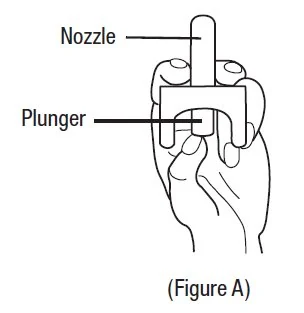
(Figure A)
Step 3. Gently close 1 side of your nose (nostril) with your other index finger. Insert the nozzle into the open nostril about half an inch or as far as it feels comfortable and tilt your head slightly forward (see Figure B). Do not press the plunger yet.
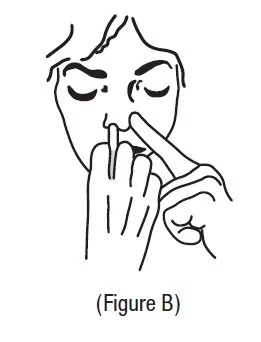
(Figure B)
Step 4. Breathe in gently through your nose, close your mouth, and at the same time press the plunger firmly upwards with your thumb.
Step 5. Remove the nozzle from your nostril. At the same time, keep your head straight for 10 to 20 seconds while gently breathing in through your nose and breathing out through your mouth.
How to dispose of (throw away) Cyanocobalamin Nasal Spray?
Cyanocobalamin Nasal Spray can be disposed of in your household trash. Place the Cyanocobalamin Nasal Spray in a container such as a zip-top or sealable plastic bag, and throw the container away in your household trash.
Manufactured by Padagis®
Yeruham, Israel
www.padagis.com
Rev 02-23
0H800 RC PH1
This Instructions for Use has been approved by the U.S. Food and Drug Administration Revised: 02/2023