


Patient information: uses, side effects, how to take - Symbicort
What is SYMBICORT?
SYMBICORT combines an inhaled corticosteroid medicine (ICS), budesonide and a long-acting beta2-adrenergic agonist (LABA) medicine, formoterol.
- Inhaled corticosteroids help to decrease inflammation in the lungs. Inflammation in the lungs can lead to breathing problems.
- LABA medicines are used in people with chronic obstructive pulmonary disease (COPD) and asthma. LABA medicines help the muscles around the airways in your lungs stay relaxed to prevent symptoms such as wheezing, cough, chest tightness, and shortness of breath. These symptoms can happen when the muscles around the airways tighten. This makes it hard to breathe. In severe cases, wheezing can stop your breathing and may lead to death if not treated right away.
SYMBICORT is not used to relieve sudden breathing problems and will not replace a rescue inhaler.
SYMBICORT is used for asthma and COPD as follows:
Asthma: SYMBICORT is used to control symptoms of asthma, and prevent symptoms such as wheezing in adults and children ages 6 and older.
SYMBICORT contains formoterol. LABA medicines such as formoterol when used alone increase the risk of death and hospitalizations from asthma problems. SYMBICORT contains an ICS and a LABA. When an ICS and LABA are used together, there is not a significant increased risk in hospitalizations and death from asthma problems. SYMBICORT is not for adults and children with asthma who are well controlled with an asthma-control medicine, such as a low to medium dose of an ICS. SYMBICORT is for adults and children with asthma who need both an ICS and LABA medicine.
It is not known if SYMBICORT is safe and effective in children less than 6 years of age with asthma.
- COPD: COPD is a long-term (chronic) lung disease that includes chronic bronchitis, emphysema, or both. SYMBICORT 160/4.5 mcg is used long-term, as 2 inhalations 2 times each day, to improve symptoms of COPD for better breathing and to reduce the number of flare-ups (the worsening of your COPD symptoms for several days).
Do not use SYMBICORT:
- to treat sudden severe symptoms of asthma or COPD.
- if you are allergic to any of the ingredients in SYMBICORT. See the end of this leaflet for a list of ingredients in SYMBICORT.
Before you use SYMBICORT, tell your healthcare provider about all of your medical conditions, including if you:
- have heart problems.
- have high blood pressure.
- have seizures.
- have thyroid problems.
- have diabetes.
- have liver problems.
- have osteoporosis.
- have an immune system problem.
- have eye problems such as increased pressure in the eye, glaucoma, or cataracts.
- are allergic to any medicines.
- have any type of viral, bacterial, fungal, or parasitic infection.
- are exposed to chicken pox or measles.
are pregnant or plan to become pregnant. It is not known if SYMBICORT may harm your unborn baby.
- are breastfeeding. Budesonide, one of the active ingredients in SYMBICORT, passes into breast milk. You and your healthcare provider should decide if you will take SYMBICORT while breast-feeding.
Tell your healthcare provider about all the medicines you take including prescription and over-the-counter medicines, vitamins, and herbal supplements. SYMBICORT and certain other medicines may interact with each other. This may cause serious side effects. Especially tell your healthcare provider if you take antifungal or anti-HIV medicines.
Know all the medicines you take. Keep a list and show it to your healthcare provider and pharmacist each time you get a new medicine.
How should I use SYMBICORT?
See the step-by-step instructions for using SYMBICORT at the end of this Patient Information leaflet. Do not use SYMBICORT unless your healthcare provider has taught you and you understand everything. Ask your healthcare provider or pharmacist if you have any questions.
- Use SYMBICORT exactly as prescribed. Do not use SYMBICORT more often than prescribed. SYMBICORT comes in 2 strengths. Your healthcare provider has prescribed the strength that is best for you. Note the differences between SYMBICORT and your other inhaled medications, including the differences in prescribed use and physical appearance.
- Children should use SYMBICORT with an adult’s help, as instructed by the child’s healthcare provider.
- SYMBICORT should be taken every day as 2 puffs in the morning and 2 puffs in the evening about 12 hours apart.
- If you miss a dose of SYMBICORT, you should take your next dose at the same time you normally do.
- Rinse your mouth with water and spit the water out after each dose (2 puffs) of SYMBICORT. Do not swallow the water. This will help to lessen the chance of getting a fungus infection (thrush) in the mouth and throat.
- If you take too much SYMBICORT, call your healthcare provider or go to the nearest hospital emergency room right away if you have any unusual symptoms, such as worsening shortness of breath, chest pain, increased heart rate, or shakiness.
- Do not spray SYMBICORT in your eyes. If you accidentally get SYMBICORT in your eyes, rinse your eyes with water, and if redness or irritation persists, consult your healthcare provider.
- Do not change or stop any medicines used to control or treat your breathing problems. Your healthcare provider will change your medicines as needed.
- While you are using SYMBICORT 2 times each day, do not use other medicines that contain a LABA for any reason. Ask your healthcare provider or pharmacist if any of your other medicines are LABA medicines.
- SYMBICORT does not relieve sudden symptoms. Always have a rescue inhaler medicine with you to treat sudden symptoms. If you do not have a rescue inhaler, call your healthcare provider to have one prescribed for you.
Call your healthcare provider or get medical care right away if:
- your breathing problems worsen with SYMBICORT.
- you need to use your rescue inhaler medicine more often than usual.
- your rescue inhaler medicine does not work as well for you at relieving symptoms.
- your peak flow meter results decrease. Your healthcare provider will tell you the numbers that are right for you.
- your symptoms do not improve after using SYMBICORT regularly for 1 week.
What are the possible side effects of SYMBICORT?
SYMBICORT may cause serious side effects, including:
- Using too much of a LABA medicine may cause:
- chest pain
- a fast and irregular heartbeat
- tremor
- increased blood pressure
- headache
- nervousness
- Fungal infection in your mouth or throat (thrush). Rinse your mouth with water without swallowing after using SYMBICORT to help reduce your chance of getting thrush.
- Pneumonia and other lower respiratory tract infections. People with COPD have a higher chance of getting pneumonia and other lung infections. Inhaled corticosteroids may increase the chance of getting pneumonia. Call your healthcare provider if you notice any of these symptoms:
- increase in mucus (sputum) production
- fever
- increased cough
- change in mucus color
- chills
- increased breathing problems
- Immune system effects and a higher chance for infections. Tell your healthcare provider about any signs of infection such as:
- fever
- body aches
- feeling tired
- vomiting
- pain
- chills
- nausea
- Adrenal insufficiency. Adrenal insufficiency is a condition in which the adrenal glands do not make enough steroid hormones. This can happen when you stop taking oral corticosteroid medicines and start inhaled corticosteroid medicine.
- Increased wheezing right after taking SYMBICORT. Always have a rescue inhaler with you to treat sudden wheezing.
- Serious allergic reactions including rash, hives, swelling of the face, mouth, and tongue, and breathing problems. Call your healthcare provider or get emergency medical care if you get any symptoms of a serious allergic reaction.
- Lower bone mineral density. This can happen in people who have a high chance for low bone mineral density (osteoporosis). Your healthcare provider should check you for this during treatment with SYMBICORT.
- Slowed growth in children. A child’s growth should be checked regularly while using SYMBICORT.
- Eye problems including glaucoma and cataracts. You should have regular eye exams while using SYMBICORT.
- Swelling of your blood vessels. This can happen in people with asthma. Tell your healthcare provider right away if you have:
- a feeling of pins and needles or numbness of your arms or legs
- rash
- flu like symptoms
- pain and swelling of the sinuses
- Decreases in blood potassium levels (hypokalemia).
- Increases in blood sugar levels (hyperglycemia).
The most common side effects of SYMBICORT include:
People with asthma:
- throat irritation
- upper respiratory tract infection
- inflammation of mucous membranes of the sinuses (sinusitis)
- back pain
- stomach discomfort
- thrush in the mouth and throat. Rinse your mouth with water without swallowing after use to help prevent thrush
- headache
- throat pain
- flu
- nasal congestion
- vomiting
People with COPD:
- throat irritation.
- thrush in the mouth and throat. Rinse your mouth with water without swallowing after use to help prevent thrush.
- infection and inflammation of the mucous membranes of the bronchial tubes (bronchitis).
- inflammation of mucous membranes in the sinuses (sinusitis).
- upper respiratory tract infection.
Tell your healthcare provider about any side effect that bothers you or that does not go away.
These are not all the possible side effects of SYMBICORT.
Call your doctor for medical advice about side effects. You may report side effects to FDA at 1-800-FDA-1088.
You may also report side effects to AstraZeneca at 1-800-236-9933.
How should I store SYMBICORT?
- Store SYMBICORT at room temperature between 68°F to 77°F (20°C to 25°C).
- Store SYMBICORT with the mouthpiece down.
- The contents of your SYMBICORT canister are under pressure. Do not puncture or throw the canister into a fire or incinerator. Do not use or store it near heat or open flame. Storage above 120ºF may cause the canister to burst.
- Throw away SYMBICORT when the counter reaches zero (“0”) or 3 months after you take SYMBICORT out of its foil pouch, whichever comes first.
- Keep SYMBICORT and all medicines out of the reach of children.
General Information about the safe and effective use of SYMBICORT.
Medicines are sometimes prescribed for purposes other than those listed in a Patient Information leaflet. Do not use SYMBICORT for a condition for which it was not prescribed. Do not give SYMBICORT to other people, even if they have the same symptoms that you have. It may harm them.
You can ask your healthcare provider or pharmacist for information about SYMBICORT that is written for health professionals.
What are the ingredients in SYMBICORT?
Active ingredients: micronized budesonide and micronized formoterol fumarate dihydrate
Inactive ingredients: hydrofluroalkane (HFA 227), povidone K25 USP, and polyethylene glycol 1000 NF
Manufactured for: AstraZeneca Pharmaceuticals LP, Wilmington, DE 19850
By: AstraZeneca Dunkerque Production, Dunkerque, France Product of France
For more information, call 1-800-236-9933 or go to www.MySymbicort.com.
Revised: December 2017
Instructions for Use
Instructions for Use
SYMBICORT (SIM-bi-kort)
(budesonide 80 mcg and formoterol fumarate dihydrate 4.5 mcg)
Inhalation Aerosol
SYMBICORT (SIM-bi-kort)
(budesonide 160 mcg and formoterol fumarate dihydrate 4.5 mcg)
Inhalation Aerosol
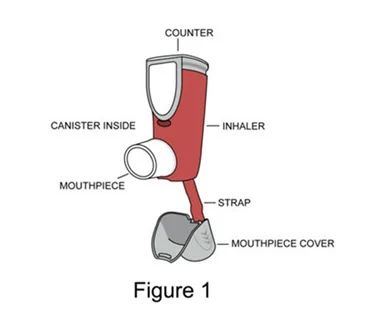
Upright Position
How to Use SYMBICORT
Follow the instructions below for using SYMBICORT. You will breathe-in (inhale) the medicine. If you have any questions, ask your doctor or pharmacist.
Preparing your SYMBICORT inhaler for use
- 1. Take your SYMBICORT out of the moisture-protective foil pouch before you use it for the first time and throw the foil away. Write the date that you open the foil pouch on the box.
- 2. A counter is attached to the top of the metal canister. The counter will count down each time you release a puff of SYMBICORT. The arrow points to the number of inhalations (puffs) left in the canister. The counter will stop counting at zero (“0”).
- 3. Use the SYMBICORT canister only with the red SYMBICORT inhaler supplied with the product. Parts of the SYMBICORT inhaler should not be used with parts from any other inhalation product.
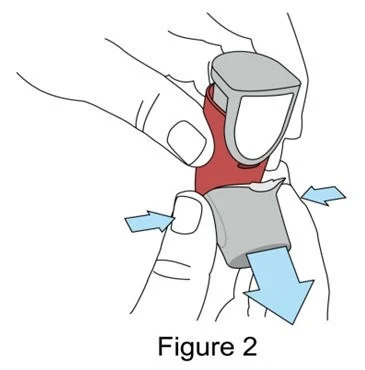
- 4. Shake your SYMBICORT inhaler well for 5 seconds right before each use. Remove the mouthpiece cover by squeezing gently at both sides, then pulling out (see Figure 2). Check the mouthpiece for foreign objects before use.
- 5.
Priming your SYMBICORT inhaler
Before you use SYMBICORT for the first time, you will need to prime it. To prime SYMBICORT, hold it in the upright position. See Figure 1. Shake the SYMBICORT inhaler well for 5 seconds. Hold your SYMBICORT inhaler facing away from you and press down firmly and fully on the top of the counter on the SYMBICORT inhaler to release a test spray. Then shake it again for 5 seconds and release a second test spray. Your SYMBICORT inhaler is now primed and ready for use. After you have primed the SYMBICORT inhaler for the first time, the counter will read either 120 or 60, depending on which size was provided to you.
If you do not use your SYMBICORT inhaler for more than 7 days or if you drop it, you will need to prime again.
Ways to hold the SYMBICORT inhaler for use
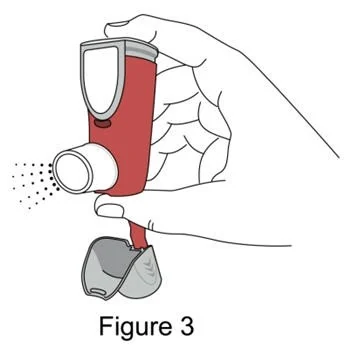
OR
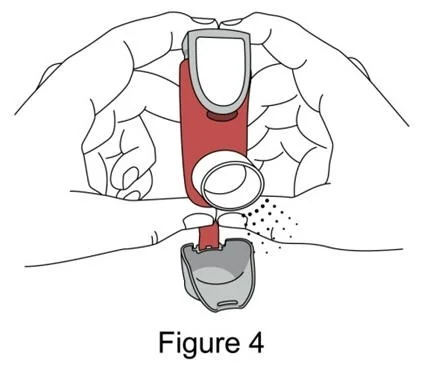
Using your SYMBICORT inhaler
- 6. Shake your SYMBICORT inhaler well for 5 seconds. Remove the mouthpiece cover. Check the mouthpiece for foreign objects.
- 7. Breathe out fully (exhale). Hold the SYMBICORT inhaler up to your mouth. Place the white mouthpiece fully into your mouth and close your lips around it. Make sure that the SYMBICORT inhaler is upright and that the opening of the mouthpiece is pointing towards the back of your throat (see Figure 5).
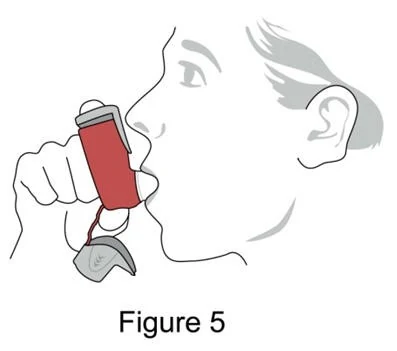
- 8. Breathe in (inhale) deeply and slowly through your mouth. Press down firmly and fully on the top of the counter on the SYMBICORT inhaler to release the medicine (see Figures 3 and 4).
- 9. Continue to breathe in (inhale) and hold your breath for about 10 seconds, or for as long as is comfortable. Before you breathe out (exhale), release your finger from the top of the counter. Keep the SYMBICORT inhaler upright and remove from your mouth.
- 10. Shake the SYMBICORT inhaler again for 5 seconds and repeat steps 7 to 9.
After using your SYMBICORT inhaler
- 11. After use, close the mouthpiece cover by pushing until it clicks in place.
- 12. After you finish taking SYMBICORT (2 puffs), rinse your mouth with water. Spit out the water. Do not swallow it.
Reading the counter
- The arrow on the counter on the top of the SYMBICORT inhaler points to the number of inhalations (puffs) left in your inhaler.
COUNTER
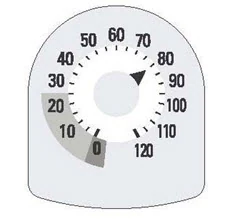
- The counter will count down each time you release a puff of medicine (either when priming your SYMBICORT inhaler or when taking the medicine).
- When the arrow on the counter approaches 20, you will notice the beginning of a yellow area letting you know that it is time to call your healthcare provider for a refill.
COUNTER
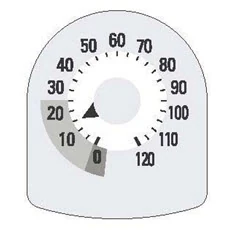
- It is important that you pay attention to the number of inhalations (puffs) left in your SYMBICORT inhaler by reading the counter. Throw away SYMBICORT when the counter shows zero (“0”) or 3 months after you take your SYMBICORT inhaler out of its foil pouch, whichever comes first. Your SYMBICORT inhaler may not feel empty and it may continue to operate, but you will not get the right amount of medicine if you keep using it. Use a new SYMBICORT inhaler and follow the instructions for priming (see instruction 5 above).
How to clean your SYMBICORT inhaler
Clean the white mouthpiece of your SYMBICORT inhaler every 7 days. To clean the mouthpiece:
- Remove the grey mouthpiece cover
- Wipe the inside and outside of the white mouthpiece opening with a clean, dry cloth
- Replace the mouthpiece cover
- Do not put the SYMBICORT inhaler into water
- Do not try to take apart your SYMBICORT inhaler
Manufactured for: AstraZeneca Pharmaceuticals LP, Wilmington, DE 19850
By: AstraZeneca Dunkerque Production, Dunkerque, France
Product of France
This Patient Information and Instructions for Use has been approved by the U.S. Food and Drug Administration.
SYMBICORT is a trademark of the AstraZeneca group of companies. FORADIL AEROLIZER is a trademark of Novartis Pharmaceuticals Corporation.
©AstraZeneca 2017
Revised: December 2017