


Patient information: uses, side effects, how to take - Sprix
What is the most important information I should know about medicines called Nonsteroidal Anti-inflammatory Drugs (NSAIDs)?
NSAIDs can cause serious side effects, including:
Increased risk of a heart attack or stroke that can lead to death.This risk may happen early in treatment and may increase:
- with increasing doses of NSAIDs
- with longer use of NSAIDs
Do not take NSAIDs right before or after a heart surgery called a “coronary artery bypass graft (CABG)."
Avoid taking NSAIDs after a recent heart attack, unless your healthcare provider tells you to. You may have an increased risk of another heart attack if you take NSAIDs after a recent heart attack.
Increased risk of bleeding, ulcers, and tears (perforation) of the esophagus (tube leading from the mouth to the stomach), stomach and intestines:
- anytime during use
- without warning symptoms
- that may cause death
The risk of getting an ulcer or bleeding increases with:
- past history of stomach ulcers, or stomach or intestinal bleeding with use of NSAIDs
- taking medicines called “corticosteroids”, “anticoagulants”, “SSRIs”, or “SNRIs”
- increasing doses of NSAIDs
- longer use of NSAIDs
- smoking
- drinking alcohol
- older age
- poor health
- advanced liver disease
- bleeding problems
NSAIDs should only be used:
- exactly as prescribed
- at the lowest dose possible for your treatment
- for the shortest time needed
What are NSAIDs?
NSAIDs are used to treat pain and redness, swelling, and heat (inflammation) from medical conditions such as different types of arthritis, menstrual cramps, and other types of short-term pain.
Who should not take NSAIDs?
Do not take NSAIDs:
- if you have had an asthma attack, hives, or other allergic reaction with aspirin or any other NSAIDs.
- right before or after heart bypass surgery.
Before taking NSAIDs, tell your healthcare provider about all of your medical conditions, including if you:
- have liver or kidney problems
- have high blood pressure
- have asthma
are pregnant or plan to become pregnant. Taking NSAIDs at about 20 weeks of pregnancy or later may harm
your unborn baby. If you need to NSAIDs for more than 2 days when you are between 20 and 30 weeks of
pregnancy, your healthcare provider may need to monitor the amount of fluid in your womb around your
baby. You should not take NSAIDs after about 30 weeks of pregnancy.
- are breastfeeding or plan to breast feed.
Tell your healthcare provider about all of the medicines you take, including prescription or over-the-counter medicines, vitamins or herbal supplements. NSAIDs and some other medicines can interact with each other and cause serious side effects. Do not start taking any new medicine without talking to your healthcare provider first.
What are the possible side effects of NSAIDs?
NSAIDs can cause serious side effects, including:
See “What is the most important information I should know about medicines called Nonsteroidal Anti-inflammatory Drugs (NSAIDs)?”
- new or worse high blood pressure
- heart failure
- liver problems including liver failure
- kidney problems including kidney failure
- low red blood cells (anemia)
- life-threatening skin reactions
- life-threatening allergic reactions
- Other side effects of NSAIDs include: stomach pain, constipation, diarrhea, gas, heartburn, nausea, vomiting, and dizziness.
Get emergency help right away if you get any of the following symptoms:
- shortness of breath or trouble breathing
- chest pain
- weakness in one part or side of your body
- slurred speech
- swelling of the face or throat
Stop taking your NSAID and call your healthcare provider right away if you get any of the following symptoms:
- nausea
- more tired or weaker than usual
- diarrhea
- itching
- your skin or eyes look yellow
- indigestion or stomach pain
- flu-like symptoms
- vomit blood
- there is blood in your bowel movement or it is black and sticky like tar
- unusual weight gain
- skin rash or blisters with fever
- swelling of the arms, legs, hands and feet
If you take too much of your NSAID, call your healthcare provider or get medical help right away.
These are not all the possible side effects of NSAIDs. For more information, ask your healthcare provider or pharmacist about NSAIDs.
Call your doctor for medical advice about side effects. You may report side effects to FDA at 1-800-FDA-1088.
Other information about NSAIDs
- Aspirin is an NSAID but it does not increase the chance of a heart attack. Aspirin can cause bleeding in the brain, stomach, and intestines. Aspirin can also cause ulcers in the stomach and intestines.
- Some NSAIDs are sold in lower doses without a prescription (over-the-counter). Talk to your healthcare provider before using over-the-counter NSAIDs for more than 10 days.
General information about the safe and effective use of NSAIDs
Medicines are sometimes prescribed for purposes other than those listed in a Medication Guide. Do not use NSAIDs for a condition for which it was not prescribed. Do not give NSAIDs to other people, even if they have the same symptoms that you have. It may harm them.
If you would like more information about NSAIDs, talk with your healthcare provider. You can ask your pharmacist or healthcare provider for information about NSAIDs that is written for health professionals.
Manufactured for: Zyla Life Sciences US Inc., Wayne, PA 19087
Distributed by: Zyla Life Sciences US Inc., Wayne, PA 19087
For more information, go to www.sprix.com or call 1-800-518-1084.
This Medication Guide has been approved by the U.S. Food and Drug Administration.
Issued or Revised: 04/2021
Instructions for Use
SPRIX® (spriks)
(ketorolac tromethamine)
Nasal Spray
Read this Instructions for Use before you start using SPRIX and each time you get a refill. There may be new information. This information does not take the place of talking to your healthcare provider about your medical condition or your treatment.
Important information:
- SPRIX is for use in your nose only. Do not breathe in (inhale) SPRIX.
- Each SPRIX bottle has enough pain medicine for 1 day.
- Throw away each SPRIX bottle within 24 hours of taking your first dose, even if the bottle still contains unused medicine.
Your healthcare provider has prescribed SPRIX to treat moderate to severe pain.
- Use SPRIX exactly as your healthcare provider tells you to use it.
- Your healthcare provider will tell you how many sprays you should use each time you use SPRIX.
- Do not use SPRIX for more than 5 days. If you still have pain after 5 days, contact your healthcare provider.
- Do not use SPRIX more than every 6 hours.
- It is important that you drink plenty of fluids while you are using SPRIX. Tell your healthcare provider if you urinate less while using SPRIX.
You may have discomfort or irritation in your nose when using SPRIX. This usually lasts for a short time. Do not breathe in (inhale) SPRIX while spraying.
Using SPRIX Nasal Spray
Parts of your SPRIX bottle
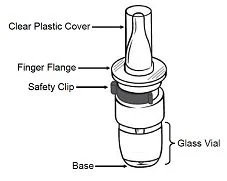
Follow the instructions below to use SPRIX.
Before you use SPRIX for the first time, you will need to prime the bottle.
Priming SPRIX:
Step 1. Hold the finger flange with your fingers (see Figure A), and remove the clear plastic cover with your opposite hand. Keep the clear plastic cover for later. Remove and throw away the blue plastic safety clip.
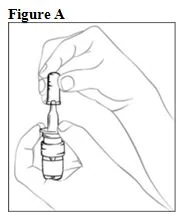
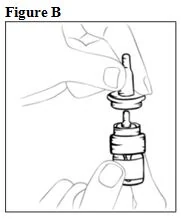
If the clear plastic cover is improperly removed, the tip of the bottle may be pulled off of the glass vial. If this happens, place the tip back onto the glass vial by lining it up carefully and gently pushing it back on until it is back in the correct position (see Figure B). The SPRIX bottle should work properly again.
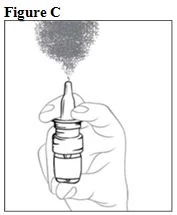
Step 2. Hold the SPRIX bottle upright at arm’s length away from you with your index finger and middle finger resting on the top of the finger flange and your thumb supporting the base (see Figure C).
Press down on the finger flange and release the pump 5 times. You may not see a spray the first few times you press down.
Now the pump is primed and ready to use. You do not need to prime the pump again if you use more doses from this bottle.
Step 3. Blow your nose to clear your nostrils.
Step 4. Sit up straight or stand.
Step 5. Keep your head tilted downward toward your toes.
Step 6. Place the tip of the SPRIX bottle into your right nostril.
Step 7. Hold the SPRIX bottle upright and aim the tip toward the back of your nose (see Figure D).
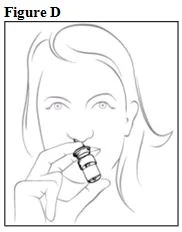
Step 8. Hold your breath and spray 1 time into your right nostril, pressing down on both sides of the finger flange (see Figure D).
Step 9. Breathe in gently through your mouth after you use SPRIX. You may also pinch your nose to help keep the medicine in your nose.
Step 10. If your healthcare provider has prescribed only 1 spray per dose for you, you have now finished your dose, skip to Step 12 below.
Step 11. If your healthcare provider has prescribed 2 sprays for you, repeat steps 3 - 9 above for your left nostril. Be sure to point the spray away from the center of your nose. Spray 1 time into your left nostril.
Step 12. When you are finished using SPRIX, put the clear plastic cover back on the SPRIX bottle.
How should I store SPRIX?
- Store unopened SPRIX bottles between 36°F to 46°F (2°C to 8°C).
- Keep opened bottles of SPRIX at room temperature.
- Keep SPRIX out of direct sunlight.
- Do not freeze SPRIX.
- SPRIX does not contain a preservative. Throw away each SPRIX bottle within 24 hours of taking your first dose, even if the bottle still contains unused medicine.
Keep SPRIX and all medicines out of the reach of children.
General information about the safe and effective use of SPRIX.
Medicines are sometimes prescribed for purposes other than those listed in a Medication Guide. Do not give SPRIX to other people, even if they have the same symptoms that you have. It may harm them.
You can ask your pharmacist or healthcare provider for information about SPRIX that is written for health professionals.
What are the ingredients in SPRIX?
Active ingredient: ketorolac tromethamine
Inactive ingredient: edetate disodium (EDTA), monobasic potassium phosphate, sodium hydroxide, and water for injection
This Instructions for Use has been approved by the U.S. Food and Drug Administration.
Distributed by:
Zyla Life Sciences US Inc.
Wayne, PA 19087
LBL # 102.04 Revised: 04/2021