


Prescribing information (package insert) - Sorilux
1 INDICATIONS AND USAGE
SORILUX Foam is indicated for the topical treatment of plaque psoriasis of the scalp and body in adults and pediatric patients 4 years of age and older.
2 DOSAGE AND ADMINISTRATION
SORILUX Foam is for topical use only. SORILUX Foam is not for oral, ophthalmic, or intravaginal use.
Apply a thin layer of SORILUX Foam twice daily to the affected areas and rub in gently and completely. Avoid contact with the face and eyes.
3 DOSAGE FORMS AND STRENGTHS
0.005%, white foam. SORILUX Foam contains calcipotriene 50 mcg/g in an aqueous-based emulsion foam vehicle.
4 CONTRAINDICATIONS
SORILUX Foam should not be used by patients with known hypercalcemia.
5 WARNINGS AND PRECAUTIONS
5.1 Flammability
The propellant in SORILUX Foam is flammable. Instruct the patient to avoid fire, flame, and smoking during and immediately following application.
5.2 Effects on Calcium Metabolism
Elevation of serum calcium has occurred with use of calcipotriene. If elevation in serum calcium outside the normal range should occur, discontinue treatment until normal calcium levels are restored.
6 ADVERSE REACTIONS
6.1 Clinical Trials Experience
Because clinical trials are conducted under widely varying conditions, adverse reaction rates observed in clinical trials of a drug cannot be directly compared with rates in the clinical trials of another drug and may not reflect the rates observed in clinical practice.
SORILUX Foam was studied in four vehicle-controlled trials. A total of 1094 adult subjects with plaque psoriasis, including 654 exposed to SORILUX Foam, were treated twice daily for 8 weeks. Adverse reactions reported in ≥1% of subjects treated with SORILUX Foam and at a higher incidence than subjects treated with vehicle were application site erythema (2%) and application site pain (3%). The incidence of these adverse reactions was similar between the body and scalp.
In an open-label study, 19 pediatric subjects age 12 to less than 17 years applied SORILUX Foam twice daily for 14 days and once on Day 15. Adverse reactions included application site pain, application site pruritus and pruritus [see Clinical Pharmacology (12.2 and 12.3) and Pediatric Use (8.4)].
In an open-label study, 36 pediatric subjects age 4 to less than 12 years applied SORILUX Foam twice daily for up to 8 weeks. Adverse reactions included application site pain and contact dermatitis [see Clinical Pharmacology (12.2 and 12.3) and Pediatric Use (8.4)].
6.2 Postmarketing Experience
The following adverse reactions have been identified during post approval use of SORILUX Foam. Because these reactions are reported voluntarily from a population of uncertain size, it is not always possible to reliably estimate their frequency or establish a causal relationship to drug exposure.
Skin and Subcutaneous: application site vesicles
8 USE IN SPECIFIC POPULATIONS
8.1 Pregnancy
Risk Summary
Although there are no available data on the drug- associated risk of major birth defects, miscarriage or adverse maternal or fetal outcomes in pregnant women exposed to SORILUX Foam, systemic exposure to calcipotriene is likely to be low [see Clinical Pharmacology (12.2, 12.3)].
In animal reproduction studies, oral administration of calcipotriene to pregnant rats and rabbits during the period of organogenesis resulted in an increased incidence of minor skeletal abnormalities, including enlarged fontanelles and extra ribs in rats and an increased incidence of minor skeletal abnormalities, including incomplete ossification of pubic bones and forelimb phalanges in rabbits (see Data). The available data do not allow the calculation of relevant comparisons between the systemic exposure of calcipotriene observed in animal studies to the systemic exposure that would be expected in humans after topical use of SORILUX Foam.
The estimated background risk of major birth defects and miscarriage for the indicated population is unknown. All pregnancies have a background risk of birth defect, loss, or other adverse outcomes. In the U.S. general population, the estimated risk of major birth defects and miscarriage in clinically recognized pregnancies is 2 to 4% and 15 to 20%, respectively.
Data
Animal Data
Embryofetal development studies were conducted with calcipotriene after oral administration in rats and rabbits. Pregnant rats received daily oral administration of calcipotriene during the period of organogenesis. Fetuses from dams dosed with 54 mcg/kg/day (318 mcg/m2/day) exhibited a significantly increased incidence of minor skeletal abnormalities consisting primarily of enlarged fontanelles and extra ribs. The enlarged fontanelles are most likely due to calcipotriene's effect upon calcium metabolism. There were no effects on the incidence of major malformations in fetuses.
Pregnant rabbits received daily oral administration of calcipotriene during the period of organogenesis. Increased rabbit maternal and fetal toxicity was noted at 12 mcg/kg/day (132 mcg/m2/day). Fetuses from does dosed with 36 mcg/kg/day (396 mcg/m2/day) exhibited a significantly increased incidence of minor skeletal abnormalities including incomplete ossification of pubic bones and forelimb phalanges. There were no effects on the incidence of major malformations in fetuses.
8.2 Lactation
Risk Summary
There are no data on the presence of topically administered calcipotriene in human or animal milk, the effects on the breastfed infant, or the effects on milk production. After topical administration of SORILUX Foam, concentrations of calcipotriene in plasma are low, and therefore, concentrations in human milk are likely to be low [see Clinical Pharmacology (12.3)]. The developmental and health benefits of breastfeeding should be considered along with the mother's clinical need for and any potential adverse effects on the breastfed child from SORILUX Foam or from the underlying maternal condition.
8.4 Pediatric Use
The safety and effectiveness of SORILUX Foam have been established in pediatric patients age 4 years and older for topical treatment of plaque psoriasis of the scalp and body.
Use of SORILUX Foam in this age group is supported by two adequate and well controlled 8-week trials in adults and adolescents 12 years of age and older, with additional data from a 15-day open-label safety and pharmacokinetics (PK) study conducted in 19 subjects 12 to less than 17 years of age; and an 8-week open-label safety and PK study in 36 subjects 4 to 11 years of age with psoriasis. Data from 19 subjects aged 12 to less than 17 years and 18 subjects aged 5 to 11 years showed no significant effects on indices of calcium metabolism. Systemic concentrations of calcipotriene were not quantifiable in the two studies in subjects aged 7 years to less than 17 years. [see Clinical Studies (14), Clinical Pharmacology (12.2, 12.3) and Adverse Reactions (6.1)].
The safety and effectiveness of SORILUX Foam in pediatric patients less than 4 years of age have not been established.
8.5 Geriatric Use
Clinical trials of SORILUX Foam did not include sufficient numbers of subjects aged 65 years and over to determine whether they respond differently from younger subjects. Other reported clinical experience has not identified differences in responses between the elderly and younger patients.
10 OVERDOSAGE
Topically applied calcipotriene can be absorbed in sufficient amounts to produce systemic effects. Elevated serum calcium has been observed with use of topical calcipotriene [See Warnings and Precautions (5.2)].
11 DESCRIPTION
SORILUX Foam contains the compound calcipotriene, a synthetic vitamin D3 analog, in an aqueous-based emulsion foam vehicle for topical dermatologic use.
Chemically, calcipotriene is (5Z,7E,22E,24S)-24-cyclopropyl-9,10-secochola-5,7,10(19), 22-tetraene- 1α,3β,24-triol. The structural formula is represented below:
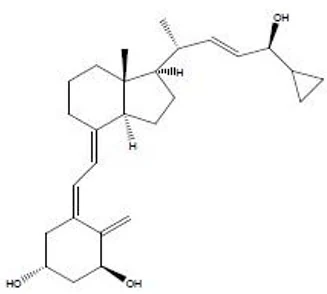
Molecular Formula: C27H40O3 Molecular Weight: 412.6
Calcipotriene is a white or off-white crystalline substance. SORILUX Foam contains calcipotriene 50 mcg/g in an aqueous-based emulsion foam vehicle consisting of cetyl alcohol, dibasic sodium phosphate, dl-α-tocopherol, edetate disodium, isopropyl myristate, light mineral oil, polyoxyl 20 cetostearyl ether, propylene glycol, purified water, stearyl alcohol, and white petrolatum. SORILUX Foam is dispensed from an aluminum can pressurized with a hydrocarbon (propane/n-butane/isobutane) propellant.
12 CLINICAL PHARMACOLOGY
12.1 Mechanism of Action
Calcipotriene is a synthetic vitamin D3 analog that has a similar receptor binding affinity as natural vitamin D3. However, the exact mechanism of action contributing to the clinical efficacy in the treatment of psoriasis is unknown.
12.2 Pharmacodynamics
Effects on Calcium Metabolism
In 19 subjects with psoriasis aged 12 to less than 17 years treated with SORILUX Foam two times a day for 15 days, there was no significant effect on indices of calcium metabolism including serum albumin adjusted calcium, urine calcium/creatinine ratio, iPTH, alkaline phosphatase, magnesium and phosphorus.
The effects of SORILUX Foam, 0.005%, on calcium metabolism were evaluated in 18 pediatric subjects 5 to 11 years of age receiving SORILUX Foam administered twice daily for a minimum of 14 days (mean: 56 days, range: 14 to 69 days). These subjects had plaque psoriasis involving an average of 10% of the body surface area (BSA) (range: 0.5%-36.5%). There was no relationship between urinary calcium/creatinine ratio (comparing Week 2 to Baseline) and % BSA treated.
12.3 Pharmacokinetics
The systemic absorption of calcipotriene in subjects with psoriasis of the body was evaluated at steady state following application of either SORILUX Foam or calcipotriene ointment to a body surface area of 5% to 10%. In the SORILUX Foam treatment group, 15 out of 16 subjects had calcipotriene plasma concentrations below the limit of quantitation (10 pg/mL), while in the calcipotriene ointment treated group, 5 out of 16 subjects had measurable calcipotriene plasma concentrations at various time points. All measurable plasma calcipotriene concentrations were below 25 pg/mL.
The pharmacokinetics of SORILUX Foam, 0.005% was investigated when applied topically for 15 days to 17 subjects aged 12 to less than 17 years with moderate plaque psoriasis involving a mean BSA of 24%, excluding face and scalp, and a mean scalp involvement of 43%. Systemic concentration of calcipotriene were not quantifiable in any of the subjects (limit of quantification = 10 pg/mL).
In 11 pediatric subjects 7 to 11 years of age with plaque psoriasis involving a mean BSA of 10%, plasma concentration of calcipotriene was measured following 2 weeks of twice daily administration of SORILUX Foam. No subject had quantifiable calcipotriene plasma concentration (limit of quantification = 10 pg/mL).
The systemic disposition of calcipotriene is expected to be similar to that of the naturally occurring vitamin D. Absorbed calcipotriene is known to be converted to inactive metabolites within 24 hours of application and the metabolism occurs via a similar pathway to the natural hormone.
13 NONCLINICAL TOXICOLOGY
13.1 Carcinogenesis, Mutagenesis, Impairment of Fertility
Calcipotriene topically administered to mice for up to 24 months at dose levels of 3, 10, or 30 mcg/kg/day (corresponding to 9, 30, or 90 mcg /m2/day) showed no significant changes in tumor incidence when compared with controls.
The genotoxic potential of calcipotriene was evaluated in an Ames assay, a mouse lymphoma TK locus assay, a human lymphocyte chromosome aberration assay, and a mouse micronucleus assay. All assay results were negative.
Studies in rats at oral doses up to 54 mcg /kg/day (318 mcg /m2/day) of calcipotriene indicated no impairment of fertility or general reproductive performance.
14 CLINICAL STUDIES
In two multi-center, randomized, double-blind, vehicle-controlled clinical trials a total of 659 subjects with psoriasis were randomized 2:1 to SORILUX Foam or vehicle; subjects applied the assigned treatment twice daily for 8 weeks. Baseline disease severity was graded using a 5-point Investigator Static Global Assessment scale (ISGA), on which subjects scored either "mild" or "moderate" as shown in Table 1.
Table 1. Investigator Static Global Assessment (ISGA) Scale for Body
| Disease Severity | Grade | Definition |
|---|---|---|
| Clear | 0 | No evidence of scaling, erythema, or plaque thickness |
| Almost clear | 1 | Occasional fine scale, faint erythema, and barely perceptible plaque thickness |
| Mild | 2 | Fine scale with light coloration and mild plaque elevation |
| Moderate | 3 | Coarse scale with moderate red coloration and moderate plaque thickness |
| Severe | 4 | Thick tenacious scale with deep coloration and severe plaque thickness |
Efficacy evaluation was carried out at Week 8 with treatment success being defined as a score of "clear" (grade 0) or "almost clear" (grade 1) and at least 2 grade improvement from the baseline score. Approximately 30% of enrolled subjects were graded as "mild" on the ISGA scale. The study population ranged in age from 12 to 89 years with 10 subjects less than 18 years of age at baseline. The subjects were 54% male and 88% Caucasian. Table 2 presents the efficacy results for each trial.
Table 2. Number and Percent of Subjects Achieving Success for Body at Week 8 in Each Trial
| Trial 1 | Trial 2 | |||
|---|---|---|---|---|
SORILUX Foam N = 223 | Vehicle Foam N = 113 | SORILUX Foam N = 214 | Vehicle Foam N = 109 | |
| Number (%) of Subjects with Treatment Success | 31 (14%) | 8 (7%) | 58 (27%) | 17 (16%) |
In one trial, subjects graded as "mild" at baseline showed a greater response to vehicle than SORILUX Foam.
Table 3 presents the success rates by disease severity at baseline for each trial.
Table 3. Number and Percent of Subjects Achieving Success for Body by Baseline ISGA Score and by Trial
| Trial 1 | Trial 2 | |||
|---|---|---|---|---|
| ISGA Scores at Baseline | SORILUX Foam (N = 223) | Vehicle Foam (N = 113) | SORILUX Foam (N = 214) | Vehicle Foam (N = 109) |
| Mild | 2/73 (2.7%) | 3/34 (8.8%) | 8/56 (14.3%) | 4/31 (12.9%) |
| Moderate | 29/150 (19.3%) | 5/79 (6.3%) | 50/158 (31.6%) | 13/78 (16.7%) |
In another multi-center, randomized, double-blind, vehicle-controlled clinical trial, a total of 363 subjects with moderate plaque psoriasis of the scalp and body were randomized 1:1 to SORILUX Foam or vehicle. Subjects applied the assigned treatment to the affected areas twice daily for 8 weeks.
Baseline disease severity of the scalp was graded using a 6-point ISGA; a score of "moderate" corresponded to grade 3.
The primary efficacy evaluation for scalp involvement was carried out at Week 8 with treatment success being defined as a score of "clear" (grade 0) or "almost clear" (grade 1). The study population ranged in age from 12 to 97 years with 11 subjects less than 18 years of age at baseline. The subjects were 60% male and 87% Caucasian. Table 4 presents the efficacy results for the trial.
Table 4. Number and Percent of Subjects Achieving Success for Scalp at Week 8
| Trial 3 | ||
|---|---|---|
SORILUX Foam N = 181 | Vehicle Foam N = 182 | |
| Number (%) of Subjects with Treatment Success | 74 (41%) | 44 (24%) |
The contribution to efficacy of individual components of the vehicle has not been established.
16 HOW SUPPLIED/STORAGE AND HANDLING
16.1 How Supplied
SORILUX (calcipotriene) Foam, 0.005%, is supplied as follows:
| 120 g aluminum can | NDC 51862-376-12 |
16.2 Storage and Handling
- Store at 20ºC to 25°C (68°F to 77°F); excursions permitted to 15°C – 30°C (59°F – 86°F).
- Flammable. Contents under pressure. Do not puncture or incinerate. Do not expose to heat or store at temperatures above 120°F (49°C).
- Keep out of reach of children.
17 PATIENT COUNSELING INFORMATION
Advise the patient to read the FDA-approved patient labeling (Patient Information).
Inform the patient to adhere to the following instructions:
- Apply SORILUX Foam to the affected skin areas.
- Apply SORILUX Foam to the scalp when the hair is dry.
- Avoid fire, flame, and smoking during and immediately following application since SORILUX Foam is flammable.
- Avoid contact with the face and eyes. If SORILUX Foam gets on the face or in or near their eyes, rinse thoroughly with water.
- Talk to your doctor if your skin does not improve after treatment with SORILUX Foam for 8 weeks.
- Wash your hands after applying SORILUX Foam unless your hands are the affected site.
- Do not place SORILUX Foam in the refrigerator or freezer.
SORILUX is a registered trademark of Mayne Pharma LLC.
Distributed by:
Mayne Pharma
Raleigh, NC 27609
141294