


Patient information: uses, side effects, how to take - Sabril Powder
Before starting to take SABRIL, talk to your healthcare provider about what you or your child should do if a SABRIL dose is missed.
If you or your child are taking SABRIL for CPS and the seizures do not improve enough within 3 months, your healthcare provider will stop prescribing SABRIL.
If your child is taking SABRIL for IS and the seizures do not improve within 2 to 4 weeks, your healthcare provider will stop prescribing SABRIL.
Do not stop taking SABRIL suddenly. This can cause serious problems. Stopping SABRIL or any seizure medicine suddenly can cause seizures that will not stop (status epilepticus) in people who are being treated for seizures. You should follow your healthcare provider’s instructions on how to stop taking SABRIL.
Tell your healthcare provider right away about any increase in seizures when SABRIL treatment is being stopped. Before your child starts taking SABRIL, speak to your child’s healthcare provider about what to do if your baby misses a dose, vomits, spits up, or only takes part of the dose of SABRIL.
Do not stop taking SABRIL without talking to your healthcare provider. If SABRIL improves your (or your child’s) seizures, you and your healthcare provider should talk about whether the benefit of taking SABRIL is more important than the risk of vision loss, and decide if you (or your child) will continue to take SABRIL.
If you are giving SABRIL for oral solution to your child, it can be given at the same time as their meal. SABRIL powder should be mixed with water only.
See “Instructions for Use” for detailed information about how to mix and give SABRIL for oral solution to your child the right way.
W hat should I avoid while taking SABRIL ?
SABRIL causes sleepiness and tiredness. Adults taking SABRIL should not drive, operate machinery, or perform any hazardous task, unless you and your healthcare provider have decided that you can do these things safely.
W hat are the possible side effects of SABRIL ?
SABRIL can cause serious side effects , including:
See “W hat is the most important information I should know about SABRIL?”
s leepiness and tiredness. See “What should I avoid while taking SABRIL?”
SABRIL may cause your baby to be sleepy. Sleepy babies may have a harder time suckling and feeding, or may be irritable.
weight gain that happens without swelling.
The following serious side effects happen in adults. It is not known if these side effects also happen in babies who take SABRIL.
l ow red blood cell counts (anemia).
n erve problems. Symptoms of a nerve problem can include numbness and tingling in your toes or feet. It is not known if nerve problems will go away after you stop taking SABRIL.
s welling.
If you or your child has CPS, SABRIL may make certain types of seizures worse. Tell your healthcare provider right away if your (or your child's) seizures get worse.
The most common side effect of SABRIL in adults include blurred vision, sleepiness, dizziness, problems walking or feeling uncoordinated, shaking (tremor), and tiredness.
The most common side effect of SABRIL in children 3 to 16 years of age is weight gain. Also expect side effects like those seen in adults.
If you are giving SABRIL to your baby for IS:
SABRIL may make certain types of seizures worse. You should tell your baby’s healthcare provider right away if your baby’s seizures get worse. Tell your baby’s healthcare provider if you see any changes in your baby’s behavior.
The most common side effects of SABRIL in babies include:
sleepiness - SABRIL may cause your baby to be sleepy. Sleepy babies may have a harder time suckling and feeding or may be irritable.
swelling in the bronchial tubes (bronchitis)
ear infection
irritability
Tell your healthcare provider if you or your child have any side effect that bothers you or that does not go away. These are not all the possible side effects of SABRIL.
Call your doctor for medical advice about side effects. You may report side effects to FDA at 1-800-FDA-1088.
H ow should I store SABRIL ?
Store SABRIL tablets and SABRIL packets at room temperature between 68ºF to 77ºF (20ºC to 25ºC).
Keep SABRIL and all medicines out of the reach of children.
G eneral information about the safe and effective use o f SABRIL .
Medicines are sometimes prescribed for purposes other than those listed in a Medication Guide. You can ask your pharmacist or healthcare provider for information about SABRIL that is written for health professionals. Do not use SABRIL for a condition for which it was not prescribed. Do not give SABRIL to other people, even if they have the same symptoms that you have. It may harm them.
W hat are the ingredients in SABRIL?
Active Ingredient: vigabatrin
Inactive Ingredients :
T ablets: hydroxypropyl methylcellulose, magnesium stearate, microcrystalline cellulose, polyethylene glycols, povidone, sodium starch glycolate, and titanium dioxide
For oral solution: povidone
Marketed by: Lundbeck, Deerfield, IL 60015, U.S.A.
SABRIL is a registered trademark of Lundbeck
For more information, go to www.SABRIL.net or call 1-866-402-8520.
This Medication Guide has been approved by the U.S. Food and Drug Administration. Revised: 10/2021
INSTRUCTIONS FOR USE
SABRIL ® (SAY-bril)
(vigabatrin)
for oral solution
Read this Instructions for Use before your child starts taking SABRIL and each time you get a refill. There may be new information. This information does not take the place of talking with your healthcare provider about your child’s medical condition or treatment. Talk to your healthcare provider if you have any questions about the right dose of medicine to give your child or how to mix it.
Important Note:
SABRIL for oral solution comes in a packet
Sabril packet contains 500 mg of powder
SABRIL must be mixed with water only. The water may be cold or at room temperature.
Your healthcare provider will tell you:
how many packets of SABRIL you will need for each dose
how many milliliters (mL) of water to use to mix one dose of SABRIL
how many milliliters (mL) of the powder and water mixture you will need for each dose of medicine
SABRIL should be given right away after it is mixed
Use the oral syringes, provided by the pharmacy, to measure and give the correct dose. Do not use a household teaspoon or tablespoon.
Supplies you will need to mix 1 dose of SABRIL:
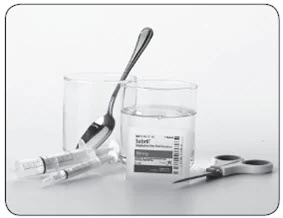
The number of packets of SABRIL needed for each dose
2 clean cups: 1 for mixing and 1 for water. The cup used for mixing SABRIL should be clear so you can see if the powder is dissolved
Water to mix with the SABRIL powder
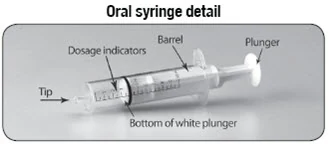
One small 3 mL oral syringe and one large 10 mL oral syringe which are provided by the pharmacy
Small spoon or other clean utensil to stir the mixture
Scissors
Step 1: Start with 1 of the empty cups and the total number of packets you will need for 1 dose.
Step 2: Before you open the packet, tap it to settle all the powder to the bottom of the packet.
Step 3: Use a pair of scissors to cut open the SABRIL packet along the dotted line.
Step 4: Empty the entire contents of the SABRIL packet into 1 of the clean empty cups (see Figure A).
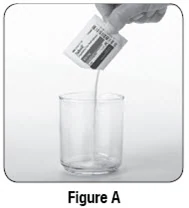
Repeat steps 2 to 4 above to open all of the packets needed for 1 dose of SABRIL.
Step 5: Take the second cup and fill it half way with water (see Figure B).
Do not mix SABRIL with anything other than water.
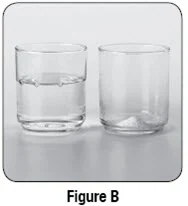
You will use the larger oral syringe (10 mL) to draw up the water needed to mix with the powder from the packets. You will need 10 mL of water for each packet of SABRIL.
For example:
If you are using 1 packet of SABRIL, you will need to use 10 mL of water (fill the 10 mL oral syringe 1 time)
If you are using 2 packets of SABRIL, you will need to use 20 mL of water (fill the 10 mL oral syringe 2 times)
If you are using 3 packets of SABRIL, you will need to use 30 mL of water (fill the 10 mL oral syringe 3 times)
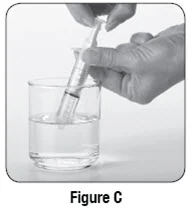
Step 6: Use the 10 mL oral syringe to draw up 10 mL of water. To do this, put the tip of the oral syringe all the way into the water in your cup. Then pull the plunger up towards you until the edge of the plunger is at the 10 mL line on the barrel of the oral syringe (see Figure C).
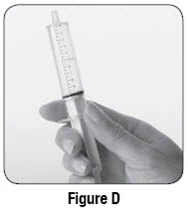
If you see bubbles of air in the oral syringe after drawing up the water, turn the oral syringe so the tip is pointing up (see Figure D). The air will move to the top of the oral syringe. Pull the plunger back towards you and then push it back gently into the oral syringe to get rid of the bubbles. Tiny bubbles are normal.
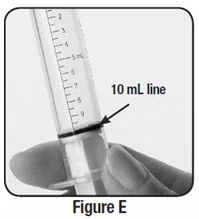
Step 7: Check the oral syringe to make sure it is filled with water up to the 10 mL line (see Figure E).
Step 8: Get the second cup that contains the SABRIL needed for your dose.
Step 9: Hold the 10mL oral syringe that is filled with water with the tip pointing down over the SABRIL.
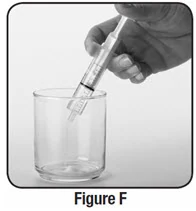
Step 10: Slowly push the oral syringe plunger all the way down to empty the water from the oral syringe straight into the cup containing the SABRIL (see Figure F).
Repeat steps 6 through 10 until all of the water that is needed to mix 1 dose of SABRIL has been added to the cup containing the powder.
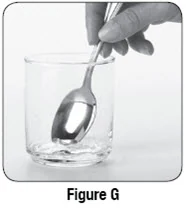
Step 11: Stir the mixture with the small spoon or other clean utensil until the solution is clear (see Figure G). This means that all of the powder is dissolved and ready for use.
To give a dose of SABRIL to your child, you should use the oral syringe to draw up the total number of mLs of the mixture that your healthcare provider tells you to.
If you are giving 3 mL or less of the mixture, use the smaller 3 mL oral syringe.
If you are giving more than 3 mL of the mixture, use the larger 10 mL oral syringe (this is the oral syringe that you just used to add the water).
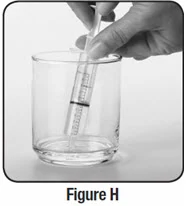
Step 12: Put the tip of the oral syringe all the way into the mixture. Pull the plunger up towards you to draw up the mixture. Stop when the edge of the plunger lines up with markings on the barrel of the oral syringe that matches the number of mLs of mixture your healthcare provider told you to give (see Figure H).
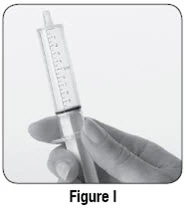
If you see bubbles of air in the oral syringe after drawing up the mixture, turn the oral syringe so the tip is pointing up (see Figure I). The air will move to the top of the oral syringe. Pull the plunger back towards you and then gently push it back in the oral syringe in order to get rid of the bubbles. Tiny bubbles are normal.
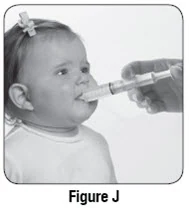
Step 13: Place the tip of the oral syringe into your child’s mouth and point the oral syringe towards either cheek (see Figure J). Push on the plunger slowly, a small amount at a time, until all of the mixture in the oral syringe is given.
If the dose you are giving your child is more than 10 mLs, repeat steps 12 and 13 until you give the total dose of mixture prescribed by your healthcare provider.
Step 14: Throw away any mixture that is left over. Do not save or reuse any leftover mixture.
Step 15: Wash the oral syringes and mixing cups in warm water. To clean the oral syringes, remove the plunger by gently pulling it straight out of the barrel. The barrel and plunger can be hand washed with soap and water, rinsed, and allowed to dry.
This Instructions for Use has been approved by the U.S. Food and Drug Administration.
Marketed by: Lundbeck, Deerfield, IL 60015, U.S.A.
SABRIL is a registered trademark of Lundbeck
Revised: 10/2021