


Patient information: uses, side effects, how to take - Pirfenidone
What is pirfenidone?
- Pirfenidone is a prescription medicine used to treat people with a lung disease called idiopathic pulmonary fibrosis (IPF).
- It is not known if pirfenidone is safe and effective in children.
Before you take pirfenidone, tell your doctor about all of your medical conditions, including if you:
- have liver problems
- have kidney problems
- are a smoker
are pregnant or plan to become pregnant. It is not known if pirfenidone will harm your unborn baby.
- are breastfeeding or plan to breastfeed. It is not known if pirfenidone passes into your breast milk. You and your doctor should decide if you will take pirfenidone.
Tell your doctor about all the medicines you take, including prescription and over-the-counter medicines, vitamins, and herbal supplements.
How should I take pirfenidone?
- Take pirfenidone exactly as your doctor tells you to take it.
- Your doctor may change your dose of pirfenidone as needed.
- Take pirfenidone with food at the same time each day. This may help to decrease your nausea and dizziness.
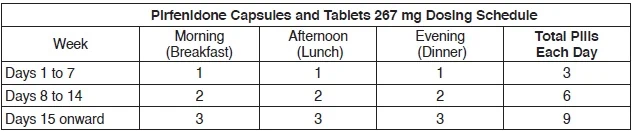
- Pirfenidone 267 mg is supplied as either a white opaque hard gelatin capsule or a yellow tablet. If you have been prescribed pirfenidone 267 mg, take it as follows:
- Take 1 pirfenidone 267 mg capsule or tablet 3 times each day for days 1 through 7.
- Take 2 pirfenidone 267 mg capsule or tablet 3 times each day for days 8 through 14.
- Take 3 pirfenidone 267 mg capsule or tablet 3 times each day on day 15 and each day after.
- If you have been prescribed the orange 534 mg pirfenidone film-coated tablets, take them as follows:
- Take 1 orange 534 mg pirfenidone tablet 3 times each day.

- If you have been prescribed the brown 801 mg pirfenidone film-coated tablets, take them as follows:
- Take 1 brown 801 mg pirfenidone tablet 3 times each day.

- If you miss 14 days or more of pirfenidone call your doctor right away for further instructions about how to take your medicine.
- Do not take 2 doses at the same time to make up for your missed dose.
- Do not take more than 3 doses each day.
- If you take too much pirfenidone, call your doctor or go to the nearest hospital emergency room right away.
- Your doctor should do certain blood tests before you start taking pirfenidone.
What should I avoid while taking pirfenidone?
- Avoid sunlight. Pirfenidone can make your skin sensitive to the sun and the light from sunlamps and tanning beds. You could get a severe sunburn. Use sunscreen (SPF 50) and wear a hat and clothes that cover your skin if you have to be in sunlight. Talk to your doctor if you get sunburn or a rash.
- Avoid taking pirfenidone with other medicines that can make your skin sensitive to the sun, the light from sunlamps and tanning beds.
- Avoid smoking. Smoking may affect how well pirfenidone works.
What are the possible side effects of pirfenidone?
Pirfenidone may cause serious side effects, including:
- liver problems. Call your doctor right away if you have unexplained symptoms such as yellowing of your skin or the white part of your eyes (jaundice), dark or brown (tea colored) urine, pain on the upper right side of your stomach area (abdomen), bleeding or bruising more easily than normal, feeling tired.
Your doctor will do blood tests to check how your liver is working during your treatment with pirfenidone.
- sensitivity to sunlight (photosensitivity) and rash. See “What should I avoid while taking pirfenidone?”
- severe skin reactions. Call your doctor right away if you have a severe skin reaction such as skin blisters, rash, sores in the mouth, hives or any other severe skin symptoms. Your doctor may stop your treatment with pirfenidone.
- stomach problems. Pirfenidone may cause stomach problems such as nausea, vomiting, diarrhea, indigestion, heartburn, and stomach pain. Tell your doctor right away if your stomach problems get worse or do not go away. Your doctor may need to change your dose of pirfenidone.
The most common side effects of pirfenidone include feeling tired, insomnia, upper respiratory tract infections, sinusitis, headache, dizziness, decreased weight and decreased or loss of appetite.
These are not all the possible side effects of pirfenidone. Call your doctor for medical advice about side effects. You may report side effects to FDA at 1-800-FDA-1088.
How should I store pirfenidone?
- Store pirfenidone capsules and tablets at room temperature, 77°F (25°C).
- Keep in a tightly closed container.
Safely throw away any pirfenidone that is out of date or no longer needed. Keep pirfenidone and all medicines out of reach of children.
General information about the safe and effective use of pirfenidone.
Medicines are sometimes prescribed for purposes other than those listed in a Patient Information leaflet. Do not use pirfenidone for a condition for which it was not prescribed. Do not give pirfenidone to other people, even if they have the same symptoms that you have. It may harm them. You can ask your pharmacist or doctor for information about pirfenidone that is written for health professionals.
For more information call Laurus Generics Inc. at 1-833-3-LAURUS (1-833-352-8787).
What are the ingredients in pirfenidone capsules?
Active ingredient: pirfenidone USP
Inactive ingredients: croscarmellose sodium, isomalt, and magnesium stearate
Capsule Shell: gelatin and titanium dioxide
Capsule Brown Printing Ink: black iron oxide, brown iron oxide, propylene glycol, and shellac
What are the ingredients in pirfenidone film-coated tablets?
Active ingredient: pirfenidone USP
Inactive ingredients: colloidal silicon dioxide, croscarmellose sodium, mannitol, microcrystalline cellulose, povidone, and sodium stearyl fumarate
The film-coating material contains polyethylene glycol, polyvinyl alcohol, talc, and titanium dioxide. Additionally 267 mg tablets contain iron oxide yellow. 534 mg tablets contain FD&C yellow #6. 801 mg tablets contain black iron oxide and iron oxide red
This Patient Information has been approved by the U.S. Food and Drug Administration.
Manufactured for:
Laurus Generics Inc.
400 Connell Drive
Suite 5200
Berkeley Heights, NJ 07922
Manufactured by:
Laurus Labs Limited
Anakapalli-531011
India
Revised: 1/2025