


Patient information: uses, side effects, how to take - Palynziq
What is the most important information I should know about PALYNZIQ?
PALYNZIQ can cause a severe allergic reaction (anaphylaxis). These reactions may be life-threatening and may happen any time during treatment with PALYNZIQ. Severe allergic reactions are a serious and common side effect of PALYNZIQ.
- You will get your first injection of PALYNZIQ under the supervision of a healthcare provider prepared to manage a severe allergic reaction. You will be closely watched for at least 1 hour after your injection for a severe allergic reaction.
- If you have a severe allergic reaction during treatment with PALYNZIQ, you will need to receive epinephrine and get emergency medical help right away.
- Your healthcare provider will decide if you (or your caregiver) are able to give PALYNZIQ injections, recognize the signs and symptoms of a severe allergic reaction, and use epinephrine and get emergency medical help, if needed.
- Your healthcare provider may ask an adult observer (or your caregiver) to be with you during and for at least 1 hour after each PALYNZIQ injection to watch for signs of a severe allergic reaction. If needed, they should be ready to give you epinephrine and get emergency medical help right away.
Stop PALYNZIQ and get emergency medical care right away if you have any of the following signs or symptoms of a severe allergic reaction during treatment with PALYNZIQ:
- fainting (passing out)
- dizziness or lightheadedness
- sudden confusion
- trouble breathing or wheezing
- chest discomfort or chest tightness
- fast heart rate
- swelling of your face, lips, eyes, or tongue
- throat swelling or tightness
- flushed or red skin
- skin rash, itching, or raised bumps on skin
- nausea, vomiting, or diarrhea
- losing control of urine or stools
- Your healthcare provider will give you a prescription for epinephrine and teach you (or your caregiver) and your observer, if needed, how to use it if you have a severe allergic reaction. Carry epinephrine with you at all times during treatment with PALYNZIQ. Read the Patient Information that comes with epinephrine for more information.
If you have a severe allergic reaction, stop taking PALYNZIQ until you talk with your healthcare provider. Tell them that you had a severe allergic reaction. They will decide if it is safe for you to keep using it.
- Your healthcare provider may prescribe other medicines to take before your PALYNZIQ injection to help reduce the symptoms of an allergic reaction.
- If your healthcare provider decides you can continue treatment with PALYNZIQ, you will receive your next injection under the supervision of a healthcare provider prepared to manage a severe allergic reaction, where you will be closely watched for at least 1 hour after your injection for signs of a severe allergic reaction.
- Your healthcare provider will give you a PALYNZIQ Patient Wallet Card that lists the signs and symptoms of a severe allergic reaction. You (or your caregiver), or your observer, should get emergency medical help right away if any of these signs or symptoms occur. Carry this card with you at all times during treatment with PALYNZIQ. Show this card to any other healthcare provider who treats you.
PALYNZIQ is only available through a restricted program called the PALYNZIQ Risk Evaluation and Mitigation Strategy (REMS). Before you can receive PALYNZIQ, you must:
- enroll in the program.
- learn about the risk of a severe allergic reaction (anaphylaxis) from a healthcare provider certified in the PALYNZIQ REMS so you can understand the risks and benefits of treatment with PALYNZIQ.
- fill a prescription for epinephrine and carry it with you at all times during treatment with PALYNZIQ.
- carry the PALYNZIQ Patient Wallet Card with you at all times.
See "What are the possible side effects of PALYNZIQ?" for more information about side effects.
What is PALYNZIQ?
PALYNZIQ is a prescription medicine used to reduce blood levels of phenylalanine in adults and children 12 years of age and older with phenylketonuria (PKU) who have uncontrolled blood phenylalanine levels greater than 600 micromol/L on their current treatment.
It is not known if PALYNZIQ is safe and effective in children younger than 12 years of age.
Before injecting PALYNZIQ, tell your healthcare provider about all of your medical conditions, including if you:
- cannot or do not want to use epinephrine to treat a severe allergic reaction.
are pregnant or plan to become pregnant. It is not known if PALYNZIQ will harm your unborn baby. Tell your healthcare provider right away if you become pregnant or think you might be pregnant during treatment with PALYNZIQ.
- If your phenylalanine levels are too high or too low during pregnancy, this may affect your unborn baby. You and your healthcare provider can decide the best way for you to manage your blood phenylalanine levels and if taking PALYNZIQ is right for you and your unborn baby.
- It is very important to keep your phenylalanine at the levels your healthcare provider recommends during pregnancy.
- Pregnancy Surveillance Program. There is a pregnancy surveillance program for females who take PALYNZIQ during pregnancy, or who become pregnant during treatment with PALYNZIQ or within 1 month after their last dose of PALYNZIQ. This program collects information about the health of you and your baby during treatment with PALYNZIQ. Talk to your healthcare provider about how you can take part in this program or call BioMarin at 1-866-906-6100.
- are breastfeeding or plan to breastfeed. It is not known if PALYNZIQ passes into your breast milk. Talk to your healthcare provider about the best way to feed your baby during treatment with PALYNZIQ.
Tell your healthcare provider about all the medicines you take, including prescription and over-the-counter medicines, vitamins, or herbal supplements.
How should I take PALYNZIQ?
- Your healthcare provider will give you the PALYNZIQ injection until they decide that you (or your caregiver) can give it. See "What is the most important information I should know about PALYNZIQ?"
- Your healthcare provider may prescribe medicines for you to take before your PALYNZIQ injection to help reduce the symptoms of an allergic reaction.
- If your healthcare provider decides that you (or your caregiver) can give your PALYNZIQ injections, your healthcare provider will show you (or your caregiver) how to prepare and give the injections. See the detailed "Instructions for Use" that comes with PALYNZIQ for information about how to prepare and inject a dose of PALYNZIQ.
- Use PALYNZIQ exactly as your healthcare provider tells you to, including how much to inject and when to inject it.
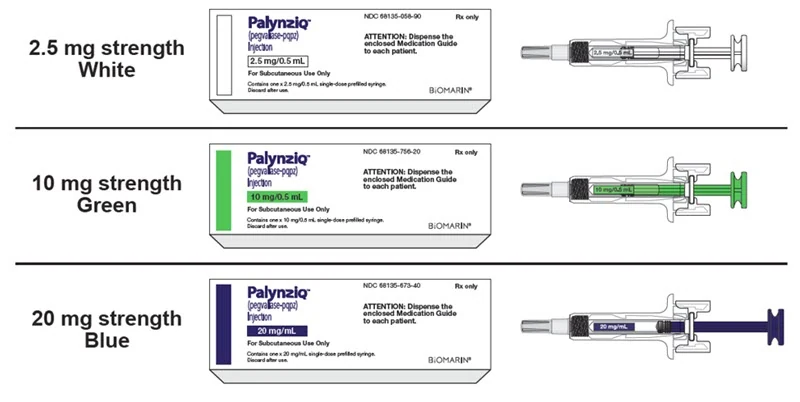
- PALYNZIQ comes in prefilled syringes with 3 different strengths (2.5 mg, 10 mg, or 20 mg). You may need more than 1 prefilled syringe for your prescribed dose.
- Monitor the amount of protein and phenylalanine you eat or drink during treatment with PALYNZIQ. Your healthcare provider may change your diet based on the amount of phenylalanine in your blood. Follow your healthcare provider's instructions about the amount of protein and phenylalanine you should have in your diet.
- If you miss a dose, take the next dose at the regular time. Do not take 2 doses of PALYNZIQ to make up for a missed dose.
What are the possible side effects of PALYNZIQ?
PALYNZIQ may cause serious side effects, including:
- Severe allergic reactions (anaphylaxis). See "What is the most important information I should know about PALYNZIQ?"
- Other allergic reactions to PALYNZIQ can happen during treatment. Call your healthcare provider right away if you get any of the following symptoms of an allergic reaction including: rash, itching, or swelling of the face, lips, eyes, or tongue. Your healthcare provider may change your dose or temporarily stop treatment with PALYNZIQ, or give you medicine for you to take before your PALYNZIQ injection to help reduce the symptoms of an allergic reaction.
- Injection site infections. Serious infections at the injection site have happened in people during treatment with PALYNZIQ. Some of these injection site infections required hospitalization, surgery, treatment with antibiotics given through the vein, or stopping treatment with PALYNZIQ. Change (rotate) your injection site and check your injection site for redness, swelling, or tenderness before each injection. Tell your healthcare provider right away if you develop signs or symptoms of an infection at your injection site that are new, do not go away, or get worse, including:
- pain, redness, swelling, or tenderness
- the area feels hard
- fluid or pus
- blisters
- a dark scab
- an open wound
Do not inject PALYNZIQ into the affected area until the infection has cleared.
- Low levels of phenylalanine in your blood (hypophenylalaninemia). Your healthcare provider will monitor your blood levels of phenylalanine during treatment with PALYNZIQ.
The most common side effects of PALYNZIQ include:
- injection site reactions: redness, itching, pain, bruising, rash, swelling, tenderness
- joint pain
- allergic reactions
- headache
- skin reactions that spread and last at least 14 days, such as itching, rash, redness
- nausea
- stomach pain
- vomiting
- cough
- mouth and throat pain
- itching
- diarrhea
- stuffy nose
- feel very tired
- dizziness
- anxiety
The most common side effects of PALYNZIQ in people 12 years to less than 18 years of age include:
- injection site reactions: redness, itching, pain, bruising, rash, swelling, tenderness
- joint pain
- headache
- fever
- allergic reactions
- dizziness
- nausea
- vomiting
- feel very tired
- pain in your arms or legs
These are not all the possible side effects of PALYNZIQ. Call your doctor for medical advice about side effects.
You may report side effects to FDA at 1-800-FDA-1088.
How should I store PALYNZIQ?
- Store PALYNZIQ in the refrigerator at 36°F to 46°F (2°C to 8°C).
If needed, you can store PALYNZIQ at room temperature between 68°F to 77°F (20°C to 25°C) for up to 30 days.
- Write the date that you remove PALYNZIQ from the refrigerator on the carton.
- If stored at room temperature, do not put PALYNZIQ back in the refrigerator.
- Keep PALYNZIQ in the original carton to protect from light.
- Do not freeze or shake PALYNZIQ.
- Throw away PALYNZIQ if it has been stored at room temperature for more than 30 days, or after the expiration date on the carton, whichever comes first.
Keep PALYNZIQ and all medicines out of the reach of children.
General information about the safe and effective use of PALYNZIQ.
Medicines are sometimes prescribed for purposes other than those listed in a Medication Guide. Do not use PALYNZIQ for a condition for which it was not prescribed. Do not give PALYNZIQ to other people, even if they have the same symptoms that you have. It may harm them. For more information, ask your pharmacist or healthcare provider for information about PALYNZIQ that is written for health professionals.
What are the ingredients in PALYNZIQ?
Active ingredients: pegvaliase-pqpz
Inactive ingredients: sodium chloride, trans-cinnamic acid, tromethamine, and tromethamine hydrochloride
Manufactured by: BioMarin Pharmaceutical Inc. Novato, CA 94949 US License No. 1649
For more information, go to http://www.PALYNZIQ.com/ or call 1-866-906-6100.
INSTRUCTIONS FOR USE
PALYNZIQ (Pal-lin-zeek)
(pegvaliase-pqpz)
injection, for subcutaneous use
single-dose prefilled syringe
This Instructions for Use contains information on how to inject PALYNZIQ.
Read this Instructions for Use before you start using the PALYNZIQ prefilled syringe and each time you get a new prescription. There may be new information. This information does not take the place of talking to your healthcare provider about your medical condition or your treatment.
Important Information You Need to Know Before Injecting PALYNZIQ:
- Follow these instructions carefully while you are using PALYNZIQ.
- If your healthcare provider decides that you (or your caregiver) can give the injections of PALYNZIQ at home, your healthcare provider will show you (or your caregiver) how to inject PALYNZIQ the right way.
- Your healthcare provider should watch you (or your caregiver) give the first PALYNZIQ injection and monitor you for signs and symptoms of a severe allergic reaction (anaphylaxis).
- Do not inject PALYNZIQ until your healthcare provider shows you (or your caregiver) how to inject PALYNZIQ the right way and has watched you (or your caregiver) give your injection.
- Do not use a PALYNZIQ prefilled syringe more than 1 time.
- Do not pull back on the plunger at any time.
- Do not remove the needle cap until you are ready to inject.
- Do not share your prefilled syringes with anyone else. You may give an infection to them or get an infection from them.
- Store your PALYNZIQ prefilled syringe(s) in its original carton in the refrigerator. See "Storing PALYNZIQ" at the end of this Instructions for Use.
- Talk to your healthcare provider if you (or your caregiver) have any questions about how to inject PALYNZIQ the right way.
Supplies you will need for each injection of PALYNZIQ (See Figure A):
- PALYNZIQ prefilled syringe(s) in sealed tray(s). Each tray contains 1 prefilled syringe. You may need more than 1 prefilled syringe for your prescribed dose.
- 1 gauze pad or cotton ball
- 1 alcohol pad
- 1 bandage
- 1 puncture resistant or sharps disposal container. See "Dispose of the used prefilled syringes" at the end of this Instructions for Use.
| Figure A |
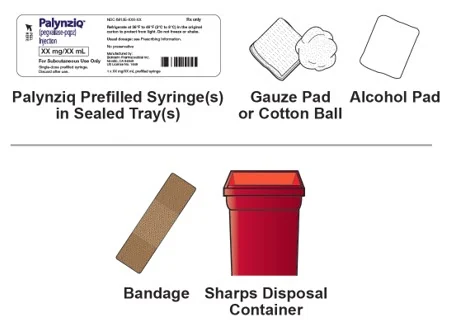 |
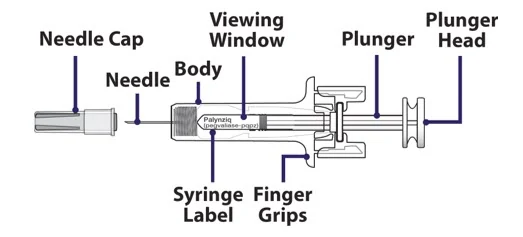
Figure B below shows what the prefilled syringe looks like before use.
| Figure B |
 |
Select the correct PALYNZIQ prefilled syringe(s) for your dose. You may need more than 1 prefilled syringe for your prescribed dose. Your healthcare provider will tell you which prefilled syringe(s) to use. Ask your healthcare provider if you have any questions.
When you receive your PALYNZIQ prefilled syringe(s), check that the name "Palynziq" appears on the carton(s).
- PALYNZIQ prefilled syringes come in 3 different strengths (See Figure C ).
- Before you inject PALYNZIQ, check each carton and syringe to make sure you have the right prefilled syringe for your prescribed dose.
| Figure C |
 |
Set up your injection
Step 1: Gather your supplies for the injection(s) (See Figure A ) and place them on a clean flat surface. Take out the number of cartons needed for your prescribed dose from the refrigerator. Check the expiration date (EXP) on the carton(s) (See Figure D ).
| Figure D 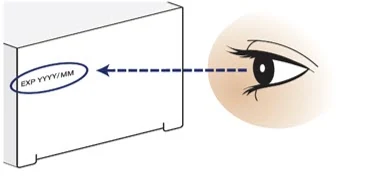 |
Step 2: Open the carton(s) and take out the sealed tray(s) that you need for your prescribed dose (See Figure E ). You may need more than 1 prefilled syringe for your prescribed dose. Place the sealed tray(s) on a clean, flat surface out of reach of children and pets. Put the carton with any remaining trays back in the refrigerator. | Figure E 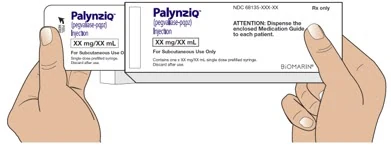 |
Step 3: Let the sealed tray(s) sit at room temperature for at least 30 minutes. Injecting PALYNZIQ when cold can make the injection feel uncomfortable.
| Let the sealed tray(s) sit at room temperature for at least 30 minutes before opening. |
| Step 4: Peel off the cover from the tray (See Figure F ). | Figure F 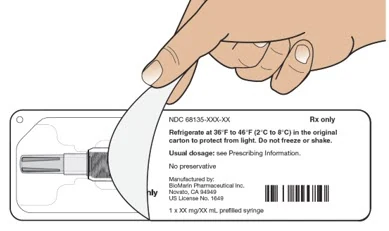 |
Step 5: Hold the middle of the prefilled syringe body and remove the prefilled syringe from the tray (See Figure G ).
| Figure G 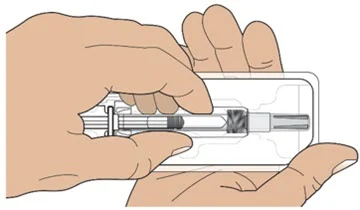 |
| Step 6: Check the prefilled syringe label to make sure you have the correct strength for your prescribed dose. | Check the prefilled syringe label to make sure you have the correct strength. |
Step 7: Look at the liquid through the viewing window (See Figure H ).
| Figure H  |
Choose and prepare injection site
Step 8: Choose your injection site. The recommended injection sites are (See Figure I ):
If a caregiver is giving the injection, the top of the buttocks and the back of the upper arms may also be used (See Figure I ). | Figure I 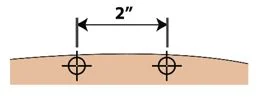 |
| Figure J Inject at least 2 inches apart 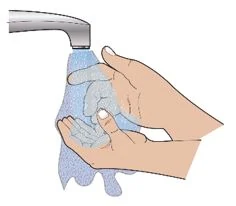 |
| Step 9: Wash your hands well with soap and water before injecting PALYNZIQ (See Figure K ). | Figure K 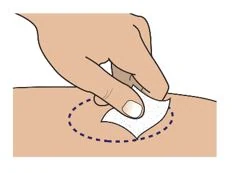 |
Step 10: Clean the chosen injection site with an alcohol pad. Let the skin air dry for at least 10 seconds before injecting PALYNZIQ (See Figure L ).
| Figure L 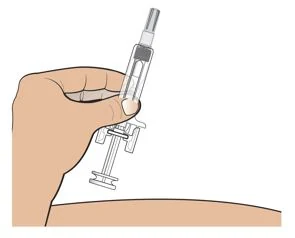 |
Inject PALYNZIQ
Step 11: Hold the body of the prefilled syringe with 1 hand with the needle facing away from you (See Figure M ).
| Figure M 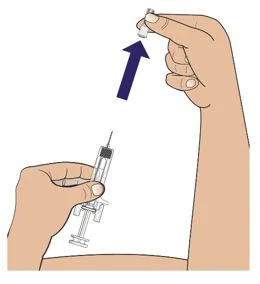 |
Step 12: Pull the needle cap straight off the needle (See Figure N ).
You may see a drop of liquid on the tip of the needle. This is normal. Do not wipe it away. Throw the needle cap away in a puncture resistant or sharps disposal container. | Figure N 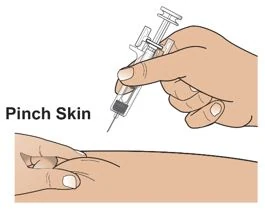 |
Step 13: Hold the body of the prefilled syringe in 1 hand between your thumb and index finger. Use your other hand to pinch up the skin around the injection site. Hold the skin firmly (See Figure O ).
| Figure O 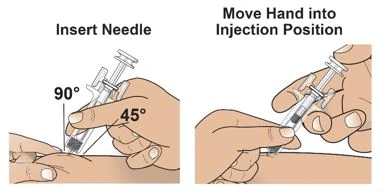 |
Step 14: Use a quick motion to fully insert the needle into the pinched skin at a 45 to 90 degree angle (See Figure P ). Release the pinch of skin. Use that hand to hold the bottom of the prefilled syringe steady. Place the thumb of your other hand on the plunger head and place your index and middle fingers under the finger grips (See Figure P ). | Figure P 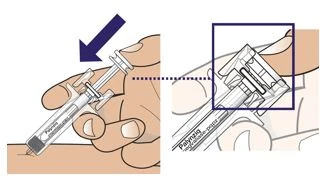 |
| Step 15: Use your thumb to push in the plunger slowly and steadily as far as it will go to inject all the medicine (See Figure Q ). More pressure on the plunger may be needed to inject all the medicine for the 10 mg and 20 mg strength prefilled syringes. | Figure Q 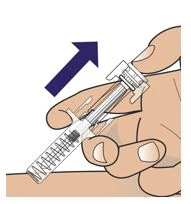 |
| Step 16: Slowly move your thumb up to release the plunger. The needle will automatically be covered by the prefilled syringe body (See Figure R ). | Figure R 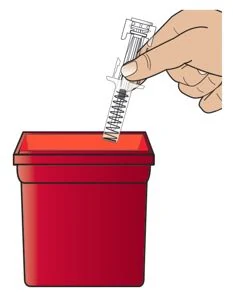 |
Treat injection site
Step 17: Treat injection site (if needed). If you see drops of blood at the injection site, press a cotton ball or gauze over the injection site and hold for about 10 seconds. You may cover the injection site with a small adhesive bandage if needed. | |
If more than 1 prefilled syringe is needed for your prescribed dose: Step 18: If your healthcare provider tells you to use more than 1 prefilled syringe for your prescribed dose, repeat Steps 4 to 17 listed above for each prefilled syringe that you use. | If you need to use more than 1 prefilled syringe for your prescribed dose, repeat Steps 4 to 17 right away for each prefilled syringe you use. |
|
Dispose of the used prefilled syringes
Step 19: Put your used prefilled syringes in a puncture resistant container, such as an FDA-cleared sharps disposal container right away after use (See Figure S ). Do not throw away (dispose of) prefilled syringes in your household trash. If you do not have an FDA-cleared sharps disposal container, you may use a household container that is:
When your sharps disposal container is almost full, you will need to follow your community guidelines for the right way to dispose of your sharps disposal container. There may be state or local laws about how you should throw away used needles and syringes. For more information about safe sharps disposal and for specific information about sharps disposal in the state that you live in, go to the FDA's website at: http://www.fda.gov/safesharpsdisposal Do not dispose of your used sharps disposal container in your household trash unless your community guidelines permit this. Do not recycle your used sharps disposal container. Note: Keep sharps disposal container out of the reach of children and pets. | Figure S 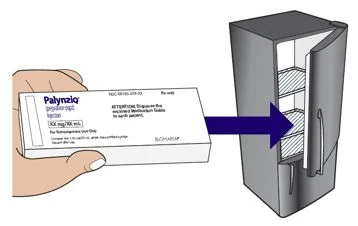 |
Storing PALYNZIQ
Keep PALYNZIQ and all medicines out of the reach of children. | Figure T 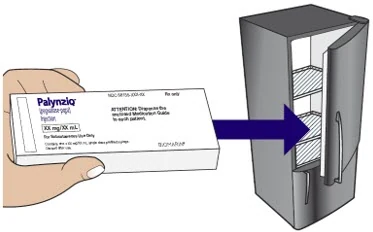 |
This Instructions for Use has been approved by the U.S. Food and Drug Administration.
Manufactured by:
BioMarin Pharmaceutical Inc.
Novato, CA 94949
U.S. License No. 1649
Revised: 2/2026