


Patient information: uses, side effects, how to take - Orencia
What is ORENCIA?
ORENCIA is a prescription medicine that reduces signs and symptoms in:
- adults with moderate to severe rheumatoid arthritis (RA), including those who have not been helped enough by other medicines for RA. ORENCIA may prevent further damage to your bones and joints and may help your ability to perform daily activities. In adults, ORENCIA may be used alone or with other RA treatments other than tumor necrosis factor (TNF) antagonists.
- people 2 years of age and older with moderate to severe polyarticular juvenile idiopathic arthritis (pJIA). ORENCIA may be used alone or with methotrexate.
- people 2 years of age and older with active psoriatic arthritis (PsA). In adults, ORENCIA can be used alone or with other PsA treatments. In children, ORENCIA can be used alone or with methotrexate.
ORENCIA is also used for the preventative treatment of acute graft versus host disease (aGVHD), in combination with a calcineurin inhibitor and methotrexate, in:
- people 2 years of age and older undergoing hematopoietic stem cell transplantation (HSCT) from a matched or 1 allele-mismatched unrelated-donor.
It is not known if ORENCIA is safe and effective in children less than two years of age for the treatment of pJIA.
It is not known if ORENCIA is safe and effective in children less than two years of age for the treatment of PsA.
It is not known if ORENCIA is safe and effective in children less than two years of age for the preventative treatment of aGVHD.
Before you receive or use ORENCIA, tell your healthcare provider about all of your medical conditions, including if you:
- have any kind of infection even if it is small (such as an open cut or sore), or an infection that is in your whole body (such as the flu). If you have an infection during treatment with ORENCIA, you may have a higher chance for getting serious side effects.
- have an infection that will not go away or an infection that keeps coming back.
- are allergic to abatacept or any of the ingredients in ORENCIA. See the end of this Patient Information leaflet for a complete list of ingredients in ORENCIA.
- have or have had inflammation of your liver due to an infection (viral hepatitis). Your healthcare provider may examine you for hepatitis before treatment with ORENCIA.
- have had a lung infection called tuberculosis (TB), a positive skin test for TB, or you recently have been in close contact with someone who has had TB. Your healthcare provider may examine you for TB or perform a skin test before treatment with ORENCIA. Symptoms of TB may include:
- a cough that does not go away
- weight loss
- fever
- night sweats
- have a history of Epstein-Barr Virus (EBV) or Cytomegalovirus (CMV) in people receiving ORENCIA for preventative treatment of aGVHD during HSCT from an unrelated donor.
- are scheduled to have surgery.
- recently received a vaccination or are scheduled for a vaccination.
- have a history of a breathing problem called chronic obstructive pulmonary disease (COPD).
- have diabetes and use a blood glucose monitor to check your blood sugar (blood glucose) levels.
- ORENCIA for intravenous infusion (given through a needle placed in a vein) contains maltose, a type of sugar, that can give false high blood sugar readings with certain types of blood glucose monitors on the day of ORENCIA infusion. Your healthcare provider may tell you to use a different way to monitor your blood sugar levels.
- ORENCIA for subcutaneous injection (injected under the skin) does not contain maltose. You do not need to change your blood sugar monitoring if you are using ORENCIA subcutaneously.
are pregnant or plan to become pregnant. It is not known if ORENCIA can harm your unborn baby. If you took ORENCIA during pregnancy, talk to your healthcare provider before your baby receives any vaccines.
- are breastfeeding or plan to breastfeed. It is not known if ORENCIA passes into your breast milk. Talk to your healthcare provider about the best way to feed your baby if you use ORENCIA.
- Some people treated with ORENCIA have developed skin cancer. Tell your healthcare provider if you have a family or personal history of skin cancer, and if you see any growths or changes in the appearance of your skin during or after your treatment with ORENCIA.
Tell your healthcare provider about all the medicines you take, including prescription and over-the-counter medicines, vitamins, and herbal supplements.
ORENCIA may affect the way other medicines work, and other medicines may affect the way ORENCIA works causing serious side effects.
Especially tell your healthcare provider if you take other biologic medicines that may affect your immune system, such as:
- Enbrel® (etanercept)
- Humira® (adalimumab)
- Remicade® (infliximab)
- Kineret® (anakinra)
- Rituxan® (rituximab)
- Simponi® (golimumab)
- Cimzia® (certolizumab pegol)
- Actemra® (tocilizumab)
You may have a higher chance of getting a serious infection if you take ORENCIA with other biologic medicines that may affect your immune system.
Know the medicines you take. Keep a list of them to show your healthcare provider and pharmacist when you get a new prescription.
How will I receive or use ORENCIA?
For treatment of RA, pJIA or PsA:
- You may receive ORENCIA given by a healthcare provider through a vein in your arm (intravenous infusion). It takes about 30 minutes to give you the full dose of medicine. You will then receive ORENCIA 2 weeks and 4 weeks after the first dose and then every 4 weeks. Intravenous administration of ORENCIA is not approved for pediatric patients with psoriatic arthritis.
- You may also receive ORENCIA as an injection under your skin (subcutaneous). For home use, ORENCIA comes in a prefilled syringe or prefilled ClickJect autoinjector. Your healthcare provider will prescribe the type that is best for you. If your healthcare provider decides that you or a caregiver can give your injections of ORENCIA prefilled syringes or ORENCIA ClickJect autoinjectors at home, you or your caregiver should receive training on the right way to prepare and inject ORENCIA. Do not try to inject ORENCIA until you have been shown the right way to give the injections by your healthcare provider.
- Your healthcare provider will tell you how much ORENCIA to use and when to use it.
See the Instructions for Use at the end of this Patient Information leaflet for instructions about the right way to prepare and give your ORENCIA injections at home.
For preventative treatment of aGVHD:
- You will receive ORENCIA by a healthcare provider through a vein in your arm (intravenous infusion) over 60 minutes on the day before transplantation (Day -1). You will then receive ORENCIA on Days 5, 14, and 28 after transplantation.
- Your healthcare provider may give you antiviral medicines before, during, and after your transplantation to help prevent Epstein-Barr Virus (EBV) and Cytomegalovirus (CMV) infections.
What are the possible side effects of ORENCIA?
ORENCIA may cause serious side effects, including:
- infections. ORENCIA can make you more likely to get infections or make the infection that you have get worse. Some people have died from these infections. Call your healthcare provider right away if you have any symptoms of an infection. Symptoms of an infection may include:
- fever
- feel very tired
- have a cough
- have flu-like symptoms
- warm, red, or painful skin
- allergic reactions. Allergic reactions can happen to people who are treated with ORENCIA. Call your healthcare provider or go to the emergency room right away if you have any symptoms of an allergic reaction. Symptoms of an allergic reaction may include:
- hives
- swollen face, eyelids, lips, or tongue
- trouble breathing
- hepatitis B infection in people who carry the virus in their blood. If you are a carrier of the hepatitis B virus (a virus that affects the liver), the virus can become active during treatment with ORENCIA. Your healthcare provider may do a blood test before you start treatment with ORENCIA.
- vaccinations. You should not receive ORENCIA with certain types of vaccines (live vaccines). You can receive non-live vaccines, such as pneumococcal and inactivated influenza (flu) vaccines. ORENCIA may also cause some vaccinations to be less effective. Talk with your healthcare provider about your vaccination plans.
- breathing problems in people with Chronic Obstructive Pulmonary Disease (COPD). You may get certain respiratory problems more often if you receive ORENCIA and have COPD. Symptoms of respiratory problems include:
- COPD that becomes worse
- cough
- trouble breathing
- cancer (malignancies). Certain kinds of cancer have been reported in people using ORENCIA. It is not known if ORENCIA increases your chance of getting certain kinds of cancer.
- Cytomegalovirus (CMV) and Epstein-Barr Virus (EBV) infections. CMV and EBV infections and return of CMV and EBV (reactivation) have happened in people receiving ORENCIA for preventative treatment of aGVHD during unrelated HSCT. Your healthcare provider will monitor you for 6 months after transplantation and may treat you with medicines to help prevent CMV and EBV infection if needed.
The most common side effects of ORENCIA in people with RA include:
- headache
- upper respiratory tract infection
- sore throat
- nausea
In children and adolescents, other side effects may include:
- diarrhea
- cough
- fever
- abdominal pain
The most common side effects of ORENCIA in prevention of aGVHD include:
- low red blood cell count
- high blood pressure
- CMV infection
- fever
- pneumonia
- nosebleed
- decreased CD4 lymphocytes
- increased levels of magnesium in the blood
- kidney problems
These are not all the possible side effects of ORENCIA.
Call your doctor for medical advice about side effects. You may report side effects to FDA at 1-800-FDA-1088.
How should I store ORENCIA?
- Store ORENCIA in the refrigerator at 36°F to 46°F (2°C to 8°C).
- Keep ORENCIA in the original package and out of the light.
- Do not freeze ORENCIA.
- Safely throw away medicine that is out of date or no longer needed.
Keep ORENCIA and all medicines out of the reach of children.
General information about the safe and effective use of ORENCIA.
Medicines are sometimes prescribed for purposes other than those listed in a Patient Information leaflet. Do not use ORENCIA for a condition for which it was not prescribed. Do not give ORENCIA to other people, even if they have the same symptoms that you have. It may harm them.
You can ask your pharmacist or healthcare provider for information about ORENCIA that is written for health professionals.
What are the ingredients in ORENCIA?
Active ingredient: abatacept
Intravenous inactive ingredients: maltose, monobasic sodium phosphate, sodium chloride for administration
Subcutaneous inactive ingredients: sucrose, poloxamer 188, monobasic sodium phosphate monohydrate, dibasic sodium phosphate anhydrous, water for injection.
Bristol-Myers Squibb Company
Princeton, NJ 08543 USA, U.S. License Number 1713
All other trademarks are property of their respective owners.
For more information, go to www.ORENCIA.com or call 1-800-ORENCIA.
This Patient Information has been approved by the U.S. Food and Drug Administration.
Revised: 5/2024
Instructions for Use
ORENCIA ® (oh-REN-see-ah)
(abatacept)
Prefilled syringe with BD UltraSafe Passive ™ needle guard
ORENCIA ® prefilled syringe with BD UltraSafe Passive™ needle guard (abatacept) Injection | 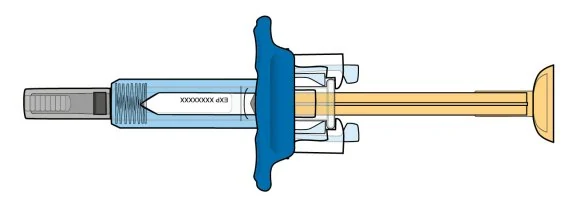 |
Read these instructions before you start using your ORENCIA prefilled syringe and each time you get a refill. There may be new information. Before you use the prefilled syringe for the first time, make sure your healthcare provider shows you the right way to use it and decides that you or a caregiver may be able to give your injections of ORENCIA at home. Important:
| |
| Before you begin: get to know your prefilled syringe | |
| There are 3 types of prefilled syringes: | |
 | |
The type of prefilled syringe you receive depends on the dose prescribed by your healthcare provider. The 125 mg/mL prefilled syringe is shown below. | |
| Before use | 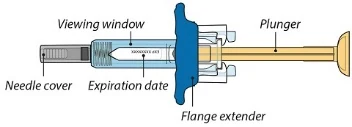 |
| After use | 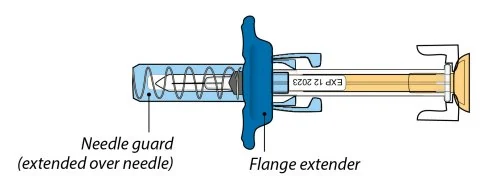 |
The prefilled syringe has a flange extender that makes it easier to hold and inject, and a needle guard that automatically covers the needle after a complete injection.
| |
| Go to Step 1 | |
Step 1: Preparing for an ORENCIA injection
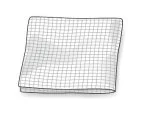
Gather and place supplies for your injection on a clean, flat surface. Only the prefilled syringe is included in the package: | |||
|  |
| 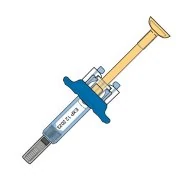 |
| 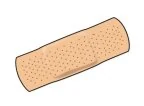 |
| 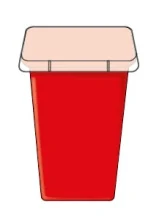 |
| 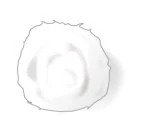 | ||
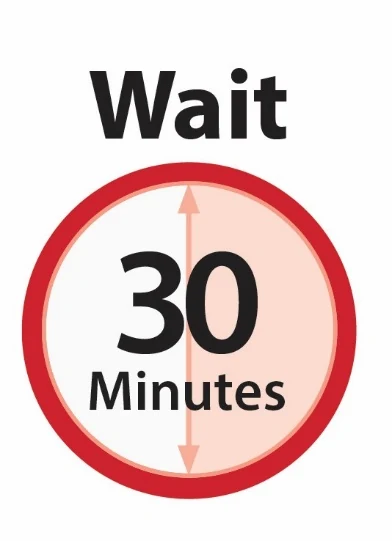
Let your prefilled syringe warm up. Remove 1 prefilled syringe from the refrigerator and wait 30 minutes to allow it to reach room temperature.
|  | ||
| Wash your hands well with soap and water. | 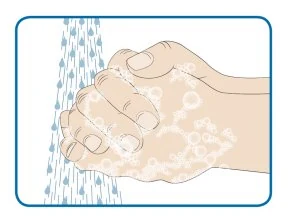 | ||
| Go to Step 2 | |||
Step 2: Examine the prefilled syringe
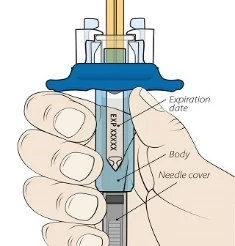
Hold the prefilled syringe by the body with the needle cover pointing down as shown.
|  |
Check the Liquid.
| 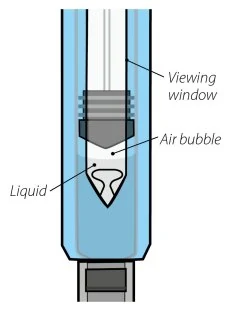 |
Note: the 50 mg prefilled syringe is shown. Note: It is normal to see an air bubble. Do not attempt to remove it. | |
| Go to Step 3 | |
Step 3: Check the dose on the prefilled syringe
| Hold the syringe at eye level. Look closely to make sure that the amount of liquid in the prefilled syringe is at or just above the fill line for your prescribed dose: |
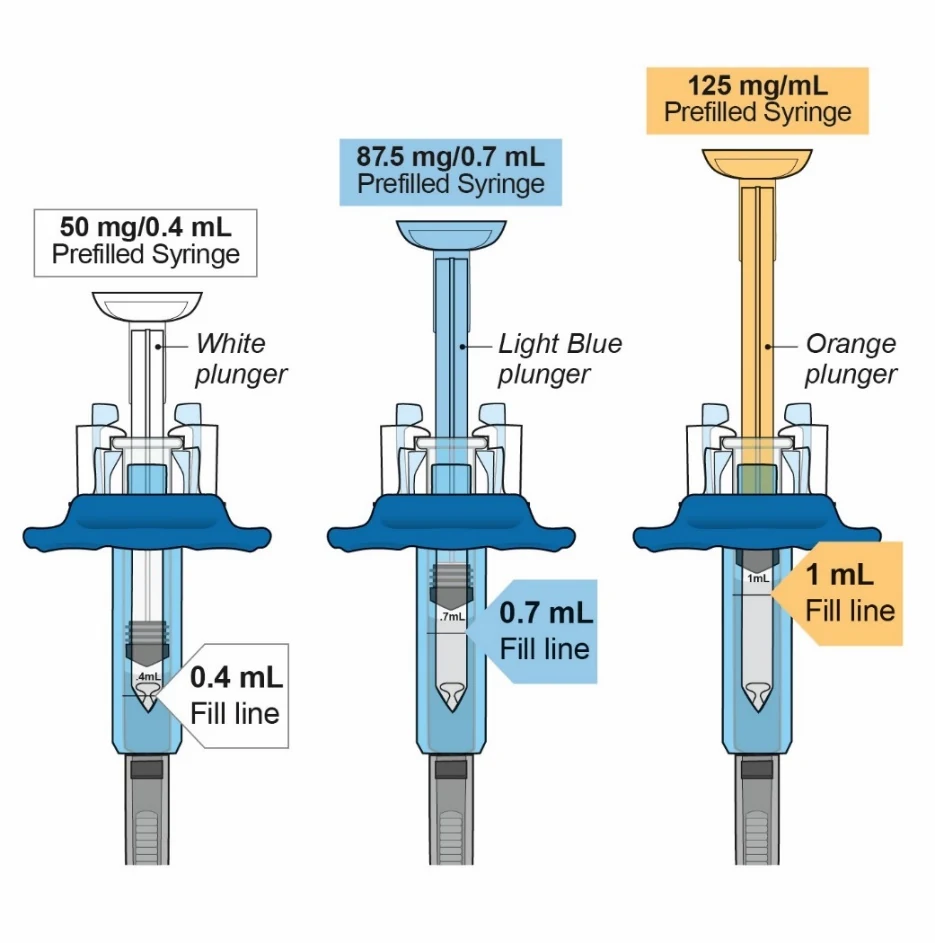 |
| Do not use if your prefilled syringe does not have the correct amount of liquid. Call your pharmacist immediately. |
| Go to Step 4 |
Step 4: Choose and prepare an injection site
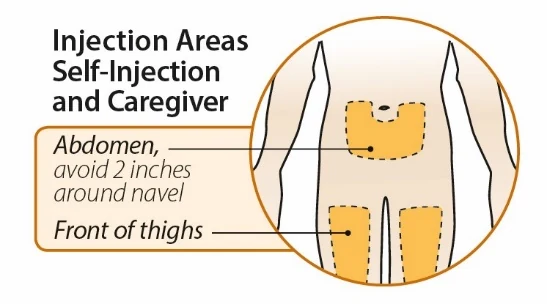
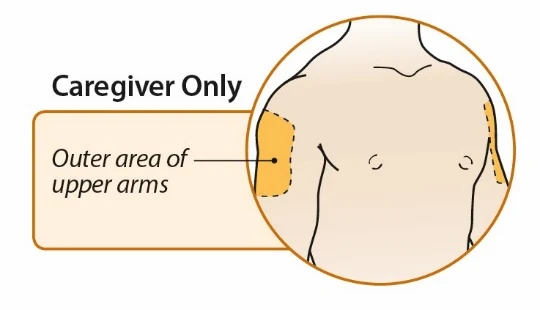
Choose your injection site. Choose your injection site in either the stomach (abdomen), front of the thighs, or outer area of upper arm (only if caregiver administered). Rotate injection site.
|  |
|  |
Gently clean injection site.
| |
Remove the needle cover by holding the body of the prefilled syringe with one hand and pulling the cover straight off with your other hand. Do not put the needle cover back on the needle after you remove it. Throw away the needle cover in your household trash.
Note: It is normal to see a drop of fluid leaving the needle. | 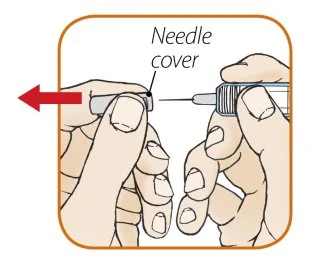 |
| |
| Go to Step 5 | |
Step 5: Inject Your Dose of ORENCIA
| Hold the body of the prefilled syringe in your hand using your thumb and index finger. With your other hand, pinch the area of skin you cleaned. | 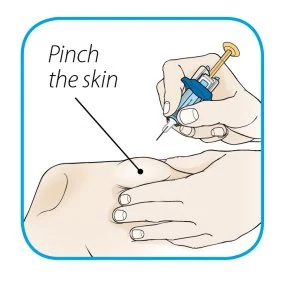 | ||
Insert the needle. Gently insert the needle into the pinched skin at a 45° angle. | 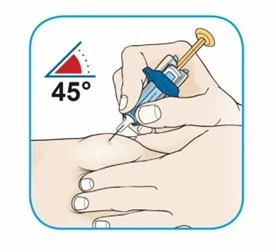 | ||
| Complete all steps to deliver your full dose of the medicine. | |||
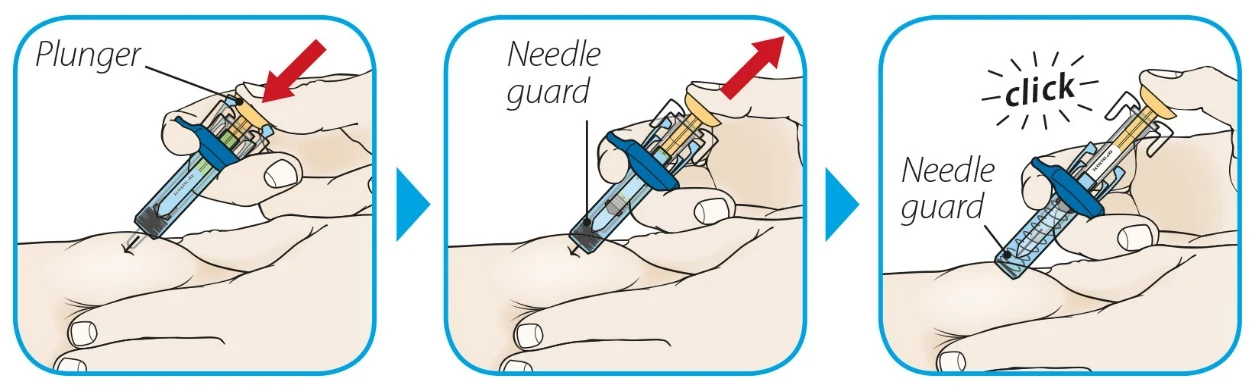 | |||
| Inject: push the plunger with your thumb as far as it will go. | Release the needle guard: slowly lift your thumb from the plunger to activate the needle guard. | Confirm: after a complete injection, the needle guard will cover the needle and you may hear a click. | |
| Remove the prefilled syringe and let go of the pinched skin. | |||
| Go to Step 6 | |||
Step 6: After the injection
Care of injection site:
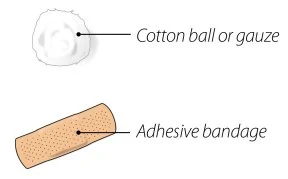
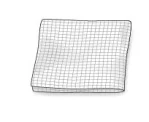
- There may be a little bleeding at the injection site. You can press a cotton ball or gauze over the injection site.
- Do not rub the injection site.
- If needed, you may cover the injection site with an adhesive bandage.
Throwing away (disposing of) used prefilled syringes:
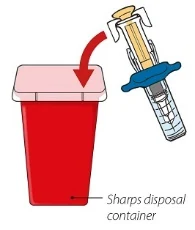
- Put your used ORENCIA prefilled syringes in a FDA-cleared sharps disposal container right away after use. Do not throw away (dispose of) loose needles and prefilled syringes in your household trash.
- If you do not have a FDA-cleared sharps disposal container, you may use a household container that is:
- made of a heavy-duty plastic,
- can be closed with a tight-fitting, puncture-resistant lid, without sharps being able to come out,
- upright and stable during use,
- leak resistant, and
- properly labeled to warn of hazardous waste inside the container.
- When your sharps disposal container is almost full, you will need to follow your community guidelines for the right way to dispose of your sharps disposal container. There may be state or local laws about how you should throw away used needles and syringes. For more information about safe sharps disposal, and for specific information about sharps disposal in the state that you live in, go to the FDA’s website at: http://www.fda.gov/safesharpsdisposal.
- Do not throw away (dispose of) your used sharps disposal container in your household trash unless your community guidelines permit this. Do not recycle your used sharps disposal container.
See Frequently Asked Questions for additional throwing away (disposal) information.
If your injection is administered by a caregiver, this person must also be careful handling the syringe to prevent accidental needle stick injury and possibly spreading infection.
Keep the ORENCIA prefilled syringes and the sharps disposal container out of the reach of children.
How to store ORENCIA prefilled syringe
- Store ORENCIA in the refrigerator at 36°F to 46°F (2°C to 8°C).
- Keep ORENCIA in the original package and out of the light.
- Do not freeze ORENCIA.
- Safely throw away medicine that is out of date or no longer needed.
Go to next page
Frequently Asked Questions
Q.
Why do I need to allow the prefilled syringe to warm up at room temperature for 30 minutes prior to injecting?
A.
This step is primarily for your comfort. Never try to speed up the warming process in any way, like using the microwave or placing the syringe in warm water.
Q.
Is it necessary to hold the skin pinch during the entire time I inject the dose?
A.
You must pinch the skin during needle insertion however, for your comfort you may release the skin pinch as you deliver the injection.
Q.
What if my prefilled syringe appears to be broken or damaged?
A.
Do not use the prefilled syringe. Contact your healthcare provider or pharmacist for further instructions.
Q.
What if I cannot clearly see the liquid inside the syringe?
A.
Look at the syringe closely by holding at eye level and up to the light. You may tilt the syringe slowly to get a better view of the drug fluid. If you still have trouble, contact your healthcare provider or pharmacist for further instructions.
Q.
Is it normal to feel a little bit of burning or pain during injection?
A.
You may feel a prick from the needle. Sometimes, the medicine can cause slight irritation near the injection site. Discomfort should be mild to moderate. If you have any side effects, including pain, swelling, or discoloration near the injection site, contact your healthcare provider.
Go to next page
Frequently Asked Questions
Q.
How should I dispose of a used prefilled syringe?
A.
Place the used prefilled syringe into an FDA-cleared sharps disposal container.
If you do not have one you may use a household container that is:
- made of a heavy-duty plastic,
- can be closed with a tight-fitting, puncture-resistant lid, without sharps being able to come out,
- upright and stable during use, leak-resistant, and properly labeled to warn of hazardous waste inside the container.
- When your sharps disposal container is almost full, you will need to follow your community guidelines for the right way to dispose of your sharps disposal container. There may be state or local laws about how you should throw away used needles and injector pens. For more information about safe sharps disposal, and for specific information about sharps disposal in the state that you live in, go to the FDA’s website at: http://www.fda.gov/safesharpsdisposal.
Q.
How should I keep my prefilled syringes cool while traveling?
A.
Store them in a cool carrier between 36ºF to 46ºF (2ºC to 8ºC).
Do not freeze them. Keep them in the original carton and protected from light. Your healthcare provider may know about special carrying cases.
Q.
Can I take my prefilled syringes on an airplane?
A.
Generally, you are allowed to carry your prefilled syringes with you on an airplane. Do not put them in your checked luggage. You should carry your prefilled syringes with you in your travel cooler at a temperature of 36ºF to 46ºF (2ºC to 8ºC). Keep your prefilled syringes in the original carton, and with its original preprinted labels and protected from light.
Q.
What if my prefilled syringe does not stay cool for an extended period of time?
Is it dangerous to use?
A.
Contact 1-800-673-6242 for more information.
Go to back cover
If you have questions or concerns about your prefilled syringe, please contact your healthcare provider or call our toll-free help line at 1-800-673-6242.
Bristol-Myers Squibb Company
Princeton, NJ 08543 USA, U.S. License Number 1713
This Instructions for Use has been approved by the U.S. Food and Drug Administration.
ORENCIA is a registered trademark of Bristol-Myers Squibb Company.
BD UltraSafe Passive™ is a trademark of Becton, Dickinson, and Company.
Revised 10/2023
Instructions for Use
ORENCIA ® ClickJect™ (oh-REN-see-ah)
(abatacept)
Prefilled autoinjector
ORENCIA ® ClickJect™ (abatacept) injection Prefilled autoinjector | 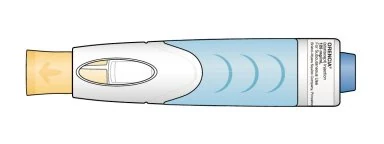 | ||
| 125 mg/mL, single-dose autoinjector, for subcutaneous use only | |||
Read these instructions before you use the ClickJect autoinjector and each time you get a refill. There may be new information. Before you use the autoinjector for the first time, make sure your healthcare provider shows you the right way to use it. Important:
| |||
| Before you begin: | |||
Get to know the ClickJect autoinjector
| |||
| Before use | 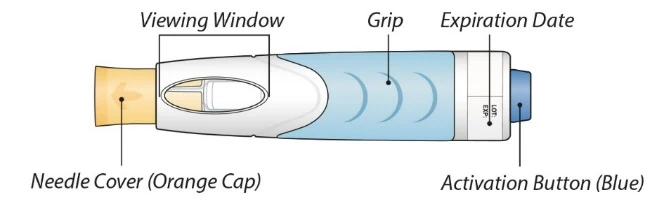 | ||
| After use | 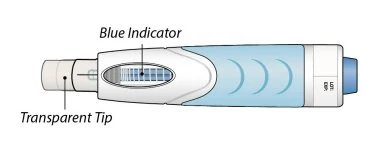 | ||
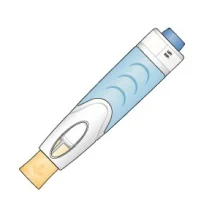
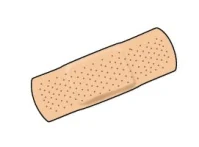
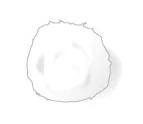
Gather supplies for your injection on a clean, flat surface (only the ClickJect autoinjector is included in the package): | |||
|  |
|  |
|  |
| |
|  | ||
| Go to Step 1 | |||
Step 1: Prepare your autoinjector
Let your ClickJect autoinjector warm up. Remove 1 autoinjector from the refrigerator and let it rest at room temperature for 30 minutes. Do not remove the autoinjector needle cover while allowing it to reach room temperature. | |
| Wash your hands well with soap and water. | |
Examine the ClickJect autoinjector:
| 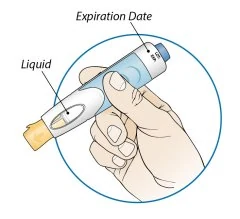 |
| Go to Step 2 | |
Step 2: Prepare for injection
Choose your injection site in either the stomach (abdomen), front of the thighs, or outer area of upper arm (only if caregiver administered). Rotate injection site.
| |
| |
Gently clean injection site:
| |
Pull orange needle cover straight off.
| 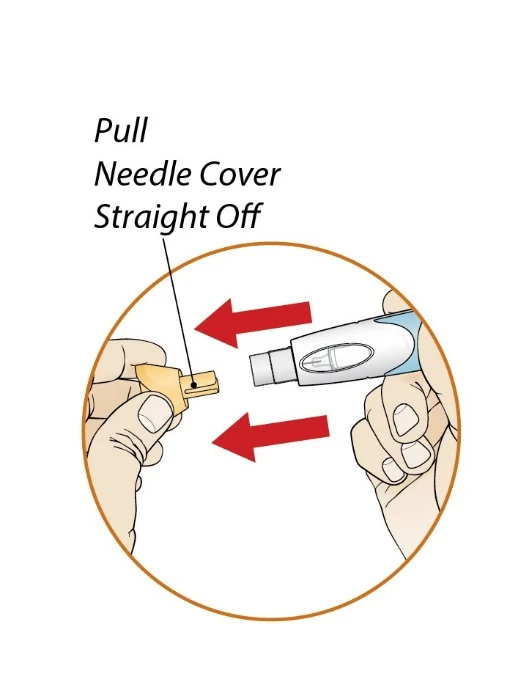 |
| Go to Step 3 | |
Step 3: Inject your dose
| Position the autoinjector so you can see the viewing window and it is at a 90° angle to the injection site. With your other hand, gently pinch the cleaned skin. | 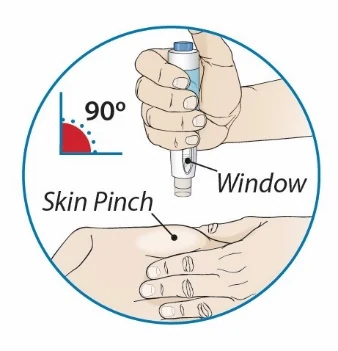 | |
| Complete all steps to deliver your full dose of medicine: | ||
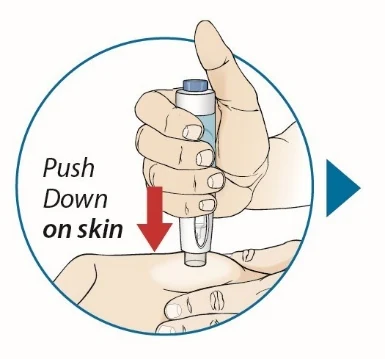 | 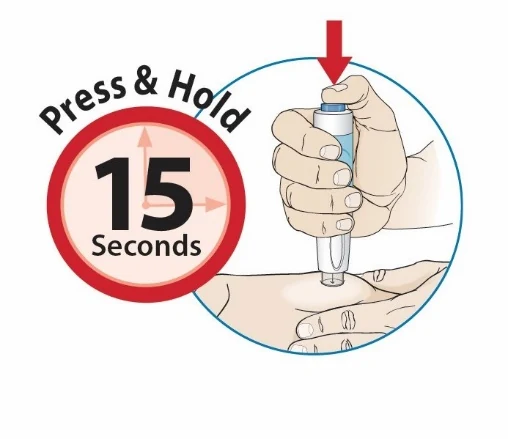 | 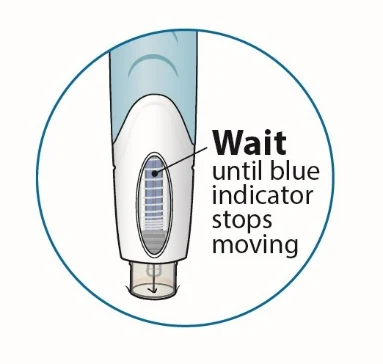 |
Push down on the skin to unlock the autoinjector. | Press button, hold for 15 seconds and watch the window.
| |
| Remove the ClickJect autoinjector from the injection site by lifting it straight up. After you remove it from your skin, the transparent tip will lock over the needle. Release the pinched skin. | ||
| Go to Step 4 | ||
Step 4: After the injection
Care of injection site:
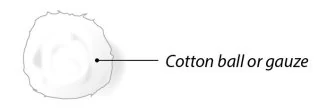
- There may be a little bleeding at the injection site. You can press a cotton ball or gauze over the injection site.
- Do not rub the injection site.
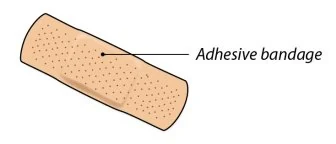
- If needed, you may cover the injection site with an adhesive bandage.
Throwing away (disposing of) used ClickJect autoinjectors:
- Put your used ClickJect autoinjector in a FDA-cleared sharps disposal container right away after use. Do not throw away (dispose of) loose needles and prefilled syringes in your household trash.
- If you do not have a FDA-cleared sharps disposal container, you may use a household container that is:
- made of a heavy-duty plastic,
- can be closed with a tight-fitting, puncture-resistant lid, without sharps being able to come out,
- upright and stable during use,
- leak resistant, and
- properly labeled to warn of hazardous waste inside the container.
- When your sharps disposal container is almost full, you will need to follow your community guidelines for the right way to dispose of your sharps disposal container. There may be state or local laws about how you should throw away used needles and syringes. For more information about safe sharps disposal, and for specific information about sharps disposal in the state that you live in, go to the FDA’s website at: http://www.fda.gov/safesharpsdisposal.
- Do not dispose of your used sharps disposal container in your household trash unless your community guidelines permit this. Do not recycle your used sharps disposal container.
See Frequently Asked Questions for additional throwing away (disposal) information.
If your injection is administered by a caregiver, this person must also handle the autoinjector carefully to prevent accidental needle stick injury and possibly spreading infection.
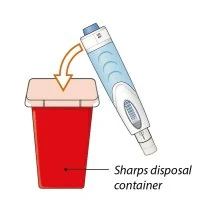
Keep autoinjector and the sharps disposal container out of the reach of children.
How to store ORENCIA ClickJect autoinjector
- Store ORENCIA in the refrigerator at 36°F to 46°F (2°C to 8°C).
- Keep ORENCIA in the original package and out of the light.
- Do not freeze ORENCIA.
- Safely throw away medicine that is out of date or no longer needed.
Continued on next page
Frequently Asked Questions
Q.
Why do I need to allow the autoinjector to warm up at room temperature for 30 minutes prior to injecting?
A.
This step is primarily for your comfort. If the medicine is cold, the injection may take longer than 15 seconds. Never try to speed the warming process in any way, like using the microwave or placing the autoinjector in warm water.
Q.
What if I accidentally remove the needle cover (orange cap) before I’m ready to use the autoinjector?
A.
If you remove the cover before you are ready to use the autoinjector, be careful. Do not try to replace it. Use the autoinjector as soon as possible. While you prepare for the injection, carefully place the autoinjector on its side on a clean, flat surface. Be sure to keep the autoinjector away from children.
Q.
What if the autoinjector appears to be broken or damaged?
A.
Do not use the autoinjector. Contact your healthcare provider or pharmacist for further instructions.
Q.
What if the injection was not triggered?
A.
Before the injection can be triggered, the device must be unlocked. To unlock, firmly push the autoinjector down on the skin without touching the button. When the stop-point is felt, the device is unlocked and can be triggered by pushing the button.
Q.
I feel a little bit of burning or pain during injection. Is this normal?
A.
When giving an injection, you may feel a prick from the needle. Sometimes, the medicine can cause slight irritation near the injection site. If this occurs, the discomfort should be mild to moderate. If you experience any side effects, including pain, swelling, or discoloration near the injection site, contact your healthcare provider or pharmacist immediately. You are encouraged to report side effects of prescription drugs to the FDA. Visit www.fda.gov/medwatch or call 1-800-FDA-1088.
Q.
How do I know I received my full dose?
A.
Before lifting the autoinjector from the injection site, check to make sure that the blue indicator has stopped moving. Then, before throwing away (disposing of) the autoinjector, check the bottom of the transparent viewing window to make sure there is no liquid left inside. If the medicine has not been completely injected, consult your healthcare provider or pharmacist.
Continued on next page
Frequently Asked Questions
Q.
How should I throw away (dispose of) a used autoinjector?
A.
Place used autoinjector into an FDA-cleared sharps disposal container right away after use.
- If you do not have one, you may use a household container that is:
- made of a heavy-duty plastic,
- can be closed with a tight-fitting, puncture-resistant lid, without sharps being able to come out,
- upright and stable during use, leak-resistant, and properly labeled to warn of hazardous waste inside the container.
- When your sharps disposal container is almost full, you will need to follow your community guidelines for the right way to throw away (dispose of) your sharps disposal container. There may be state or local laws about how you should throw away used needles and Autoinjectors. For more information about safe sharps disposal, and for specific information about sharps disposal in the state that you live in, go to the FDA’s website at: http://www.fda.gov/safesharpsdisposal.
- Do not recycle your used sharps disposal container.
Q.
How should I keep my autoinjector cool while traveling?
A.
Your healthcare provider or pharmacist may be familiar with special carrying cases for injectable medicines. Store in the refrigerator at 36°F to 46°F (2°C to 8°C). Do not freeze. Protect from light.
Q.
Can I take my autoinjector on board an aircraft?
A.
Generally, this is allowed. Be sure to pack your autoinjector in your carry-on, and do not put it in your checked luggage. You should carry it with you in your travel cooler at a temperature of 36°F to 46°F (2°C to 8°C) until you are ready to use it. Airport security procedures and airline policies change from time to time, so it’s best to check with airport authorities and the airline for any special rules. Prior to flying, get a letter from your healthcare provider to explain that you are traveling with prescription medicine that uses a device with a needle; if you are carrying a sharps container in your carry-on baggage, notify the screener at the airport.
Q.
What if my autoinjector does not stay cool for an extended period of time?
Is it dangerous to use?
A.
Contact 1-800-673-6242 for details.
If you have questions or concerns about your autoinjector, please contact a healthcare provider or call our toll-free help line at 1-800-673-6242.
Bristol-Myers Squibb Company
Princeton, NJ 08543 USA, U.S. License Number 1713
This Instructions for Use has been approved by the U.S. Food and Drug Administration.
ORENCIA is a registered trademark and ClickJect is a trademark of Bristol-Myers Squibb Company.
Revised 1/2024