


Patient information: uses, side effects, how to take - ONSWIK KwikPen
What is ONSWIK?
- ONSWIK is a long-acting man-made insulin that is used with diet and exercise to control high blood sugar in adults with type 2 diabetes mellitus.
- ONSWIK should not be used by people who have type 1 diabetes mellitus.
- It is not known if ONSWIK is safe and effective in children.
ONSWIK is available in 2 concentrations (U-500 and U-1,000):
- U-500 (500 units/mL) prefilled pen can be injected in 5 unit increments and can deliver up to 400 units in a single injection.
- U-1,000 (1,000 units/mL) prefilled pen can be injected in 10 unit increments and can deliver up to 800 units in a single injection.
Who should not take ONSWIK?
Do not take ONSWIK if you:
- are having an episode of low blood sugar (hypoglycemia).
- have an allergy to insulin efsitora alfa-gobe or any of the ingredients in ONSWIK. See the end of this Patient Information leaflet for a complete list of ingredients in ONSWIK.
Before taking ONSWIK, tell your healthcare provider about all of your medical conditions, including if you:
- have liver or kidney problems.
- take any other medicines, especially ones called TZDs (thiazolidinediones).
- have heart failure or other heart problems. If you have heart failure, it may get worse while you take TZDs with ONSWIK.
- are pregnant, planning to become pregnant, or are breastfeeding. It is not known if ONSWIK may harm your unborn or breastfeeding baby.
Tell your healthcare provider about all the medicines you take, including prescription and over-the-counter medicines, vitamins, and herbal supplements.
Before you start using ONSWIK, talk to your healthcare provider about low blood sugar and how to manage it.
How should I take ONSWIK?
- Read the Instructions for Use that come with your ONSWIK KwikPen.
- Your healthcare provider should show you how to use ONSWIK KwikPen before you use it for the first time.
- Take ONSWIK exactly as your healthcare provider tells you to. Your healthcare provider should tell you how much ONSWIK to use and when to use it.
- Know the type, strength and amount of insulin you take. Do not change the type of insulin unless your healthcare provider tells you to. The amount of insulin and the best time for you to take your insulin may need to change If you take different types of insulin.
- Inject ONSWIK 1 time each week, on the same day of the week.
- If you need to change the day of the week, you may do so if it has been at least 4 days since your last dose. After your injection day has changed continue to inject 1 time each week on the new day you have chosen.
If you miss a dose of ONSWIK:
- take the missed dose as soon as possible within 4 days (96 hours) after the missed dose, then continue your regular weekly dose schedule
- If more than 4 days have passed, skip the missed dose and take your next dose on the regularly scheduled day or take the missed dose then change your regular weekly dose schedule to start 1 week after your missed dose was injected.
- If you accidentally take your 1-time starting dose of ONSWIK more than 1 time (2 weeks in a row) or you take your weekly dose more than 1 time in the same week, skip your next week's dose.
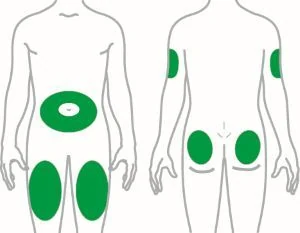
- ONSWIK can be injected under the skin (subcutaneously) of your stomach area (abdomen), buttocks, thigh or back of the upper arms.
- Do not use ONSWIK in an insulin pump or inject ONSWIK into your vein (intravenously) or muscle (intramuscularly).
Change (rotate) your injection sites within the area you choose with each dose to reduce your risk of getting lipodystrophy (pits in skin or thickened skin) and localized cutaneous amyloidosis (skin with lumps) at the injection sites.
- Do not use the exact same spot for each injection.
- Do not inject where the skin has pits, is thickened, or has lumps.
- Do not inject where the skin is tender, bruised, scaly or hard, or into scars or damaged skin.
- Always use a new needle for each injection to help prevent infections and blocked needles. If your needle is blocked get a new needle as instructed in the Troubleshooting section at the end of the Instructions for Use.
- Do not reuse or share your needles with other people. You may give other people a serious infection or get a serious infection from them.
- Do not use a syringe to remove the solution from the pen. Using a syringe may cause dosing errors and potential overdose.
- Do not dilute or mix ONSWIK with any other type of insulin or liquid medicine.
- Check your blood sugar levels. Ask your healthcare provider what your blood sugar levels should be and when you should check your blood sugar levels.
Keep ONSWIK and all medicines out of the reach of children.
What should I avoid while taking ONSWIK?
While taking ONSWIK do not:
- drive or operate heavy machinery, until you know how ONSWIK affects you.
- drink alcohol or use prescription or over-the-counter medicines that contain alcohol.
What are the possible side effects of ONSWIK?
ONSWIK may cause serious side effects that can lead to death, including:
low blood sugar (hypoglycemia). Signs and symptoms that may indicate low blood sugar include:
- dizziness or light-headedness
- anxiety, irritability, or mood change
- confusion
- shakiness
- blurred vision
- slurred speech
- fast heartbeat
- sweating
- hunger
- headache
severe allergic reactions (whole body reaction). Stop using ONSWIK and get medical help right away if you have any of these signs or symptoms of a severe allergic reaction:
- a rash over your whole body
- a fast heartbeat
- trouble breathing
- sweating
- low potassium in your blood (hypokalemia).
heart failure. Taking certain diabetes pills called TZDs with ONSWIK may cause heart failure in some people. This can happen even if you have never had heart failure or heart problems before. If you already have heart failure it may get worse while you take TZDs with ONSWIK. Your healthcare provider should monitor you closely while you are taking TZDs with ONSWIK. Tell your healthcare provider if you have any new or worse symptoms of heart failure including:
- shortness of breath
- sudden weight gain
- swelling of your ankles or feet
- tiredness
Treatment with TZDs and ONSWIK may need to be changed or stopped by your healthcare provider if you have new or worse heart failure.
Your insulin dose may need to change because of:
- change in level of physical activity or exercise
- weight gain or loss
- increased stress
- change in diet
- illness
- other medicines you take
The most common side effects of ONSWIK include:
- hypoglycemia, allergic reactions, reactions at the injection site, skin thickening or pits at the injection site (lipodystrophy), itching, rash, swelling of your hands and feet, and weight gain.
Get emergency medical help if you have:
- trouble breathing, shortness of breath, fast heartbeat, swelling of your face, tongue, or throat, sweating, extreme drowsiness, dizziness, confusion.
These are not all the possible side effects of ONSWIK. Call your doctor for medical advice about side effects. You may report side effects to FDA at 1-800-FDA-1088.
General information about the safe and effective use of ONSWIK.
Medicines are sometimes prescribed for purposes other than those listed in a Patient Information leaflet. You can ask your pharmacist or healthcare provider for information about ONSWIK that is written for health professionals. Do not use ONSWIK for a condition for which it was not prescribed. Do not give ONSWIK to other people, even if they have the same symptoms that you have. It may harm them.
What are the ingredients in ONSWIK?
Active ingredients: insulin efsitora alfa-gobe
Inactive ingredients: benzyl alcohol, dibasic sodium phosphate, glycerin, monobasic sodium phosphate, phenol, poloxamer 188 and Water for Injection. Hydrochloric acid, glacial acetic acid and/or sodium hydroxide may have been added to adjust the pH.
ONSWIK™ is a trademark of Eli Lilly and Company.
Manufactured by: Eli Lilly and Company, Indianapolis, IN 46285, USA, US License No. 1891
Copyright © 2026, Eli Lilly and Company. All rights reserved.
For more information, go to www.onswik.lilly.com or call 1-800-545-5979.
ONS-0001-PPI-20260923
ONSWIK U-500 KwikPen INSTRUCTIONS FOR USE
INSTRUCTIONS FOR USE
ONSWIK™ KwikPen ® [ON-swihk KWIHK-pehn]
(insulin efsitora alfa-gobe)
injection, for subcutaneous use
3 mL single-patient-use pen (500 units/mL, U-500)


Important:
|

Read this Instructions for Use before you start injecting ONSWIK KwikPen and each time you get another Pen. There may be new information. This information does not take the place of talking to your healthcare provider about your medical condition or your treatment.
ONSWIK KwikPen (“Pen”) is a disposable (can be thrown away) single-patient-use prefilled pen containing 1,500 units of ONSWIK. You can give yourself more than 1 dose from the Pen. Each turn (click) of the Dose Knob dials 5 units of insulin. You can give from 5 units to 400 units in a single injection. If your dose is more than 400 units, you will need to give yourself more than 1 injection.
The Plunger only moves a little with each injection, and you may not notice that it moves. The Plunger will only reach the end of the cartridge when you have used all 1,500 units in the Pen. When the Pen is empty, throw away the entire Pen and get a new Pen (see Throwing away (disposing of) Pens and Needles section at the end of this Instructions for Use).
ONSWIK KwikPen is used 1 time a week. You may want to mark your calendar to remind yourself when to take your next dose.
Inject ONSWIK only with your Pen. Do not transfer insulin from your Pen to a syringe. A severe overdose can happen, causing very low blood sugar, which may put your life in danger.
People who are blind or have vision problems should not use the Pen without help from a person trained to use the Pen.
Do not share your ONSWIK KwikPen with other people, even if the needle has been changed. You may give other people a serious infection or get a serious infection from them.
Storing your Pen
Keep your Pen refrigerated.
- Store the Pen you are currently using in the refrigerator at 36°F to 46°F (2°C to 8°C) at all times.
If you are not able to refrigerate the Pen, the Pen can be stored at room temperature up to 86°F (30°C) for up to a total of 14 days.
- Do not freeze ONSWIK KwikPen. Do not use if it has been frozen.
- Keep away from heat and light.
If the Pen has been stored in the refrigerator, throw away the Pen you are using after 112 days (16 weeks), even if it still has ONSWIK in it.
- If the Pen has been at room temperature for over 14 days, throw away the Pen.
- Do not use your Pen past the expiration date printed on the Label.
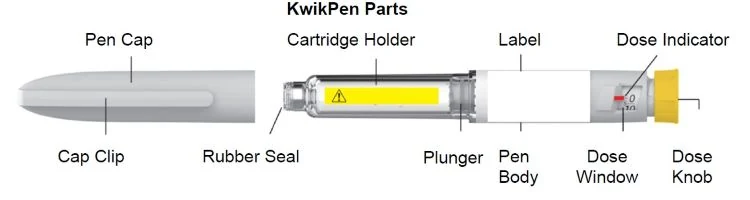
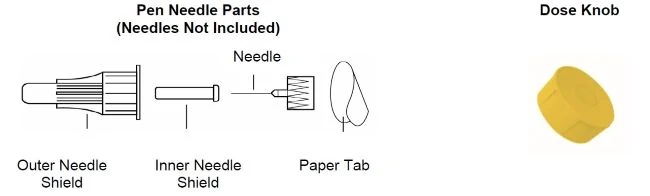
How to recognize your ONSWIK KwikPen
|  |
Supplies needed to give your injection
- ONSWIK KwikPen
- KwikPen compatible Needle (29 to 32 gauge needle recommended)
- 1 alcohol swab
- 1 cotton ball or piece of gauze
- 1 FDA-cleared sharps disposal container
Preparing your Pen
- Wash your hands with soap and water.
- Check the Pen to make sure you are taking the right type of insulin. This is especially important if you use more than 1 type of insulin.
- Do not use your Pen past the expiration date printed on the Label or for more than 112 days (16 weeks) after you first start using the Pen.
- Always use a new Needle for each injection to help prevent infections and blocked Needles. Do not reuse or share your needles with other people. You may give other people a serious infection or get a serious infection from them.
Step 1:
ONSWIK should look clear and colorless to yellow. Do not use if it is cloudy, discolored, or has particles or clumps in it. | 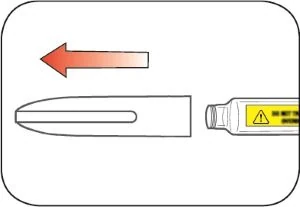 |
Step 2:
| 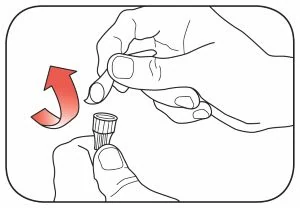 |
Step 3:
| 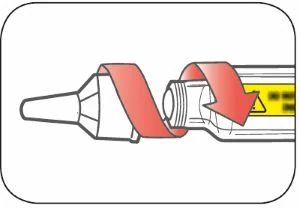 |
Step 4:
| 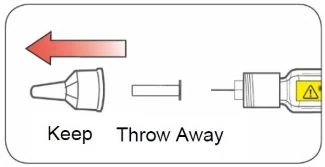 |
Priming your Pen
Prime before each injection.
- Priming your Pen means removing the air from the Needle and Cartridge that may collect during normal use and ensures that the Pen is working correctly.
- If you do not prime before each injection, you may get too little insulin.
Step 5:
| 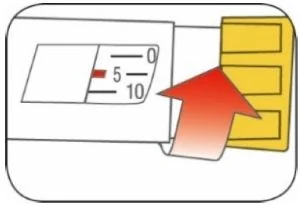 |
Step 6:
| 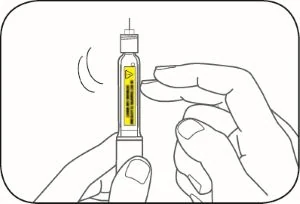 |
Step 7:
Small air bubbles are normal and will not affect your dose. | 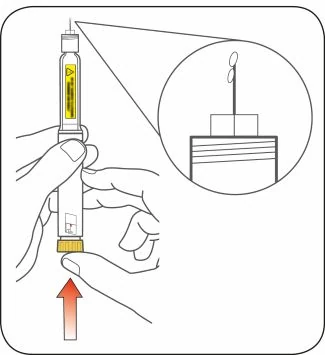 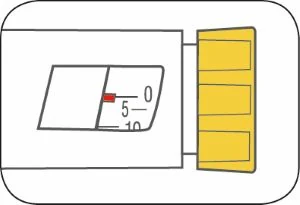 |
Selecting your dose
This Pen has been made to deliver the dose in insulin units that is shown in the Dose Window. Ask your healthcare provider what your dose should be for this Pen.
- You can give from 5 units to 400 units in a single injection.
If your dose is more than 400 units, you will need to give more than 1 injection.
- If you need help with dividing up your dose the right way, ask your healthcare provider.
- Use a new Needle for each injection and repeat the priming step.
Step 8:
| 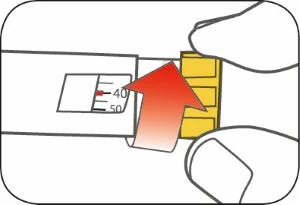
shown in Dose Window
shown in Dose Window |
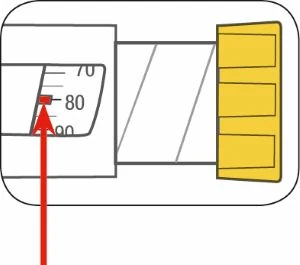 Example: 80 units
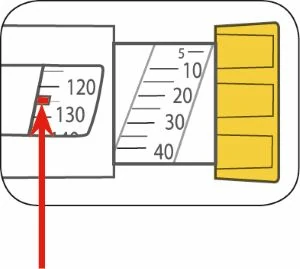 Example: 125 units
- The Pen will not let you dial more than the number of units left in the Pen.
If your dose is more than the number of units left in the Pen, you may either:
inject the amount left in your Pen and then use a new Pen to give the rest of your dose,
or
- get a new Pen and inject your full dose.
- It is normal to see a small amount of insulin left in the Pen that you cannot inject. Do not transfer the insulin to a syringe. Severe overdose can happen.
Giving your injection
- Inject your insulin as your healthcare provider has shown you.
Change (rotate) your injection sites within the area you choose for each injection to reduce your risk of getting pits in the skin or thickened skin (lipodystrophy) and skin with lumps (localized cutaneous amyloidosis) at the injection sites.
- Do not inject where the skin has pits, is thickened, or has lumps.
- Do not inject where the skin is tender, bruised, scaly or hard, or into scars or damaged skin.
- Do not try to change your dose while injecting.
Step 9:
| 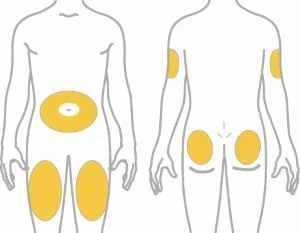 | |
Step 10:
| 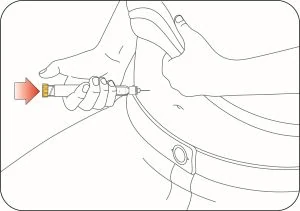 | |
| 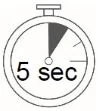 | |
| Do not try to inject your insulin by turning the Dose Knob. You will not receive your insulin by turning the Dose Knob. | ||
Step 11:
The Plunger only moves a little with each injection, and you may not notice that it moves. If you see blood after you take the Needle out of your skin, press the injection site lightly with a piece of gauze or an alcohol swab. Do not rub the area. | 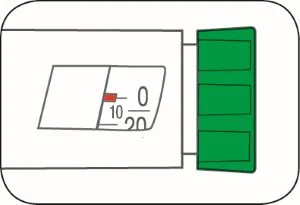 | |
After your injection
Step 12:
| 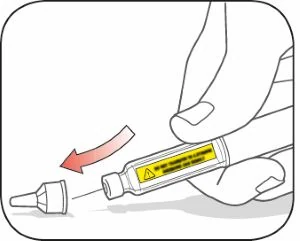 |
Step 13:
| 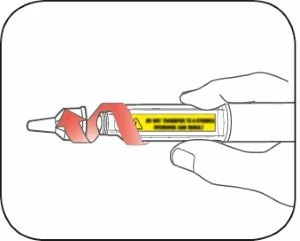 |
Step 14:
| 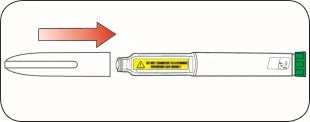 |
Throwing away (disposing of) Pens and Needles
- Throw away your used Needles in an FDA-cleared sharps disposal container right away after use. Do not throw away (dispose of) loose Needles in your household trash.
If you do not have an FDA-cleared sharps disposal container, you may use a household container that is:
- made of a heavy-duty plastic,
- can be closed with a tight-fitting, puncture-resistant lid, without sharps being able to come out,
- upright and stable during use,
- leak-resistant, and
- properly labeled to warn of hazardous waste inside the container.
- When your sharps disposal container is almost full, you will need to follow your community guidelines for the right way to dispose of your sharps disposal container. There may be state or local laws about how you should throw away used needles and syringes. For more information about safe sharps disposal, and for specific information about sharps disposal in the state that you live in, go to the FDA's website at: http://www.fda.gov/safesharpsdisposal
- Do not throw away (dispose of) your used sharps disposal container in your household trash unless your community guidelines permit this. Do not recycle your used sharps disposal container.
- The used Pen may be thrown away (discarded) in your household trash after you have removed the needle.
What you should know if you are switching to ONSWIK KwikPen
Ask your healthcare provider what your dose should be for your Pen in insulin units. Always follow your healthcare provider's instructions for dosing.
| If you are: | It is important to know: |
| Switching from another type of insulin device or pen. | This ONSWIK KwikPen is different from other pens. It dials 5 insulin units with each click of the Dose Knob. Do not select your dose by counting clicks. You may get too much insulin or you may not get enough insulin. |
General information about the safe and effective use of your Pen
- Keep your Pen and Needles out of the sight and reach of children.
- Do not use your Pen if any part looks broken or damaged. Always have an extra Pen in case yours is lost or damaged.
Troubleshooting
- If you cannot remove the Pen Cap, gently twist the cap back and forth, and then pull the cap straight off.
If it is hard to push the Dose Knob:
- Pushing the Dose Knob more slowly will make it easier to inject.
- Your Needle may be blocked. Put on a new Needle and prime the Pen.
- You may have dust, food, or liquid inside the Pen. Throw the Pen away and get a new Pen.
If you have any questions or problems with your ONSWIK KwikPen, contact Lilly at 1-800-LillyRx (1-800-545-5979) or call your healthcare provider for help. For more information on ONSWIK KwikPen and insulin, go to www.ONSWIK.lilly.com.

Scan this code to launch
www.ONSWIK.lilly.com
Manufactured by
Eli Lilly and Company
Indianapolis, IN 46285, USA
U.S. License Number: 1891
ONSWIK™ and ONSWIK™ KwikPen® are trademarks of Eli Lilly and Company.
Copyright © 2026, Eli Lilly and Company. All rights reserved.
This Instructions for Use has been approved by the U.S. Food and Drug Administration.
Issued: September 2026
| ONSWIK KwikPen meets the current dose accuracy and functional requirements of ISO 11608-1. |
ONS-KP-0001-IFU-U500-20260923
ONSWIK U-1,000 KwikPen INSTRUCTIONS FOR USE
INSTRUCTIONS FOR USE
ONSWIK™ KwikPen ® [ON-swihk KWIHK-pehn]
(insulin efsitora alfa-gobe)
injection, for subcutaneous use
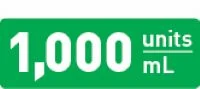
3 mL single-patient-use pen (1,000 units/mL, U-1,000)

Important:
|
Read this Instructions for Use before you start injecting ONSWIK KwikPen and each time you get another Pen. There may be new information. This information does not take the place of talking to your healthcare provider about your medical condition or your treatment.
ONSWIK KwikPen (“Pen”) is a disposable (can be thrown away) single-patient-use prefilled pen containing 3,000 units of ONSWIK. You can give yourself more than 1 dose from the Pen. Each turn (click) of the Dose Knob dials 10 units of insulin. You can give from 10 units to 800 units in a single injection. If your dose is more than 800 units, you will need to give yourself more than 1 injection.
The Plunger only moves a little with each injection, and you may not notice that it moves. The Plunger will only reach the end of the cartridge when you have used all 3,000 units in the Pen. When the Pen is empty, throw away the entire Pen and get a new Pen (see Throwing away (disposing of) Pens and Needles section at the end of this Instructions for Use).
ONSWIK KwikPen is used 1 time a week. You may want to mark your calendar to remind yourself when to take your next dose.
Inject ONSWIK only with your Pen. Do not transfer insulin from your Pen to a syringe. A severe overdose can happen, causing very low blood sugar, which may put your life in danger.
People who are blind or have vision problems should not use the Pen without help from a person trained to use the Pen.
Do not share your ONSWIK KwikPen with other people, even if the needle has been changed. You may give other people a serious infection or get a serious infection from them.
Storing your Pen
Keep your Pen refrigerated.
- Store the Pen you are currently using in the refrigerator at 36°F to 46°F (2°C to 8°C) at all times.
If you are not able to refrigerate the Pen, the Pen can be stored at room temperature up to 86°F (30°C) for up to a total of 14 days.
- Do not freeze ONSWIK KwikPen. Do not use if it has been frozen.
- Keep away from heat and light.
If the Pen has been stored in the refrigerator, throw away the Pen you are using after 112 days (16 weeks), even if it still has ONSWIK in it.
- If the Pen has been at room temperature for over 14 days, throw away the Pen.
- Do not use your Pen past the expiration date printed on the Label.
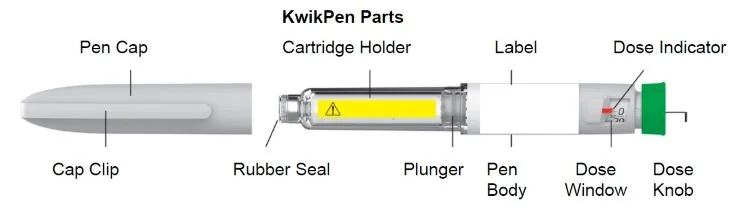
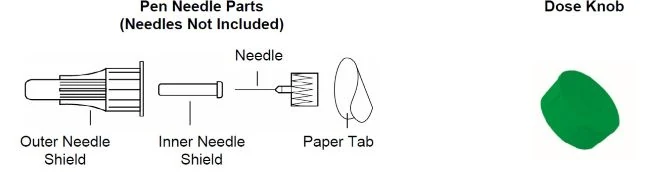
How to recognize your ONSWIK KwikPen
|  |
Supplies needed to give your injection
- ONSWIK KwikPen
- KwikPen compatible Needle (29 to 32 gauge needle recommended)
- 1 alcohol swab
- 1 cotton ball or piece of gauze
- 1 FDA-cleared sharps disposal container
Preparing your Pen
- Wash your hands with soap and water.
- Check the Pen to make sure you are taking the right type of insulin. This is especially important if you use more than 1 type of insulin.
- Do not use your Pen past the expiration date printed on the Label or for more than 112 days (16 weeks) after you first start using the Pen.
- Always use a new Needle for each injection to help prevent infections and blocked Needles. Do not reuse or share your needles with other people. You may give other people a serious infection or get a serious infection from them.
Step 1:
ONSWIK should look clear and colorless to yellow. Do not use if it is cloudy, discolored, or has particles or clumps in it. | |
Step 2:
| |
Step 3:
| |
Step 4:
| |
Priming your Pen
Prime before each injection.
- Priming your Pen means removing the air from the Needle and Cartridge that may collect during normal use and ensures that the Pen is working correctly.
- If you do not prime before each injection, you may get too little insulin.
Step 5:
| 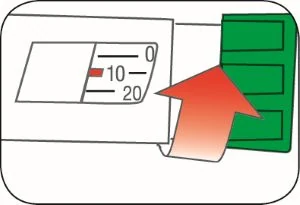 |
Step 6:
| |
Step 7:
Small air bubbles are normal and will not affect your dose. | 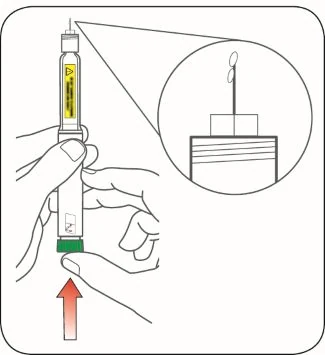 |
Selecting your dose
This Pen has been made to deliver the dose in insulin units that is shown in the Dose Window. Ask your healthcare provider what your dose should be for this Pen.
- You can give from 10 units to 800 units in a single injection.
If your dose is more than 800 units, you will need to give more than 1 injection.
- If you need help with dividing up your dose the right way, ask your healthcare provider.
- Use a new Needle for each injection and repeat the priming step.
Step 8:
| 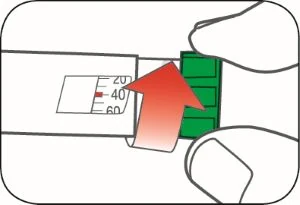
shown in Dose Window
shown in Dose Window |
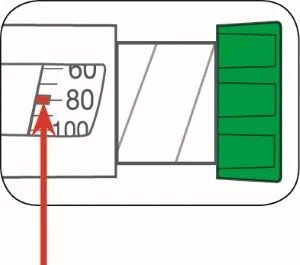 Example: 80 units
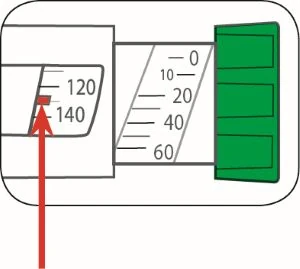 Example: 130 units
- The Pen will not let you dial more than the number of units left in the Pen.
If your dose is more than the number of units left in the Pen, you may either:
inject the amount left in your Pen and then use a new Pen to give the rest of your dose,
or
- get a new Pen and inject your full dose.
- It is normal to see a small amount of insulin left in the Pen that you cannot inject. Do not transfer the insulin to a syringe. Severe overdose can happen.
Giving your injection
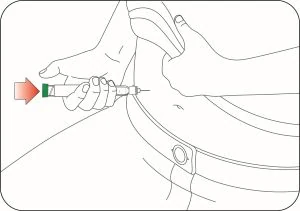
- Inject your insulin as your healthcare provider has shown you.
Change (rotate) your injection sites within the area you choose for each injection to reduce your risk of getting pits in the skin or thickened skin (lipodystrophy) and skin with lumps (localized cutaneous amyloidosis) at the injection sites.
- Do not inject where the skin has pits, is thickened, or has lumps.
- Do not inject where the skin is tender, bruised, scaly or hard, or into scars or damaged skin.
- Do not try to change your dose while injecting.
Step 9:
|  | |
Step 10:
|  | |
| | |
| Do not try to inject your insulin by turning the Dose Knob. You will not receive your insulin by turning the Dose Knob. | ||
Step 11:
The Plunger only moves a little with each injection, and you may not notice that it moves. If you see blood after you take the Needle out of your skin, press the injection site lightly with a piece of gauze or an alcohol swab. Do not rub the area. | | |
After your injection
Step 12:
| |
Step 13:
| |
Step 14:
| |
Throwing away (disposing of) Pens and Needles
- Throw away your used Needles in an FDA-cleared sharps disposal container right away after use. Do not throw away (dispose of) loose Needles in your household trash.
If you do not have an FDA-cleared sharps disposal container, you may use a household container that is:
- made of a heavy-duty plastic,
- can be closed with a tight-fitting, puncture-resistant lid, without sharps being able to come out,
- upright and stable during use,
- leak-resistant, and
- properly labeled to warn of hazardous waste inside the container.
- When your sharps disposal container is almost full, you will need to follow your community guidelines for the right way to dispose of your sharps disposal container. There may be state or local laws about how you should throw away used needles and syringes. For more information about safe sharps disposal, and for specific information about sharps disposal in the state that you live in, go to the FDA's website at: http://www.fda.gov/safesharpsdisposal
- Do not throw away (dispose of) your used sharps disposal container in your household trash unless your community guidelines permit this. Do not recycle your used sharps disposal container.
- The used Pen may be thrown away (discarded) in your household trash after you have removed the needle.
What you should know if you are switching to ONSWIK KwikPen
Ask your healthcare provider what your dose should be for your Pen in insulin units. Always follow your healthcare provider's instructions for dosing.
| If you are: | It is important to know: |
| Switching from another type of insulin device or pen. | This ONSWIK KwikPen is different from other pens. It dials 10 insulin units with each click of the Dose Knob. Do not select your dose by counting clicks. You may get too much insulin or you may not get enough insulin. |
General information about the safe and effective use of your Pen
- Keep your Pen and Needles out of the sight and reach of children.
- Do not use your Pen if any part looks broken or damaged. Always have an extra Pen in case yours is lost or damaged.
Troubleshooting
- If you cannot remove the Pen Cap, gently twist the cap back and forth, and then pull the cap straight off.
If it is hard to push the Dose Knob:
- Pushing the Dose Knob more slowly will make it easier to inject.
- Your Needle may be blocked. Put on a new Needle and prime the Pen.
- You may have dust, food, or liquid inside the Pen. Throw the Pen away and get a new Pen.
If you have any questions or problems with your ONSWIK KwikPen, contact Lilly at 1-800-LillyRx (1-800-545-5979) or call your healthcare provider for help. For more information on ONSWIK KwikPen and insulin, go to www.ONSWIK.lilly.com.
Scan this code to launch
www.ONSWIK.lilly.com
Manufactured by
Eli Lilly and Company
Indianapolis, IN 46285, USA
U.S. License Number: 1891
ONSWIK™ and ONSWIK™ KwikPen® are trademarks of Eli Lilly and Company.
Copyright © 2026, Eli Lilly and Company. All rights reserved.
This Instructions for Use has been approved by the U.S. Food and Drug Administration.
Issued: September 2026
| ONSWIK KwikPen meets the current dose accuracy and functional requirements of ISO 11608-1. |
ONS-KP-0001-IFU-U1000-20260923