


Patient information: uses, side effects, how to take - Kesimpta
What is the most important information I should know about KESIMPTA?
KESIMPTA can cause serious side effects, including:
Infections. Serious infections, which can be life-threatening or cause death, can happen during treatment with KESIMPTA. If you have an active infection, your healthcare provider should delay your treatment with KESIMPTA until your infection is gone. KESIMPTA taken before or after other medicines that weaken the immune system may increase your risk of getting infections.
Tell your healthcare provider right away if you have any infections or get any symptoms, including painful and frequent urination, nasal congestion, runny nose, sore throat, fever, chills, cough, or body aches.
- Hepatitis B virus (HBV) reactivation. Before starting treatment with KESIMPTA, your healthcare provider will do blood tests to check for HBV. If you have ever had HBV infection, the HBV may become active again during or after treatment with KESIMPTA. Hepatitis B virus becoming active again (called reactivation) may cause serious liver problems, including liver failure or death. You should not receive KESIMPTA if you have active hepatitis B liver disease. Your healthcare provider will monitor you for HBV infection during and after you stop using KESIMPTA.
Tell your healthcare provider right away if you get worsening tiredness or yellowing of your skin or white part of your eyes during treatment with KESIMPTA.
- Progressive Multifocal Leukoencephalopathy (PML). PML may happen with KESIMPTA. PML is a rare, serious brain infection caused by a virus that may get worse over days or weeks. PML can result in death or severe disability. Tell your healthcare provider right away if you have any new or worsening neurologic signs or symptoms. These may include weakness on one side of your body, loss of coordination in arms and legs, vision problems, changes in thinking and memory which may lead to confusion and personality changes.
- Weakened immune system. KESIMPTA taken before or after other medicines that weaken the immune system could increase your risk of getting infections.
What is KESIMPTA?
KESIMPTA is a prescription medicine used to treat adults with relapsing forms of multiple sclerosis (MS), including:
- clinically isolated syndrome
- relapsing-remitting disease
- active secondary progressive disease
It is not known if KESIMPTA is safe or effective in children.
Do not use KESIMPTA if you:
- have an active hepatitis B virus infection.
- have had an allergic reaction to ofatumumab or life-threatening injection-related reaction to KESIMPTA. See the end of this Medication Guide for a complete list of ingredients in KESIMPTA.
Before using KESIMPTA, tell your healthcare provider about all of your medical conditions, including if you:
- have or think you have an infection, including HBV or PML. See “What is the most important information I should know about KESIMPTA?”
- have ever taken, currently take, or plan to take medicines that affect your immune system. These medicines could increase your risk of getting an infection.
- have a history of liver problems.
have had a recent vaccination or are scheduled to receive any vaccinations.
- You should receive any required ‘live’ or ‘live-attenuated’ vaccines at least 4 weeks before you start treatment with KESIMPTA. You should not receive ‘live’ or ‘live-attenuated’ vaccines while you are being treated with KESIMPTA and until your healthcare provider tells you that your immune system is no longer weakened.
- Whenever possible, you should receive any ‘non-live’ vaccines at least 2 weeks before you start treatment with KESIMPTA.
- Talk to your healthcare provider about vaccinations for your baby if you used KESIMPTA during your pregnancy.
are pregnant, think that you might be pregnant, or plan to become pregnant. It is not known if KESIMPTA will harm your unborn baby. Females who can become pregnant should use birth control (contraception) during treatment with KESIMPTA and for 6 months after your last treatment. Talk with your healthcare provider about what birth control method is right for you during this time.
- Pregnancy Registry: There is a registry for women who become pregnant during treatment with KESIMPTA. If you become pregnant while taking KESIMPTA, tell your healthcare provider right away. Talk to your healthcare provider about registering with the MotherToBaby Pregnancy Study in Multiple Sclerosis. The purpose of the registry is to collect information about your health and your baby’s health. For more information or to register, contact MotherToBaby by calling 1-877-311-8972, by sending an email to MotherToBaby@health.ucsd.edu, or go to www.mothertobaby.org/join-study.
are breastfeeding or plan to breastfeed. It is not known if KESIMPTA passes into your breast milk. Talk to your healthcare provider about the best way to feed your baby if you take KESIMPTA.
Tell your healthcare provider about all the medicines you take, including prescription and over-the-counter medicines, vitamins, and herbal supplements.
Know the medicines you take. Keep a list of them to show your healthcare provider and pharmacist when you get a new medicine.
How should I use KESIMPTA?
See the detailed Instructions for Use that comes with KESIMPTA for information about how to prepare and inject a dose of KESIMPTA and how to properly throw away (dispose of) used KESIMPTA Sensoready pens or prefilled syringes.
- Use KESIMPTA exactly as your healthcare provider tells you to use it.
- KESIMPTA is given as an injection under your skin (subcutaneous injection), in your thigh or stomach-area (abdomen) by you or a caregiver. A caregiver may also give you an injection of KESIMPTA in your upper outer arm.
- Your healthcare provider will show you how to prepare and inject KESIMPTA the right way before you use it for the first time.
- Do not inject into areas where the skin is tender, bruised, red, scaly or hard. Avoid areas with moles, scars or stretch marks.
- The initial dosing is 20 mg of KESIMPTA given by subcutaneous injection at Weeks 0, 1, and 2. There is no injection at Week 3. Starting at Week 4 and then every month, the recommended dose is 20 mg of KESIMPTA administered by subcutaneous injection.
- If you miss an injection of KESIMPTA at Week 0, 1, or 2, talk to your healthcare provider. If you miss a monthly injection, give it as soon as possible without waiting until the next scheduled dose. After that, give your KESIMPTA injections a month apart.
What are the possible side effects of KESIMPTA?
KESIMPTA may cause serious side effects, including:
See “What is the most important information I should know about KESIMPTA?”
Injection-related reactions. Injection-related reactions are a common side effect of KESIMPTA. Injecting KESIMPTA can cause injection-related reactions that can happen within 24 hours (1 day) following the first injection and with later injections. There are two kinds of reactions:
- at or near the injection site: redness of the skin, swelling, itching and pain. Talk with your healthcare provider if you have any of these signs and symptoms.
- that may happen when certain substances are released in your body: fever, headache, pain in the muscles, chills, tiredness, rash, hives, trouble breathing, swelling of the face, eyelids, lips, mouth, tongue and throat, and feeling faint, or chest tightness. Contact your healthcare provider right away if you experience any of these signs and symptoms, especially if they become worse or you have new severe signs of reactions after subsequent injections. It could be a sign of an allergic reaction, which can be serious.
- Low immunoglobulins. KESIMPTA may cause a decrease in some types of antibodies. Your healthcare provider will do blood tests to check your blood immunoglobulin levels.
Liver damage. KESIMPTA may cause liver damage. Your healthcare provider will do blood tests to check your liver before you start KESIMPTA and while you take KESIMPTA if needed. Tell your healthcare provider right away if you have any symptoms of liver damage, such as:
- yellowing of the skin and eyes (jaundice)
- nausea
- vomiting
- unusual darkening of the urine
- feeling tired or weak
The most common side effects of KESIMPTA include:
- upper respiratory tract infection, with symptoms, such as sore throat and runny nose, and headache. See “What is the most important information I should know about KESIMPTA?”
- headache
These are not all the possible side effects of KESIMPTA. Call your doctor for medical advice about side effects.
You may report side effects to FDA at 1-800-FDA-1088.
How should I store KESIMPTA?
- Store KESIMPTA in a refrigerator between 36°F to 46°F (2°C to 8°C).
- Keep KESIMPTA in the original carton until ready for use to protect from light.
- If needed, KESIMPTA may be stored for up to 7 days at room temperature, up to 86°F (30°C).
- Write the date taken out of the refrigerator in the space provided on the carton.
- If stored below 86°F (30°C), unused KESIMPTA may be returned to the refrigerator and must be used within the next 7 days. If this KESIMPTA is not used within those 7 days, then discard the medicine.
- Do not freeze KESIMPTA.
- Do not shake KESIMPTA.
Keep KESIMPTA and all medicines out of the reach of children.
General information about the safe and effective use of KESIMPTA.
Medicines are sometimes prescribed for purposes other than those listed in a Medication Guide. Do not use KESIMPTA for a condition for which it was not prescribed. Do not give KESIMPTA to other people, even if they have the same symptoms that you have. It may harm them. You can ask your pharmacist or healthcare provider for information about KESIMPTA that is written for health professionals.
What are the ingredients in KESIMPTA?
Active ingredient: ofatumumab
Inactive ingredients: Sensoready Pen and prefilled syringe: arginine, disodium edetate, polysorbate 80, sodium acetate trihydrate, sodium chloride, and Water for Injection. Hydrochloric acid may be added.
Distributed by: Novartis Pharmaceuticals Corporation, East Hanover, New Jersey 07936
For more information, go to www.novartis.us or call 1-888-669-6682.
T2026-08
This Instructions for Use has been approved by the U.S. Food and Drug Administration.
Revised: 9/2022
INSTRUCTIONS FOR USE
KESIMPTA® [KEY-simp-ta]
(ofatumumab)
injection, for subcutaneous use
Sensoready® Pen
This Instructions for Use contains information on how to inject KESIMPTA Sensoready Pen.
Be sure that you read, understand, and follow this Instructions for Use before injecting KESIMPTA. Your healthcare provider should show you how to prepare and inject KESIMPTA the right way using the Sensoready Pen before you use it for the first time. Talk to your healthcare provider if you have any questions before you use KESIMPTA for the first time.
Important Information You Need to Know Before Injecting KESIMPTA Sensoready Pen.
- Do not use the KESIMPTA Sensoready Pen if either the seal on the outer carton or the seal on the KESIMPTA Sensoready Pen is broken. Keep the KESIMPTA Sensoready Pen in the sealed outer carton until you are ready to use it.
- Do not shake the KESIMPTA Sensoready Pen.
- If you drop your KESIMPTA Sensoready Pen, do not use it if it looks damaged, or if you dropped it with the cap removed.
Throw away (dispose of) the used KESIMPTA Sensoready Pen right away after use. Do not re-use a KESIMPTA Sensoready Pen. See “How should I dispose of used KESIMPTA Sensoready Pens?” at the end of this Instructions for Use.
How should I store KESIMPTA Sensoready Pen?
- Store your carton of KESIMPTA Sensoready Pen in a refrigerator, between 36°F to 46°F (2°C to 8°C).
- Keep KESIMPTA Sensoready Pen in the original carton until ready to use to protect from light.
- If needed, KESIMPTA Sensoready Pen may be stored for up to 7 days at room temperature, up to 86°F (30°C).
- Write the date taken out of the refrigerator in the space provided on the carton.
- If stored below 86°F (30°C), unused KESIMPTA may be returned to the refrigerator and must be used within the next 7 days. If this KESIMPTA is not used within those 7 days, then discard the medicine.
- Do not freeze KESIMPTA Sensoready Pen.
Keep KESIMPTA Sensoready Pen and all medicines out of the reach of children.
KESIMPTA Sensoready Pen parts (see Figure A):
Figure A
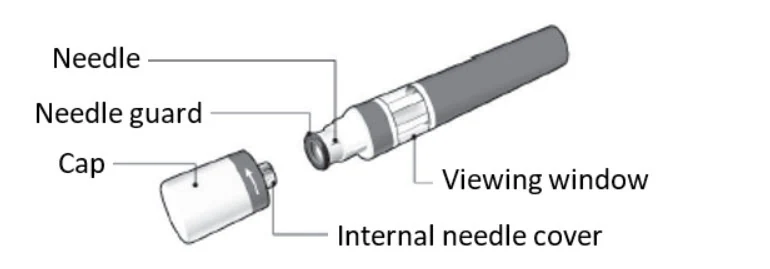
The KESIMPTA Sensoready Pen is shown with the cap removed. Do not remove the cap until you are ready to inject.
What you need for your injection:
Included in the carton:
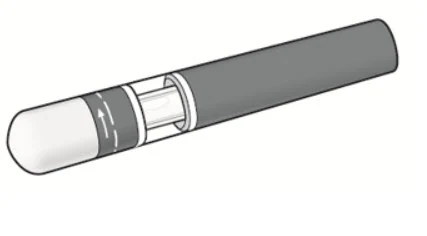
A new KESIMPTA Sensoready Pen (see Figure B).
Figure B
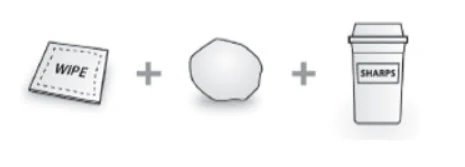
Not included in the carton (see Figure C):
- 1 alcohol wipe
- 1 cotton ball or gauze
- Sharps disposal container
See “How should I dispose of used KESIMPTA Sensoready Pens?” at the end of this Instructions for Use.
Figure C
Before your injection
Take the KESIMPTA Sensoready Pen out of the refrigerator 15 to 30 minutes before injecting to allow it to reach room temperature.
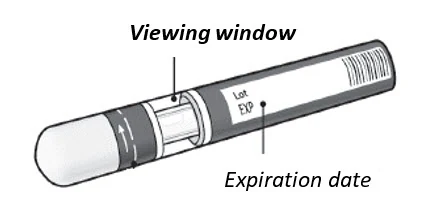
Step 1. Important safety checks before you inject (see Figure D):
- Look through the viewing window. The liquid should be clear to slightly cloudy.
Do not use if the liquid contains visible particles or is cloudy.
You may see a small air bubble, which is normal.
- Look at the expiration date (EXP) on your KESIMPTA Sensoready Pen. Do not use your pen if the expiration date has passed.
Contact your pharmacist or healthcare provider if your pen fails any of these checks.
Figure D
Step 2. Choose your injection site:
- The recommended site is the front of the thighs. You may also use the lower stomach area (lower abdomen), but not the area 2 inches around the navel (belly button) (see Figure E).
- Do not inject into areas where the skin is tender, bruised, red, scaly, or hard. Avoid areas with moles, scars or stretch marks.
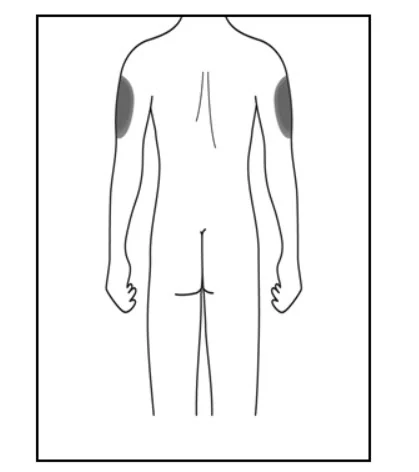
- If a caregiver or healthcare provider is giving you your injection, they may also inject into your outer upper arm (see Figure F).
Figure E
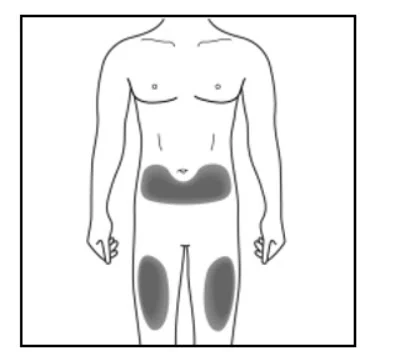
Figure F (Caregiver and healthcare provider only)
Step 3. Clean your injection site:
- Wash your hands with soap and water.
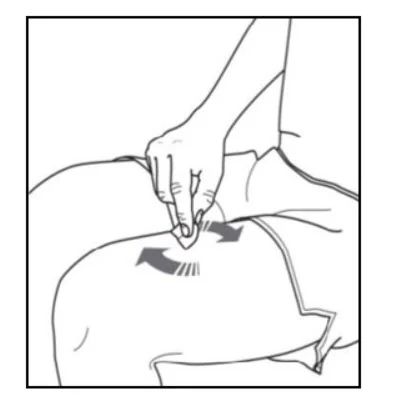
- Using a circular motion, clean the injection site with the alcohol wipe. Leave it to dry before injecting (see Figure G).
- Do not touch the cleaned area again before injecting.
Figure G
Your injection
Step 4. Remove the cap:
- Only remove the cap when you are ready to use the KESIMPTA Sensoready Pen.
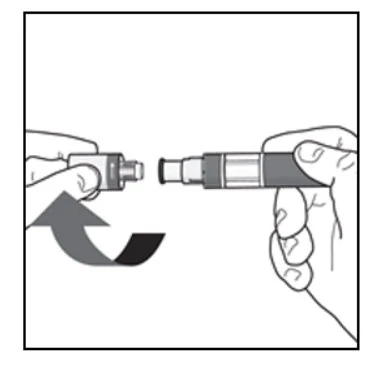
- Twist off the cap in the direction of the arrow (see Figure H).
- Throw away the cap. Do not try to re-attach the cap.
- Use the KESIMPTA Sensoready Pen within 5 minutes of removing the cap.
You may see a few drops of medicine come out of the needle. This is normal.
Figure H
Step 5. Hold your KESIMPTA Sensoready Pen:
- Hold the KESIMPTA Sensoready Pen at 90 degrees to the cleaned injection site (see Figure I).
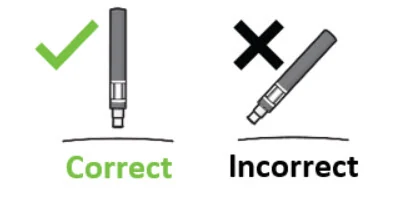
Figure I
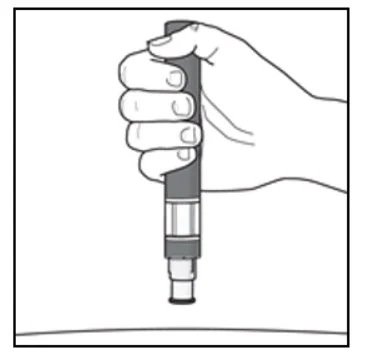
Important: During the injection you will hear 2 loud clicks:
- The 1st click indicates that the injection has started
- A 2nd click will indicate that the injection is almost complete
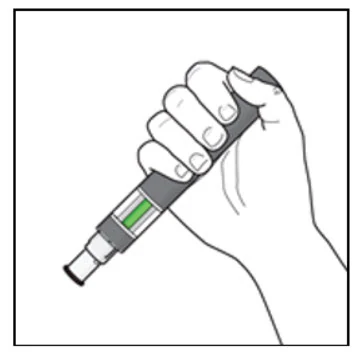
You must keep holding the KESIMPTA Sensoready Pen firmly against the skin until the green indicator fills the window and stops moving.
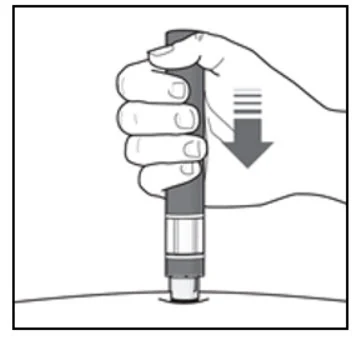
Step 6. Start your injection:
- Press the KESIMPTA Sensoready Pen firmly against the skin to start the injection (see Figure J).
- The 1st click indicates the injection has started.
- Keep holding the KESIMPTA Sensoready Pen firmly against your skin.
- The green indicator shows the progress of the injection.
Figure J
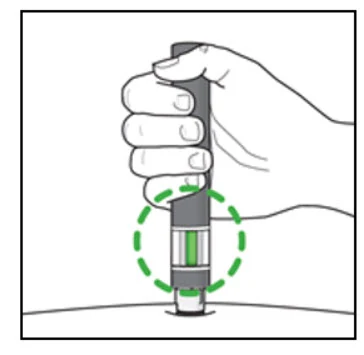
Step 7. Complete your injection:
- Listen for the 2nd click. This indicates that the injection is almost complete.
- Check to see if the green indicator fills the window and has stopped moving (see Figure K).
- The KESIMPTA Sensoready Pen can now be removed (see Figure L).
Figure K
After your injection
- In case the green indicator does not fill the window, it means the medicine has not been delivered. Contact your healthcare provider if the green indicator is not visible.
- There may be a small amount of blood at the injection site. You can press a cotton ball or gauze over the injection site and hold it for 10 seconds. Do not rub the injection site. You may cover the injection site with a small adhesive bandage, if needed.
Figure L
How should I dispose of used KESIMPTA Sensoready® Pens?
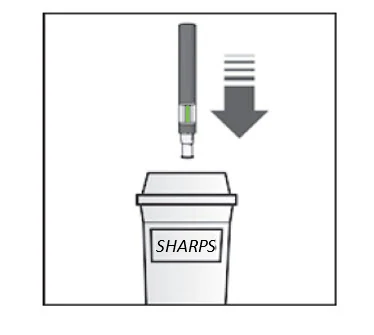
Step 8. Put your used KESIMPTA Sensoready Pen in an FDA-cleared sharps disposal container right away after use (see Figure M). Do not throw away (dispose of) your used KESIMPTA Sensoready Pen in your household trash.
If you do not have an FDA-cleared sharps disposal container, you may use a household container that is:
- made of a heavy-duty plastic,
- can be closed with a tight-fitting, puncture-resistant lid, without sharps being able to come out,
- upright and stable during use,
- leak-resistant, and
- properly labeled to warn of hazardous waste inside the container.
When your sharps disposal container is almost full, you will need to follow your community guidelines for the right way to dispose of your sharps disposal container. There may be state or local laws about how you should throw away used needles, syringes and pens. For more information about safe sharps disposal, and for specific information about sharps disposal in the state that you live in, go to the FDA’s website at: http://www.fda.gov/safesharpsdisposal.
Keep the sharps container out of the reach of children.
Manufactured by:
Novartis Pharmaceuticals Corporation
East Hanover, NJ 07936
U.S. License No.: 1244
Figure M
T2022-54
This Instructions for Use has been approved by the U.S. Food and Drug Administration.
Revised: 4/2024
INSTRUCTIONS FOR USE
KESIMPTA® [KEY-simp-ta]
(ofatumumab)
injection, for subcutaneous use
Prefilled Syringe
This Instructions for Use contains information on how to inject KESIMPTA Prefilled Syringe.
Be sure that you read, understand, and follow this Instructions for Use before injecting KESIMPTA prefilled syringe. Your healthcare provider should show you how to prepare and inject KESIMPTA the right way before using the prefilled syringe the first time. Talk to your healthcare provider if you have any questions.
Important Information You Need to Know Before Injecting KESIMPTA prefilled syringe.
- Do not use the KESIMPTA prefilled syringe if either the seal on the outer carton or the seal of the blister is broken. Keep the KESIMPTA prefilled syringe in the sealed carton until you are ready to use it.
- Do not shake the KESIMPTA prefilled syringe.
- The KESIMPTA prefilled syringe has a needle guard that will be activated to cover the needle after the injection is finished. The needle guard will help to prevent needle stick injuries to anyone who handles the KESIMPTA prefilled syringe after injection.
- Do not remove the needle cap until just before you give the injection.
- Avoid touching the syringe guard wings before use. Touching them may cause the needle guard to be activated too early.
- Do not use if the prefilled syringe has been dropped onto a hard surface or dropped after removing the needle cap.
- Throw away (dispose of) the used KESIMPTA prefilled syringe right away after use. Do not re-use a KESIMPTA prefilled syringe. See "How should I dispose of used KESIMPTA prefilled syringes?” at the end of these Instructions for Use.
How should I store KESIMPTA Prefilled Syringe?
- Store your carton of the KESIMPTA prefilled syringe in a refrigerator, between 36°F to 46°F (2°C to 8°C).
- Keep the KESIMPTA prefilled syringe in the original carton until ready to use to protect from light.
- If needed, KESIMPTA prefilled syringe may be stored for up to 7 days at room temperature, up to 86°F (30°C).
- Write the date taken out of the refrigerator in the space provided on the carton.
- If stored below 86°F (30°C), unused KESIMPTA may be returned to the refrigerator and must be used within the next 7 days. If this KESIMPTA is not used within those 7 days, then discard the medicine.
- Do not freeze the KESIMPTA prefilled syringe.
Keep KESIMPTA Prefilled Syringe and all medicines out of the reach of children.
KESIMPTA prefilled syringe parts (see Figure A):
Figure A 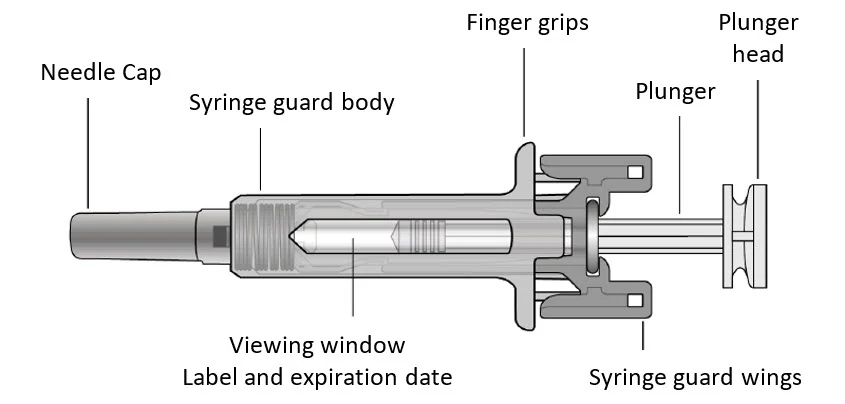
What you need for your injection
Included in the carton:
A new KESIMPTA prefilled syringe.
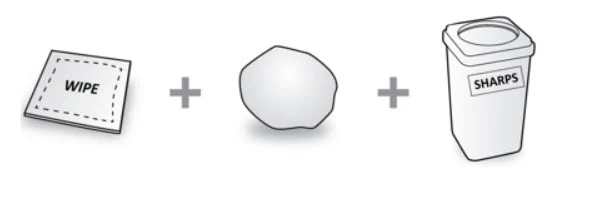
Not included in the carton (see Figure B):
- 1 alcohol wipe
- 1 cotton ball or gauze
- Sharps disposal container
See “How should I dispose of used KESIMPTA prefilled syringe?” at the end of these Instructions for Use.
Figure B
Prepare the KESIMPTA prefilled syringe
Step 1. Find a clean, well-lit, flat work surface.
Step 2. Take the carton containing the KESIMPTA prefilled syringe out of the refrigerator and leave it unopened on your work surface for about 15 to 30 minutes so that it reaches room temperature.
Step 3. Wash your hands well with soap and water.
Step 4. Remove the KESIMPTA prefilled syringe from the outer carton and take it out of the blister by holding the syringe guard body.
Step 5. Look through the viewing window on the KESIMPTA prefilled syringe. The liquid inside should be clear to slightly cloudy. You may see a small air bubble in the liquid, which is normal. Do not use the KESIMPTA prefilled syringe if the liquid contains particles or is cloudy.
Step 6. Do not use the KESIMPTA prefilled syringe if it is broken. Return the KESIMPTA prefilled syringe and the package it came in to the pharmacy.
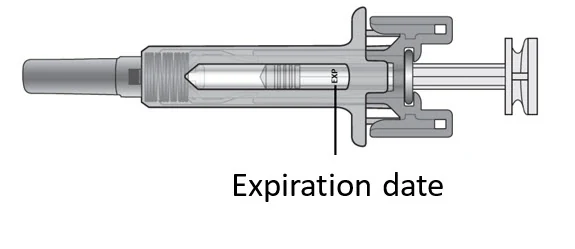
Step 7. Do not use the KESIMPTA prefilled syringe if the expiration date has passed (see Figure C). Return the expired KESIMPTA prefilled syringe and the package it came in to the pharmacy.
Figure C
Choose and clean the injection site
Areas of your body that you may use as injection sites include:
- the front of your thighs (see Figure D)
- the lower stomach-area (abdomen), but not the area 2 inches around your navel (belly button) (see Figure D)
- your outer upper arms, if a healthcare provider or caregiver is giving you the injection (see Figure E)
- Do not inject into areas where the skin is tender, bruised, red, scaly, or hard. Avoid areas with moles, scars, or stretch marks.
Step 8. Using a circular motion, clean the injection site with the alcohol wipe. Leave it to dry before injecting. Do not touch the cleaned area again before injecting.
Figure D
Figure E (Caregiver and healthcare provider only)
Giving your injection
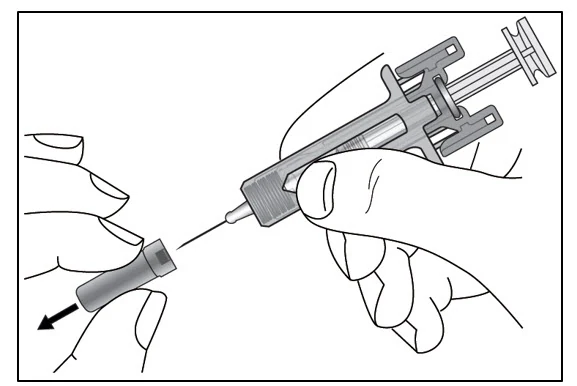
Step 9. Carefully remove the needle cap from the KESIMPTA prefilled syringe (see Figure F). Throw away the needle cap. You may see a drop of liquid at the end of the needle. This is normal.
Figure F
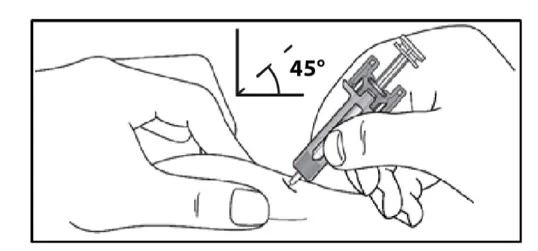
Step 10. With one hand, gently pinch the skin at the injection site. With your other hand insert the needle into your skin at an angle of about 45 degrees as shown (see Figure G). Push the needle all the way in to make sure that you inject your full dose.
Figure G
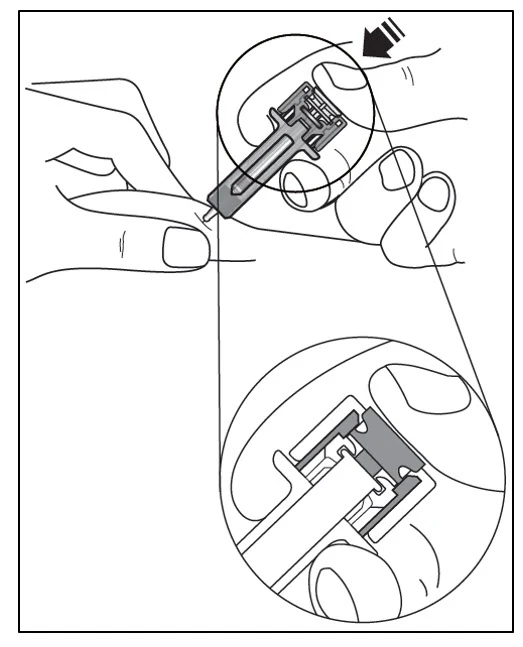
Step 11. Hold the KESIMPTA prefilled syringe finger grips as shown (see Figure H). Slowly press down on the plunger head as far as it will go, so that the plunger head is completely between the syringe guard wings.
Continue to press fully on the plunger head for an additional 5 seconds. Hold the syringe in place for the full 5 seconds.
Figure H
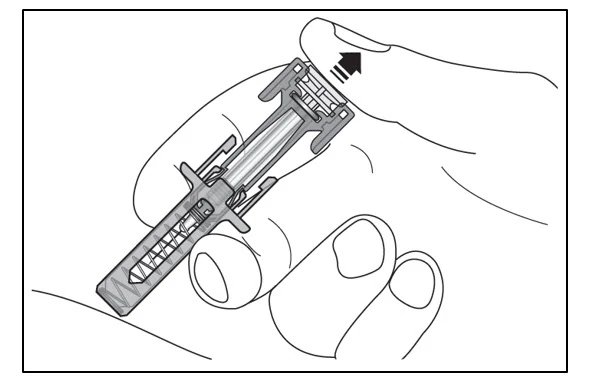
Step 12. Slowly release the plunger head until the needle is covered (see Figure I), and then remove the syringe from the injection site.
Step 13. There may be a small amount of blood at the injection site. You can press a cotton ball or gauze over the injection site and hold it for 10 seconds. Do not rub the injection site. You may cover the injection site with a small adhesive bandage, if needed.
Figure I
How should I dispose of used KESIMPTA prefilled syringes?
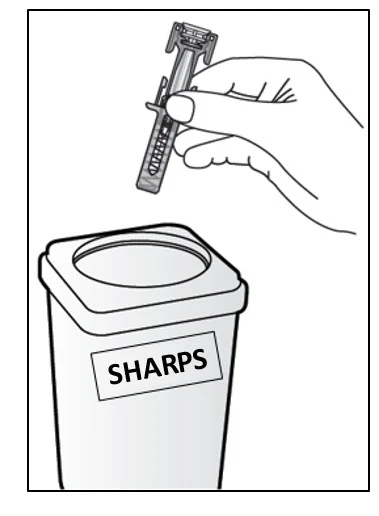
Step 14. Put your used KESIMPTA prefilled syringe in an FDA-cleared sharps disposal container right away after use (see Figure J). Do not throw away (dispose of) your used KESIMPTA prefilled syringe in your household trash. Never try to reuse your KESIMPTA prefilled syringe.
If you do not have an FDA-cleared sharps disposal container, you may use a household container that is:
- made of a heavy-duty plastic,
- can be closed with a tight-fitting, puncture-resistant lid, without sharps being able to come out,
- upright and stable during use,
- leak-resistant, and
- properly labeled to warn of hazardous waste inside the container.
When your sharps disposal container is almost full, you will need to follow your community guidelines for the right way to dispose of your sharps disposal container. There may be state or local laws about how you should throw away used needles, syringes, and prefilled syringes. For more information about safe sharps disposal, and for specific information about sharps disposal in the state that you live in, go to the FDA’s website at: http://www.fda.gov/safesharpsdisposal.
Keep the sharps container out of the reach of children.
Manufactured by:
Novartis Pharmaceuticals Corporation
East Hanover, NJ 07936
U.S. License No.: 1244
Figure J
T2024-33