


Patient information: uses, side effects, how to take - Invega Hafyera
What is the most important information I should know about INVEGA TRINZA ?
INVEGA TRINZA can cause serious side effects, including:
- Increased risk of death in elderly people who are confused, have memory loss and have lost touch with reality (dementia-related psychosis). INVEGA TRINZA is not for treating dementia-related psychosis.
What is INVEGA TRINZA ?
INVEGA TRINZA is a prescription medicine given by injection by a healthcare professional and used to treat schizophrenia.
INVEGA TRINZA is used in people who have been treated with INVEGA SUSTENNA 1 time a month injections for at least 4 months.
It is not known if INVEGA TRINZA is safe and effective in children under 18 years of age.
Who should not receive INVEGA TRINZA ?
Do not receive INVEGA TRINZA if you:
- are allergic to paliperidone palmitate, risperidone, or any of the ingredients in INVEGA TRINZA. See the end of this Patient Information leaflet for a complete list of ingredients in INVEGA TRINZA.
What should I tell my healthcare provider before receiving INVEGA TRINZA ?
Before you receive INVEGA TRINZA, tell your healthcare provider about all your medical conditions, including if you:
- have had Neuroleptic Malignant Syndrome (NMS)
- have or have had heart problems, including a heart attack, heart failure, abnormal heart rhythm, or long QT syndrome
- have or have had low levels of potassium or magnesium in your blood
- have or have had uncontrolled movements of your tongue, face, mouth, or jaw (tardive dyskinesia)
- have or have had kidney or liver problems
- have diabetes or have a family history of diabetes
- have had a low white blood cell count
- have had problems with dizziness or fainting or are being treated for high blood pressure
- have or have had seizures or epilepsy
- have any other medical conditions
are pregnant or plan to become pregnant. It is not known if INVEGA TRINZA will harm your unborn baby.
- If you become pregnant while taking INVEGA TRINZA, talk to your healthcare provider about registering with the National Pregnancy Registry for Atypical Antipsychotics. You can register by calling 1-866-961-2388 or visit http://womensmentalhealth.org/clinical-and-research-programs/pregnancyregistry/.
- Infants born to women who are treated with INVEGA TRINZA may experience symptoms such as tremors, irritability, excessive sleepiness, eye twitching, muscle spasms, decreased appetite, difficulty breathing, or abnormal movement of arms and legs. Let your healthcare provider know if these symptoms occur.
- are breastfeeding or plan to breastfeed. INVEGA TRINZA can pass into your breast milk. Talk to your healthcare provider about the best way to feed your baby if you receive INVEGA TRINZA.
Tell your healthcare provider about all the medicines you take, including prescription and over-the-counter medicines, vitamins, and herbal supplements.
Know the medicines you take. Keep a list of them to show to your healthcare provider or pharmacist when you get a new medicine.
How will I receive INVEGA TRINZA ?
- Follow your INVEGA TRINZA treatment schedule exactly as your healthcare provider tells you to.
- Your healthcare provider will tell you how much INVEGA TRINZA you will receive and when you will receive it.
- INVEGA TRINZA is given as an injection by your healthcare provider into the muscle (intramuscularly) of your arm or your buttocks, 1 time every 3 months.
What should I avoid while receiving INVEGA TRINZA ?
- INVEGA TRINZA may affect your ability to make decisions, think clearly, or react quickly. Do not drive, operate heavy machinery, or do other dangerous activities until you know how INVEGA TRINZA affects you.
- Avoid getting overheated or dehydrated.
What are the possible side effects of INVEGA TRINZA ?
INVEGA TRINZA may cause serious side effects, including:
- See " What is the most important information I should know about INVEGA TRINZA?"
- stroke in elderly people (cerebrovascular problems) that can lead to death
Neuroleptic Malignant Syndrome (NMS). NMS is a rare but very serious problem that can happen in people who receive INVEGA TRINZA. NMS can cause death and must be treated in a hospital. Call your healthcare provider right away if you become severely ill and have any of these symptoms:
- high fever
- severe muscle stiffness
- confusion
- loss of consciousness
- changes in your breathing, heartbeat and blood pressure
problems with your heartbeat.These heart problems can cause death. Call your healthcare provider right away if you have any of these symptoms:
- passing out or feeling like you will pass out
- dizziness
- feeling as if your heart is pounding or missing beats
- uncontrolled movements of your tongue, face, mouth, or jaw (tardive dyskinesia)
- metabolic changes. Metabolic changes may include high blood sugar (hyperglycemia), diabetes mellitus and changes in the fat levels in your blood (dyslipidemia), and weight gain.
- low blood pressure and fainting
- changes in your blood cell counts
- high level of prolactin in your blood (hyperprolactinemia). INVEGA TRINZA may cause a rise in the blood levels of a hormone called prolactin (hyperprolactinemia) that may cause side effects including missed menstrual periods, leakage of milk from the breasts, development of breasts in men, or problems with erection.
- problems thinking clearly and moving your body
- seizures
- difficulty swallowing that can cause food or liquid to get into your lungs
- prolonged or painful erection lasting more than 4 hours. Call your healthcare provider or go to your nearest emergency room right away if you have an erection that lasts more than 4 hours.
- problems with control of your body temperature especially when you exercise a lot or spend time doing things that make you warm. It is important for you to drink water to avoid dehydration.
The most common side effects of INVEGA TRINZA include: injection site reactions, weight gain, headache, upper respiratory tract infections, feeling restlessness or difficulty sitting still, slow movements, tremors, stiffness and shuffling walk.
Tell your healthcare provider if you have any side effect that bothers you or does not go away.
These are not all the possible side effects of INVEGA TRINZA. For more information, ask your healthcare provider or pharmacist.
Call your doctor for medical advice about side effects. You may report side effects to FDA at 1-800-FDA-1088.
General information about the safe and effective use of INVEGA TRINZA .
Medicines are sometimes prescribed for purposes other than those listed in a Patient Information leaflet. Do not use INVEGA TRINZA for a condition for which it was not prescribed. Do not give INVEGA TRINZA to other people, even if they have the same symptoms that you have. It may harm them. You can ask your pharmacist or healthcare provider for information about INVEGA TRINZA that is written for health professionals.
This Patient Information leaflet summarizes the most important information about INVEGA TRINZA. If you would like more information, talk with your healthcare provider.
You can ask your healthcare provider or pharmacist for more information that is written for healthcare professionals. For more information, go to www.invegatrinzahcp.com or call 1-800-526-7736.
What are the ingredients in INVEGA TRINZA ?
Active ingredient : paliperidone palmitate
Inactive ingredients: polysorbate 20, polyethylene glycol 4000, citric acid monohydrate, sodium dihydrogen phosphate monohydrate, sodium hydroxide, and water for injection
Manufactured for: Janssen Pharmaceuticals, Inc., Titusville, NJ 08560, USA
For patent information: www.janssenpatents.com
© Johnson & Johnson and its affiliates 2015
Instructions for Use
INVEGA TRINZA ®
paliperidone palmitate extended-release injectable suspension
 | Administer every 3 months |
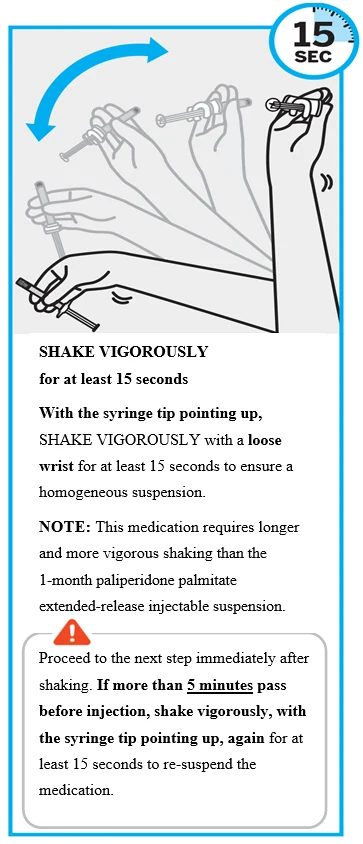
 | Shake syringe vigorously for at least 15 seconds |
For intramuscular injection only.
Do not administer by any other route.
Important
INVEGA TRINZA should be administered by a healthcare professional as a single injection. DO NOT divide dose into multiple injections.
INVEGA TRINZA is intended for intramuscular use only. Inject slowly, deep into the muscle taking care to avoid injection into a blood vessel.
Read complete instructions prior to use.
Dosing
This medication should be administered once every 3 months.
Preparation
Peel off tab label from the syringe and place in patient record.
INVEGA TRINZA requires longer and more vigorous shaking than INVEGA SUSTENNA (1-month paliperidone palmitate extended-release injectable suspension). Shake the syringe vigorously, with the syringe tip pointing up, for at least 15 seconds within 5 minutes prior to administration (see Step 2).
Thin Wall Safety Needle Selection
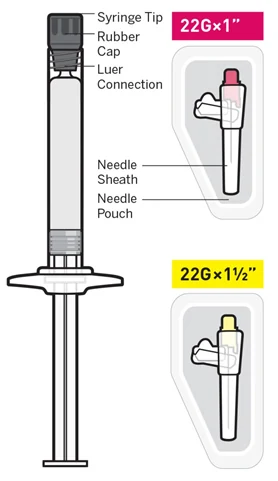
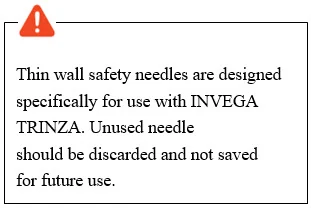
Thin wall safety needles are designed to be used with INVEGA TRINZA. Therefore, it is important to only use the needles provided in the INVEGA TRINZA kit.
Dose pack contents
| Prefilled Syringe | Thin Wall Safety Needles | ||||
|---|---|---|---|---|---|
 | |||||
1 Select needle
Needle selection is determined by injection area and patient weight.
If administering a Deltoid injection 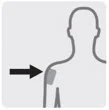 If patient weighs: Less than 90 kg pink hub  | If administering a Gluteal injection 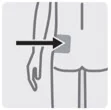 If patient weighs: Less than 90 kg yellow hub 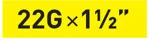 |
90 kg or more yellow hub | 90 kg or more yellow hub |
 | |
2 Prepare for injection
Check suspension
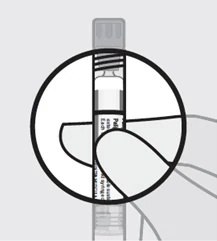
After shaking the syringe for at least 15 seconds, check the liquid in the viewing window.
The suspension should appear uniform and milky white in color.
It is also normal to see small air bubbles.
Open needle pouch and remove cap
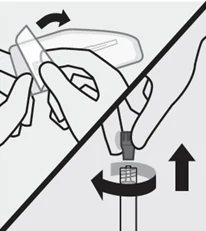
First, open needle pouch by peeling the cover back half way. Place on a clean surface.
Then, holding the syringe upright, twist and pull the rubber cap to remove.
Grasp needle pouch
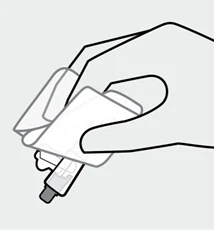
Fold back needle cover and plastic tray. Then, firmly grasp the needle sheath through the pouch, as shown.
Attach needle
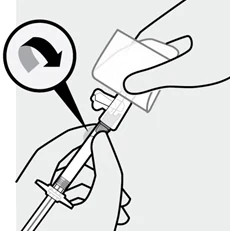
Hold the syringe pointing up. Attach the safety needle to the syringe using a gentle twisting motion to avoid needle hub cracks or damage. Always check for signs of damage or leakage prior to administration.
Remove needle sheath
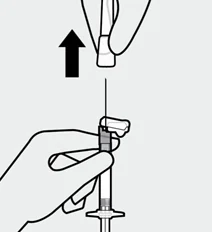
Pull the needle sheath away from the needle in a straight motion.
Do not twist the sheath, as this may loosen the needle from the syringe.
Remove air bubbles
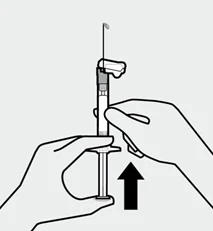
Hold the syringe upright and tap gently to make any air bubbles rise to the top.
Remove air by pressing the plunger rod upward carefully until a drop of liquid comes out of the needle tip.
3 Inject
Inject dose
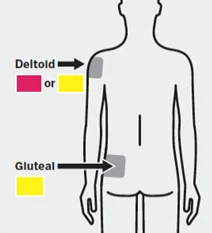
Slowly inject the entire contents of the syringe intramuscularly, deep into the selected deltoid or gluteal muscle.
Do not administer by any other route.
4 After injection
Secure needle
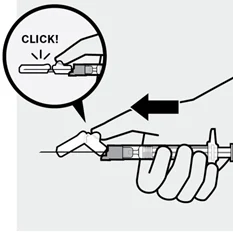
After the injection is complete, use your thumb or a flat surface to secure the needle in the safety device.
The needle is secure when a "click" sound is heard.
Dispose properly
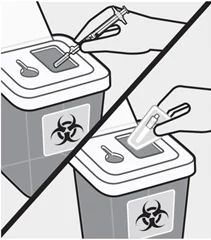
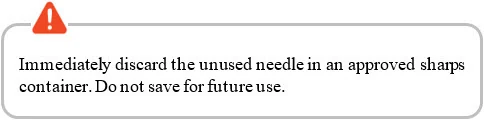
Dispose of the syringe and unused needle in an approved sharps container.
Manufactured for:
Janssen Pharmaceuticals, Inc.
Titusville, NJ 08560, USA
For patent information: www.janssenpatents.com
© Johnson & Johnson and its affiliates 2015
This Instructions for Use has been approved by the U.S. Food and Drug Administration. Revised: 2/2025