


Patient information: uses, side effects, how to take - Gonal-f RFF Redi-ject
What is GONAL-f RFF Redi-ject?
GONAL-f RFF Redi-ject is an injection Pen that delivers a prescription medicine containing follicle-stimulating hormone (FSH) used in infertile women to:
- help healthy ovaries develop (mature) and release an egg
- cause your ovaries to make multiple (more than 1) eggs as part of an Assisted Reproductive Technology (ART) program
Who should not use GONAL-f RFF Redi-ject?
Do not use the GONAL-f RFF Redi-ject if you:
- are allergic to recombinant human FSH or any of the ingredients in GONAL-f RFF Redi-ject. See the end of this leaflet for a complete list of ingredients in GONAL-f RFF Redi-ject.
- have a high level of FSH in your blood that shows your ovaries no longer make eggs (primary ovarian failure)
- have uncontrolled thyroid, adrenal, or pituitary problems
- have a tumor in your female organs, including your ovaries, breast, or uterus that may get worse with high levels of estrogen
- have a tumor in your brain, such as a tumor in your pituitary or hypothalamus
- have abnormal bleeding from your uterus or vagina from an unknown cause
- have ovarian cysts or large ovaries from an unknown cause
What should I tell my healthcare provider before using GONAL-f RFF Redi- ject?
Before you use GONAL-f RFF Redi-ject, tell your healthcare provider if you:
- have or have had asthma
- have been told by a healthcare provider that you have an increased risk for blood clots (thrombosis)
- have ever had a blood clot (thrombosis), or anyone in your family has ever had a blood clot (thrombosis)
- have had stomach (abdominal) surgery
- have had twisting of your ovary (ovarian torsion)
- had or have a cyst on your ovary
- have polycystic ovarian disease
- have any other medical conditions
- are pregnant or think you may be pregnant. GONAL-f RFF Redi-ject is not for pregnant women. Your healthcare provider will give you a pregnancy test before starting GONAL-f RFF Redi-ject.
- are breastfeeding. It is not known if GONAL-f RFF Redi-ject passes into your breast milk. You and your healthcare provider should decide if you will take GONAL-f RFF Redi-ject or breastfeed. You should not do both.
- are not an adult. GONAL-f RFF Redi-ject is not for children. It is not known if GONAL-f RFF Redi-ject is safe or works for children.
Tell your healthcare provider about all the medicines you take, including prescription and over-the-counter medicines, vitamins, and herbal supplements.
Know the medicines you take. Keep a list of them to show your healthcare provider and pharmacist when you get a new medicine.
How should I use GONAL-f RFF Redi-ject?
- Read the "Instructions for Use" that comes with GONAL-f RFF Redi-ject for information about the right way to use GONAL-f RFF Redi-ject.
- GONAL-f RFF Redi-ject is given by injection under your skin. Do not inject GONAL-f RFF Redi-ject until your healthcare provider has taught you the correct way to use it.
- Change your injection site as your healthcare provider showed you.
- Use GONAL-f RFF Redi-ject exactly as your healthcare provider tells you to use it.
- Do not change your dose of GONAL-f RFF Redi-ject unless your healthcare provider tells you to.
- Call your healthcare provider if you have any questions about your dose or how to use GONAL-f RFF Redi-ject
What are the possible side effects of GONAL-f RFF Redi-ject
GONAL-f RFF Redi-ject may cause serious side effects, including:
severe allergic reactions. Women who have used GONAL-f, GONAL-f RFF, or GONAL-f RFF Redi-ject in the past may have a severe allergic reaction right away when they use GONAL-f RFF Redi-ject again. This severe allergic reaction may lead to death. If you have any of the following symptoms of a severe allergic reaction, stop using GONAL-f RFF Redi-ject and go to the hospital right away:
- shortness of breath
- swelling of your face
- itchy, red bumps or rash on your skin (hives)
- ovaries that are too large. GONAL-f RFF Redi-ject may cause your ovaries to be abnormally large. Symptoms of large ovaries include bloating or pain in your lower stomach (pelvic) area.
ovarian hyperstimulation syndrome (OHSS). Using GONAL-f RFF Redi- ject may cause OHSS. OHSS is a serious medical condition that can happen when your ovaries produce too many eggs (overstimulated). OHSS can cause fluid to suddenly build up in the area of your stomach, chest, and heart, and can cause blood clots to form. In rare cases OHSS has caused death. OHSS may also happen after you stop using GONAL-f RFF Redi-ject. Stop using GONAL-f RFF Redi-ject and call your healthcare provider right away if you have symptoms of OHSS, including:
- trouble breathing
- severe lower stomach (pelvic) area pain
- decreased urine output
- nausea
- vomiting
- weight gain
- diarrhea
- lung problems. GONAL-f RFF Redi-ject may cause serious lung problems including fluid in your lungs (atelectasis), trouble breathing (acute respiratory distress syndrome), and worsening of asthma.
blood clots. GONAL-f RFF Redi-ject may increase your chance of having blood clots in your blood vessels. Blood clots can cause:
- blood vessel problems (thrombophlebitis)
- stroke
- loss of your arm or leg
- blood clot in your lung (pulmonary embolus)
- twisting (torsion) of your ovary. GONAL-f RFF Redi-ject may increase the chance of your ovary twisting if you already have certain conditions such as OHSS, pregnancy and previous abdominal surgery. Twisting of your ovary may lead to blood flow being cut off to your ovary.
- pregnancy with and birth of multiple babies. GONAL-f RFF Redi-ject may increase your chance of having a pregnancy with more than 1 baby. Having a pregnancy and giving birth to more than 1 baby at a time increases the health risk for you and your babies. Your healthcare provider should tell you about your chances of multiple births.
birth defects. A baby born after an ART cycle may have an increased chance of having birth defects. Your chances of having a baby with birth defects may increase depending on:
- your age
- certain sperm problems
- your genetic background and that of your partner
- a pregnancy with more than 1 baby at a time
ectopic pregnancy (pregnancy outside your womb). GONAL-f RFF Redi-ject may increase your chance of having a pregnancy that is abnormally outside of your womb. Your chance of having a pregnancy outside of your womb is increased if you also have fallopian tube problems. Call your healthcare provider right away if you have symptoms of an ectopic pregnancy including:
- stomach or pelvic pain especially on one side
- shoulder pain
- neck pain
- rectal pain
- nausea and vomiting
- miscarriage. Your chance of loss of an early pregnancy may be increased if you had difficulty becoming pregnant.
- tumors of the ovary. If you have used medicines like GONAL-f RFF Redi- ject more than 1 time to get pregnant, you may have an increased chance of having tumors in your ovary(ies) (including cancer).
The most common side effects of GONAL-f RFF Redi-ject include:
- ovarian cyst
- headache
- OHSS
- stomach pain
- stomach bloating
- gas
- bruising at the injection site
- nausea
- diarrhea
These are not all the possible side effects of GONAL-f RFF Redi-ject. For more information, call your healthcare provider or pharmacist.
Tell your healthcare provider if you have any side effect that bothers you or that does not go away.
Call your healthcare provider for medical advice about side effects. You may report side effects to FDA at 1-800-FDA-1088.
How should I store GONAL-f RFF Redi-ject?
Before you use GONAL-f RFF Redi-ject for the first time, store your Pen in the original carton to protect from light:
- in the refrigerator between 36°F to 46°F (2°C to 8°C) until the expiration date, or
- store your Pen at room temperature between 68°F to 77°F (20°C to 25°C) for up to 3 months or until the expiration date, whichever comes first
- After you use GONAL-f RFF Redi-ject and there is still medicine left, store your Pen in the refrigerator between 36°F to 46°F (2°C to 8°C) or at room temperature between 68°F to 77°F (20°C to 25°C) up to 28 days. Throw away any unused GONAL-f RFF Redi-ject after 28 days.
- Store your GONAL-f RFF Redi-ject with the Pen cap on in a safe place.
- Store GONAL-f RFF Redi-ject away from light.
- Do not freeze GONAL-f RFF Redi-ject.
Keep GONAL-f RFF Redi-ject and all medicines out of the reach of children.
General Information about the safe and effective use of GONAL-f RFF Redi- ject.
Medicines are sometimes prescribed for purposes other than those listed in a Patient Information leaflet. Do not use GONAL-f RFF Redi-ject for a condition for which it was not prescribed. Do not give GONAL-f RFF Redi-ject to other people, even if they have the same condition that you have. It may harm them.
This Patient Information leaflet summarizes the most important patient information about GONAL-f RFF Redi-ject. If you would like more information, talk with your healthcare provider. You can ask your pharmacist or healthcare provider for information about GONAL-f RFF Redi-ject that is written for health professionals.
What are the ingredients in GONAL-f RFF Redi-ject?
Active ingredient: follitropin alfa
Inactive ingredients: dibasic sodium phosphate, m-cresol, methionine, monobasic sodium phosphate, poloxamer, sucrose and Water for Injection. Phosphoric acid and/or sodium hydroxide may be used for pH adjustment.
For more information, go to www.fertilitylifelines.com, or call 1-866-538-7879.
Manufactured by: EMD Serono, Inc. Boston, MA 02210
U.S. License Number:
1773
INSTRUCTIONS FOR USE
GONAL-f® RFF Redi-ject®
(follitropin alfa) injection
for subcutaneous use
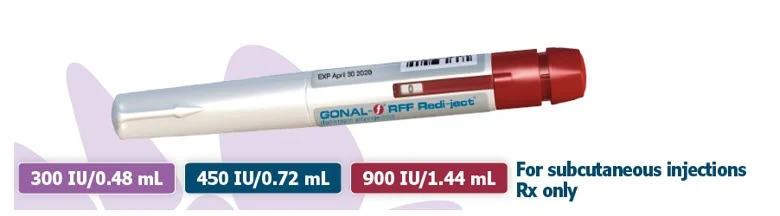
GONAL-f® RFF Redi-ject®
(follitropin alfa) injection
Important Information
- Read this Instructions for Use before you start using GONAL-f RFF Redi-ject and each time you get a prescription refill. There may be new information.
- GONAL-f RFF Redi-ject (follitropin alfa) injection is for use under the skin only (subcutaneous).
- Only use GONAL-f RFF Redi-ject if your healthcare provider trains you on how to use it correctly.
Do not reuse needles.
Do not share your pen or needles with anyone, because doing so can cause an infection.
Do not use the GONAL-f RFF Redi-ject if it has been dropped, or if the pen is cracked or damaged. This can cause an injury.
The pen comes in 3 different IU amounts

- For the 300 IU pen, the maximum dose you can dial is 300 IU.
- For both the 450 IU and 900 IU pens, the maximum dose you can dial is 450 IU.
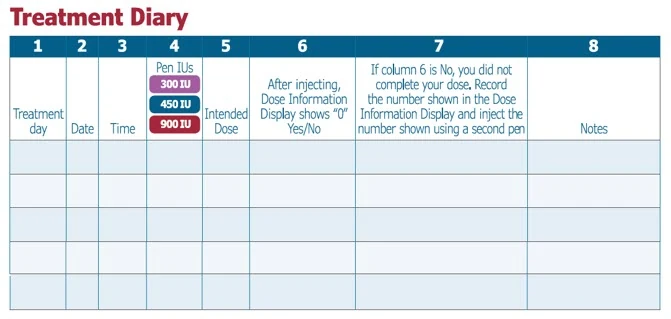
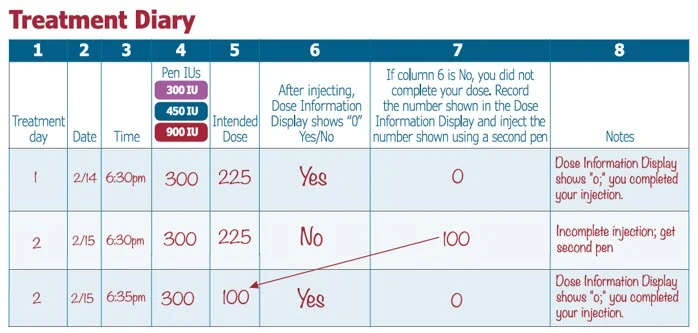
- Use the attached treatment diary to make sure you take the correct dose. Consult your healthcare provider on proper use of your treatment diary.
- You might need to use more than one pen to give today's intended dose. Contact your healthcare provider with any questions.
- The Dose Information Display is used for setting your dose, to confirm a completed dose, and to display the amount remaining to complete your intended dose.
Gather your supplies
- Take the carton out of the refrigerator at least 30 minutes before you inject to let it warm to room temperature.

Do not use a microwave or other heating element to warm up the pen.
- Prepare a clean, flat surface, such as a table or countertop, in a well-lit area.
- Identify a firm, vertical surface, such as the side of your GONAL-f RFF Redi-ject carton or a wall.
- Fill in the first 5 columns of the treatment diary. Refer to the treatment diary for sample entries.
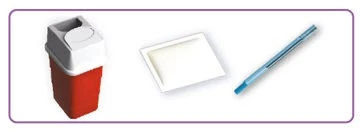
- You will also need a sharps disposal container, alcohol pads, and a writing utensil (not included).
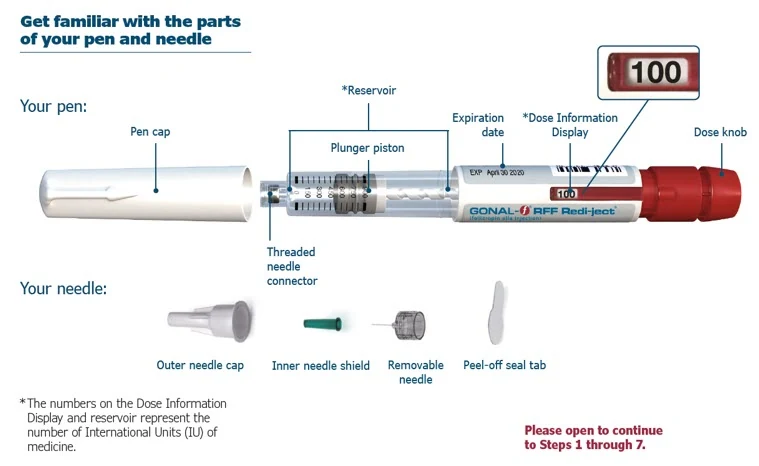
Step 1 Get ready
- Wash your hands with soap and water and dry them well.
Do not shake the pen. If you shake the pen, air bubbles may appear in the medicine.
- Remove the pen and a new needle from the carton using your hands.
Do not use any tools (such as a knife, scissors or box cutters) to take the pen out of the carton because they may damage the pen.
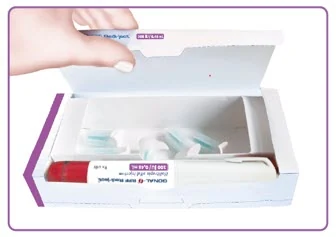
- Check that the name on the pen says GONAL-f RFF Redi-ject.
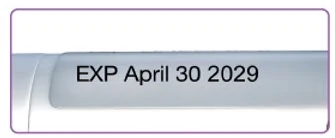
- Check the expiration date on the pen label.
Do not use an expired pen. Get a new pen from your healthcare provider.
Step 2 Choose and prepare your injection site
Note: Your healthcare provider should show you the injection sites to use around your stomach area.
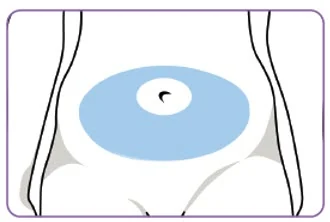
- Select your injection site and wipe the skin with an alcohol pad to clean the site.
Do not blow on or touch the injection site after cleaning.
- Choose a different injection site each time you give your injection to reduce redness, irritation, or other skin problems.
Step 3 Attach your needle
Pull off the pen cap.
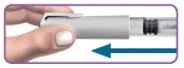
- Make sure the plastic reservoir that holds the medicine is not cracked. Confirm the medicine is clear, colorless, and does not contain particles. If the plastic is cracked or if the liquid is discolored or cloudy, get a new pen from your healthcare provider. This can cause an infection.
- Get a new needle. Only use the single-use needles supplied. Re-using needles can cause infection.
- Check that the needle's peel-off seal tab is not broken. If it is, get a new needle.
Do not use the needle if it is damaged, expired or if the outer needle cap or peel-off seal tab is damaged or loose. This can lead to an infection. Throw it away in a sharps disposal container and get a new needle.
Peel off the needle seal.
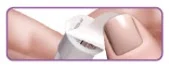
Push the needle on the clear, plastic end of the pen, and twist the needle until you cannot twist it anymore.
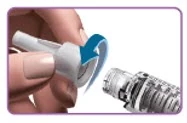
Do not attach the needle too tightly, the needle could be difficult to remove after the injection.
Pull off the outer needle cap and save it for removing the needle after the injection.
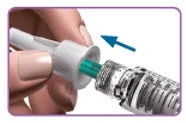
Keeping the needle pointing up, carefully pull off the inner needle shield and throw it away.
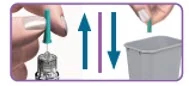
Do not recap the needle with the inner needle shield, or you could get a needle stick injury.
| Important | |
| If | Then |
| Using a new pen | Check for a droplet of liquid at the tip of the needle. |
 |
|
| |
| Re-using a pen | You do not have to check for droplets of liquid at the tip of the needle. Go to Step 4 Dial your dose. |
Step 4 Dial your dose
Note: Call your healthcare provider if you are unsure of today's intended dose.
Do not push or pull the dose knob while you turn it to avoid damaging it.
Turn the dose knob until your intended dose shows in the Dose Information Display.
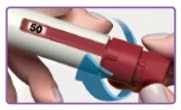
Note: You can turn the dose knob backward if you turn it past your intended dose.
Step 5 Inject your dose
Important
- Make sure the Dose Information Display matches the intended dose recorded in Column 5 in your treatment diary.
Example: If your intended dose is 150 IU, confirm that the Dose Information Display reads "150".
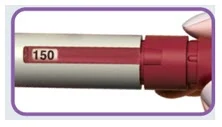
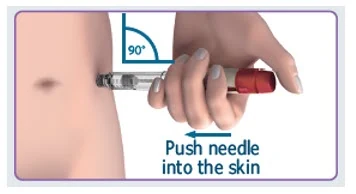
- Hold the pen at a 90° angle to the injection site, and push the needle into your skin.
You might bend the needle if you do not insert the needle straight in at a 90° angle.
- Place your thumb in the middle of the dose knob. Use your thumb to slowly press the dose knob straight down as far as it will go.
Do not release the dose knob until you remove the needle from your skin. Hold the dose knob down for a slow count of 5 before you remove the needle from your skin. Then release the dose knob after removal of the needle from your skin.
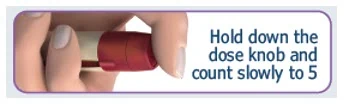
- Remove the needle from your skin, release the dose knob, and put the pen on the table.
- After injecting, fill in "Yes" or "No" in Column 6 of the treatment diary, to record if the Dose Information Display shows "0".
If the Dose Information Display does not show "0", you did not complete your dose.
- Fill in Column 7 of the treatment diary with the number in the Dose Information Display.
- You will need to use a second pen to inject the number shown in the Dose Information Display to complete your dose.
Step 6 Remove and throw away your needle
You must remove the needle from the pen and throw it away after each injection to avoid risk of infection.
- Lay the outer needle cap on its side on a flat surface.
Hold the pen with the needle attached in one hand, and slip the needle into the outer needle cap without using your other hand.
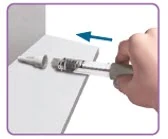
Push the capped needle against a firm, vertical surface, such as a GONAL-f RFF Redi-ject carton or a wall, until you hear a "click".
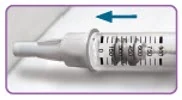
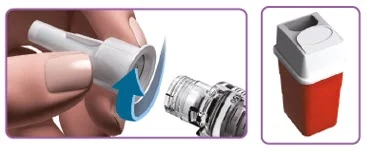
- Twist off the capped needle and throw it away in a FDA-cleared sharps disposal container. See Appendix C for proper disposal information.
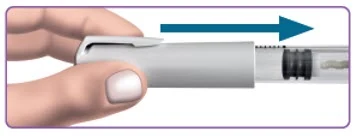
- After removing the needle, recap the pen.
- If the pen is empty after your injection, throw it away in a FDA-cleared sharps disposal container. See Appendix C for proper disposal information.
Step 7 Record your injection
Important
- After injecting, fill in Column 7 of the treatment diary by recording the number you see in the Dose Information Display.
- If the Dose Information Display shows "0", you have completed your dose.
If the Dose Information Display does not show "0", you did not complete your dose. You need to inject the number shown in the Dose Information Display using a second pen.
- Follow the instructions in Appendix A: Completing an incomplete dose.
- The amount you need to inject using the second pen might be less than expected because of the extra medicine (see note below). Always inject the amount you wrote in Column 7 of the treatment diary to complete your dose.
- Refer to the treatment diary for sample entries.
Note: The pen contains extra medicine to ensure that you receive the full amount indicated on the pen (300 IU, 450 IU, or 900 IU).
Appendix A: Completing an incomplete dose
- The number recorded in Column 7 in the treatment diary indicates the number you need to dial with the second pen to complete today's intended dose. To complete the dose with a second pen, repeat Steps 1 through 7.
Appendix B: How to create a droplet of liquid
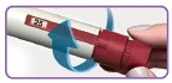
If you do not see a droplet of liquid on the tip of the needle when using a pen for the first time, turn the dose knob until the Dose Information Display reads "25".
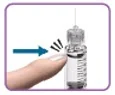
With the needle pointing up, gently tap the reservoir so that any air bubbles rise to the top.
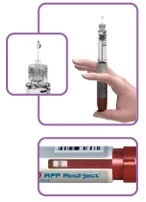
Hold the pen with the needle pointing up. Slowly press the dose knob in all the way. One or more tiny drops of liquid will appear at the tip of the needle. Release the dose knob. Make sure that the Dose Information Display reads "0".
- Go to Step 4 Dial your dose.
- If a droplet of liquid does not appear, contact your healthcare provider.
Appendix C: How to throw away used needles and empty pens
- Put used needles and empty pens in a FDA-cleared sharps disposal container immediately after use.
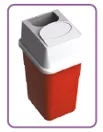
Do not throw away loose needles and pens in your household trash.
If you do not have a FDA-cleared sharps disposal container, you may use a household container that is:
- Made of heavy-duty plastic,
- Can be closed with a tight-fitting, puncture-resistant lid, without sharps being able to come out,
- Upright and stable during use,
- Leak-resistant, and
- Properly labeled to warn of hazardous waste inside the container.
When your sharps disposal container is almost full, you will need to follow your community guidelines for the right way to dispose of your sharps disposal container. There may be state or local laws about how you should throw away used needles and syringes. For more information about safe sharps disposal, and for specific information about sharps disposal in the state that you live in, go to the FDA's website at: http://www.fda.gov/safesharpsdisposal.
- Do not reuse the needles.
- Do not throw away (dispose of) your used sharps disposal container in your household trash unless your community guidelines permit this.
- Do not recycle your used sharps disposal container.
For more information, go to http:/www.fda.gov/safesharpsdisposal.
Appendix D: How to store your pen
- Store all pens with the cap attached and away from light.
- Store new pens in the refrigerator between 36°F and 46°F (2°C and 8°C) until the expiration date, or at room temperature between 68°F and 77°F (20°C and 25°C) for up to 3 months or until the expiration date, whichever comes first. Store pen in the original carton to protect from light.
- Do not freeze the pen.
- Keep the pen out of reach of children.
- If you have medicine left in a pen after injecting, store it in the refrigerator or at room temperature for up to 28 days. After 28 days, you must throw away your pen in a FDA-cleared sharps disposal container. See Appendix C for proper disposal information.
For more information, call 1-866-538-7879.
To view the Instructions for Use video, please visit www.Rediject.com.
EMD Serono, Inc
Boston, MA 02210
US License number: 1773

This Instructions for Use has been approved by the U.S. Food and Drug Administration.
Revised: 03/2025