


Patient information: uses, side effects, how to take - Glatopa
What is the most important information I should know about Glatopa?
- Serious allergic reactions (anaphylactic reactions). Serious allergic reactions that may be life-threatening or lead to death may happen any time after you start using Glatopa. These reactions may happen right after your first dose up to years after starting treatment with Glatopa, even if you never had an allergic reaction before. Many reactions have happened within 1 hour of using Glatopa. Some signs and symptoms may be the same as those of an immediate post-injection reaction. See What are the possible side effects of Glatopa?
- Stop using Glatopa and get emergency help right away if you have:
- widespread rash
- swelling of the face, eyelids, lips, mouth, throat, or tongue
- sudden shortness of breath, difficulty breathing, or wheezing
- uncontrolled shaking (convulsions)
- trouble swallowing or speaking
- fainting, feeling dizzy or faint
What is Glatopa?
Glatopa is a prescription medicine that is used to treat relapsing forms of multiple sclerosis (MS), to include clinically isolated syndrome, relapsing-remitting disease, and active secondary progressive disease, in adults.
It is not known if Glatopa is safe and effective in children under 18 years of age.
Do not take Glatopa:
- if you are allergic to glatiramer acetate or mannitol. Serious allergic reactions including life-threatening or anaphylactic reactions that can lead to death have happened. See the end of this leaflet for a complete list of the ingredients in Glatopa.
Before you use Glatopa, tell your healthcare provider about all of your medical conditions, including if you:
are pregnant or plan to become pregnant. Talk to your healthcare provider who will advise if you should take Glatopa during your pregnancy.
- are breastfeeding or plan to breastfeed. It is not known if glatiramer acetate passes into your breast milk. Talk to your healthcare provider about the best way to feed your baby while using Glatopa.
Tell your healthcare provider about all the medicines you take, including prescription and over-the-counter medicines, vitamins, and herbal supplements.
Glatopa may affect the way other medicines work, and other medicines may affect how Glatopa works.
Know the medicines you take. Keep a list of your medicines with you to show your healthcare provider and pharmacist when you get a new medicine.
How should I use Glatopa?
- For detailed instructions, see the Instructions for Use at the end of this leaflet for complete information on how to use Glatopa.
- Your healthcare provider will tell you how much Glatopa to use and when to use it.
- Glatopa is given by injection under your skin (subcutaneously).
- Use Glatopa exactly as your healthcare provider tells you to use it.
- Since every body type is different, talk with your healthcare provider about the injection areas that are best for you.
- You should receive your first dose of Glatopa with a healthcare provider or nurse present. This might be at your healthcare provider’s office or with a visiting home health nurse who will teach you how to give your Glatopa injections.
Some glatiramer acetate products can be used with an optional compatible autoinjector. Compatible autoinjectors are supplied separately if available, but the availability of compatible autoinjectors may change with time.
- Check with your healthcare provider when you fill or refill your medicine to make sure the autoinjector you have is meant to be used with your glatiramer acetate product. Not all optional autoinjectors are meant to be used with all glatiramer acetate products. If you use the wrong autoinjector, you might not get the correct dose of your medicine. Contact the manufacturer of your glatiramer acetate product to find out if there is an autoinjector that is meant to be used with your glatiramer acetate product.
- Read your Instructions for Use and talk to your healthcare provider about the best way for you to use Glatopa.
What are the possible side effects of Glatopa?
Glatopa may cause serious side effects, including:
Immediate Post-Injection Reactions. Serious side effects may happen right after or within minutes after you inject Glatopa at any time during your course of treatment. Some signs and symptoms may be the same as those of a serious allergic reaction (anaphylaxis). See What is the most important information I should know about Glatopa? Call a healthcare provider right away if you have any of these immediate post-injection reaction symptoms including:
- redness to your cheeks or other parts of the body (flushing)
- chest pain
- fast heartbeat
- anxiety
- breathing problems or tightness in your throat
- swelling, rash, hives, or itching
- If you have symptoms of an immediate post-injection reaction, do not give yourself more injections until a healthcare provider tells you to.
- Chest Pain. You can have chest pain as part of an immediate post-injection reaction or by itself. This type of chest pain usually lasts a few minutes and can begin around 1 month after you start using Glatopa. Call your healthcare provider right away if you have chest pain while using Glatopa.
Damage to your skin. Damage to the fatty tissue just under your skin’s surface (lipoatrophy) and, rarely, death of your skin tissue (necrosis) can happen when you use Glatopa. Damage to the fatty tissue under your skin can cause a “dent” at the injection site that may not go away. You can reduce your chance of developing these problems by:
- following your healthcare provider’s instructions for how to use Glatopa
- choosing a different injection area each time you use Glatopa. See Step 4 in the Instructions for Use, “Choose your injection area”.
- Liver problems. Liver problems, including liver failure, can occur with Glatopa. Call your healthcare provider right away if you have symptoms, such as:
- nausea
- loss of appetite
- tiredness
- dark colored urine and pale stools
- yellowing of your skin or the white part of your eye
- bleeding more easily than normal
- confusion
- sleepiness
The most common side effects of Glatopa are:
skin problems at your injection site, including:
- redness
- pain
- swelling
- itching
- lumps
- rash
- shortness of breath
- flushing (vasodilation)
- chest pain
Tell your healthcare provider if you have any side effect that bothers you or that does not go away.
These are not all the possible side effects of Glatopa. For more information, ask your healthcare provider or pharmacist.
Call your doctor for medical advice about side effects. You may report side effects to FDA at 1-800-FDA-1088.
How should I store Glatopa?
- Store Glatopa in the refrigerator between 36°F to 46°F (2°C to 8°C).
- When you are not able to refrigerate Glatopa, you may store it for up to 1 month at room temperature between 59°F to 86°F (15°C to 30°C).
- Protect Glatopa from light or high temperature.
- Do not freeze Glatopa syringes. If a syringe freezes, throw it away in a sharps disposal container. See Step 13 in the Instructions for Use, “Dispose of your needles and syringes”.
Keep Glatopa and all medicines out of the reach of children.
General information about the safe and effective use of Glatopa.
Medicines are sometimes prescribed for purposes other than those listed in a Medication Guide. Do not use Glatopa for a condition for which it was not prescribed. Do not give Glatopa to other people, even if they have the same symptoms as you have. It may harm them. You can ask your pharmacist or healthcare provider for information about Glatopa that is written for health professionals.
What are the ingredients in Glatopa?
Active ingredient: glatiramer acetate
Inactive ingredients: mannitol
Distributed by
Sandoz Inc., Princeton, NJ 08540
For more information, go to www.glatopa.com or call Sandoz GlatopaCare® at 1-855-452-8672.
For additional medication guide, please go to www.us.sandoz.com or call 1-800-525-8747.
This Medication Guide has been approved by the U.S. Food and Drug Administration Revised: February 2025
INSTRUCTIONS FOR USE
Glatopa®
(gluh-TOH-puh)
(glatiramer acetate injection) for Subcutaneous Use
For subcutaneous injection only.
Do not inject Glatopa in your veins (intravenously).
Do not re-use your Glatopa pre-filled syringes.
Do not share your Glatopa pre-filled syringes with another person. You may give another person an infection or get an infection from them.
You should receive your first dose of Glatopa with a healthcare provider or nurse present. This might be at your healthcare provider’s office or with a visiting home health nurse who will show you how to give your own injections.
Glatopa comes in either a 20 mg Pre-filled Syringe with needle attached or a 40 mg Pre-filled Syringe with needle attached. How often a dose is given depends on the product strength that is prescribed. Your healthcare provider will prescribe the correct dose for you.
If you plan to use your glatiramer acetate product with an autoinjector, ask your healthcare provider or pharmacist to make sure that your autoinjector is meant to be used with your glatiramer acetate product. If you use an autoinjector that is not meant to be used with your glatiramer acetate product, you might not get the correct dose of your medicine.
Instructions for Using Your Glatopa 20 mg Pre-filled Syringe:
- Glatopa 20 mg is injected 1 time each day, in the fatty layer under your skin (subcutaneously).
- Each Glatopa 20 mg pre-filled syringe is for single use (1 time use) only.
- The Glatopa 20 mg dose is packaged in boxes of 30 pre-filled syringes with needles attached. Glatopa 20 mg pre-filled syringes have white plungers.
Instructions for Using Your Glatopa 40 mg Pre-filled Syringe:
- Glatopa 40 mg is injected 3 times each week, in the fatty layer under your skin (subcutaneously).
- Glatopa 40 mg should be given on the same 3 days each week, if possible, for example, Monday, Wednesday, and Friday. Give your Glatopa injections at least 48 hours (2 days) apart.
- Each Glatopa 40 mg pre-filled syringe is for single use (1 time use) only.
- The Glatopa 40 mg dose is packaged in boxes of 12 pre-filled syringes with needles attached. Glatopa 40 mg pre-filled syringes have blue plungers.
How do I inject Glatopa?
Step 1: Gather the supplies you will need to inject Glatopa. See Figure A.
- 1 blister pack with a Glatopa Pre-filled Syringe with needle attached
- Alcohol wipe (not supplied)
- Dry cotton ball (not supplied)
- A place to record your injections, like a notebook (not supplied)
- Sharps disposal container (not supplied). See Step 13 below, “Dispose of your needles and syringes”.
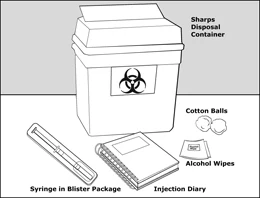
Figure A
Step 2: Remove only 1 blister pack from the Glatopa pre-filled syringe carton. See Figure B.
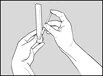
Figure B
- Place the supplies you will need on a clean, flat surface in a well-lit area.
- After you remove 1 blister pack from the carton, keep all unused syringes in the carton and store them in the refrigerator.
- Let the blister pack, with the syringe inside, warm to room temperature for about 20 minutes.
- Wash your hands. Be careful not to touch your face or hair after washing your hands.
Step 3: Look closely at your Glatopa pre-filled syringe.
- There may be small air bubbles in the syringe. Do not try to push the air bubble from the syringe before giving your injection so you do not lose any medicine.
- Check the liquid medicine in the syringe before you give your injection. The liquid in the syringe should look clear, and colorless, and may look slightly yellow. If the liquid is cloudy or contains any particles, do not use the syringe and throw it away in a sharps disposal container. See Step 13 below, “Dispose of your needles and syringes.”
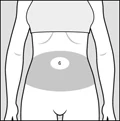
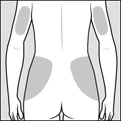
Step 4: Choose your injection area. See Figure C.
See the injection areas you should use on your body. Talk with your healthcare provider about the injection areas that are best for you.
The possible injection areas on your body include (See Figure C):
- your stomach area (abdomen) around the belly button
- the back of your upper arms
- upper hips (below your waist)
- your thighs (above your knees)
Abdomen
Avoid about 2 inches around the belly button
Back of Hips and Arms
Fleshy areas of the upper hips, always below the waist
Fleshy areas of the upper back portion of the arms
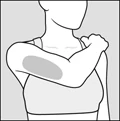
Arms
Fleshy areas of the upper back portion
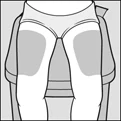
Thighs
About 2 inches above the knee and 2 inches below the groin
Figure C
- For each Glatopa dose, choose a different injection area from 1 of the areas shown above. See Figure C.
- Do not stick the needle in the same place (site) more than 1 time each week. Each injection area contains multiple injection sites for you to choose from. Avoid injecting in the same site over and over again.
- Keep a record of the sites where you give your injection each day so you will remember where you already injected.
Step 5: Prepare to give your injection.
- There are some injection areas on your body that are hard to reach (like the back of your arm). You may need help from someone who has been instructed on how to give your injection if you cannot reach certain injection areas.
- Do not inject in sites where the skin has scarring or “dents”. Using scarred or dented skin for your injections may make your skin worse.
Step 6: Clean your injection site.
- Clean the injection site using the alcohol wipe and allow your skin to air dry. See Figure D.
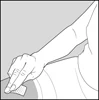
Figure D
Step 7: Pick up the syringe with 1 hand and hold it like a pencil. Remove the needle cover with your other hand and set it aside. See Figure E.
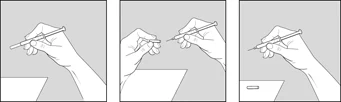
Figure E
Step 8: Pinch about a 2 inch fold of skin between your thumb and index finger. See Figure F.
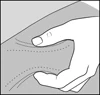
Figure F
Step 9: Giving your injection.
- Rest the heel of your hand holding the syringe against your skin at the injection site. Insert the needle at a 90 degree angle straight into your skin. See Figure G.
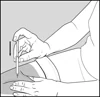
Figure G
- When the needle is all the way into your skin, release the fold of skin. See Figure H.
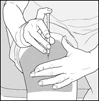
Figure H
Step 10: Give your Glatopa injection.
To inject the medicine, hold the syringe steady and slowly push down the plunger. See Figure I.
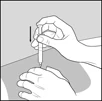
Figure I
Step 11: Remove the needle.
After you have injected all of the medicine, pull the needle straight out. See Figure J.
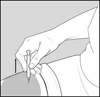
Figure J
Step 12: Use a clean, dry cotton ball to gently press on the injection site for a few seconds. Do not rub the injection site or re-use the needle or syringe. See Figure K.
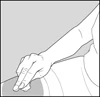
Figure K
Step 13: Dispose of your needles and syringes.
- Put your used needles and syringes in a FDA-cleared sharps disposal container right away after use. Do not throw away (dispose of) loose needles and syringes in your household trash.
If you do not have a FDA-cleared sharps disposal container, you may use a household container that is:
- made of a heavy-duty plastic,
- can be closed with a tight-fitting, puncture-resistant lid, without sharps being able to come out,
- upright and stable during use,
- leak-resistant, and
- properly labeled to warn of hazardous waste inside the container.
- When your sharps disposal container is almost full, you will need to follow your community guidelines for the right way to dispose of your sharps disposal container. There may be state or local laws about how you should throw away used needles and syringes. For more information about safe sharps disposal, and for specific information about sharps disposal in the state that you live in, go to the FDA’s website at: http://www.fda.gov/safesharpsdisposal.
- Do not dispose of your used sharps disposal container in your household trash unless your community guidelines permit this. Do not recycle your used sharps disposal container.
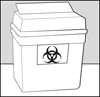
Figure L
This Instructions for Use has been approved by the U.S. Food and Drug Administration.
Distributed by
Sandoz Inc., Princeton, NJ 08540
Rev. December 2023