


Patient information: uses, side effects, how to take - Fentanyl Topical Extended-Release
Fentanyl transdermal system is :
- A strong prescription pain medicine that contains an opioid (narcotic) that is used to manage severe and persistent pain that requires an extended treatment period with a daily opioid pain medicine, in people who are already regularly using opioid pain medicine, when other pain medicines do not treat your pain well enough or you cannot tolerate them.
- A long-acting (extended-release) opioid pain medicine that can put you at risk for overdose and death. Even if you take your dose correctly as prescribed you are at risk for opioid addiction, abuse, and misuse that can lead to death.
- Not to be used on an “as needed” basis.
Important information about fentanyl transdermal system:
- Get emergency help or call 911 right away if you use too much fentanyl transdermal system (overdose). When you first start taking fentanyl transdermal system, when your dose is changed, or if you take too much (overdose), serious or life-threatening breathing problems that can lead to death may occur. Ask your healthcare provider about medicines like naloxone or nalmefene that can be used in an emergency to reverse an opioid overdose.
- Taking fentanyl transdermal system with other opioid medicines, benzodiazepines, gabapentinoids (gabapentin or pregabalin), alcohol, or other central nervous system depressants (including street drugs) may cause severe drowsiness, decreased awareness, breathing difficulties, with slow or shallow breathing, coma, and death.
- Never give anyone else your fentanyl transdermal system. They could die from taking it. Selling or giving away fentanyl transdermal system is against the law.
- Store fentanyl transdermal system, securely, out of sight and reach of children, and in a location not accessible by others, including visitors to the home.
- If the patch accidentally sticks to a family member while in close contact, take the patch off, wash the area with water, and get emergency help right away because an accidental exposure to fentanyl transdermal system can lead to death or other serious medical problems.
- Dispose of expired, unwanted, or unused fentanyl transdermal system, by folding the patch so that the adhesive side of the patch adheres to itself, and immediately flushing down the toilet (if a drug take-back option is not readily available) [see Instructions for Use]. Visit www.fda.gov/drugdisposal for additional information on disposal of unused medicines.
Do not use fentanyl transdermal system if you have:
- severe asthma, trouble breathing, or other lung problems.
- a bowel blockage or have narrowing of the stomach or intestines.
Before applying fentanyl transdermal system, tell your healthcare provider if you have a history of:
- head injury, seizures
- problems urinating
- liver, kidney, thyroid problems
- pancreas or gallbladder problems
- abuse of street or prescription drugs, alcohol addiction, opioid overdose, or mental health problems.
Tell your healthcare provider if you:
- noticing your pain getting worse. If your pain gets worse after you use fentanyl transdermal system, do not use more of fentanyl transdermal system without first talking to your healthcare provider. Talk to your healthcare provider if the pain that you have increases, if you feel more sensitive to pain, or if you have new pain after using fentanyl transdermal system.
- have a fever
- Are pregnant or planning to become pregnant. Use of fentanyl transdermal system for an extended period of time during pregnancy can cause withdrawal symptoms in your newborn baby that could be life-threatening if not recognized and treated.
- are breastfeeding. Not recommended during treatment with fentanyl transdermal system. It may harm your baby.
- are living in a household where there are small children or someone who has abused street or prescription drugs.
- are taking prescription or over-the-counter medicines, vitamins, or herbal supplements. Taking fentanyl with certain other medicines can cause serious side effects that could lead to death.
When using fentanyl transdermal system :
- Do not change your dose. Apply fentanyl transdermal system exactly as prescribed by your healthcare provider. Use the lowest dose possible for the shortest time needed.
- See the detailed Instructions for Use for information about how to apply and dispose of the fentanyl transdermal system patch. Visit www.fda.gov/drugdisposal for additional information on disposal of unused medicines.
- Do not apply more than 1 patch at the same time unless your healthcare provider tells you to.
- You should wear the fentanyl transdermal patch continuously for 3 days, unless advised otherwise by your healthcare provider.
- Do not cut, break, chew, crush, dissolve, snort, or inject fentanyl transdermal system because this may cause you to overdose and die.
- Call your healthcare provider if the dose you are using does not control your pain.
- Do not stop using fentanyl transdermal system without talking to your healthcare provider.
While using fentanyl transdermal system DO NOT:
- Take hot baths or sunbathe, use hot tubs, saunas, heating pads, electric blankets, heated waterbeds, or tanning lamps, or engage in exercise that increases your body temperature. These can cause an overdose that can lead to death.
- Drive or operate heavy machinery, until you know how fentanyl transdermal system affects you. Fentanyl transdermal system can make you sleepy, dizzy, or lightheaded.
- Drink alcohol or use prescription or over-the-counter medicines that contain alcohol. Using products containing alcohol during treatment with fentanyl transdermal system may cause you to overdose and die.
The possible side effects of fentanyl transdermal system are:
- constipation, nausea, sleepiness, vomiting, tiredness, headache, dizziness, abdominal pain, itching, redness, or rash where the patch is applied. Call your healthcare provider if you have any of these symptoms and they are severe.
Get emergency medical help or call 911 right away if you have:
- trouble breathing, shortness of breath, fast heartbeat, chest pain, swelling of your face, tongue or throat, extreme drowsiness, light-headedness when changing positions, feeling faint, agitation, high body temperature, trouble walking, stiff muscles, or mental changes such as confusion.
These are not all the possible side effects of fentanyl transdermal system. Call your healthcare provider for medical advice about side effects. You may report side effects to FDA at 1-800-FDA-1088. For more information go to dailymed.nlm.nih.gov.
Manufactured by:
Aveva Drug Delivery Systems, Inc.,
Miramar, FL 33025
Manufactured for:
Ingenus Pharmaceuticals, LLC
Orlando, FL 32811-7193
medinfo@ingenus.com or call 1-877-748-1970, 9 A.M. to 5 P.M., Eastern Time, Monday through Friday.
This Medication Guide has been approved by the U.S. Food and Drug Administration.
Revised: October 2025
Instructions for Use
Fentanyl Transdermal System, CII
(fen' ta nil)
Rx only
Be sure that you read, understand, and follow these Instructions for Use before you apply fentanyl transdermal system (patch). Talk to your healthcare provider or pharmacist if you have any questions.
Important information about the fentanyl transdermal system (patch) appearance:
- Fentanyl transdermal system is a rectangular unit with round corners.
Fentanyl transdermal system comes in 8 different dosage strengths and sizes:
- 12 mcg/hour
- 25 mcg/hour
- 37.5 mcg/hour
- 50 mcg/hour
- 62.5 mcg/hour
- 75 mcg/hour
- 87.5 mcg/hour
- 100 mcg/hour
- The product name, “Fentanyl” and dosage strength are printed in green on overall clear backing material.
Parts of Fentanyl Transdermal System Patch:
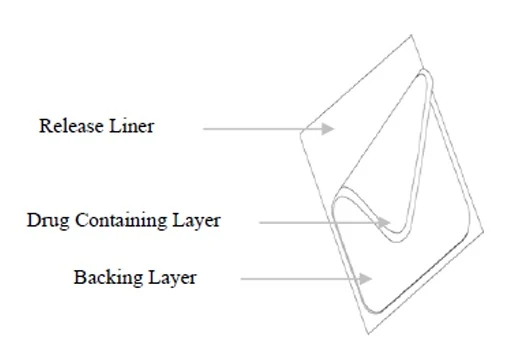
Before applying Fentanyl Transdermal System
- Each fentanyl transdermal system patch is sealed in its own protective blister. Do not remove a fentanyl transdermal system patch from the blister until you are ready to use it.
- Do not use a fentanyl transdermal system patch if the seal is broken or the patch is cut, damaged or changed in any way.
- Fentanyl transdermal system patches are available in 8 different dosage strengths and patch sizes. Make sure you have the right dose patch or patches that have been prescribed for you.
Applying a Fentanyl Transdermal System Patch
1. Skin areas where the fentanyl transdermal system patch may be applied :
For adults:
- Put the patch on the chest, back, flank (sides of the waist), or upper arm in a place where there is no hair (see Figures A to D).

For children (and adults with mental impairment):
- Put the patch on the upper back (see Figure B) . This will lower the chances that the child will remove the patch and put it in their mouth.
For adults and children
- Do not put a fentanyl transdermal system patch on skin that is very oily, burned, broken out, cut, irritated, or damaged in any way.
- Avoid sensitive areas or those that move around a lot. If there is hair, do not shave (shaving irritates the skin). Instead, clip hair as close to the skin as possible (see Figure E).
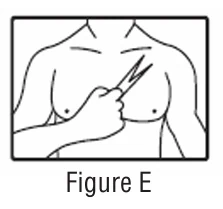
- Talk to your healthcare provider if you have questions about skin application sites.
2. Prepare to apply a fentanyl transdermal system patch:
- Choose the time of day that is best for you to apply the fentanyl transdermal system. Change it at about the same time of day (3 days or 72 hours after you apply the patch) or as directed by your healthcare provider.
- Do not wear more than one fentanyl transdermal system patch at a time unless your healthcare provider tells you to do so. Before applying a new fentanyl transdermal system patch, remove the patch you have been wearing.
- Clean the skin area with clear water only. Pat skin completely dry. Do not use anything on the skin such as soaps, lotions, oils, or alcohol before the patch is applied.
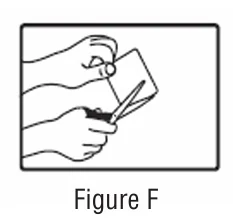
- 3. Open the blister: Fold and tear at slit, or cut at slit taking care not to cut the patch. Remove the fentanyl transdermal system patch. Each fentanyl transdermal system patch is sealed in its own protective blister. Do not remove the fentanyl transdermal system patch from the blister until you are ready to use it (see Figure F).
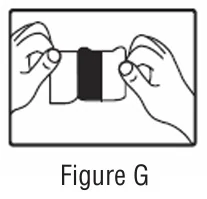
- 4. Peel: Peel off both parts of the release liner from the patch. Each fentanyl transdermal system patch has a clear plastic release liner that can be peeled off in two pieces. This covers the sticky side of the patch. Carefully peel this release liner off and throw the pieces away. Touch the sticky side of the fentanyl transdermal system patch as little as possible (see Figure G) .
- 5. Press: Press the patch onto the chosen skin site with the palm of your hand and hold there for at least 30 seconds (see Figure H) . Make sure it sticks well, especially at the edges.
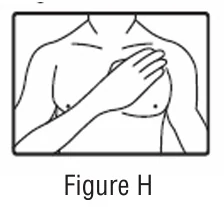
- Fentanyl transdermal system may not stick to all people. You need to check the patch often to make sure that it is sticking well to the skin.
- If the patch falls off right away after applying, throw it away and put a new one on at a different skin site. See the section below called “Disposing of a fentanyl transdermal system patch”.
If you have a problem with the patch not sticking
- Apply first aid tape only to the edges of the patch.
- If you continue to have problems with the patch not sticking, you may cover the patch with a transparent adhesive film dressing such as Bioclusive™ or Tegaderm™. These are special see-through adhesive dressings. Never cover a fentanyl transdermal system patch with any other bandage or tape. Remove the backing from the Bioclusive™ or Tegaderm™ dressing and place it carefully over the fentanyl transdermal system patch, smoothing it over the patch and your skin.
- If your patch falls off before 3 days (72 hours) of use, dispose of (throw away) properly. See the section below “Disposing of a Fentanyl Transdermal System Patch”. Apply a new fentanyl transdermal system patch on at a different skin site. Be sure to let your healthcare provider know that this has happened, and do not replace the new patch until 3 days (72 hours) after you put it on (or as directed by your healthcare provider).
- 6. Wash your hands when you have finished applying a fentanyl transdermal system patch.
- 7. Remove a fentanyl transdermal system patch after wearing it for 3 days (72 hours). Dispose of the used patch right away. See the section below “Disposing of a Fentanyl Transdermal System Patch”. Choose a different skin site to apply a new fentanyl transdermal system patch. Repeat Steps 2 through 6 above when applying a new fentanyl transdermal system patch.
Do not apply the new patch to the same place as the last one.
Water and Fentanyl Transdermal System
- You can bathe, swim or shower while you are wearing a fentanyl transdermal system patch. If the patch falls off before 3 days (72 hours) after application, dispose of properly. See the section below “Disposing of a Fentanyl Transdermal System Patch”. Apply a new fentanyl transdermal system patch on at a different skin site. Be sure to let your healthcare provider know that this has happened, and do not replace the new patch until 3 days (72 hours) after you put it on (or as directed by your healthcare provider).
Disposing of a Fentanyl Transdermal System Patch
- Fold the used fentanyl transdermal system patch in half so that the sticky side sticks to itself (see Figure I) . Flush the used fentanyl transdermal system down the toilet right away (see Figure J) . A used fentanyl transdermal system patch can be very dangerous for or lead to death in babies, children, pets, and adults who have not been prescribed fentanyl transdermal system.
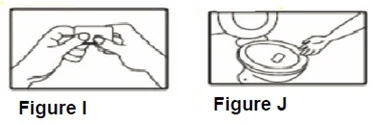
- Throw away any fentanyl transdermal system patches that are left over from your prescription as soon as they are no longer needed. Remove the leftover patches from their protective blister and remove the release liner. Fold the patches in half with the sticky sides together, and flush the patches down the toilet. Do not flush the blister or the release liner down the toilet. These items can be thrown away in a trash can.
This Instructions for Use has been approved by the U.S. Food and Drug Administration.
All registered trademarks in this document are the property of their respective owners.
Manufactured by:
Aveva Drug Delivery Systems, Inc.
Miramar, FL 33025
Manufactured for:
Ingenus Pharmaceuticals, LLC
Orlando, FL 32811-7193
Revised: February 2024