


Patient information: uses, side effects, how to take - Enbrel
What is the most important information I should know about Enbrel?
Enbrel may cause serious side effects, including:
- 1. Risk of Infection
- 2. Risk of Cancer
1. Risk of infection
Enbrel can lower the ability of your immune system to fight infections. Some people have serious infections while taking Enbrel. These infections include tuberculosis (TB), and infections caused by viruses, fungi, or bacteria that spread throughout their body. Some people have died from these infections.
- Your healthcare provider should test you for TB before starting Enbrel.
- Your healthcare provider should monitor you closely for symptoms of TB during treatment with Enbrel even if you tested negative for TB.
- Your healthcare provider should check you for symptoms of any type of infection before, during, and after your treatment with Enbrel.
You should not start taking Enbrel if you have any kind of infection unless your healthcare provider says it is okay.
2. Risk of cancer
There have been cases of unusual cancers, some resulting in death, in children and teenagers who started using TNF-blocking agents at less than 18 years of age.
- For children, teenagers, and adults taking TNF-blocker medicines, including Enbrel, the chances of getting lymphoma or other cancers may increase.
- People with rheumatoid arthritis, especially those with very active disease, may be more likely to get lymphoma.
Before starting Enbrel, be sure to talk to your healthcare provider:
Enbrel may not be right for you. Before starting Enbrel, tell your healthcare provider about all of your medical conditions, including:
Infections. Tell your healthcare provider if you:
- have an infection. See "What is the most important information I should know about Enbrel?"
- are being treated for an infection.
- think you have an infection.
- have symptoms of an infection such as fever, sweats or chills, cough or flu-like symptoms, shortness of breath, blood in your phlegm, weight loss, muscle aches, warm, red or painful areas on your skin, sores on your body, diarrhea or stomach pain, burning when you urinate or urinating more often than normal, and feel very tired.
- have any open cuts on your body.
- get a lot of infections or have infections that keep coming back.
- have diabetes, HIV, or a weak immune system. People with these conditions have a higher chance for infections.
- have TB, or have been in close contact with someone with TB.
- were born in, lived in, or traveled to countries where there is a risk for getting TB. Ask your healthcare provider if you are not sure.
- live, have lived in, or traveled to certain parts of the country (such as the Ohio and Mississippi River valleys, or the Southwest) where there is a greater risk for getting certain kinds of fungal infections (histoplasmosis, coccidioidomycosis, blastomycosis). These infections may happen or become more severe if you use Enbrel. Ask your healthcare provider if you do not know if you live or have lived in an area where these infections are common.
- have or have had hepatitis B.
Also, before starting Enbrel, tell your healthcare provider:
About all the medicines you take including prescription and over-the-counter medicines, vitamins and herbal supplements including:
- Orencia (abatacept) or Kineret (anakinra). You have a higher chance for serious infections when taking Enbrel with Orencia or Kineret.
- Cyclophosphamide (Cytoxan). You may have a higher chance for getting certain cancers when taking Enbrel with cyclophosphamide.
- Anti-diabetic medicines. If you have diabetes and are taking medicine to control your diabetes, your healthcare provider may decide you need less anti-diabetic medicine while taking Enbrel.
Keep a list of all your medicines with you to show your healthcare provider and pharmacist each time you get a new medicine. Ask your healthcare provider if you are not sure if your medicine is one listed above.
Other important medical information you should tell your healthcare provider before starting Enbrel, includes if you:
- have or had a nervous system problem such as multiple sclerosis or Guillain-Barré syndrome.
- have or had heart failure.
- are scheduled to have surgery.
have recently received or are scheduled to receive a vaccine.
- All vaccines should be brought up-to-date before starting Enbrel.
- People taking Enbrel should not receive live vaccines.
- Ask your healthcare provider if you are not sure if you received a live vaccine.
- have been around someone with varicella zoster (chicken pox).
are pregnant or plan to become pregnant. It is not known if Enbrel will harm your unborn baby. If you took Enbrel during pregnancy, talk to your healthcare provider prior to administration of live vaccines to your infant.
are breastfeeding or plan to breastfeed. Enbrel can pass into breast milk. Talk to your healthcare provider about the best way to feed your baby while taking Enbrel.
See the section "What are the possible side effects of Enbrel?" below for more information.
What is Enbrel?
Enbrel is a prescription medicine called a Tumor Necrosis Factor (TNF) blocker.
Enbrel is used to treat:
- moderately to severely active rheumatoid arthritis (RA). Enbrel can be used alone or with a medicine called methotrexate.
- moderately to severely active polyarticular juvenile idiopathic arthritis (pJIA) in children 2 years of age or older.
- psoriatic arthritis (PsA) in adults. Enbrel can be used alone or with methotrexate.
- active juvenile psoriatic arthritis (JPsA) in children 2 years of age or older.
- ankylosing spondylitis (AS).
- chronic moderate to severe plaque psoriasis (PsO) in children 4 years of age or older and adults who may benefit from taking injections or pills (systemic therapy) or phototherapy (ultraviolet light).
You may continue to use other medicines that help treat your condition while taking Enbrel, such as nonsteroidal anti-inflammatory drugs (NSAIDs) and prescription steroids, as recommended by your healthcare provider.
Enbrel can help reduce joint damage and the signs and symptoms of the above-mentioned diseases. People with these diseases have too much of a protein called tumor necrosis factor (TNF), which is made by your immune system.
Enbrel can reduce the effect of TNF in the body and block the damage that too much TNF can cause, but it can also lower the ability of your immune system to fight infections. See "What is the most important information I should know about Enbrel?" and "What are the possible side effects of Enbrel?"
Who should not use Enbrel?
Do not use Enbrel if you:
- have an infection that has spread through your body (sepsis).
How should I use Enbrel?
- Enbrel is given as an injection under the skin (subcutaneous or SC).
- If your healthcare provider decides that you or a caregiver can give the injections of Enbrel at home, you or your caregiver should receive training on the right way to prepare and inject Enbrel. Do not try to inject Enbrel until you have been shown the right way by your healthcare provider or nurse.
Enbrel is available in the forms listed below. Your healthcare provider will prescribe the type that is best for you.
- Single-dose Prefilled Syringe
- Single-dose Prefilled SureClick Autoinjector
- Single-dose Vial
- Multiple-dose Vial
- Enbrel Mini single-dose cartridge for use with the AutoTouch reusable autoinjector
- See the detailed Instructions for Use with this Medication Guide for instructions about the right way to store, prepare, and give your Enbrel injections at home.
- Your healthcare provider will tell you how often you should use Enbrel. Do not miss any doses of Enbrel. If you forget to use Enbrel, inject your dose as soon as you remember. Then, take your next dose at your regular(ly) scheduled time. In case you are not sure when to inject Enbrel, call your healthcare provider or pharmacist. Do not use Enbrel more often than as directed by your healthcare provider.
- Your child's dose of Enbrel depends on his or her weight. Your child's healthcare provider will tell you which form of Enbrel to use and how much to give your child.
What are the possible side effects of Enbrel?
Enbrel can cause serious side effects, including:
- See "What is the most important information I should know about Enbrel?"
- Infections. Enbrel can make you more likely to get infections or make any infection that you have worse. Call your healthcare provider right away if you have any symptoms of an infection. See "Before starting Enbrel, be sure to talk to your healthcare provider" for a list of symptoms of infection.
- Previous Hepatitis B infection. If you have been previously infected with the hepatitis B virus (a virus that affects the liver), the virus can become active while you use Enbrel. Your healthcare provider may do a blood test before you start treatment with Enbrel and while you use Enbrel.
- Nervous system problems. Rarely, people who use TNF-blocker medicines have developed nervous system problems such as multiple sclerosis, seizures, or inflammation of the nerves of the eyes. Tell your healthcare provider right away if you get any of these symptoms: numbness or tingling in any part of your body, vision changes, weakness in your arms and legs, and dizziness.
- Blood problems. Low blood counts have been seen with other TNF-blocker medicines. Your body may not make enough of the blood cells that help fight infections or help stop bleeding. Symptoms include fever, bruising or bleeding very easily, or looking pale.
- New heart failure or worsening of heart failure you already have. New or worse heart failure can happen in people who use TNF-blocker medicines like Enbrel. If you have heart failure your condition should be watched closely while you take Enbrel. Call your healthcare provider right away if you get new or worsening symptoms of heart failure while taking Enbrel, such as shortness of breath or swelling of your lower legs or feet.
- Psoriasis. Some people using Enbrel developed new psoriasis or worsening of psoriasis they already had. Tell your healthcare provider if you develop red scaly patches or raised bumps that may be filled with pus. Your healthcare provider may decide to stop your treatment with Enbrel.
- Allergic reactions. Allergic reactions can happen to people who use TNF-blocker medicines. Call your healthcare provider right away if you have any symptoms of an allergic reaction. Symptoms of an allergic reaction include a severe rash, a swollen face, or trouble breathing.
Autoimmune reactions, including:
- Lupus-like syndrome. Symptoms include a rash on your face and arms that gets worse in the sun. Tell your healthcare provider if you have this symptom. Symptoms may go away when you stop using Enbrel.
- Autoimmune hepatitis. Liver problems can happen in people who use TNF-blocker medicines, including Enbrel. These problems can lead to liver failure and death. Call your healthcare provider right away if you have any of these symptoms: feel very tired, skin or eyes look yellow, poor appetite or vomiting, pain on the right side of your stomach (abdomen).
Common side effects of Enbrel include:
- Injection site reactions such as redness, itching, pain, swelling, bleeding or bruising. These symptoms usually go away within 3 to 5 days. If you have pain, redness, or swelling around the injection site that does not go away or gets worse, call your healthcare provider.
- Upper respiratory infections (sinus infections).
These are not all the possible side effects with Enbrel. Tell your healthcare provider about any side effect that bothers you or does not go away.
Call your doctor for medical advice about side effects. You may report side effects to FDA at 1-800-FDA-1088.
How should I store Enbrel?
- Store Enbrel in the refrigerator between 36°F to 46°F (2°C to 8°C).
- Store Enbrel in the original carton to protect from light or damage.
If needed, you may store your dose tray for the multiple-dose vial at room temperature between 68°F to 77°F (20°C to 25°C) for up to 14 days.
- When the dose tray has reached room temperature, do not put it back in the refrigerator.
- Throw away the dose tray that has been stored at room temperature after 14 days.
- Mixed Enbrel multiple-dose vials should be used right away or kept in the refrigerator between 36°F to 46°F (2°C to 8°C) for up to 14 days.
If needed, you may store the Enbrel prefilled syringe, SureClick autoinjector, single-dose vial, or Enbrel Mini cartridge at room temperature between 68°F to 77°F (20°C to 25°C) for up to 30 days.
- When Enbrel has reached room temperature, do not put it back in the refrigerator.
- Throw away Enbrel that has been stored at room temperature after 30 days.
- Do not store Enbrel in extreme heat or cold such as in your vehicle's glove box or trunk.
- Do not shake.
- Do not freeze.
- Keep Enbrel and all medicines out of the reach of children.
General information about the safe and effective use of Enbrel.
Medicines are sometimes prescribed for purposes other than those listed in a Medication Guide. Do not use Enbrel for a condition for which it was not prescribed. Do not give Enbrel to other people, even if they have the same symptoms that you have. It may harm them.
This Medication Guide summarizes the most important information about Enbrel. If you would like more information, talk with your healthcare provider. You can ask your healthcare provider or pharmacist for information about Enbrel that is written for health professionals.
What are the ingredients in Enbrel?
Single-dose Prefilled Syringe, Single-dose Prefilled SureClick Autoinjector, Single-dose Vial and Enbrel Mini single-dose cartridge:
Active Ingredient: etanercept
Inactive Ingredients: L-arginine hydrochloride, sodium chloride, and sucrose
Multiple-dose Vial:
Active Ingredient: etanercept
Inactive Ingredients: mannitol, sucrose, tromethamine
AMGEN
Manufactured by: Immunex Corporation, Thousand Oaks, CA 91320-1799, U.S. License Number 1132
Immunex Corporation. All rights reserved. 1XXXXXX – v25
For more information, call 1 888 4ENBREL (1 888 436 2735) or www.enbrel.com.
 This printed material is recyclable
INSTRUCTIONS FOR USE
ENBREL® [en-brel]
(etanercept)
injection, for subcutaneous use
50 mg/mL
single-dose prefilled SureClick® autoinjector
This Instructions for Use contains information on how to inject ENBREL with a SureClick autoinjector.
If your healthcare provider decides that you or a caregiver may be able to give your injections of ENBREL at home, you should receive training on the right way to prepare and inject ENBREL. Do not try to inject yourself until you have been shown the right way to give the injections by your healthcare provider or nurse.
The medicine in the ENBREL autoinjector is for injection under the skin (subcutaneous injection). See the ENBREL Medication Guide for information about ENBREL.
Getting to know the prefilled autoinjector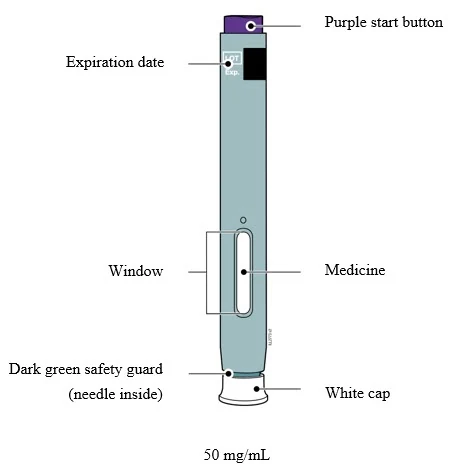 |
Important Information You Need to Know Before Injecting ENBREL
- It is important that you do not try to give the injection until you have fully read and understood this Instructions for Use.
- Check the autoinjector label and prescription to make sure you have the correct medicine and dose.
- Do not use the autoinjector if the carton is damaged or the seal is broken.
- Do not use the autoinjector after the expiration date on the label.
- Do not shake the autoinjector.
- Do not remove the white cap from the autoinjector until you are ready to inject.
- Do not use the autoinjector if it has been frozen.
- Do not use the autoinjector if it has been dropped on a hard surface. Part of the autoinjector may be broken even if you cannot see the break. Use a new autoinjector, and call 1-888-4ENBREL (1-888-436-2735).
- Children must weigh at least 138 pounds to use the ENBREL SureClick autoinjector. Children who weigh less than 138 pounds should use a different form of ENBREL.
- The autoinjector is not made with natural rubber latex.
Frequently asked questions:
For additional information and answers to frequently asked questions, visit www.enbrel.com.
Where to get help:
If you want more information or help using ENBREL:
- Contact your healthcare provider,
- Visit www.enbrel.com, or
- Call 1-888-4ENBREL (1-888-436-2735).
Storing and Preparing to Inject ENBREL
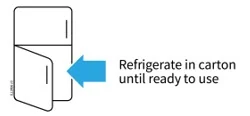 |
Refrigerate the autoinjector carton until you are ready to use it.
- Keep the autoinjector in the refrigerator between 36°F to 46°F (2°C to 8°C).
- Keep the autoinjector in the original carton to protect it from light or physical damage.
- Do not freeze the autoinjector.
- Do not store the autoinjector in extreme heat or cold. For example, avoid storing in your vehicle's glove box or trunk.
| Important: Keep the autoinjector and all medicines out of the sight and reach of children. |
WAIT 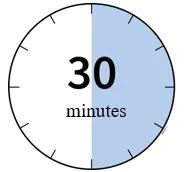 |
Wait 30 minutes for the autoinjector to reach room temperature.
- Remove the autoinjector and put any unused autoinjectors back into the refrigerator.
- Let the autoinjector warm up naturally.
- Do not heat the autoinjector with hot water, a microwave, or direct sunlight.
- Do not shake the autoinjector at any time.
- Using the autoinjector at room temperature makes sure the full dose is delivered and allows for a more comfortable injection.
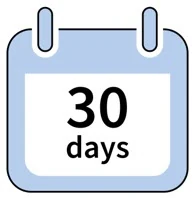 |
You may keep ENBREL at room temperature for up to 30 days, if needed.
- For example, when you are traveling, you may keep ENBREL at room temperature.
- Keep it at room temperature between 68°F to 77°F (20°C to 25°C).
- Do not put it back in the refrigerator.
- Record the date you removed it from the refrigerator and use it within 30 days.
| Important: Place the autoinjector in a sharps disposal container if it has reached room temperature and has not been used within 30 days. |
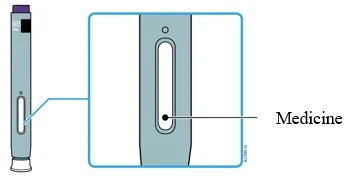 |
Inspect the medicine. It should be clear and colorless to slightly yellow.
- It is okay to see air bubbles or small white particles in the medicine.
- Do not use the autoinjector if the medicine is cloudy, discolored, or contains large lumps, flakes or colored particles.
| Important: If the medicine is cloudy, discolored, or contains large lumps, flakes or colored particles, or if the autoinjector is damaged or expired, call 1-888-4ENBREL (1-888-436-2735). |
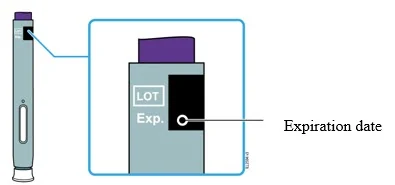 |
Check the expiration date (Exp.) and inspect the autoinjector for damage.
- Do not use the autoinjector if the expiration date has passed.
Do not use the autoinjector if:
- the white cap is missing or loose in carton,
- it has cracks or broken parts, or
- it has been dropped on a hard surface.
Getting Ready to Inject ENBREL
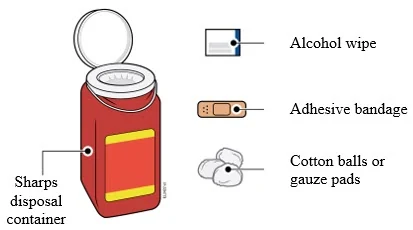 |
Gather and place the following items for your injection on a clean, flat, and well-lit surface:
- ENBREL autoinjector (room temperature),
- Sharps disposal container [see Completing the Injection and Disposal],
- Alcohol wipe,
- Adhesive bandage, and
- Cotton balls or gauze pads.
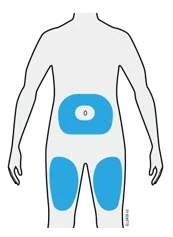 |
Select 1 of these injection sites.
- Select the thigh or stomach (except for 2 inches around the belly button).
- Someone else can inject in your thigh, stomach, or back of the upper arm.
- Change injection site each time, shifting the area of the injection to avoid skin irritation.
| Important: Avoid areas with scars or stretch marks, or where the skin is tender, bruised, red, hard, raised, thick or scaly skin patch, or lesion. |
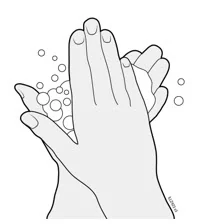 |
- Wash your hands thoroughly with soap and water.
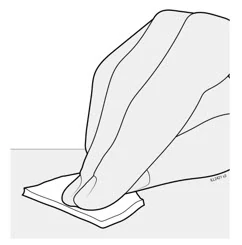 |
Clean the injection site with an alcohol wipe.
- Let the skin dry on its own.
- Do not touch this area again before injecting.
Injecting ENBREL
| Important: Only remove the white cap when you can inject right away (within 5 minutes) because the medicine can dry out. Do not recap. |
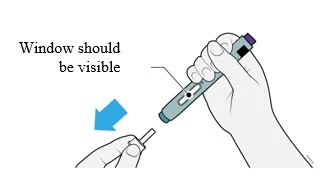 |
Grasp the autoinjector so you can see the window. Pull the white cap straight off. You may need to pull hard.
- Do not twist, bend, or wiggle the white cap to pull it off.
- Never put the white cap back on. It may damage the needle.
- Do not put your finger inside the dark green safety guard.
- It is normal to see a drop of medicine come out of the needle or dark green safety guard.
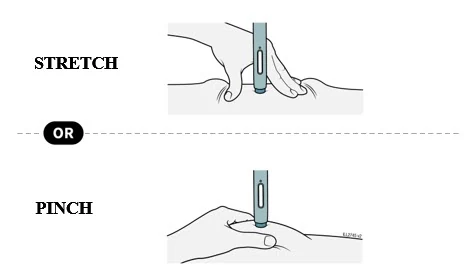 |
Stretch or pinch the skin to create a firm surface at the injection site until the injection is finished. Place the dark green safety guard straight against the skin.
- Make sure you can see the window.
- Make sure the autoinjector is positioned straight on the injection site (at a 90-degree angle).
PUSH and hold against skin |
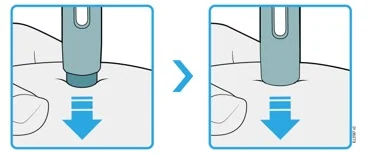
Firmly push the autoinjector down until the dark green safety guard stops moving. Hold the autoinjector down, do not lift.
- The dark green safety guard pushes in and unlocks the purple start button.
PRESS purple start button |
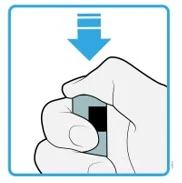
Keep pushing the autoinjector down and press the purple start button to start the injection.
- You may hear or feel a click.
- The window starts to turn yellow.
- It is okay to let go of the purple start button.
WATCH window will turn fully yellow |
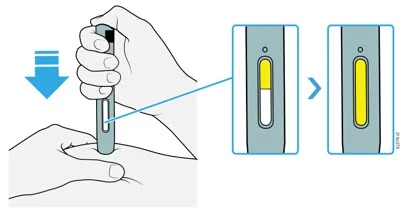
Keep pushing the autoinjector down. Wait for the window to turn fully yellow.
- The injection may take up to 15 seconds to complete.
- You may hear or feel a click.
- After the window turns fully yellow, lift the autoinjector away from the skin.
- The dark green safety guard locks around the needle.
Completing the Injection and Disposal
CONFIRM 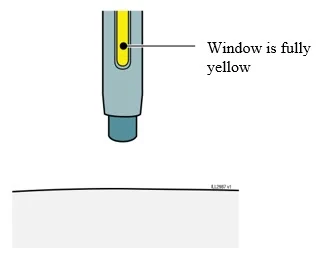 |
Confirm a full dose of medicine was injected.
- Do not touch the dark green safety guard.
- A small drop of liquid on the injection site is okay.
| Important: If the window has not turned fully yellow or if it looks like the medicine is still coming out, a full dose was not injected. Call your healthcare provider right away. |
 |
Check the injection site.
- Do not rub the injection site.
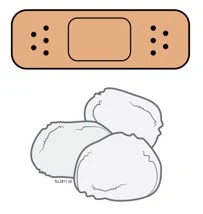
- If there is blood, press a cotton ball or gauze pad on your injection site.
- Apply an adhesive bandage if necessary.
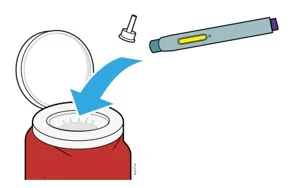 |
Place the used autoinjector and white cap in an FDA-cleared sharps disposal.
Important: Do not throw away the autoinjector in your household trash. - Do not reuse the autoinjector.
- Do not touch the dark green safety guard.
Additional information about your sharps disposal container
If you do not have an FDA-cleared sharps disposal container, you may use a household container that is:
- made of a heavy-duty plastic,
- can be closed with a tight-fitting, puncture-resistant lid, without sharps being able to come out,
- upright and stable during use,
- leak-resistant, and
- properly labeled to warn of hazardous waste inside the container.
Disposing of sharps disposal containers:
When your sharps disposal container is almost full, you will need to follow your community guidelines for the right way to dispose of your sharps disposal container.
There may be state or local laws about how you should throw away used needles and syringes.
For more information about safe sharps disposal, and for specific information about sharps disposal in the state that you live in, go to the FDA's website at:
http://www.fda.gov/safesharpsdisposal
Do not dispose of your used sharps disposal container in your household trash unless your community guidelines permit this.
Do not recycle your used sharps disposal container.
Keep the autoinjector and sharps disposal container out of the sight and reach of children.
For more information or help call 1-888-4ENBREL (1-888-436-2735).
ENBREL (etanercept)
AMGEN
Manufactured by:
Immunex Corporation
Thousand Oaks, CA 91320-1799
U.S. License Number 1132
©1998–2016, 2019-2025 Immunex Corporation. All rights reserved.
1XXXXXX
This Instructions for Use has been approved by the U.S. Food and Drug Administration.
Revised: 6/2025 v21
Instructions for Use
Enbrel® (en-brel)
(etanercept)
injection, for subcutaneous use
Single-dose Prefilled Syringe
How do I prepare and give an injection with Enbrel Single-dose Prefilled Syringe?
There are 2 types of Enbrel single-dose prefilled syringes:
- The 50 mg/mL single-dose prefilled syringe that contains one 50 mg dose of Enbrel.
- The 25 mg/0.5 mL single-dose prefilled syringe that contains one 25 mg dose of Enbrel.
Your healthcare provider will tell you which one to use.
A 50 mg dose can be given as one injection using a 50 mg/mL single-dose prefilled syringe or as two injections using 25 mg/0.5 mL single-dose prefilled syringes. Your healthcare provider will tell you whether the two injections with 25 mg/0.5 mL single-dose prefilled syringes should be given on the same day once a week or on two different days (3 or 4 days apart) in the same week.
Children must weigh at least 138 pounds to use the Enbrel 50 mg/mL single-dose prefilled syringe. Children who weigh less than 138 pounds should use a different form of Enbrel. The Enbrel 25 mg/0.5 mL single-dose prefilled syringe should not be used in pediatric patients weighing less than 68 pounds.
Important: The Enbrel prefilled syringe is not made with natural rubber latex.
Storage of your Enbrel prefilled syringe
- Store the Enbrel prefilled syringe in the refrigerator at 36°F to 46°F (2°C to 8°C).
- Store the Enbrel prefilled syringe in the original carton to protect from light or physical damage.
If needed, you may store your Enbrel prefilled syringe at room temperature between 68°F to 77°F (20°C to 25°C) for up to 30 days.
- Once the Enbrel prefilled syringe has reached room temperature, do not put it back in the refrigerator.
- Throw away any Enbrel prefilled syringe that has been stored at room temperature after 30 days.
- Do not store the Enbrel prefilled syringe in extreme heat or cold. For example, avoid storing Enbrel prefilled syringe in your vehicle's glove box or trunk.
- Do not freeze.
- Do not shake.
- Keep the Enbrel prefilled syringe and all medicines out of the reach of children.
If you have any questions about storage, contact your healthcare provider or call 1-888-4ENBREL (1-888-436-2735) for further instructions.
Step 1: Setting Up for an Injection
- 1. Select a clean, well-lit, flat work surface, such as a table.
- 2. Take the Enbrel carton containing the prefilled syringes out of the refrigerator and place it on your flat work surface. Remove one prefilled syringe and place it on your work surface. Carefully lift the prefilled syringe straight up out of the box. Do not shake the prefilled syringe of Enbrel. Place the carton containing any remaining prefilled syringes back into the refrigerator at 36°F to 46°F (2°C to 8°C).
- 3. Check the expiration date on the prefilled syringe. If the expiration date has passed, do not use the prefilled syringe and contact your pharmacist or call 1-888-4ENBREL (1-888-436-2735) for assistance.
- 4. Do not use the prefilled syringe if the needle cover is missing or not securely attached. Call 1-888-4ENBREL (1-888-436-2735).
- 5. For a more comfortable injection, leave the prefilled syringe at room temperature for about 15 to 30 minutes before injecting. Do not remove the needle cover while allowing it to reach room temperature. Do not warm Enbrel in any other way (for example, do not warm it in a microwave or in hot water).
- 6.
Hold the prefilled syringe with the covered needle pointing down. If bubbles are seen in the syringe, very gently tap the prefilled syringe to allow any bubbles to rise to the top of the syringe. Turn the syringe so that the purple horizontal lines on the barrel are directly facing you. Check to see if the amount of liquid in the syringe falls between the purple lines. The top of the liquid may be curved. If the syringe does not have the right amount of liquid, do not use that syringe. Contact your pharmacist or call 1-888-4ENBREL (1-888-436-2735) for assistance.
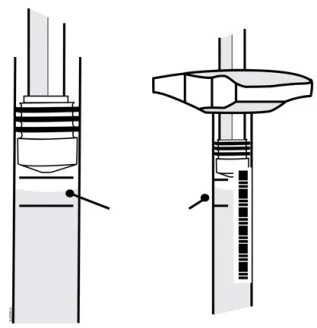
Fill Level Indicator - 7. Assemble the additional supplies you will need for your injection. These include an alcohol swab, a cotton ball or gauze, and a sharps disposal container (see "Step 4: Disposing of Supplies").
- 8. Wash your hands with soap and warm water.
- 9. Make sure the solution in the prefilled syringe is clear and colorless. You may notice small white particles in the solution. These particles are formed from Enbrel and this is acceptable. However, do not inject the solution if it is cloudy or discolored, or contains large or colored particles, call 1-888-4ENBREL (1-888-436-2735).
Step 2: Choosing and Preparing an Injection Site
- 1.
Recommended injection sites for Enbrel using a prefilled syringe include:
- the front of the middle thigh
- the stomach area (abdomen), except for the 2-inch area right around the navel (belly button)
the outer area of the upper arm (only if someone else is giving you the injection)
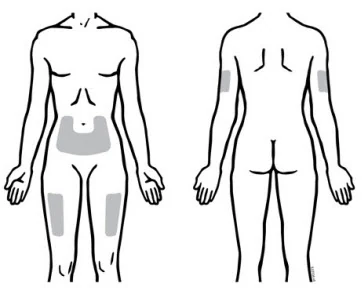
Front Back
- 2. Rotate the site for each injection. Do not inject into areas where the skin is tender, bruised, red, or hard. Avoid areas with scars or stretch marks.
- 3. If you have psoriasis, you should not inject directly into any raised, thick, red, or scaly skin patches or lesions.
- 4. To prepare the area of skin where Enbrel is to be injected, wipe the injection site with an alcohol swab. Do not touch this area again before giving the injection.
Step 3: Injecting Enbrel Using a Prefilled Syringe
Do not remove the needle cover from the prefilled syringe until you are ready to inject.
- 1.
Pick up the prefilled syringe from your flat work surface. Hold the barrel of the prefilled syringe with one hand and pull the needle cover straight off, only when you are ready to inject. Do not leave the needle cover off for more than 5 minutes. This can dry out the medicine.
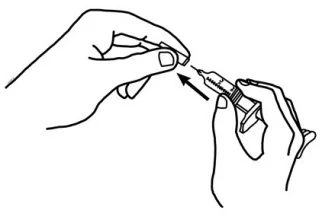
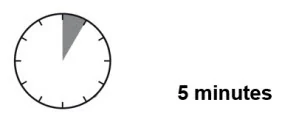
To avoid damaging the needle, do not twist or bend the needle cover while you are removing it, and do not try to put the needle cover back onto the prefilled syringe.
When you remove the needle cover, there may be a drop of liquid at the end of the needle; this is normal. Do not touch the needle or allow it to touch any surface. Do not touch or bump the plunger. Doing so could cause the liquid to leak out.
- 2. Holding the syringe with the needle pointing up, check the syringe for air bubbles. If there are bubbles, gently tap the syringe with your finger until the air bubbles rise to the top of the syringe. Slowly push the plunger up to force the air bubbles out of the syringe.
- 3. Holding the syringe in one hand like a pencil, use the other hand to gently pinch a fold of skin at the cleaned injection site and hold it firmly.
- 4.
With a quick and "dart-like" motion, insert the needle at a 45-degree angle into the skin.
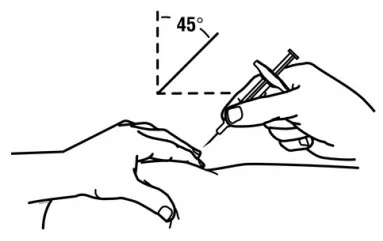
- 5. When the needle is completely inserted into the skin, let go of the skin that you are holding. With your free hand, hold the syringe near its base to stabilize it. Then push the plunger to inject all of the Enbrel solution at a slow, steady rate.
- 6. When the syringe is empty, pull the needle out of the skin, being careful to keep it at the same angle as inserted. There may be a little bleeding at the injection site. You can press a cotton ball or gauze over the injection site for 10 seconds. Do not rub the injection site. If needed, you may cover the injection site with a bandage.
Step 4: Disposing of Supplies
The syringe should never be reused. Never recap a needle.
- Put the used prefilled syringes in a FDA-cleared sharps disposal container right away after use. Do not throw away (dispose of) prefilled syringes in your household trash.
If you do not have a FDA-cleared sharps disposal container, you may use a household container that is:
- made of a heavy-duty plastic,
- can be closed with a tight-fitting, puncture-resistant lid, without sharps being able to come out,
- upright and stable during use,
- leak-resistant, and
- properly labeled to warn of hazardous waste inside the container.
- When your sharps disposal container is almost full, you will need to follow your community guidelines for the right way to dispose of your sharps disposal container. There may be state or local laws about how you should throw away used syringes and needles. For more information about safe sharps disposal, and for specific information about sharps disposal in the state that you live in, go to the FDA's website at: http://www.fda.gov/safesharpsdisposal
- Do not reuse the syringe.
- Do not recycle the syringe or sharps disposal container or throw them into household trash.
Important: Always keep the sharps disposal container out of the reach of children.
A healthcare provider familiar with Enbrel should answer all questions. Call 1-888-4ENBREL (1-888-436-2735) or visit www.enbrel.com for more information about Enbrel.
This Instructions for Use have been approved by the U.S. Food and Drug Administration.
AMGEN
Manufactured by:
Immunex Corporation
Thousand Oaks, CA 91320-1799
U.S. License Number 1132
© 1998 – 2016, 2019-2020, 2022-2024 Immunex Corporation. All rights reserved.
1XXXXXX – v13
Revised: 10/2024
 This printed material is recyclable.
Instructions for Use
Enbrel® (en-brel)
(etanercept)
for injection, for subcutaneous use
Multiple-dose Vial
How do I prepare and give an injection with Enbrel multiple -dose vial?
A multiple-dose vial contains 25 mg of Enbrel.
Storage of Enbrel multiple -dose vial
- Store Enbrel multiple-dose vial in the refrigerator at 36°F to 46°F (2°C to 8°C).
- Store Enbrel multiple-dose vial in the original carton to protect from light or physical damage.
If needed, you may store your Enbrel multiple-dose vial and diluent syringe (dose tray) at room temperature between 68°F to 77°F (20°C to 25°C) for up to 14 days.
○ Once Enbrel multiple-dose vial has reached room temperature, do not put it back in the refrigerator.
- Throw away Enbrel multiple-dose vial that has been stored at room temperature after 14 days.
- Mixed (reconstituted) Enbrel multiple-dose vial should be used right away or kept in the refrigerator at 36°F to 46°F (2°C to 8°C) for up to 14 days.
- Do not store Enbrel multiple-dose vial in extreme heat or cold. For example, avoid storing Enbrel multiple-dose vial in your vehicle’s glove box or trunk.
- Do not freeze.
- Do not shake.
- Keep Enbrel multiple -dose vial and all medicines out of the reach of children.
If you have any questions about storage, contact your healthcare provider or call 1-888-4ENBREL (1-888-436-2735) for further instructions.
Step 1: Setting Up for an Injection
- 1. Select a clean, well-lit, flat work surface, such as a table.
- 2. Take the Enbrel dose tray out of the refrigerator and place it on your flat work surface.
- 3.
Check the expiration date on the dose tray. If the expiration date has passed, do not use the dose tray. Also check to make sure the dose tray has 5 items as pictured below:
- One prefilled diluent syringe containing 1 mL of diluent (liquid) with attached adapter and twist-off cap
- One plunger
- One Enbrel vial
- One 27-gauge ½ inch needle in hard plastic cover
- One vial adapter
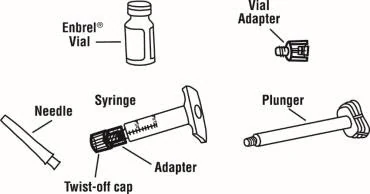
If the expiration date has passed, the five items are not included in the dose tray or if any item looks damaged, contact your pharmacist or call 1-888-4ENBREL (1-888-436-2735) for assistance.
- 4. For a more comfortable injection, leave the dose tray at room temperature for about 15 to 30 minutes before injecting.
- 5. Wash your hands with soap and warm water.
- 6. Peel the paper seal off the dose tray and remove all items.
- 7. Inspect the volume of diluent in the syringe with the twist-off cap pointing down. Use the unit markings on the side of the syringe to make sure there is at least 1 mL of liquid in the syringe. If the level of liquid is below the 1 mL mark, do not use. Contact your pharmacist or call 1-888-4ENBREL (1-888-436-2735) for assistance.
- 8. Do not use the syringe if the twist-off cap is missing or not securely attached. Call 1-888-4ENBREL (1-888-436-2735).
- 9. Two alcohol swabs should be available for the preparation and injection of Enbrel. Alcohol swabs can be found at your local drug store.
Step 2: Preparing the Enbrel Solution
There are two methods for preparing the Enbrel solution. For some children, one vial of Enbrel solution can be used for more than one dose. The free-hand method should be used for children on Enbrel who are using one vial of Enbrel solution for more than one dose. You should not use the vial adapter method if you will be using the vial more than once. Ask your healthcare provider if you have questions about which method to use.
- The Vial Adapter Method
Adults and larger children on Enbrel may use the vial adapter device to assist with mixing the powder with the liquid and withdrawing Enbrel, and then use a 27-gauge needle to inject the dose. This method should not be used for children using multiple doses from the same vial of Enbrel. The instructions for using the vial adapter method are in Step 2A.
- The Free -Hand Method
In the free-hand method, a 25-gauge needle is used to assist with mixing the powder with the liquid and withdrawing Enbrel, and a 27-gauge needle is used to inject the dose. Obtain 25-gauge needles from your healthcare provider. Instructions for using the free-hand method are in Step 2B.
The instructions for preparing additional doses from the same vial of Enbrel solution are in Step 3. For each additional dose, you will need two new needles (one 25-gauge needle to withdraw the solution and one 27-gauge needle for injection) and one new empty syringe (1 mL). Never reuse a syringe or needle.
If you are using the vial of Enbrel for more than one dose, you should write the date you mixed the powder and liquid in the area marked “Mixing Date:” on the sticker supplied with these instructions, and attach the sticker to the Enbrel vial.
After you have withdrawn the dose of Enbrel that you need, store the Enbrel vial (in the dose tray) in the refrigerator at 36º to 46ºF (2º to 8ºC) as soon as possible, but always within 4 hours of mixing the solution. Do not freeze. If you have any questions about storage, contact your healthcare provider or call 1-888-4ENBREL (1-888-436-2735) for further instructions.
The Enbrel solution must be used within 14 days of the mixing date. You should discard the Enbrel vial and any remaining solution if it is not used within 14 days. Do not mix any remaining liquid in one vial of Enbrel solution with another.
STEP 2A: Vial Adapter Method
- 1.
Remove the pink plastic cap from the Enbrel vial. Do not remove the gray stopper or silver metal ring around the top of the Enbrel vial.
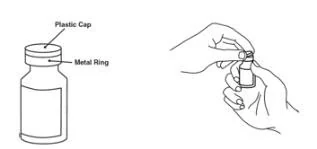
- 2. Place the Enbrel vial on your flat work surface or turn your dose tray upside down and place your Enbrel vial in the round space marked “V”. Use one alcohol swab to clean the gray stopper on the Enbrel vial. Do not touch the gray stopper with your hands.
- 3.
Open the wrapper that contains the 27-gauge needle by peeling apart the tabs and set the needle aside for later use.
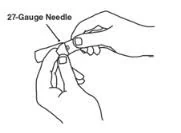
- 4.
Open the wrapper that contains the vial adapter by peeling apart the tabs and set the vial adapter aside for later use. Do not touch the vial adapter’s twist-on end or the spike inside.
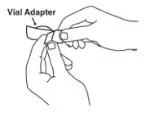
- 5.
Slide the plunger into the flange end of the syringe.
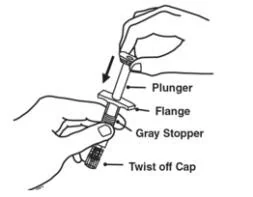
- 6.
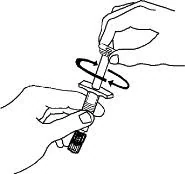
Attach the plunger to the gray rubber stopper in the syringe by turning the plunger clockwise until you feel a slight resistance.
- 7.
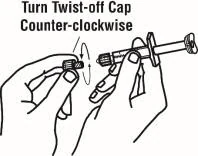
Remove the twist-off cap from the prefilled diluent syringe by turning counter-clockwise. Do not bump or touch the plunger. Doing so could cause the liquid to leak out. You may see a drop of liquid when removing the cap. This is normal. Place the cap on your flat work surface. Do not touch the syringe tip.
- 8.
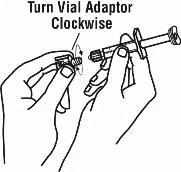
Once the twist-off cap is removed, pick up the vial adapter with your free-hand. Twist the vial adapter onto the syringe, turning clockwise until you feel a slight resistance. Do not over -tighten.
- 9.
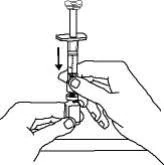
Hold the Enbrel vial upright on your flat work surface. Grasp the sides of the vial adapter and place it over the top of the Enbrel vial. Do not bump or touch the plunger. Doing so could cause the liquid to leak out. Insert the vial adapter into the gray stopper on the Enbrel vial. The plastic spike inside the vial adapter should puncture the gray stopper. The vial adapter should fit snugly.
- 10.
Hold the Enbrel vial upright on your flat work surface and push the plunger down until all the liquid from the syringe is in the Enbrel vial. You may see foaming (bubbles) in the vial. This is normal.
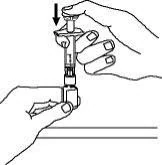
- 11.
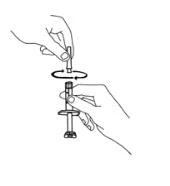
Gently swirl the Enbrel vial in a circular motion to dissolve the powder. If you used the dose tray to hold your Enbrel vial, take the vial (with the vial adapter and syringe still attached) out of the dose tray, and gently swirl the vial in a circular motion to dissolve the powder.
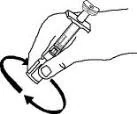
Do not shake. Wait until all the powder dissolves (usually less than 10 minutes). The solution should be clear and colorless. After the powder has completely dissolved, foam (bubbles) may still be present. This is normal. Do not inject the solution if it is discolored, contains lumps, flakes, or particles. If all the powder in the Enbrel vial is not dissolved or there are particles present after 10 minutes, call 1-888-4ENBREL (1-888-436-2735).
- 12.
Turn the Enbrel vial upside down. Hold the syringe at eye level and slowly pull the plunger down to the unit markings on the side of the syringe that correspond with your/your child’s dose. For adult patients, remove the entire volume (1 mL), unless otherwise instructed by your healthcare provider. Be careful not to pull the plunger completely out of the syringe. Some white foam may remain in the Enbrel vial. This is normal.
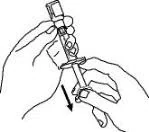
- 13.
Check for air bubbles in the syringe. Gently tap the syringe to make any air bubbles rise to the top of the syringe. Slowly push the plunger up to remove the air bubbles. If you push solution back into the vial, slowly pull back on the plunger to again draw the correct amount of solution back into the syringe.
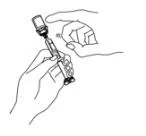
- 14.
Remove the syringe from the vial adapter, by holding the vial adapter with one hand and turning the syringe counter-clockwise with your other hand. Do not touch or bump the plunger. Place the Enbrel vial with the vial adapter on your flat work surface.
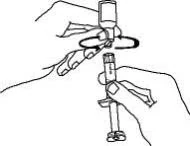
- 15.
Continue to hold the barrel of the syringe. With your free-hand, twist the 27-gauge needle onto the tip of the syringe until it fits snugly. Do not remove the needle cover from the syringe. Place the syringe on your flat work surface until you are ready to inject Enbrel.
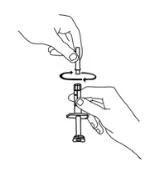
Go to Step 4 : Choosing and Preparing an Injection Site .
Step 2B: Free -Hand Method
If you are preparing a dose from an Enbrel vial that was previously used, go to Step 3: Preparing Additional Doses from a Single Enbrel Vial.
- 1.
Remove the pink plastic cap from the Enbrel vial. Do not remove the gray stopper or silver metal ring around the top of the Enbrel vial. Write the date you mix the powder and solution on the supplied “Mixing Date:” sticker and attach it to the Enbrel vial.
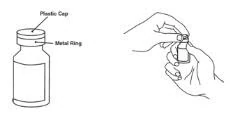
- 2. Place the Enbrel vial on your flat work surface. Use one alcohol swab to clean the gray stopper on the Enbrel vial. Do not touch the gray stopper with your hands.
- 3.
Open the wrapper that contains the 25-gauge needle by peeling apart the tabs and set the needle aside for later use. The 25-gauge needle will be used to mix the liquid with the powder and for withdrawing Enbrel from the vial.
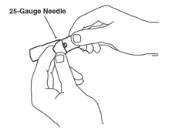
- 4.
Slide the plunger into the flange end of the syringe.
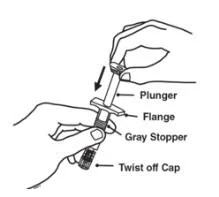
- 5.
Attach the plunger to the gray rubber stopper in the syringe by turning the plunger clockwise until you feel a slight resistance.
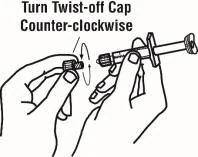
- 6.
Remove the twist-off cap from the prefilled diluent syringe by turning counter-clockwise. Do not touch or bump the plunger. Doing so could cause the liquid to leak out. You may see a drop of liquid when removing the cap. This is normal. Place the cap on your flat work surface. Do not touch the syringe tip.
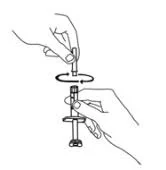
- 7.
Continue to hold the barrel of the syringe. With your free-hand, twist the 25-gauge needle onto the tip of the syringe until it fits snugly. Place the syringe on your flat work surface.
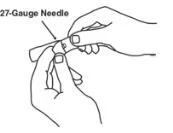
- 8.
Open the wrapper that contains the 27-gauge needle by peeling apart the tabs and set the needle aside for later use. The 27-gauge needle will be used to inject the dose.
- 9.
Pick up the syringe from your flat work surface. Hold the barrel of the syringe with one hand, and pull the needle cover straight off. To avoid damaging the needle, do not twist or bend the needle cover while you are removing it. Do not touch the needle or allow it to touch any surface. Do not touch or bump the plunger. Doing so could cause the liquid to leak out.
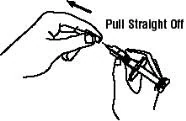
- 10.
Place the needle cover (open side up) in the round space marked “N” in the Enbrel dose tray.
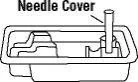
- 11.
Place the Enbrel vial on your flat work surface. Hold the syringe with the needle facing up, and gently pull back on the plunger to pull a small amount of air into the syringe. Then, insert the needle straight down through the center ring of the gray stopper (see illustrations). You should feel a slight resistance and then a “pop” as the needle goes through the center of the stopper. Look for the needle tip inside the open stopper window. If the needle is not correctly lined up with the center of the stopper, you will feel constant resistance as it goes through the stopper and no “pop”. The needle may enter at an angle and bend, break or prevent you from adding diluent into the Enbrel vial.
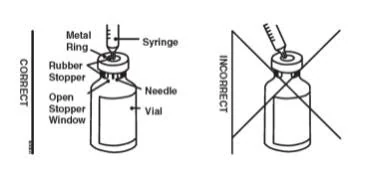
- 12.
Push the plunger down very slowly until all liquid from the syringe is in the Enbrel vial. Adding the liquid too fast will cause foaming (bubbles).
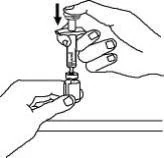
- 13.
Leave the syringe in place. Gently swirl the Enbrel vial in a circular motion to dissolve the powder.
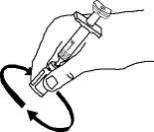
Do not shake . Wait until all the powder dissolves (usually less than 10 minutes). The solution should be clear and colorless. After the powder has completely dissolved, foam (bubbles) may still be present. This is normal. Do not inject the solution if it is discolored, contains lumps, flakes, or particles. If all the powder in the Enbrel vial is not dissolved or there are particles present after 10 minutes, call 1-888-4ENBREL (1-888-436-2735).
- 14.
With the needle in the Enbrel vial, turn the vial upside down. Hold the syringe at eye level and slowly pull the plunger down to the unit markings on the side of the syringe that correspond with the correct dose. Make sure to keep the tip of the needle in the solution. Some white foam may remain in the Enbrel vial. This is normal.
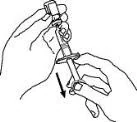
- 15.
With the needle still inserted in the Enbrel vial, check for air bubbles in the syringe. Gently tap the syringe to make any air bubbles rise to the top of the syringe. Slowly push the plunger up to remove the air bubbles. If you push solution back into the vial, slowly pull back on the plunger to draw the correct amount of solution back into the syringe.
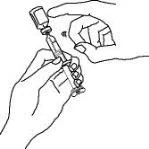
- 16.
Remove the syringe and needle from the Enbrel vial. Keep the needle attached to the syringe and insert the 25-gauge needle straight down into the needle cover in the Enbrel dose tray.
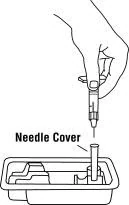
You should hear a “snap” when the needle is secure in the needle cover. Once the needle is secure in the needle cover, untwist the 25-gauge needle from the syringe and dispose of the needle in your sharps disposal container (see “Step 6: Disposing of Supplies”).
- 17.
Twist the 27-gauge needle onto the syringe until it fits snugly. Do not remove the needle cover from the syringe. Place the syringe on your flat work surface until you are ready to inject Enbrel.
- 18. If there is enough solution left in the Enbrel vial for another dose, write the date you mixed the powder and liquid in the area marked “Mixing Date:” on the sticker supplied with these instructions, and attach the sticker to the Enbrel vial. Refrigerate the reconstituted (mixed) Enbrel vial (in the dose tray) after mixing. Prepare additional doses from the Enbrel vial as described in Step 3. Otherwise, throw away (discard) the Enbrel vial and any remaining solution.
Go to Step 4: Choosing and Preparing an Injection Site.
Step 3: Preparing Additional Doses from a Single Enbrel Vial
- 1. Select a clean, well-lit, flat work surface, such as a table.
- 2. Do not reuse the needles and syringes supplied with Enbrel dose tray. You will need new needles and syringes for each additional dose. Your healthcare provider will tell you what type of syringes (1 mL) and needles (25-gauge and 27-gauge) to use. Place the sterile syringe with a 25-gauge needle (for withdrawing Enbrel), a 27-gauge needle (for injecting Enbrel) and two alcohol swabs on your flat work surface.
- 3. Take the vial of Enbrel solution that is stored in the dose tray out of the refrigerator and place it on your flat work surface.
- 4. Check the mixing date you wrote on the sticker on the Enbrel vial. Discard the Enbrel vial if more than 14 days have passed since the Enbrel solution was mixed.
- 5. Wash your hands with soap and warm water.
- 6. Use one alcohol swab to clean the gray stopper on the Enbrel vial. Do not touch the stopper with your hands.
- 7. If the syringe and the 25-gauge needle are not pre-assembled, assemble them as instructed by your healthcare provider.
- 8. Open the wrapper that contains the 27-gauge needle by peeling apart the tabs and set the needle aside for later use. The 27-gauge needle will be used to inject the dose of Enbrel.
- 9. Hold the syringe and pull the needle cover straight off. To avoid damaging the needle, do not twist or bend the needle cover while you are removing it. Do not touch the needle or allow it to touch any surface. Place the needle cover (open side up) in the round space marked “N” in the Enbrel dose tray.
- 10. Place the Enbrel vial on your flat work surface. Hold the syringe with the needle facing up, and gently pull back the plunger to pull a small amount of air into the syringe. Then, insert the 25-gauge needle straight down through the center ring of the gray stopper. You should feel a slight resistance and then a “pop” as the needle goes through the center of the stopper. Look for the needle tip inside the open stopper window. If the needle is not correctly lined up with the center of the stopper, you will feel constant resistance as it goes through the stopper and no “pop”. The needle may enter at an angle and bend, break, or prevent proper withdrawal of Enbrel solution from the vial.
- 11. Keep the needle in the Enbrel vial and turn the vial upside down. Hold the syringe at eye level, and slowly pull the plunger down to the unit markings on the syringe that correspond to your child’s dose. As the amount of solution in the Enbrel vial drops, you may need to pull the needle back just enough to keep the tip of the needle in the solution.
- 12. With the needle still inserted in the Enbrel vial, check for air bubbles in the syringe. Gently tap the syringe to make any air bubbles rise to the top of the syringe. Slowly push the plunger up to remove the air bubbles. If you push solution back into the Enbrel vial, slowly pull back on the plunger to again draw the correct amount of solution back into the syringe.
- 13. Remove the syringe and needle from the Enbrel vial. Keep the needle attached to the syringe and insert the 25-gauge needle straight down into the needle cover in the Enbrel dose tray. You should hear a “snap” when the needle is secure in the needle cover. Once the needle is secure in the needle cover, remove the 25-gauge needle from the syringe and dispose of the needle in a sharps disposal container (see “Step 6: Disposing of Supplies”).
- 14. Attach the 27-gauge needle onto the tip of the syringe until it fits snugly. Do not remove the needle cover from the syringe. Place the syringe on your flat work surface until you are ready to inject Enbrel.
Step 4: Choosing and Preparing an Injection Site
- 1.
The 3 recommended injection sites for Enbrel include:
- the front of the middle thighs
- the stomach area (abdomen), except for the 2-inch area right around the navel (belly button)
- the outer area of the upper arms (only if someone else is giving you the injection)
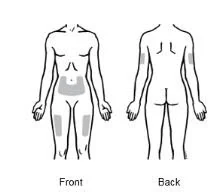
- 2. Rotate the site for each injection. Do not inject into areas where the skin is tender, bruised, red, or hard. Avoid areas with scars or stretch marks.
- 3. If you have psoriasis, you should not inject directly into any raised, thick, red, or scaly skin patches or lesions.
- 4. To prepare the area of skin where Enbrel is to be injected, wipe the injection site with a new alcohol swab. Do not touch this area again before giving the injection .
Step 5: Injecting the Enbrel Solution
Do not remove the needle cover from the syringe until you are ready to inject.
- 1.
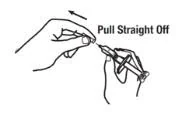
Pick up the syringe from your flat work surface. Hold the barrel of the syringe with one hand and pull the needle cover straight off. To avoid damaging the needle, do not twist or bend the needle cover while you are removing it, and do not try to put the needle cover back onto the syringe. When you remove the needle cover, there may be a drop of liquid at the end of the needle. This is normal. Do not touch the needle or allow it to touch any surface. Do not touch or bump the plunger. Doing so could cause the liquid to leak out.
- 2.
With one hand, gently pinch the cleaned area of skin and hold it firmly. With the other hand, hold the syringe (like a pencil) at a 45-degree angle to the skin.
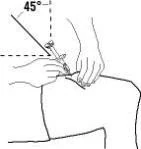
- 3. With a quick and "dart-like" motion, insert the needle at a 45-degree angle into the skin.
- 4.
When the needle is completely inserted into the skin, let go of the skin that you are holding. With your free-hand, hold the syringe near its base to stabilize it. Then push the plunger to inject all of the Enbrel solution at a slow, steady rate.
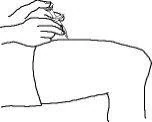
- 5. When the syringe is empty, pull the needle out of the skin, being careful to keep it at the same angle as inserted.
- 6. There may be a little bleeding at the injection site. You can press a cotton ball or gauze over the injection site for 10 seconds. Do not rub the injection site. If needed, you may cover the injection site with a bandage.
- 7. If your healthcare provider has instructed you to take two Enbrel injections on the same day, repeat the steps to prepare and give an injection of Enbrel. Choose and prepare a new injection site for the second injection.
- 8. For the Free -Hand Method: If there is enough solution left in the Enbrel vial for another dose, refrigerate the reconstituted (mixed) Enbrel vial (in the dose tray) after use. Otherwise, discard the Enbrel vial and any remaining solution.
Step 6: Disposing of Supplies
The syringe, needles, and vial adapter should never be reused. Never recap a needle.
- Put the used syringes, needles, and vials in a FDA-cleared sharps disposal container right away after use. Do not throw away (dispose of) the needles, syringes, and vials in your household trash.
If you do not have a FDA-cleared sharps disposal container, you may use a household container that is:
○ made of a heavy-duty plastic,
○ can be closed with a tight-fitting, puncture-resistant lid, without sharps being able to come out,
○ upright and stable during use,
○ leak-resistant, and
○ properly labeled to warn of hazardous waste inside the container.
- When your sharps disposal container is almost full, you will need to follow your community guidelines for the right way to dispose of your sharps disposal container. There may be state or local laws about how you should throw away used syringes and needles. For more information about safe sharps disposal, and for specific information about sharps disposal in the state that you live in, go to the FDA’s website at: http://www.fda.gov/safesharpsdisposal
- Do not reuse the syringe or vial.
- Do not recycle the syringe, vial, or sharps disposal container or throw them into household trash.
Important: Always keep the sharps disposal container out of the reach of children.
A healthcare provider familiar with Enbrel should answer all questions. Call 1-888-4ENBREL (1-888-436-2735) or visit www.enbrel.com for more information about Enbrel.
This Instructions for Use have been approved by the U.S. Food and Drug Administration.
AMGEN®
Manufactured by :
Immunex Corporation
Thousand Oaks, CA 91320-1799
U.S. License Number 1132
© 1998 – 2016, 2019 Immunex Corporation. All rights reserved.
1XXXXXX – v9
Revised: 10/2019
 This printed material is recyclable.
 | Flip over for additional information |
INSTRUCTIONS FOR USE
ENBREL® [en-brel]
(etanercept)
injection, for subcutaneous use
50 mg/mL
ENBREL Mini® Single-dose Prefilled Cartridge
for use with all AutoTouch® Reusable Autoinjectors
This Instructions for Use contains information on how to inject the ENBREL Mini single-dose prefilled cartridge with all AutoTouch reusable autoinjectors.
If your healthcare provider decides that ENBREL injections may be given at home, you or your caregiver should receive training on the right way to prepare and inject ENBREL. Do not try to inject until you or your caregiver have been shown the right way to give the injections by your healthcare provider or nurse.
The medicine in the ENBREL Mini single-dose prefilled cartridge is for injection under the skin (subcutaneous injection). See the ENBREL Medication Guide for information about ENBREL.
AutoTouch® Reusable Autoinjector
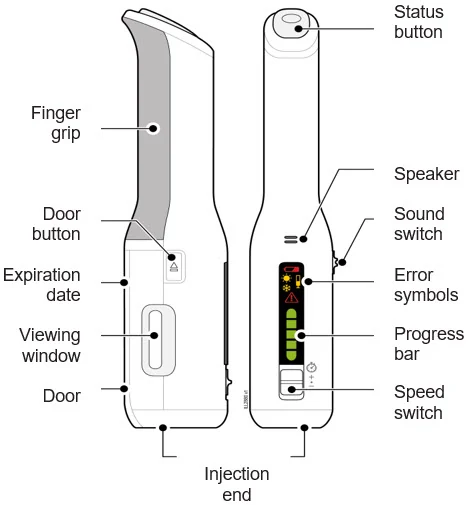
 | To learn more about autoinjector features, see the User Manual, section "Guide to Parts." |
Enbrel Mini® Single-dose Prefilled Cartridge
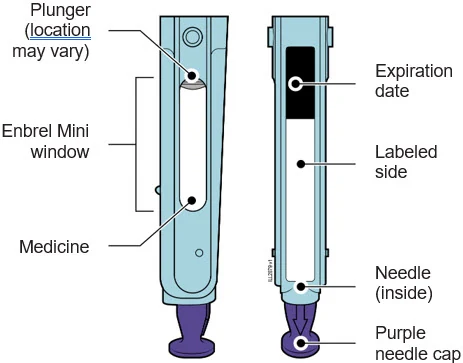
| Important: Do not remove the purple needle cap until step 11. |
| To learn more about cartridge features, see the User Manual, section "Guide to Parts." |
Frequently asked questions
For additional information and answers to frequently asked questions, visit www.enbrel.com.
Where to get help
If you want more information or help using ENBREL:
- Contact your healthcare provider,
- Visit www.enbrel.com, or
- Call 1-888-4ENBREL (1-888-436-2735).
Preparing ENBREL
| WAIT |
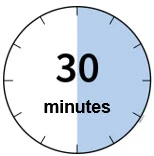 |
Wait 30 minutes for the cartridge to reach room temperature.
- Remove 1 cartridge from the carton in the refrigerator.
- Put the carton containing any unused cartridges back in the refrigerator.
- Let the cartridge warm up naturally.
- Do not heat the cartridge with hot water, a microwave, or direct sunlight.
- Do not put the cartridge back in the refrigerator once it reaches room temperature.
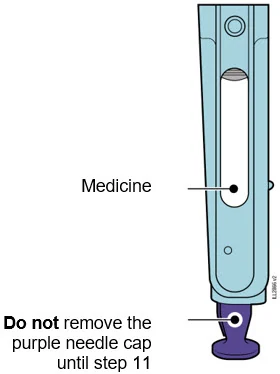
Inspect the medicine. It should be clear and colorless.
- It is okay to see air bubbles.
- Do not use the cartridge if the medicine is cloudy, discolored, or contains large lumps, flakes, or colored particles.
- It is okay to see small white particles in the medicine.
| Important: If the medicine is cloudy, discolored, contains large lumps, flakes, colored particles, or if the cartridge is damaged or expired, call 1-888-4ENBREL (1-888-436-2735). |
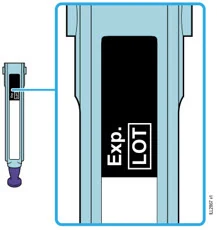 |
| Expiration date |
Check the expiration date (Exp.) and inspect the cartridge for damage.
- Do not use the cartridge if the expiration date has passed.
Do not use the cartridge if:
- the purple needle cap is missing or loose,
- it has cracks or broken parts, or
- it has been dropped on a hard surface.
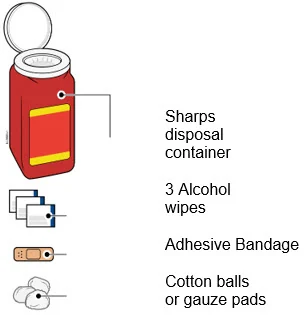
Gather and place the following items for the injection on a clean, flat, and well-lit surface:
- AutoTouch reusable autoinjector,
- 1 Enbrel Mini cartridge (room temperature),
- Sharps disposal container [see Completing the Injection],
- 3 Alcohol wipes,
- Adhesive bandage, and
- Cotton balls or gauze pads.
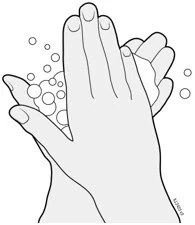
- Wash your hands thoroughly with soap and water.
Getting Ready to Inject ENBREL
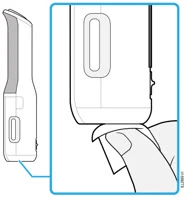
Clean the injection end of the autoinjector with an alcohol wipe.
- Let the injection end dry on its own.
- Do not touch this area again before injecting.
Do not use the autoinjector if:
- the expiration date has passed,
- it has cracks or broken parts, or
- it has been dropped on a hard surface.
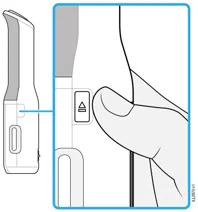
Press the door button to open the autoinjector door.
- Do not block the door while pushing the door button.
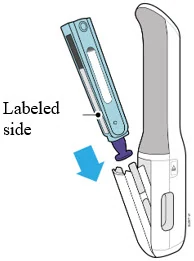
Insert the cartridge with the purple needle cap down and the labeled side facing out.
- The cartridge will slide all the way down into the autoinjector.
- Do not force the cartridge into the autoinjector door.
- Once the cartridge is inserted, push the door to close it.
- Do not remove the purple needle cap until step 11.
| If the status button flashes red, see the User Manual, section "Troubleshooting." |
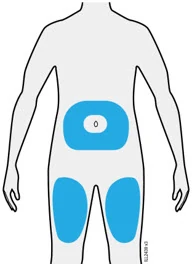
Select 1 of these injection site locations.
You can inject into the:
- Stomach (at least 2 inches away from the belly button), or
- Thigh.
- Another person may give you the injection in the back of your upper arm.
- Choose a different site for each injection.
| Important: Avoid areas with scars, stretch marks, where the skin is tender, bruised, red, hard, or areas with psoriasis. |
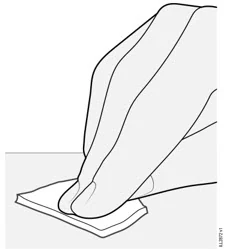
Clean the injection site with a new alcohol wipe.
- Let the skin dry on its own.
- Do not touch this area again before injecting.
Injecting ENBREL
| Important: Only remove the purple needle cap when you can inject right away (within 5 minutes) as the medicine can dry out. Do not recap. |
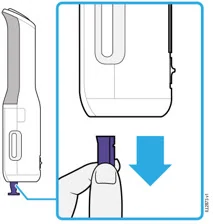
Pull the purple needle cap straight down to remove.
- Do not twist or bend the purple needle cap to pull it off.
- Never put the purple needle cap back on. It may damage the needle.
- It is normal to see a drop of medicine come out of the needle or injection end of the autoinjector.
| Important: Keep your thumb away from the status button until you are ready to inject. |
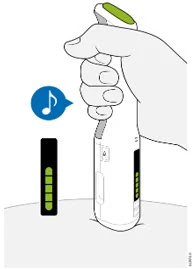
With the progress bar facing you, place and hold the autoinjector on the injection site.
After placing on the skin, wait for the:
- status button to turn green,
- progress bar to turn green, and
- chime sound (will not chime if sound switch is off).
- Do not stretch or pinch the injection site.
 | If the status button does not turn green, see the User Manual, section "Troubleshooting." |
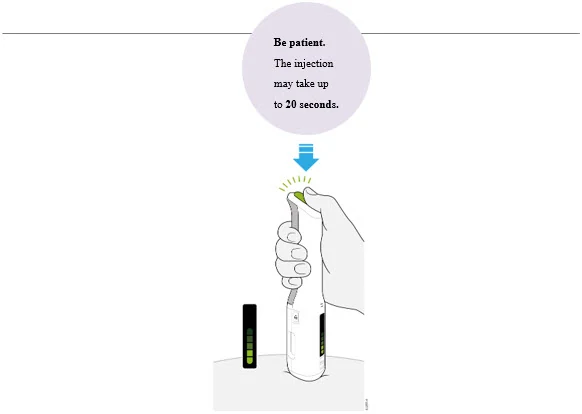
Press and release the status button to inject.
- Do not lift the autoinjector from the skin until the injection is complete.
During the injection:
- the green status button will flash on and off,
- the progress bar lights will decrease, and
- you will hear a motor noise.
- The injection may take up to 20 seconds to complete.
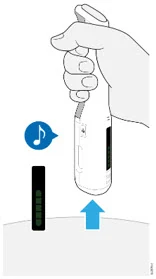
Keep holding flat on the skin until the status button and progress bar turn off.
The injection is complete when the:
- status button turns off,
- progress bar turns off, and
- chime sounds (will not chime if sound switch is off).
- Lift it from the skin when the injection is complete.
- Do not block the door, it will open automatically.
| Important: When you remove the autoinjector, if the status button is flashing red either see the User Manual, section "Troubleshooting" or call 1-888-4ENBREL (1-888-436-2735). |
Completing the Injection
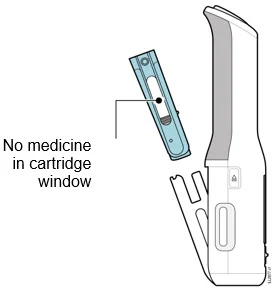
Remove the used cartridge and confirm a full dose of medicine was injected.
- When the door opens, remove the used cartridge and close the door.
- A small drop of liquid on the injection site is okay.
| Important: If it looks like the medicine is still injecting or if you see medicine in the cartridge window, this means you may not have received a full dose. Call your healthcare provider right away. |
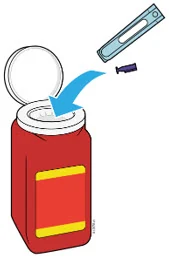
Place the used cartridge and purple needle cap in an FDA-cleared sharps disposal container.
- Do not reuse the cartridge.
- Do not throw away the cartridge in your household trash.
- Small parts such as the purple needle cap may cause a choking hazard for children and pets.
| Important: Always keep the sharps disposal container out of the reach of children. |
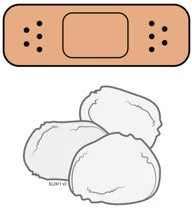
Check the injection site.
- Do not rub the injection site.
- If there is blood, press a cotton ball or gauze pad on the injection site.
- Apply an adhesive bandage if necessary.
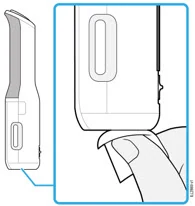
Clean the injection end of the autoinjector with a new alcohol wipe and let it dry.
- Store the autoinjector at room temperature in a dry, safe place such as in a cabinet or drawer.
- Do not store the autoinjector in the refrigerator.
Additional information about your sharps disposal container
If you do not have an FDA-cleared sharps disposal container, you may use a household container that is:
- made of a heavy-duty plastic,
- can be closed with a tight-fitting, puncture-resistant lid, without sharps being able to come out,
- upright and stable during use,
- leak-resistant, and
- properly labeled to warn of hazardous waste inside the container.
Disposing of sharps disposal containers:
When your sharps disposal container is almost full, you will need to follow your community guidelines for the right way to dispose of your sharps disposal container.
There may be state or local laws about how you should throw away used needles and syringes.
For more information about safe sharps disposal, and for specific information about sharps disposal in the state that you live in, go to the FDA's website at:
http://www.fda.gov/safesharpsdisposal
Do not dispose of your used sharps disposal container in your household trash unless your community guidelines permit this.
Do not recycle your used sharps disposal container.
 | Troubleshooting Error symbols: Why is the status button flashing red? | |
 | Low battery: | |
| The battery is running very low. Less than 3 weeks or 3 injections remain. The battery is not replaceable or rechargeable. | ||
| Call 1-888-4ENBREL (1-888-436-2735) for a replacement autoinjector. | ||
| See the User Manual, section "Troubleshooting", for more information. | ||
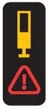 | Needle exposure: | |
| The needle may be exposed and an incomplete dose may have been injected. Look for medicine in the cartridge window. Call your healthcare provider if you feel you have given yourself an incomplete injection. Take special care when removing and handling the cartridge. Place the cartridge in an FDA-cleared sharps disposal container. | ||
| See the User Manual, section "Troubleshooting", for more information. | ||
 | Enbrel Mini problem: | |
| There are several reasons you might get this error. | ||
| See the User Manual, section "Troubleshooting", for more information. | ||
 | Battery dead: | |
| The battery is dead. | ||
| Call 1-888-4ENBREL (1-888-436-2735) for a replacement autoinjector. | ||
| See the User Manual, section "Troubleshooting", for more information. | ||
 | Too hot or too cold: | |
| The autoinjector is too hot or too cold. This will lock the door. Place the autoinjector at room temperature in a dry, safe place, and allow it to naturally cool or warm to room temperature. Then try again. | ||
| Store the autoinjector in a dry, safe place, such as a cabinet or drawer at 50°F to 104°F (10°C to 40°C). | ||
| See the User Manual, section "Troubleshooting", for more information. | ||
 | Autoinjector detected problem: | |
| See the User Manual, section "Troubleshooting", for reset instructions. | ||
| See the User Manual booklet for more information. | 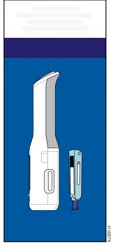 |
 Flip over for additional information |
For more information or help call 1-888-4ENBREL (1-888-436-2735).
Important Information You Need to Know Before Injecting ENBREL
The AutoTouch reusable autoinjector is used with the Enbrel Mini single-dose prefilled cartridge to administer your dose of ENBREL. The Enbrel Mini single-dose prefilled cartridge contains one 50 mg single-dose of ENBREL.
Before you use the AutoTouch reusable autoinjector with Enbrel Mini single-dose prefilled cartridge for use with ENBREL, read this important information:
- It is important that you do not try to give the injection until you have fully read and understood this Instructions for Use.
- Children must weigh at least 138 pounds to receive 50 mg Enbrel Mini. Children who weigh less than 138 pounds should receive a different form of ENBREL.
- Do not use the autoinjector or cartridges if either carton is damaged or either seal is broken.
- The autoinjector and the cartridge are not made with natural rubber latex.
Do not use the autoinjector or cartridge if it has been dropped on a hard surface. Part of the autoinjector or cartridge may be broken even if you cannot see the break.
- If the cartridge has been dropped, use a new cartridge and call 1-888-4ENBREL (1-888-436-2735).
- If the autoinjector has been dropped, call for a replacement at 1-888-4ENBREL (1-888-436-2735).
| Important: Keep the autoinjector, cartridge, and sharps disposal container out of the sight and reach of children. |
AutoTouch® Reusable Autoinjector Storage and Handling
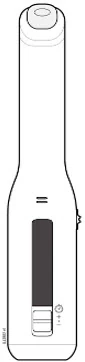
- Store the autoinjector at room temperature in a dry, safe place, such as a cabinet or drawer at 50°F to 104°F (10°C to 40°C).
- Do not store the autoinjector in the refrigerator with the cartridge.
Use an alcohol wipe to clean the bottom (injection end) before and after each use.

See the User Manual, section "Storage & Handling", for additional information.
For more information or help, call 1-888-4ENBREL (1-888-436-2735).
Enbrel Mini® Cartridge Storage and Handling
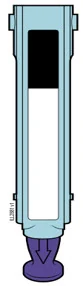
- Keep the cartridge which contains ENBREL, in the refrigerator between 36°F to 46°F (2°C to 8°C).
- If needed, you may store the cartridge at room temperature between 68°F to 77°F (20°C to 25°C) for up to 30 days.
- Do not put the cartridge back in the refrigerator once it reaches room temperature.
- Record the date you removed the cartridge from the refrigerator and use it within 30 days.
- Do not store the cartridge in extreme heat or cold. For example, avoid storing in your vehicle's glove box or trunk.
- Do not freeze the cartridge.
- Do not shake the cartridge at any time.
- Keep the cartridge in the original carton to protect it from light or physical damage.
- Do not remove the purple needle cap from the cartridge until it is inside the autoinjector and you have reached step 11 in this Instructions for Use.
| Important: Place the cartridge in a sharps disposal container if it has reached room temperature and has not been used within 30 days. |
For more information or help call 1-888-4ENBREL (1-888-436-2735).
We're right here, right when you need us.
Personalized patient support designed for you.
AMGEN Support+
With financial support resources and other helpful patient services, we are here to help you along the way.
Call 1-888-4ENBREL (1-888-436-2735) or visit enbrel.com/support to find out more.
 Scan the QR code for more information |
Additional Support
Scan the QR code for some helpful things to know as you get started.
 ENBRELinjection.com |
AMGEN
Manufactured by:
Immunex Corporation
Thousand Oaks, CA 91320-1799
U.S. License Number 1132
©2026 Immunex Corporation. All rights reserved.
Issued 02/2026
Version: 10
AutoTouch® reusable
autoinjector for use with
Enbrel Mini® (etanercept)
single-dose prefilled cartridge
User Manual
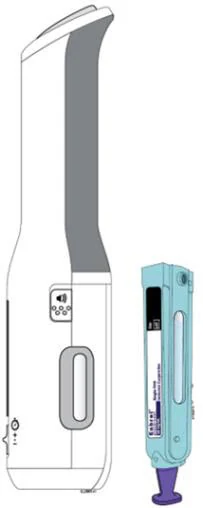
| Table of Contents | |
| Getting Started | 4 |
| Reference Guide | 5 |
| Resources | 6 |
| Guide to Parts | 8 |
| Troubleshooting: Error Symbols | 18 |
| Troubleshooting: Common Problems | 24 |
| Storage & Handling | 28 |
| Cleaning Instructions | 30 |
| Warnings | 31 |
| Technical Information | 32 |
| Symbol Table | 34 |
| Getting Started |
This User Manual contains helpful information about your AutoTouch® reusable autoinjector. It includes resources, care details, and a troubleshooting guide to save for ongoing reference.
To learn how to inject using AutoTouch, see your healthcare provider for injection training and use the Instructions for Use included in the carton.
Instructions for Use
A fold-out, step-by-step Instructions for Use is provided in the carton, which provides you with full instructions to learn how to give yourself a safe, successful and accurate injection.
Note: Please read the full Instructions for Use included in the carton.
The Reference Guide on the next page should only be used when you have successfully completed an injection using the Instructions for Use.
| Reference Guide |
| Prepare and clean your injection site. | Hold the Enbrel Mini® single-dose prefilled cartridge with labeled side facing out and slide into door. Close door. Remove purple cap. | ||||
| 1 | 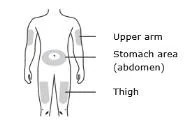 | 2 | 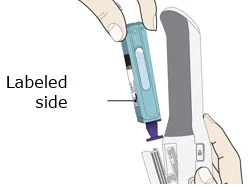 | 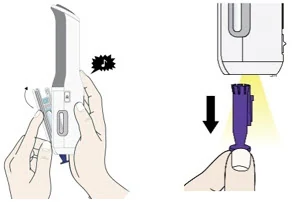 | |
| Place and hold on skin. Wait for the status button to turn green. | To start injection: Press and release the green status button. | Injection is finished when you hear a chime and all lights are turned off. | |||
| 3 | 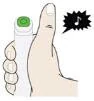 | 4 | 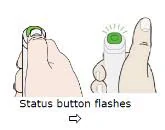 | 5 | 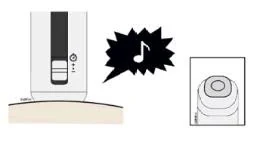 |
| Resources |
Personalized help from ENBREL Support ™
Here are just a few of the benefits available at no cost to you:
- Live nurses online or on the phone seven days a week, 8 AM to 11 PM (ET)
- ENBREL Support copay card and other financial help
- Medication and refill reminders by phone or email
- Needle disposal containers through the Sharps Mail-Back Program
Sign up at 1-888-4ENBREL (1-888-436-2735) or EnbrelSupport.com.
| Guide to Parts |
AutoTouch® reusable autoinjector
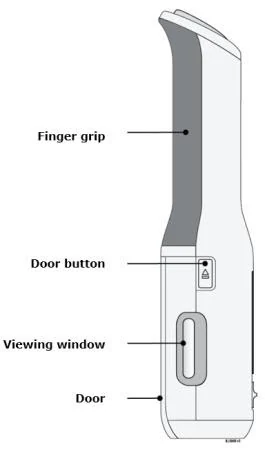
Finger grip When injecting, hold the AutoTouch® reusable autoinjector with fingers wrapped around the gray finger grip. | 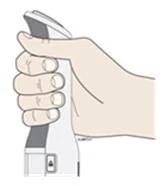 |
Door button
Press this button to open the door for insertion of the Enbrel Mini® single-dose prefilled cartridge. When your injection is finished, the door will open automatically.
Viewing window
During an injection, you can look through this window and see the plunger lowering to deliver your medicine. When AutoTouch is awake, the viewing window will light up. If Enbrel Mini is in AutoTouch, and the viewing window has no light, then press the status button to wake up AutoTouch.
You will open this door and insert Enbrel Mini into AutoTouch. The door will open automatically when your injection is finished. When inserted properly, Enbrel Mini will slide freely and completely into and out of the door.
| Guide to Parts |
AutoTouch® reusable autoinjector
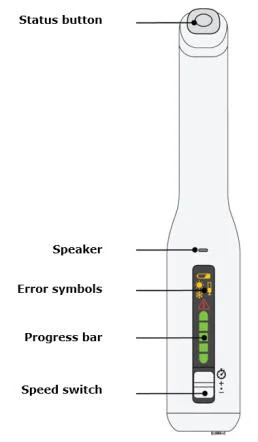
Status button
Press this button to begin an injection. Lights will indicate the status of your injection.
Green:
Ready to press and start injection.
Blinking green:
The needle is inserting and your injection is in progress.
Red:
An error has occurred. See the Troubleshooting section of this manual.
Progress bar
These stacked green bars are fully lit when your injection starts, and the bar of lights decrease as your injection is in progress. The lights will disappear when your injection is finished.
Speed switch
The AutoTouch® reusable autoinjector allows you to choose from three injection speeds. The pre-set speed is medium.
(+) is faster
(•) is medium
(–) is slower
| Guide to Parts |
AutoTouch® reusable autoinjector
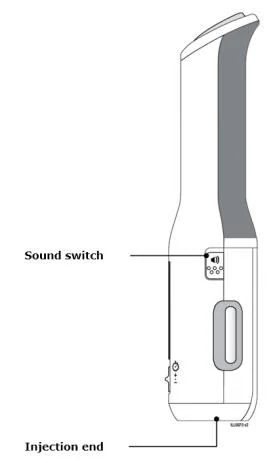
Sound switch
Sounds can be turned off and on. (Sounds on) Slide switch down. (Sounds off) Slide switch up so that the red bar is visible.
Note: Error sounds will still be heard if the sounds have been turned off.
Injection end
The entire injection end must be touching your skin during injections. This is also where the needle will come out.
Skin sensor
A skin sensor is located on the injection end. When the injection end is placed on skin the start button light will turn green. Hold the injection end flat and steady on your skin throughout the entire injection process.
Site light
When the Enbrel Mini® single-dose prefilled cartridge is loaded and the purple cap is removed, the injection end will light up to help you see your injection site.
| Guide to Parts |
Enbrel Mini® single-dose prefilled cartridge
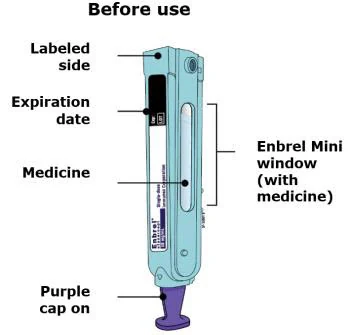
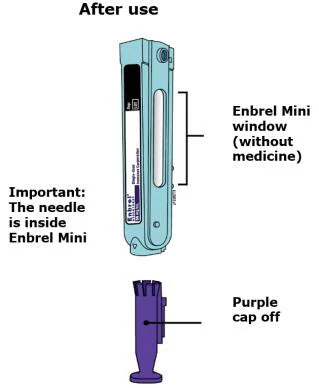
Labeled side
When inserting the Enbrel Mini® cartridge make certain that the labeled side is facing out. Then slide Enbrel Mini into the door. It will slide all the way down into the AutoTouch® reusable autoinjector.
Expiration date
Confirm expiration date printed on the label has not passed.
Enbrel Mini window
This is where you will look to examine your medicine before starting an injection. See Instructions for Use for more information.
Purple cap
The purple cap keeps your medicine safe. Do not remove the cap on Enbrel Mini before loading it into AutoTouch. Load Enbrel Mini with the purple cap on, and remove the cap only when you are ready to give yourself the injection. Do not leave the purple cap off for more than five minutes. This can dry out the medicine.
See the Instructions for Use for more detail about loading Enbrel Mini and when to remove the purple cap.
| Guide to Parts |
AutoTouch® reusable autoinjector
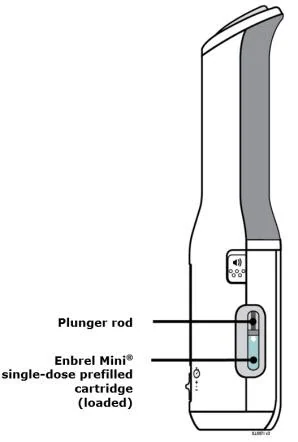
How it works.
When you push the status button to start an injection, the AutoTouch® reusable autoinjector pushes a hidden needle out of the Enbrel Mini® single-dose prefilled cartridge into your skin. Then, a plunger rod will push into Enbrel Mini, injecting medicine into your body. After the medicine is injected, the rod will pull back up and the needle will withdraw from your skin. After a successful injection all lights will turn off and the door will open. The needle stays hidden at all times during the injection process.
What you will hear.
Needle insertion and plunger rod are operated by motors. You will hear a motor noise as the rod moves down and then back up again. Whenever you hear a motorized noise, you will know that an injection is in progress.
What you will see.
During the injection, the viewing window light will be on, and the plunger rod will move through the window. Also during the injection, the status light will be flashing green, and the progress bar will decrease. After a successful injection, the progress bar, and status button will turn off, and AutoTouch will open the door.
If the status light turns red, and beeps for more than a few seconds, an error has occurred. Use the troubleshooting section of this manual to see what to do if this happens.
| Troubleshooting: Error Symbols |
Error Symbols
The AutoTouch® reusable autoinjector makes a chime sound, lights the status button red, and displays an error symbol if there is a problem.
See the following description of each error symbol, possible reasons for the error, and actions you can take.
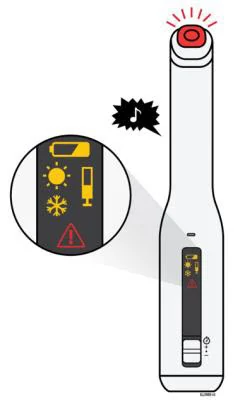
 Low battery
Symbol: Orange battery and error sound.
Problem: The battery is running very low. Less than three weeks or three injections remain. The battery has a life of two years or 130 injections from your first injection. The battery is not replaceable or rechargeable.
Action: Call 1-888-4ENBREL (1-888-436-2735) for a replacement AutoTouch reusable autoinjector.
 Battery Dead
Symbol: Orange battery and red triangle with exclamation point, red status button, and error sound.
Problem: The AutoTouch® reusable autoinjector battery is dead.
Action: Call the 1-888-4ENBREL (1-888-436-2735) for a replacement AutoTouch reusable autoinjector.
 Too hot or cold
Symbol: Orange sun and a snowflake, and an error sound.
Problem: AutoTouch is too hot or too cold. This will lock the door.
Action: Place AutoTouch at room temperature in a safe, dry place and allow it to naturally cool or warm to room temperature. Then try again. Store the AutoTouch reusable autoinjector in a dry, safe place, such as a cabinet or drawer at 50° F to 104° F (10° C to 40° C).
Troubleshooting: Error Symbols
 Enbrel Mini problem
Symbol: Orange Enbrel Mini® single-dose prefilled cartridge with blinking red status button and error alert sound.
Problem: There are five possible reasons you are getting this error. Please read below.
Problem #1: The purple cap was removed before inserting Enbrel Mini.
Action: Wait for the error to clear and close the door without Enbrel Mini in, and try again with a new Enbrel Mini. Make sure to leave the purple cap on until Enbrel Mini has been placed inside the AutoTouch® reusable autoinjector and the door is closed. Call 1-888-4ENBREL (1-888-436-2735) for a replacement Enbrel Mini.
Problem #2: Sensor lost skin contact during injection.
Action: Hold the injection end of AutoTouch on your skin throughout the entire injection until the green status button turns off, even if the motor sounds stop. Lifting or shifting on your skin during injection may lead to an incomplete injection. Call your healthcare provider if you feel you have given yourself an incomplete injection.
Problem #3: Enbrel Mini® single-dose prefilled cartridge is defective or not recognized as an Amgen product.
Action: Remove Enbrel Mini. Replace with a new Enbrel Mini. Call 1-888-4ENBREL (1-888-436-2735) for a replacement Enbrel Mini.
Problem #4: Door is held closed for more than one minute.
Action: Remove your hand from the door. When the door opens, remove Enbrel Mini from AutoTouch®, if present. Wait for the error symbol to stop blinking and close the door. If you have not given yourself an injection, place a new Enbrel Mini in AutoTouch and continue. If the error symbol remains on, call 1-888-4ENBREL (1-888-436-2735).
Problem #5: AutoTouch has been dropped.
Action: A dropped AutoTouch is not safe to use. Call 1-888-4ENBREL (1-888-436-2735) for a replacement.
Troubleshooting: Error Symbols
 Needle Exposure
Symbol: Orange Enbrel Mini® single-dose prefilled cartridge, a red triangle with an exclamation point, red status button, and error sound.
Problem: A problem occurred during an injection and the needle may be exposed.
Action: If there is still fluid in Enbrel Mini, an incomplete dose may have been injected. Call your healthcare provider if you feel you have given yourself an incomplete injection. Call 1-888-4ENBREL (1-888-436-2735) for further assistance with your AutoTouch®.
Use caution when both Enbrel Mini problem symbol and the AutoTouch® reusable autoinjector failure symbols are lit as the needle may be exposed. Take special care when removing and handling Enbrel Mini. Remove Enbrel Mini then put it in a FDA-cleared sharps disposal container.
 AutoTouch ® Reusable Autoinjector Failure
Symbol: Red triangle with an exclamation point, red status button, and error sound.
Problem: Several errors have occurred or AutoTouch has stopped working.
Action: Reset AutoTouch.
To reset AutoTouch:
Hold AutoTouch away from skin and press the status button to wake AutoTouch. The failure symbol should begin blinking and a chime should sound.
While the failure symbol is blinking, press and hold door button until all symbols are temporarily displayed and the status button blinks green. The door button should be held for at least 10 seconds. After a successful reset, if an Enbrel Mini® single-dose prefilled cartridge is still inside AutoTouch, remove it. Close the AutoTouch door. Then, for the next injection, start by pressing the door button to open Enbrel Mini door.
If AutoTouch does not respond after three attempts to reset, call 1-888-4ENBREL (1-888-436-2735).
| Troubleshooting: Common Problems |
Common Problems
Enbrel Mini® single-dose prefilled cartridge is difficult to insert into the door.
Never force Enbrel Mini into the door. When positioned correctly, it will fall freely and completely into and out of the door. If it is difficult to load, double check that you are holding Enbrel Mini as shown.
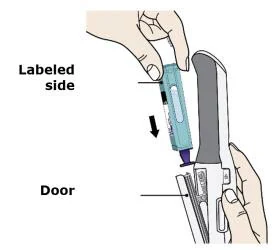
- Purple cap is facing down
- Label facing outwards (away from the handle)
Injection does not start when pressing the status button.
Reason #1 : Place the AutoTouch® reusable autoinjector on your skin and wait for the status button to turn green. A skin sensor is located on the injection end. You cannot start an injection unless the injection end of AutoTouch is touching your skin. Hold the injection end on your skin throughout the entire injection.
Reason #2 : AutoTouch may be asleep. To conserve battery power, AutoTouch goes into a “sleep mode” after three minutes of no activity. If it seems unresponsive/asleep, remove AutoTouch from your skin and press the status button to wake it up.
An Enbrel Mini error symbol appears immediately after loading the Enbrel Mini® single-dose prefilled cartridge. Reason: This will happen if the purple cap has been removed before inserting Enbrel Mini into the door. Do not reuse or recap. Begin again using a new Enbrel Mini. Do not remove the purple cap until after Enbrel Mini has been inserted into AutoTouch. |
| Troubleshooting: Common Problems |
Injection aborts or an error symbol appears while the injection is in process. The AutoTouch® reusable autoinjector will abort an injection if the sensor loses skin contact. Avoid adjusting or moving AutoTouch during an injection. Hold AutoTouch on your skin until the green status light turns off and the injection is finished. Shifting, repositioning or lifting from your skin during injection may lead to an incomplete dose. |
AutoTouch door will not remain closed. Reason #1: At the end of an injection, the door cannot be closed with a used Enbrel Mini® single-dose prefilled cartridge inside. Reason #2: When AutoTouch experiences a failure, the door will open and remain open. If this occurs, call 1-888-4ENBREL (1-888-436-2735). |
A chime is repeating but no error lights are showing. If the door is left open for more than 45 seconds, a chime will sound. Close the door to silence the chime. |
AutoTouch is not producing chiming sounds. The sound setting may be off. Turn on by sliding the sound switch down. Enbrel Mini ® single-dose prefilled cartridge will not eject. Reason #1: If the viewing window has no light, press the status button to wake up AutoTouch. Then press and hold the door button for at least two seconds to eject. Reason #2: If Enbrel Mini does not eject automatically at the end of an injection, there may be a problem. Call 1-888-4ENBREL (1-888-436-2735). |
The purple cap is very hard to remove. The purple cap should not be removed outside of the AutoTouch® reusable autoinjector. It should be removed after it is loaded into AutoTouch, when you are ready to inject. If Enbrel Mini is loaded and the purple cap is difficult to remove, call 1-888-4ENBREL (1-888-436-2735). |
The injection speed will not change during injection. Once the injection starts, the speed cannot be changed. Always set the speed prior to injection. |
The injection is faster or slower than expected. The speed switch may have been moved unintentionally. Check the speed setting prior to starting each injection. |
Storage & Handling
Storage
AutoTouch® reusable autoinjector
| Do | Do Not |
| Do store AutoTouch in dry, safe place at room temperature such as a cabinet or drawer. | Do not store AutoTouch in the refrigerator with the Enbrel Mini® single-dose prefilled cartridges. |
| Do store AutoTouch in its carton when not in use. | Do not store AutoTouch in extreme heat or cold, or in highly humid environments like the bathroom. |
Handling
AutoTouch reusable autoinjector
| Do | Do Not |
| Do inspect AutoTouch for physical damage or defects before each use. | Do not use AutoTouch if it has been dropped on a hard surface. Do not use AutoTouch if any part appears cracked or broken. |
| Do not leave AutoTouch door open for more than 45 seconds when not in use. (Chime will sound and AutoTouch will go to sleep). | |
| Do not crush, burn, heat, or incinerate the battery as this may cause a risk of fire or explosion. | |
Do not use AutoTouch if it has been dropped on a hard surface. Call 1-888-4ENBREL (1-888-436-2735) for a replacement. |
Storage and Handling
Enbrel Mini® single-dose prefilled cartridge
| Do | Do Not |
| Do store unused Enbrel Mini in the refrigerator. | Do not freeze the unused Enbrel Mini. Do not warm Enbrel Mini using a heat source such as hot water or a microwave. |
| Do make sure to hold Enbrel Mini with the labeled side facing out and slide into the door. | Do not force Enbrel Mini into the door. Do not use Enbrel Mini if it has been dropped on a hard surface. |
| Do put Enbrel Mini in the door before removing the purple cap. | Do not remove the purple cap before inserting into AutoTouch. Do not re-use or recap Enbrel Mini. |
| Do discard the purple cap immediately after removing to avoid a choking hazard. | Do not use Enbrel Mini if any part appears cracked or broken. |
Cleaning Instructions
Cleaning
AutoTouch® reusable autoinjector
| Do | Do Not |
| Do use an alcohol wipe to clean the injection end of AutoTouch before and after injections. | Do not clean AutoTouch with water. |
| Do use an alcohol wipe to clean all other areas of AutoTouch as desired. | Do not immerse AutoTouch in water. |
| Do not wipe AutoTouch with household cleanser or soap. |
| Warnings |
No modification of the AutoTouch® reusable autoinjector is allowed.
No part of AutoTouch can be repaired or replaced, including the battery.
Do not put anything inside the door other than an Enbrel Mini® single-dose prefilled cartridge.
Do not immerse AutoTouch in water.
Do not reach inside AutoTouch.
Do not crush, burn or heat AutoTouch.
AutoTouch contains moving parts. Keep your fingers out of openings in the injection end or open door.
Keep AutoTouch and Enbrel Mini out of the reach of children.
If AutoTouch fails, the maximum amount of medicine you could receive is the contents of the full Enbrel Mini, which is the correct dose.
Use caution if an error occurs as the needle may be exposed.
Carefully dispose of Enbrel Mini in an FDA approved sharps container.
Call your healthcare provider if you have any concerns regarding an incomplete injection.
When travelling, keep AutoTouch with you, in your carry-on bags.
Do not dispose of AutoTouch in the household trash. Call 1-888-4ENBREL (1-888-436-2735) for a replacement.
| Technical Information |
International Protection Rating
The international protection code for the AutoTouch® reusable autoinjector when stored in its carton is IP52. Which means it is protected from limited dust ingress and from limited dripping water. AutoTouch is not rated for dust or fluid ingress when not stored in its carton.
Environmental Operating Range
AutoTouch will operate in the temperature range of 50° F to 104° F (10° C to 40° C), and 20% to 90% relative humidity, and at elevations from 197 feet below sea level to 11,483 feet above sea level (-60 m to 3500 m).
Environmental Storage Range
Transport and store AutoTouch in its carton, in a dry place at room temperature: 50° F to 104° F (10° C to 40° C). AutoTouch been tested to a brief exposure at -40° F to 158° F (-40° C to 70° C), 50% relative humidity, and pressure equivalent of 14000 ft (4267 m).
Electromagnetic Compatibility
Avoid operating AutoTouch near microwave ovens, wireless routers, baby monitors or other common household electronics that operate using RF transmission. Two meters (six feet) is a reasonable distance.
Avoid operating AutoTouch near high magnetic or other fields such as those around MRI, CAT, or PET scanners.
AutoTouch does not emit RF.
Electrical characteristics
The AutoTouch® reusable autoinjector uses a non-replaceable, non-rechargeable DL123 Lithium battery. The battery has a nominal voltage of 3.0 V with a capacity of 1400 mAh. The expected service life of AutoTouch is two years or 130 injections from the first injection.
AutoTouch has a Type BF applied part: it has a capacitive electrical sensor that is isolated by plastic from the skin.
Dimensions and weight
AutoTouch weighs 0.4 pounds (180 grams), and is 9 inches (228 mm) tall by 1.5 inches (38 mm) wide by 1.8 inches (45 mm) deep.
Biocompatibility and electrical isolation
The injection end of the reusable autoinjector is intended to come into contact with the skin (see Guide to parts). It is a Type BF applied part. This means that it is electrically isolated from the battery. The injection end and finger grip of AutoTouch are made of ABS plastic. This material has been biocompatibility-tested for skin sensitivity and irritation.
| Symbol Table | |
 | Do not re-use |
 | Use-by date (Exp. date) |
 | Lot number |
 | Keep dry |
 | Serial number |
 | Type BF applied part Injection end of device is a Type BF applied part. |
 | CAUTION, consult accompanying documents |
 | Refer to instructions for use |
 | Do not use if package is damaged |
 | This product contains dry natural rubber |
AMGEN®
Manufactured by:
Immunex Corporation
Thousand Oaks, CA 91320-1799
©1998 – 2018 Immunex Corporation. All rights reserved.
[partnumber]
Revised: 12/2018 v5

AMGEN®
AutoTouch Connect®
reusable autoinjector for use with
Enbrel Mini® (etanercept)
single-dose prefilled cartridge
User Manual
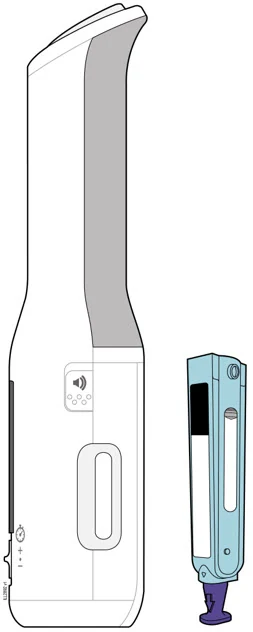 |
 |
| Table of Contents | |
| Getting Started | 4 |
| Resources | 5 |
| Guide to Parts | 6 |
| Troubleshooting: Error Symbols | 16 |
| Troubleshooting: Common Problems | 24 |
| Storage & Handling | 30 |
| Cleaning Instructions | 32 |
| Warnings | 33 |
| Technical Information | 34 |
| Symbol Table | 41 |
Getting Started
This AutoTouch Connect® User Manual contains helpful information about your AutoTouch Connect reusable autoinjector. It includes resources, care details, and a troubleshooting guide to save for ongoing reference.
To learn how to inject using the autoinjector, see your healthcare provider for injection training and use the Instructions for Use included in the carton.
Instructions for Use
Step-by-step Instructions for Use are provided in the carton, which provides you with full instructions to learn how to give yourself a safe, successful, and accurate injection.
Note: Please read the full Instructions for Use included in the carton.
Resources
We're right here, right when you need u s.
Personalized patient support designed for you.
AMGEN Support+
With financial support resources and other helpful patient services, we are here to help you along the way.
Call 1-888-4ENBREL (1-888-436-2735) or visit enbrel.com/support to find out more.
 | |
| Scan the QR code for more information |
Additional support
Scan the QR code for some helpful things to know as you get started.
 | |
| ENBRELinjection.com |
Guide to Parts
AutoTouch Connect reusable autoinjector
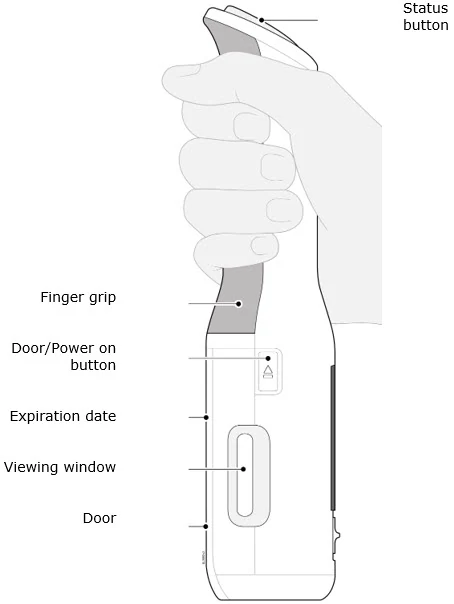
Finger grip
When injecting, hold the autoinjector with fingers wrapped around the gray finger grip.
Door/Power on button
Press this button to power on and open the door for insertion of the cartridge. When your injection is finished, the door will open automatically.
Expiration date (Exp.)
Confirm expiration date printed on the autoinjector label has not passed. If the expiration date is within 1 month, call 1-888-4ENBREL (1-888-436-2735) for a replacement.
Viewing window
During an injection, you can look through this window and see the plunger lowering to deliver your medicine. When the autoinjector is awake, the viewing window will light up. If the cartridge is in the autoinjector, and the viewing window has no light, then press the status button to wake up the autoinjector.
 |  | ||
Asleep (light off) | Awake (light on) |
Door
You will open this door and insert the cartridge into the autoinjector. The door will open automatically when your injection is finished. When inserted properly, the cartridge will slide freely and completely into and out of the door.
Guide to Parts
AutoTouch Connect reusable autoinjector
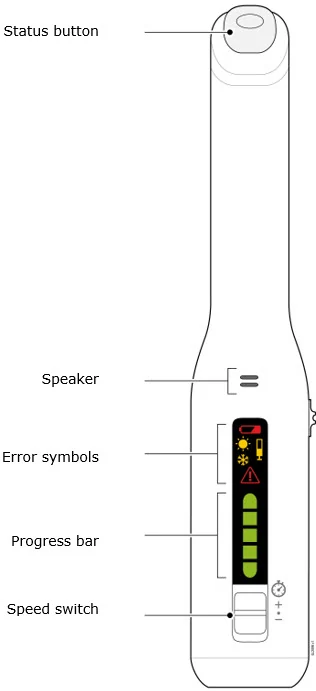
Status button
Press this button to begin an injection. Lights will indicate the status of your injection.
 | Green: Ready to press and start injection. |
 | Flashing green: The needle is inserted and your injection is in progress. |
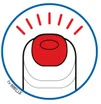 | Red: An error has occurred. See the Troubleshooting section of this manual. |
Progress bar
These stacked green bars are fully lit when your injection starts, and the bar of lights decrease as your injection is in progress. The lights will disappear when your injection is finished.
Speed switch
The autoinjector allows you to choose from 3 injection speeds. The pre-set speed is medium (•).
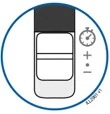 |  |  |
| (+) fast | (•) medium | (–) slow |
Guide to Parts
AutoTouch Connect reusable autoinjector
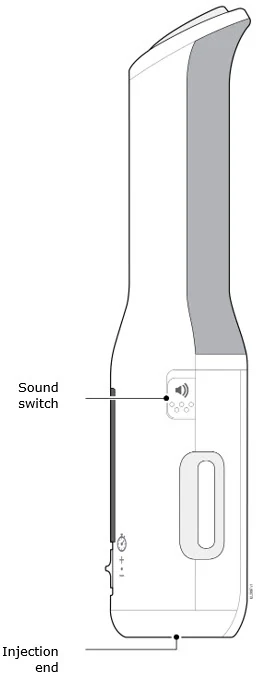
Sound switch
Sounds can be turned off and on.
Note: Error sounds will still be heard if the sounds have been turned off.
 | Sounds on: Slide switch down. | |
 | Sounds off: Slide switch up so that the red bar is visible. |
Injection end
The entire injection end must be touching your skin during injections. This is also where the needle will come out.
Skin sensor
A skin sensor is located on the injection end. When the injection end is placed on skin the status button light will turn green. Hold the injection end flat and steady on your skin throughout the entire injection process.
Site light
When the cartridge is loaded and the purple needle cap is removed, the injection end will light up to help you see your injection site. Do not remove the purple needle cap on the cartridge before loading it into the autoinjector.
Guide to Parts
Enbrel Mini single-dose prefilled cartridge
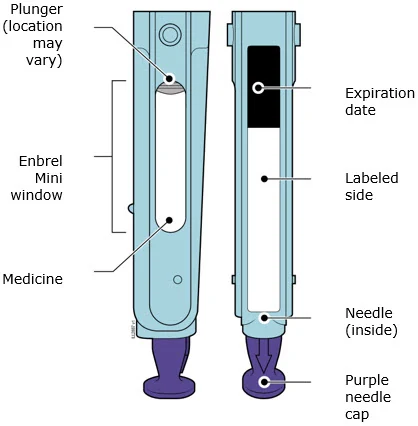
Enbrel Mini window
This is where you will look to examine your medicine before starting an injection. See Instructions for Use for more information.
Expiration date
Confirm expiration date printed on the cartridge label has not passed.
Labeled side
When inserting the cartridge make certain that the labeled side is facing out. Then slide the cartridge into the door. It will slide all the way down into the autoinjector.
Purple needle cap
The purple needle cap keeps your medicine safe. Do not remove the purple needle cap on the cartridge before loading it into the autoinjector. Load the cartridge with the purple needle cap on, and remove the cap only when you are ready to give yourself the injection. Do not leave the purple needle cap off for more than 5 minutes. This can dry out the medicine.
See the Instructions for Use for more details about loading the cartridge and when to remove the purple needle cap.
Guide to Parts
AutoTouch Connect reusable autoinjector
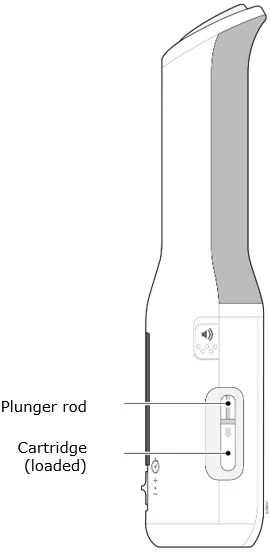
How it works.
When you push the status button to start an injection, the autoinjector pushes a hidden needle out of the cartridge into your skin. Then, a plunger rod will push into the cartridge, injecting medicine into your body. After the medicine is injected, the rod will pull back up and the needle will withdraw from your skin. After a successful injection all lights will turn off and the door will open. The needle stays hidden at all times during the injection process.
What you will hear.
Needle insertion and plunger rod are operated by motors. You will hear a motor noise as the rod moves down and then back up again. Whenever you hear a motorized noise, you will know that an injection is in progress.
What you will see.
During the injection, the viewing window light will be on, and the plunger rod will move through the window. Also during the injection, the status light will be flashing green, and the progress bar will decrease. After a successful injection, the progress bar, and status button will turn off, and the autoinjector will open the door.
If the status light turns red, and beeps for more than a few seconds, an error has occurred. Use the Troubleshooting section of this manual to see what to do if this happens.
Troubleshooting:
Error Symbols
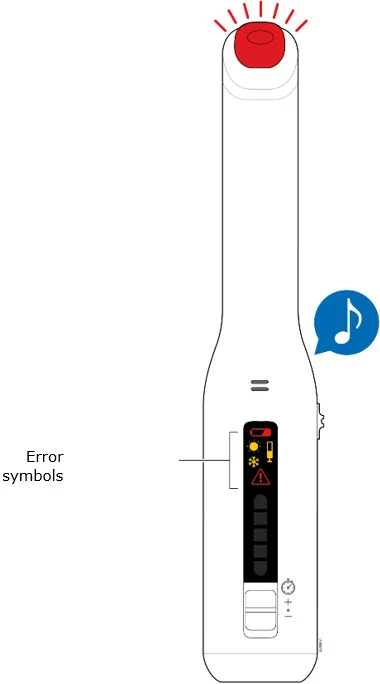
Error Symbols
If an error occurs with your autoinjector, you will hear an error sound, the status button will flash red, and an error symbol will be displayed.
See the following description of each error symbol, possible reasons for the error, and actions you can take.
 | Low battery See page 18 |
 | Needle exposure See page 18 |
 | Battery dead See page 19 |
 | Too hot or too cold See page 19 |
 | Enbrel Mini problem See page 20-21 |
 | Autoinjector detected problem See page 22-23 |
 | Low battery |
| Symbol: Red battery and error sound. |
Problem: The battery is running very low. Less than 3 weeks or 3 injections remain.
Action: Call 1-888-4ENBREL (1-888-436-2735) for a replacement autoinjector.
Note: Your autoinjector can continue to be used for up to 3 weeks or 3 injections. The battery is not replaceable or rechargeable.
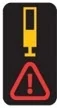 | Needle exposure |
| Symbol: Orange cartridge, red triangle with exclamation point, flashing red status button, and error sound. |
Problem: A problem occurred during an injection and the needle may be exposed.
Action: Reset the autoinjector, see "Reset instructions" on page 23.
If there is still fluid in the cartridge, an incomplete dose may have been injected. Call your healthcare provider if you feel you have given yourself an incomplete injection.
Call 1-888-4ENBREL (1-888-436-2735) for further assistance with your autoinjector.
Use caution when both the "Enbrel Mini problem" symbol and the "Autoinjector detected problem" symbols are lit as the needle may be exposed. Take special care when removing and handling the cartridge. Remove the cartridge and put in an FDA-cleared sharps disposal container.
 | Battery dead |
| Symbol: Red battery, red triangle with exclamation point, flashing red status button, and error sound. |
Problem: The autoinjector battery is dead.
Action: Call 1-888-4ENBREL (1-888-436-2735) for a replacement autoinjector.
 | Too hot or too cold |
| Symbol: Orange sun, snowflake, flashing red status button, and error sound. |
Problem: The autoinjector is too hot or too cold. This will lock the door.
Action: Place the autoinjector at room temperature in a dry, safe place and allow it to naturally cool or warm to room temperature. Then try again.
Store the autoinjector in a dry, safe place, such as a cabinet or drawer at 50°F to 104°F (10°C to 40°C). Do not store the autoinjector in the refrigerator.
 | Enbrel Mini problem |
| Symbol: Orange cartridge, flashing red status button, and error sound. |
There are 5 main reasons this error may happen. See list below:
Problem #1: The purple needle cap was removed from the cartridge before inserting into the autoinjector.
Action: Wait 2 minutes for the error to clear. Remove the cartridge. Close the door without the cartridge inserted. Start over with a new cartridge.
Make sure to leave the purple needle cap on until the cartridge has been placed inside the autoinjector and the door is closed.
Call 1-888-4ENBREL (1-888-436-2735) for a replacement cartridge and instructions on what to do with the uncapped cartridge.
- OR -
Problem #2: The autoinjector was lifted from the skin before the injection was complete.
Action: Hold the autoinjector flat and steady on your skin throughout the entire injection until the green status button turns off, even if the motor sounds stop.
Lifting or shifting on your skin during the injection may lead to an incomplete injection. Call your healthcare provider if you feel you have given yourself an incomplete injection.
- OR –
Problem #3: The cartridge is defective or is not recognized as an Amgen product.
Action: Remove the cartridge. Start over with a new cartridge.
Call 1-888-4ENBREL (1-888-436-2735) for a replacement cartridge and instructions on what to do with the defective cartridge.
- OR -
Problem #4: Door is held closed for more than 1 minute.
Action: Remove your hand from the door, and the door will open automatically. When the door opens, remove the cartridge (if one is present). Wait for the error symbol to stop flashing, then close the door.
If you have not given yourself an injection, start over with a new cartridge. If the error symbol remains on, call 1-888-4ENBREL (1-888-436-2735).
- OR -
Problem #5: Autoinjector has been dropped.
Action: A dropped autoinjector is not safe to use. Call 1-888-4ENBREL (1-888-436-2735) for a replacement.
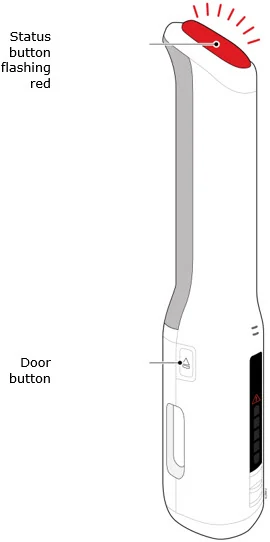
 | Autoinjector detected problem |
| Symbol: Red triangle with an exclamation point, flashing red status button, and error sound. |
Problem: Several errors have occurred or the autoinjector has stopped working.
Action: Reset the autoinjector by following the steps below.
Reset instructions:
- 1. Hold the autoinjector away from the skin.
- 2.
Press and release the status button.

- 3.
Press and hold the door button until the status button flashes green. This will take 10-15 seconds.

The autoinjector is reset and ready to use when:
- all error symbols are displayed, and
- the status button flashes green.
- After a successful reset, if the cartridge is still inside the autoinjector, remove it. Close the autoinjector door.
If the autoinjector does not respond after 3 attempts to reset, call 1-888-4ENBREL (1-888-436-2735).
Troubleshooting:
Common Problems
Common Problems
See the following description of common problems, possible causes, and actions you can take. If you are unable to resolve your issue, please call 1-888-4ENBREL (1-888-436-2735) for additional support.
- Cartridge is difficult to insert into the door. See page 25
- Injection does not start when pressing the status button. See page 26
- The status light will not turn green when placed on skin. See page 26
- An error symbol appears immediately after loading the cartridge. See page 26
- Injection aborts and an error symbol appears while the injection is in process. See page 27
- Autoinjector door will not remain closed. See page 27
- A chime is repeating but no error lights are showing. See page 28
- Autoinjector is not producing chiming sounds. See page 28
- The cartridge will not eject. See page 28
- The purple needle cap is very hard to remove. See page 29
- The injection speed will not change during the injection. See page 29
- The injection is faster or slower than expected. See page 29
Cartridge is difficult to insert into the door.
Problem: The cartridge is not positioned correctly to insert into the autoinjector.
Action: Do not force the cartridge into the door. Insert the cartridge with the purple needle cap down and the labeled side facing out. The cartridge will slide all the way down into the autoinjector.
If the cartridge is difficult to insert, double check that the:
- purple needle cap is down, and
- labeled side is facing out.
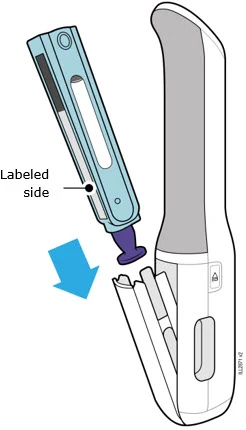
Injection does not start when pressing the status button.
Problem: The autoinjector is not in full contact with your skin.
Action: Place the autoinjector with the entire injection end flat against your skin and wait for the status button to turn green.
A skin sensor is located on the injection end. You cannot start an injection unless the injection end of the autoinjector is touching your skin. Hold the injection end on your skin throughout the entire injection.
The status light will not turn green when placed on skin.
Problem: The autoinjector may be asleep.
Action: If the autoinjector seems unresponsive, or the viewing window has no light, remove the autoinjector from your skin and press the status button to wake it up.
Note: To conserve battery power, the autoinjector goes into a "sleep mode" after 3 minutes of no activity.
An error symbol appears immediately after loading the cartridge.
Problem: The purple needle cap has been removed before inserting the cartridge into the autoinjector.
Action: Do not reuse or recap the cartridge. Start over with a new cartridge.
Do not remove the purple needle cap until after the cartridge has been inserted into the autoinjector. Only remove the purple needle cap when you can inject right away (within 5 minutes) as the medicine can dry out.
Injection aborts and an error symbol appears while the injection is in process.
Problem: The autoinjector will abort an injection if the skin sensor loses skin contact.
Action: Avoid adjusting or moving the autoinjector during an injection. Hold the autoinjector flat and steady on your skin until the green status light turns off and the injection is finished. Shifting, repositioning, or lifting from your skin during injection may lead to an incomplete dose.
Autoinjector door will not remain closed.
Problem#1: At the end of an injection, the door cannot be closed with a used cartridge inside.
Action: Remove the cartridge and close the door.
- OR -
Problem#2: When the autoinjector experiences a failure, the door will open and remain open.
Action: See "Reset instructions" on page 23 to reset the autoinjector or call 1-888-4ENBREL (1-888-436-2735).
A chime is repeating but no error lights are showing.
Problem: If the door is left open for more than 45 seconds, a chime will sound.
Action: Close the door to silence the chime.
The autoinjector is not producing chiming sounds.
Problem: The sound setting may be turned off.
Action: Turn on by sliding the sound switch down (see page 11).
The cartridge will not eject.
Problem#1: The autoinjector is asleep.
Action: If the viewing window has no light, press the status button to wake up the autoinjector. Then press and hold the door button for at least 2 seconds to eject.
- OR -
Problem#2: The cartridge does not eject automatically at the end of an injection.
Action: Call 1-888-4ENBREL (1-888-436-2735).
The purple needle cap is very hard to remove.
Problem: The purple needle cap should only be removed after the cartridge is loaded into the autoinjector and you are ready to inject.
Do not remove the purple needle cap until after the cartridge has been inserted into the autoinjector. Do not leave the purple needle cap off for more than 5 minutes. This can dry out the medicine.
Action: If the cartridge is loaded and the purple needle cap is difficult to remove, call 1-888-4ENBREL (1-888-436-2735).
The injection speed will not change during the injection.
Problem: Once the injection starts, the speed cannot be changed.
Action: Always set the speed prior to injection (see page 9).
The injection is faster or slower than expected.
Problem: The speed switch may have been moved unintentionally.
Action: Check the speed setting prior to starting each injection (see page 9).
Storage & Handling
Storage: Autoinjector
| Do | Do Not |
|---|---|
| Do store the autoinjector in dry, safe place at room temperature such as a cabinet or drawer. | Do not store the autoinjector in the refrigerator with the cartridges. |
| Do store the autoinjector in its carton when not in use. | Do not store the autoinjector in extreme heat or cold, or in highly humid environments like the bathroom. |
Handling: Autoinjector
| Do | Do Not |
|---|---|
| Do inspect the autoinjector for physical damage or defects before each use. | Do not use the autoinjector if it has been dropped on a hard surface. Call 1-888-4ENBREL (1-888-436-2735) for a replacement. |
| Do not use the autoinjector if any part appears cracked or broken. | |
| Do not leave the autoinjector door open for more than 45 seconds when not in use. (Chime will sound and the autoinjector will go to sleep). | |
| Do not crush, burn, heat, or incinerate the battery as this may cause a risk of fire or explosion. |
Storage and Handling: Cartridge
| Do | Do Not |
|---|---|
| Do store unused cartridges in the refrigerator. | Do not freeze the unused cartridges. Do not warm the cartridges using a heat source such as hot water or a microwave. |
| Do make sure to hold the cartridge with the labeled side facing out and slide into the door. | Do not force the cartridge into the door. Do not use the cartridge if it has been dropped on a hard surface. |
| Do put the cartridge in the door before removing the purple needle cap. | Do not remove the purple needle cap before inserting into the autoinjector. Do not re-use or recap the cartridge. |
| Do discard the purple cap immediately after removing to avoid a choking hazard. | Do not use the cartridge if any part appears cracked or broken. |
Cleaning Instructions
Cleaning: Autoinjector
| Do | Do Not |
|---|---|
| Do use an alcohol wipe to clean the injection end of the autoinjector before and after injections. | Do not clean the autoinjector with water. |
| Do use an alcohol wipe to clean all other areas of the autoinjector as desired. | Do not immerse the autoinjector in water. |
| Do not wipe the autoinjector with household cleanser or soap. |
Warnings
- No modification of the autoinjector is allowed.
- No part of the autoinjector can be repaired or replaced, including the battery.
- Do not put anything inside the door other than the cartridge.
- Do not immerse the autoinjector in water.
- Do not reach inside the autoinjector.
- Do not crush, burn, or heat the autoinjector.
- The autoinjector contains moving parts. Keep your fingers out of openings in the injection end or door.
- Keep the autoinjector and cartridge out of the reach of children.
- If the autoinjector fails, the maximum amount of medicine you could receive is the contents of the full cartridge, which is the correct dose.
- Use caution if an error occurs as the needle may be exposed.
- Carefully dispose of the cartridge in an FDA-cleared sharps disposal container.
- Call your healthcare provider if you have any concerns regarding an incomplete injection.
- When travelling, keep the autoinjector with you, in your carry-on bags.
- Do not dispose of the autoinjector in the household trash. Call 1-888-4ENBREL (1-888-436-2735) for a replacement.
Technical Information
This AutoTouch Connect ® reusable autoinjector has a Bluetooth® wireless feature, which is designed to communicate wirelessly with an application on your mobile device to help you track your injections.
Currently, there is no mobile application available for use with this wireless feature. This wireless feature will not affect your injection steps.
You can inject without using the wireless feature. Always follow all steps found in the Instructions for Use.
Important Information Required by the Federal Communications Commission (FCC)
FCCID: 2AGZ4–ATCONNECT
The AutoTouch Connect ® reusable autoinjector contains a Bluetooth ® wireless feature.
AutoTouch Connect complies with Part 15 of the FCC Rules.
Operation is subject to the following two conditions:
- 1. AutoTouch Connect may not cause harmful interference.
- 2. AutoTouch Connect must accept any interference received, including interference that may cause undesirable operation.
Modification to AutoTouch Connect shall not be made without the written consent of Amgen.
Unauthorized modification may void the authority granted under FCC rules permitting the operation of AutoTouch Connect.
AutoTouch Connect has been tested and found to comply with the limits for a Class B digital device, pursuant to part 15 of the FCC Rules. These limits are designed to provide reasonable protection against harmful interference in a residential installation. AutoTouch Connect generates, uses, and can radiate radio frequency energy and, if not installed and used in accordance with the instructions, may cause harmful interference to radio communications. However, there is no guarantee that interference will not occur in a particular installation.
If AutoTouch Connect ® does cause harmful interference to radio or television reception, which can be determined by moving AutoTouch Connect far away and back, the user is encouraged to try to correct the interference by one or more of the following measures:
- Reorient or relocate the receiving antenna.
- Increase the separation between AutoTouch Connect and interference receiver.
- Consult the dealer or an experienced radio/TV technician for help.
The Bluetooth ® word mark and logos are registered trademarks owned by Bluetooth Special Interest Group (SIG) Inc. and any use of such marks by Amgen is under license. Other trademarks and trade names are those of their respective owners.
Technical Information
International Protection Rating
The international protection code for the AutoTouch Connect ® reusable autoinjector when stored in its carton is IP52. Which means it is protected from limited dust ingress and from limited dripping water. AutoTouch Connect is not rated for dust or fluid ingress when not stored in its carton.
Environmental Operating Range
AutoTouch Connect will operate in the temperature range of 50°F to 104°F (10°C to 40°C), and 20% to 90% relative humidity, and at elevations from 197 feet below sea level to 11,483 feet above sea level (-60 m to 3500 m).
Environmental Storage Range
Transport and store AutoTouch Connect in its carton, in a dry place at room temperature: 50°F to 104°F (10°C to 40°C). AutoTouch Connect has been tested to a brief exposure at −40°F to 158°F (-40°C to 70°C), 50% relative humidity, and pressure equivalent of 14,000 feet (4267 m).
Bluetooth® Characteristics
The Bluetooth technology in the AutoTouch Connect complies with the Bluetooth Core Specification v5.0 and is qualified by Bluetooth SIG. The AutoTouch Connect has been designed to transmit default 0dBm standard industrial, scientific and medical (ISM) 2.4GHz band radio frequency (RF) and covers up to 10 meters communication range.
Quality of Service and Security Information
The AutoTouch Connect autoinjector has a Bluetooth wireless feature to establish an authenticated and encrypted connection with a Bluetooth capable device (e.g. mobile application). Initial setup requires physical access to the autoinjector labeled serial number for user input at initial pairing/secure bonding. There is no mobile application currently available.
Data is transferred from the autoinjector on a one-to-one paired mobile device for ensuring data integrity and quality of service (QoS). Data transferred is read-only and no patient information is stored on the autoinjector.
Data can be sent at any time, and temporary loss of proper QoS will be resolved upon resumed connection to the app. If connection with the app drops and re-establishes, data transfer resumes with data integrity verification. Data transfer latency or asynchronization does not affect drug delivery tracking as data will be confirmed upon reconnection.
Electromagnetic Compatibility
Portable and mobile RF communications equipment can affect medical electrical equipment. Avoid operating AutoTouch Connect near microwave ovens, wireless routers, baby monitors or other common household electronics that operate using RF transmission, including RFID emitters. A minimum distance of 30 cm (12 inches) is recommended.
Avoid operating AutoTouch Connect near high magnetic or other fields such as those around MRI, CAT, or PET scanners.
AutoTouch Connect emits RF.
Technical Information
Electromagnetic Emissions
| The autoinjector is intended for use in the electromagnetic environment specified below. The user of the autoinjector should ensure that it is used in such an environment. | ||
|---|---|---|
| Emissions Test | Compliance | Electromagnetic Environment - Guidance |
RF Emissions (CISPR 11) | Group 1 | The autoinjector uses RF energy for its internal and system interface functions. Its RF emissions are very low and are not likely to cause any interference in nearby electronic equipment. |
RF Emissions (CISPR 11) | Class B | The autoinjector is suitable for use in all establishments, including domestic establishments and those directly connected to the public low-voltage power supply network that supplies buildings used for domestic purposes. |
| Harmonic emissions IEC 61000-3-2 | Not Applicable | |
| Voltage fluctuations/flicker emissions IEC 61000-3-3 | Not Applicable | |
Electromagnetic Immunity
The autoinjector is intended for use in the electromagnetic environment specified below. The user of this autoinjector should ensure that it is used in such an environment. | |||
|---|---|---|---|
| Immunity Test | IEC 60601 Test Level | Compliance Level | Electromagnetic Environment-Guidance |
Electrostatic Discharge (ESD) IEC 61000-4-2 | ±8 kV Contact ±15 kV Air | ±15 kV Contact ±20 kV Air | Floors should be wood, concrete or ceramic tile. If floors are synthetic, the relative humidity should be at least 30%. |
Power Frequency 50/60 Hz Magnetic Fields IEC 61000-4-8 | 30 A/m | 30 A/m at 60 Hz | Power frequency magnetic fields should be that of typical commercial or hospital environment. |
RF Electro- magnetic Field IEC 61000-4-3 | 10 V/m 80 MHz – 2.5 GHz | (E1) = 10 V/m 26 MHz – 2.7 GHz | Portable and mobile RF communications equipment should be separated from the device by no less than the distances of 30 cm. |
Technical Information
Electrical characteristics
The AutoTouch Connect® reusable autoinjector uses a non-replaceable, non-rechargeable DL123 Lithium battery. The battery has a nominal voltage of 3.0 V with a capacity of 1400 mAh.
The autoinjector enclosure is a Type BF applied part:
The skin sensor and other electronics are isolated from the skin.
Dimensions and weight
AutoTouch Connect weighs 0.4 pounds (180 grams), and is 9 inches (228 mm) tall by 1.5 inches (38 mm) wide by 1.8 inches (45 mm) deep.
Biocompatibility and electrical isolation
The autoinjector enclosure is intended to come into contact with the skin (see Guide to Parts). It is a Type BF applied part. This means that it is electrically isolated from the battery. The injection end and finger grip of AutoTouch Connect® are made of ABS plastic. This material has been biocompatibility-tested for skin sensitivity and irritation.
Contraindications
This device is contraindicated for use in a Magnetic Resonance (MR) environment. For contraindications of ENBREL® please refer to ENBREL prescribing information.
Symbol Table
 | Do not re-use |
 | Use-by date (Exp. date) |
 | Lot number |
 | Keep dry |
 | Serial number |
 | Type BF applied part The autoinjector enclosure is a Type BF applied part. |
 | CAUTION, consult accompanying documents |
 | Refer to instructions for use |
 | Do not use if package is damaged |
 | Magnetic Resonance (MR) Unsafe |
AMGEN
Manufactured by:
Immunex Corporation
Thousand Oaks, CA 91320-1799
©2026 Immunex Corporation.
All rights reserved.
Revised: 05/2026 v6
 This printed material is recyclable.

Instructions for Use
Enbrel® (en-brel)
(etanercept)
injection, for subcutaneous use
single-dose vial
Read this Instructions for Use before you start taking Enbrel and each time you get a refill. There may be new information. This information does not take the place of talking to your healthcare provider about your medical condition and treatment.
Step 1: Set up
1a. Strength and dose
The strength of the Enbrel single-dose vial is different than the Enbrel multiple-dose vial.
Each single-dose vial contains 25 mg (0.5 mL).
Review your prescription carefully for dose and dosing schedule. Only inject Enbrel after you or your caregiver has received training by your healthcare provider. Your healthcare provider will tell you how often you should use Enbrel. Do not use Enbrel more often than directed by your healthcare provider. If you forget to use Enbrel, inject your dose right away. Inject your next dose at your regular scheduled time. If you do not know when to inject Enbrel, call your healthcare provider or pharmacist.
Keep Enbrel out of the reach of children.

1b. Store Enbrel single-dose vials
Store Enbrel in the refrigerator between 36°F to 46°F (2°C to 8°C). You may also store the Enbrel single-dose vials at room temperature between 68°F to 77°F (20°C to 25°C) for up to 30 days. Throw away Enbrel that has been stored at room temperature after 30 days.
Do not shake.
Do not freeze or store in extreme heat or cold.
Store Enbrel in the original carton to protect from light or damage.
| If your dose is 0.5 mL, or LESS |  |
| Remove 1 single-dose vial | |
| If your dose is MORE than 0.5 mL |  |
| Remove 2 single-dose vials |
1c. Remove correct number of vials
Remove the correct number of Enbrel single-dose vials from the original carton.
Check your prescription to determine if your dose will require 1 or 2 single-dose vials.
Your dose is determined in milliliters (mL).
Your child's dose of Enbrel depends on his or her weight. Your child's healthcare provider will tell you which form of Enbrel to use and how much to give your child.
| Green vial cap WAIT |
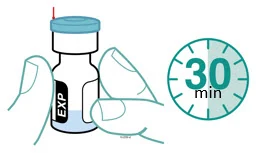 |
1d. Inspect the single-dose vial(s)
Leave the single-dose vial(s) at room temperature, with the green cap(s) on, for at least 30 minutes.
Enbrel is clear and colorless. There may be small white particles in the solution. Check the expiration date.
Keep out of direct sunlight.
Do not use Enbrel if:
- the expiration date has passed
- the green cap is not attached
- it has lumps, is discolored, or is cloudy.
If there are any issues with your Enbrel single-dose vials, please call 1-888-4ENBREL (1-888-436-2735).
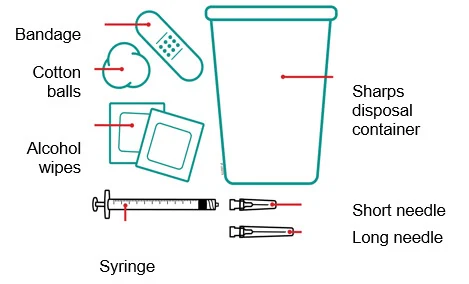
1e. Gather all materials and wash hands
Wash your hands with soap and water.
Place the following items on a clean well-lit, flat surface:
- 1 mL syringe
- Long needle: for withdrawal
- Short needle: for injection
- Alcohol wipes
- Cotton balls
- Bandage
- Sharps disposal container
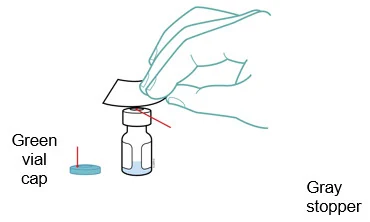
1f. Pop off the green vial cap then wipe the gray stopper
Use an alcohol wipe to clean the gray stopper.
If you require a second single-dose vial, clean the gray stopper of the second single-dose vial with a new alcohol wipe.
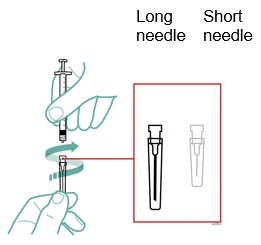
1g. Attach the long needle to the syringe
Twist the long needle onto the syringe.
Step 2: Prepare dose
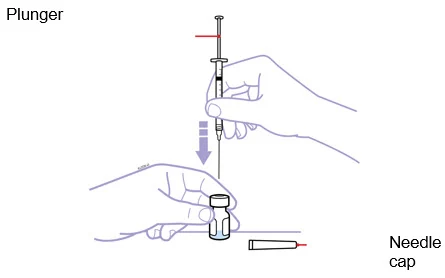
2a. Pull plunger back, insert needle, and push air into single-dose vial
Pull the needle cap straight off and away from your body. Save the needle cap for later.
Pull the syringe plunger back to 0.5 mL.
Hold the single-dose vial on a flat surface with 1 hand. Insert the long needle through the gray rubber stopper above the medicine in the single-dose vial.
Slowly push 0.5 mL of air into the single-dose vial.
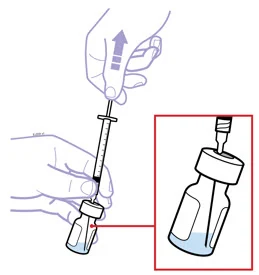
2b. Tilt the single-dose vial to withdraw all medicine
Slowly pull back the plunger to fill the syringe with all the medicine from the single-dose vial.
Remove needle from the single-dose vial.
The air in the syringe will be removed later.
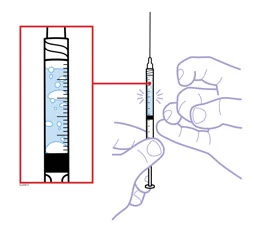
2c. Gently tap the syringe with fingers to release bubbles
Gently tap the syringe with your fingers to release air pockets and bubbles until they rise to the top of the syringe.
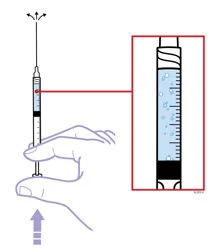
2d. Push out large air pockets and bubbles
After you have gently tapped the large air pockets and bubbles to the top of the syringe, push the plunger up to remove the air out of the syringe.
Small amounts of tiny air bubbles are ok.
If you need 1 single-dose vial, push the plunger to your total prescribed dose and continue to step 2g.
If you need more than 1 single-dose vial to get your total prescribed dose, follow these 2 steps:
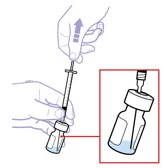 | 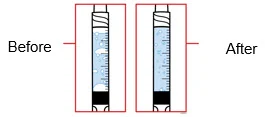 |
2e. Insert the same needle in the second vial Tilt vial to withdraw medicine. Slowly pull back the plunger to fill the syringe with all medicine from the vial. Remove the needle from the single-dose vial. The air will be removed in the next step | 2f. Gently tap the syringe to remove the air Hold the needle pointing up and gently tap the syringe so air bubbles rise to the top. Push the plunger to your prescribed dose. Small amounts of tiny air bubbles are ok. |
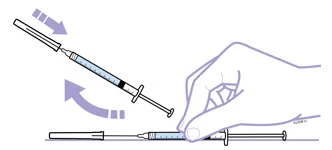 | |
2g. Use 1-handed scoop method to recap For your safety, place the needle cap on a flat surface. |
Using 1 hand, slide the needle into the cap and scoop upwards to cap the needle, without using your other hand.
Then use your other hand to secure the cap and snap into place.
Step 3: Inject and throw away
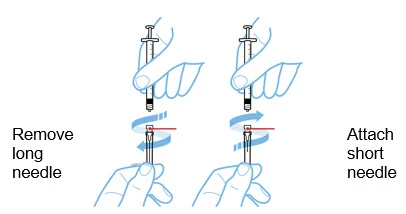
3a. Replace the long needle with the short needle
Twist the long needle off of the syringe.
Throw away the long needle in the sharps disposal container.
Twist the short needle onto the syringe.
Do not remove the needle cover until you are ready to inject.
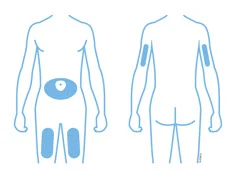
3b. Choose and clean the injection site
- thigh or stomach (avoid 2 inches around the navel)
- back of upper arm (only if someone else is giving the injection)
Choose a different site each time you give yourself an injection. Avoid injecting into tender, raised, red or scaly skin.
Clean the injection site with an alcohol wipe and let dry. Do not touch this area again before injecting.
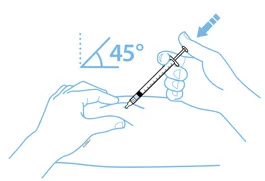
3c. Pinch and inject Enbrel
Gently pinch skin. With a quick firm action, insert the needle into your skin at a 45-degree angle.
When the needle is completely inserted into the skin, slowly push the plunger all the way down.
When the syringe is empty, remove the needle and syringe from your skin. Do not recap the needle.
Do not rub the injection site. If you see drops of blood at the injection site, you can press a cotton ball over the injection site until bleeding has stopped. Apply an adhesive bandage, if needed.
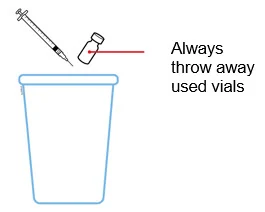
3d. Throw away the used single-dose vials, needles and syringe
Single-dose vials do not contain preservatives and are for 1-time use only. Unused medicine in the single-dose vials must be thrown away in a sharps disposal container.
Additional disposal information
Do not throw away the vials, needles, and syringe in your household trash.
If you do not have a FDA-cleared sharps disposal container, you may use a household container that is:
- made of a heavy-duty plastic
- can be closed with a tight-fitting, puncture-resistant lid without sharps being able to come out
- upright and stable during use
- leak-resistant
- properly labeled to warn of hazardous waste inside the container
When your sharps disposal container is almost full, you will need to follow your community guidelines for the right way to throw away your sharps disposal container. There may be state or local laws about how you should throw away used vials, needles and syringes.
For more information about safe sharps disposal, and for specific information about sharps disposal in the state that you live in, go to the FDA's website at: http://www.fda.gov/safesharpsdisposal
- Do not throw away your used sharps disposal container in your household trash unless your community guidelines permit this. Do not recycle your used sharps disposal container.
- Do not reuse the vials, syringe, or needles.
- Do not recycle the vials, syringe, needles, or sharps disposal container or throw them into household trash.
Important: Always keep the sharps disposal container out of the reach of children.
If you experience any difficulty using your Enbrel single-dose vials, please call 1-888-4ENBREL (1-888-436-2735).
If you have any questions about your Enbrel dosing, please call your healthcare provider.
This Instructions for Use has been approved by the U.S. Food and Drug Administration.
AMGEN
Manufactured by:
Immunex Corporation
Thousand Oaks, CA 91320-1799
U.S. License Number 1132
© 1998-2020, 2022, 2024 Immunex Corporation. All rights reserved.
[part number]
Revised: 10/2024 v3
 This printed material is recyclable.
Front Panel
Read these instructions before using Enbrel® Single-Dose Vial Instructions for Use |