


Patient information: uses, side effects, how to take - Eliquis
What is the most important information I should know about ELIQUIS?
ELIQUIS may cause serious side effects, including:
- Increased risk of blood clots if you stop taking ELIQUIS.
- ELIQUIS lowers your chance of having a stroke by helping to prevent clots from forming. If you stop taking ELIQUIS, you may have increased risk of forming a clot in your blood.
- Do not stop taking ELIQUIS without talking to the healthcare provider who prescribes it for you. Stopping ELIQUIS increases your risk of having a stroke.
- ELIQUIS may need to be stopped, if possible, prior to surgery or a medical or dental procedure. Ask the healthcare provider who prescribed ELIQUIS for you when you should stop taking it. Your healthcare provider will tell you when you may start taking ELIQUIS again after your surgery or procedure. If you have to stop taking ELIQUIS, your healthcare provider may prescribe another medicine to help prevent a blood clot from forming.
- Increased risk of bleeding. ELIQUIS can cause bleeding which can be serious and may lead to death. This is because ELIQUIS is a blood thinner medicine that reduces blood clotting.
- You may have a higher risk of bleeding if you take ELIQUIS and take other medicines that increase your risk of bleeding, including:
- aspirin or aspirin-containing products
- long-term (chronic) use of nonsteroidal anti-inflammatory drugs (NSAIDs)
- warfarin sodium
- any medicine that contains heparin
- clopidogrel
- selective serotonin reuptake inhibitors (SSRIs) or serotonin norepinephrine reuptake inhibitors (SNRIs)
- other medicines to help prevent or treat blood clots
- Tell your healthcare provider if you take any of these medicines. Ask your healthcare provider or pharmacist if you are not sure if your medicine is one listed above.
- During treatment with ELIQUIS:
- you may bruise more easily
- it may take longer than usual for any bleeding to stop
- Call your healthcare provider or get medical help right away if you or your child develop any of these signs or symptoms of bleeding during treatment with ELIQUIS:
unexpected bleeding or bruising, or bleeding that lasts a long time, such as:
- unusual bleeding from the gums
- nosebleeds that happen often
- menstrual bleeding or vaginal bleeding that is heavier than normal
- bleeding that is severe or you cannot control
- red, pink, or brown urine
- red or black stools (looks like tar)
- cough up blood or blood clots
- vomit blood or your vomit looks like “coffee grounds”
- unexpected pain, swelling, or joint pain
- headaches, feeling dizzy or weak
- Spinal or epidural blood clots (hematoma). People who take a blood thinner medicine (anticoagulant) like ELIQUIS, and have medicine injected into their spinal and epidural area, or have a spinal puncture have a risk of forming a blood clot that can cause long-term or permanent loss of the ability to move (paralysis). Your risk of developing a spinal or epidural blood clot is higher if:
- a thin tube called an epidural catheter is placed in your back to give you certain medicine
- you take NSAIDs or a medicine to prevent blood from clotting
- you have a history of difficult or repeated epidural or spinal punctures
- you have a history of problems with your spine or have had surgery on your spine
- If you take ELIQUIS and receive spinal anesthesia or have a spinal puncture, your healthcare provider should watch you closely for symptoms of spinal or epidural blood clots or bleeding. Tell your healthcare provider or get medical help right away if you have back pain, tingling, numbness, or muscle weakness, especially in your legs and feet, or loss of control of the bowels or bladder (incontinence).
- ELIQUIS is not for use in people with artificial heart valves.
- ELIQUIS is not for use in people with antiphospholipid syndrome (APS), especially with positive triple antibody testing.
What is ELIQUIS?
ELIQUIS is a prescription medicine used in adults to:
- reduce the risk of stroke and blood clots in people who have atrial fibrillation (a type of irregular heartbeat) that is not caused by a heart valve problem.
- help prevent a blood clot in the veins of your legs (deep vein thrombosis or DVT) and lungs (pulmonary embolism or PE) of people who have just had hip or knee replacement surgery.
- treat deep vein thrombosis (DVT) or pulmonary embolism (PE)
- reduce the risk of DVT or PE from happening again after receiving treatment for blood clots.
ELIQUIS is used in children from birth and older to treat blood clots in the veins of your legs and lungs (venous thromboembolism) after at least 5 days of initial anticoagulant treatment, and to reduce the risk of them happening again.
ELIQUIS was not studied and is not recommended in children who weigh less than 5.7 pounds (2.6 kg).
Do not take ELIQUIS if you or your child:
- currently have certain types of abnormal bleeding.
- have had a severe allergic reaction to apixaban or any of the ingredients in ELIQUIS. Ask your healthcare provider if you are not sure. See the end of this Medication Guide for a complete list of ingredients in ELIQUIS.
Before taking ELIQUIS, tell your healthcare provider about all of your medical conditions, including if you or your child:
- have or ever had bleeding problems
- have kidney or liver problems
- have antiphospholipid syndrome (APS)
are pregnant or plan to become pregnant. It is not known if ELIQUIS will harm your unborn baby.
- Tell your healthcare provider right away if you become pregnant during treatment with ELIQUIS. Taking ELIQUIS during pregnancy may increase the risk of bleeding in you or in your unborn baby.
- Females who are able to become pregnant: Talk with your healthcare provider about pregnancy planning during treatment with ELIQUIS. Talk with your healthcare provider about your risk for severe uterine bleeding if you are treated with ELIQUIS.
- If you take ELIQUIS during pregnancy, tell your healthcare provider right away if you develop any signs or symptoms of bleeding or blood loss. See “What is the most important information I should know about ELIQUIS?” for signs and symptoms of bleeding.
- are breastfeeding or plan to breastfeed. It is not known if ELIQUIS passes into your breast milk. Do not breastfeed during treatment with ELIQUIS. Talk to your healthcare provider about the best way to feed your baby during treatment with ELIQUIS.
Tell all of your healthcare providers and dentists that you or your child are taking ELIQUIS. They should talk to the healthcare provider who prescribed ELIQUIS for you, before you have any surgery, medical or dental procedure.
Tell your healthcare provider about all the medicines you or your child take, including prescription and over-the-counter medicines, vitamins, and herbal supplements.
Some of your other medicines may affect the way ELIQUIS works, causing side effects. Certain medicines may increase your risk of bleeding or stroke when taken with ELIQUIS. See “What is the most important information I should know about ELIQUIS?”
Know the medicines you take. Keep a list of them to show your healthcare provider and pharmacist when you get a new medicine.
How should I take ELIQUIS?
- Take ELIQUIS exactly as prescribed by your healthcare provider.
- Take ELIQUIS 2 times every day.
- Do not change your dose or stop taking ELIQUIS unless your healthcare provider tells you to.
- If you or your child misses a dose of ELIQUIS, take it as soon as you remember on the same day. Do not take 2 doses of ELIQUIS at the same time to make up for a missed dose. Return to your usual dosing schedule the next day.
- For adults and children weighing at least 77 pounds (35 kg), if you have trouble swallowing the tablet whole, talk to your healthcare provider about other ways to take ELIQUIS tablets.
- Your healthcare provider will decide how long you should take ELIQUIS. Do not stop taking it without first talking with your healthcare provider.
- Do not run out of ELIQUIS. Refill your prescription before you run out. When leaving the hospital following hip or knee replacement, be sure that you will have ELIQUIS available to avoid missing any doses.
- If you take too much ELIQUIS, call your healthcare provider or go to the nearest hospital emergency room right away.
- Call your healthcare provider or healthcare provider right away if you fall or injure yourself, especially if you hit your head. Your healthcare provider or healthcare provider may need to check you.
For children who take ELIQUIS:
- See the detailed Instructions for Use that comes with ELIQUIS SPRINKLE for oral suspension or ELIQUIS tablets for oral suspension for information on how to prepare and give a dose of ELIQUIS to children who weigh less than 77 pounds (35 kg).
- Always give ELIQUIS exactly as your child’s healthcare provider or pharmacist has told you.
- The dose of ELIQUIS is based on your child’s body weight. Your child’s healthcare provider may need to change your child’s dose as their weight changes. Do not change your child’s dose without talking with the healthcare provider.
- If a child vomits or spits up within 30 minutes after taking ELIQUIS, repeat the dose. If a child vomits or spits up more than 30 minutes after taking ELIQUIS, do not repeat the dose. Continue to give the next ELIQUIS dose at the next scheduled time.
- Contact the healthcare provider if your child repeatedly vomits or spits up after taking ELIQUIS.
What are the possible side effects of ELIQUIS?
- See “What is the most important information I should know about ELIQUIS?”
The most common side effect of ELIQUIS in adults was bleeding.
The most common side effect of ELIQUIS in children include:
- headache
- heavy menstrual bleeding
- vomiting
These are not all of the possible side effects of ELIQUIS.
Call your doctor for medical advice about side effects. You may report side effects to FDA at 1-800-FDA-1088.
How should I store ELIQUIS?
Store ELIQUIS at room temperature between 68°F to 77°F (20°C to 25°C).
Keep ELIQUIS and all medicines out of the reach of children.
General Information about the safe and effective use of ELIQUIS.
Medicines are sometimes prescribed for purposes other than those listed in a Medication Guide. Do not use ELIQUIS for a condition for which it was not prescribed. Do not give ELIQUIS to other people, even if they have the same symptoms that you have. It may harm them. You can ask your pharmacist or healthcare provider for information about ELIQUIS that is written for health professionals.
What are the ingredients in ELIQUIS?
Active ingredient: apixaban
Inactive ingredients:
ELIQUIS tablets 2.5 mg and 5 mg: anhydrous lactose, croscarmellose sodium, magnesium stearate, microcrystalline cellulose, and sodium lauryl sulfate. The film coating contains hypromellose, lactose monohydrate, titanium dioxide, triacetin, and yellow iron oxide (2.5 mg tablets) or red iron oxide (5 mg tablets).
ELIQUIS 0.5 mg film coated tablets for oral suspension: anhydrous lactose, croscarmellose sodium, magnesium stearate, microcrystalline cellulose, sodium lauryl sulfate. The film coating contains hypromellose, lactose monohydrate, red iron oxide, titanium dioxide, and triacetin.
ELIQUIS SPRINKLE 0.15 mg for oral suspension: contains hypromellose and sugar spheres.
Marketed by:
Bristol-Myers Squibb Company
Princeton, NJ 08543 USA
and
Pfizer Inc
New York, NY 10001 USA
All other trademarks are property of their respective companies.
For more information, call 1-855-354-7847 (1-855-ELIQUIS) or go to www.ELIQUIS.com.
| This Medication Guide has been approved by the U.S. Food and Drug Administration. | Revised 04/2025 |
INSTRUCTIONS FOR USE
ELIQUIS® (ELL EH KWISS)
(APIXABAN)
TABLETS
FOR ORAL SUSPENSION
Important information you need to know before giving a dose of ELIQUIS tablets for oral suspension (ELIQUIS tablets):
|
Preparing the prescribed dose of ELIQUIS tablets
There are 2 ways you can mix and give ELIQUIS tablets:
- With liquid method, using an oral dosing syringe, or
- With food method, using a small bowl and spoon.
You will need a medicine cup and oral dosing syringe (liquid mixing method) or a cup and small spoon (food mixing method) to give this medicine.
Liquid Mixing Method
❏ Step 1: Prepare Supplies
You can ask your pharmacist for the oral dosing syringe and medicine cup. | Packet(s) 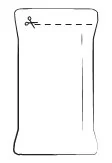 | Small spoon (not included) 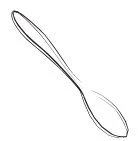 | ||||||
Medicine cup (not included) 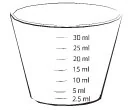 | Oral dosing syringe (not included) Small scissors (not included) 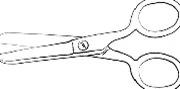 | |||||||
Mixing liquid (use infant formula, water or apple juice) (not included) 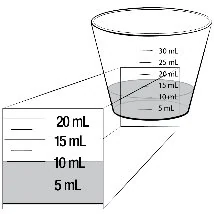 | ||||||||
❏ Step 2: Check prescription label for prescribed dose
|  | |||||||
❏ Step 3: Tap and open packet
| 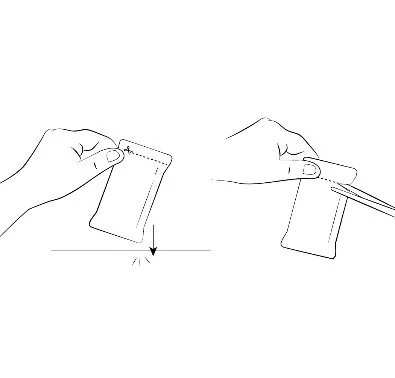 | |||||||
❏ Step 4: Empty the packet
| 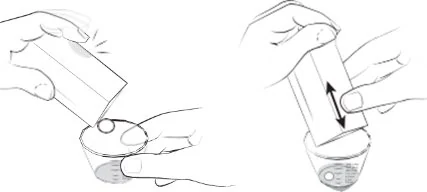 | |||||||
❏ Step 5: Add liquid to the medicine cup
Use water, infant formula, or apple juice only as the liquid. Do not use any other type of liquid. Important: To make sure your child gets the full dose, do not put the medicine in a baby bottle. | 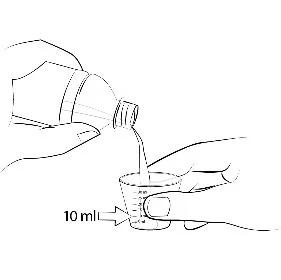 | |||||||
❏ Step 6: Mix medicine and liquid
| 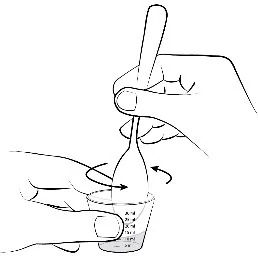 | 5 to 7 minutes  | ||||||
❏ Step 7: Give oral suspension This is a 2-part process to make sure all the medicine is given. Follow Part 1 and Part 2. Part 1: Pull up all liquid mixture with the oral dosing syringe and give all medicine in syringe. | ||||||||
| Push plunger all the way down. | Place the syringe tip into the cup and pull up all the liquid mixture. | With the child seated upright or slightly inclined (tilted back), place the oral syringe into the mouth with the tip along either cheek. Slowly push the plunger all the way down to give all medicine in the syringe. | ||||||
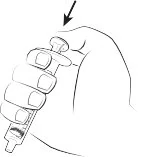 |  | 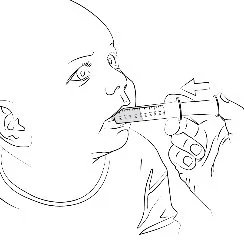 | ||||||
| Part 2: Repeat Steps 5 through 7 to give any remaining medicine in the cup: | ||||||||
Add about 5 mL (1 teaspoon) liquid to medicine cup. For children with fluid restrictions, your healthcare provider will tell you if you can use 2.5 mL (½ teaspoon) of liquid. | Gently stir liquid with small spoon. | Push plunger all the way down. | Place the syringe tip into cup and pull up all the liquid mixture. | With the child seated upright or slightly inclined (tilted back), place the oral syringe into the mouth with the tip along either cheek. Slowly push the plunger all the way down to give all medicine in the syringe. | ||||
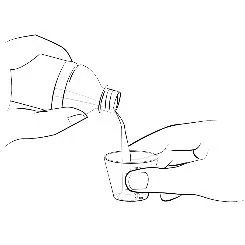 | 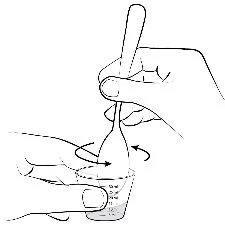 | | | | ||||
❏ Step 8: Washing parts
| 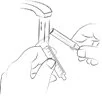 | |||||||
Food Mixing Method
❏ Step 1: Prepare Supplies
| Packet(s) | Small spoon (not included) |
Small scissors (not included) | ||
 Apple sauce (not included) | 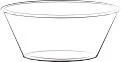 Small bowl (not included) | |
❏ Step 2: Check prescription label for prescribed dose
| | |
❏ Step 3: Prepare for mixing
| 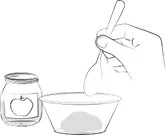 | |
❏ Step 4: Tap and open packet
| | |
❏ Step 5: Empty the packet
| | |
❏ Step 6: Mix medicine and food
The tablet(s) do not need to disperse (evenly mix) in the food. | 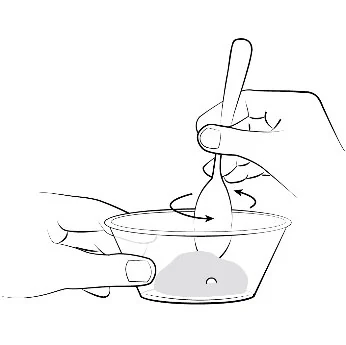 | |
❏ Step 7: Give medicine
| 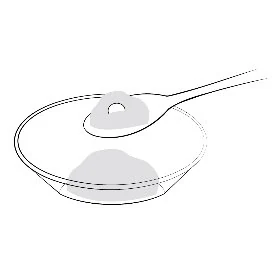 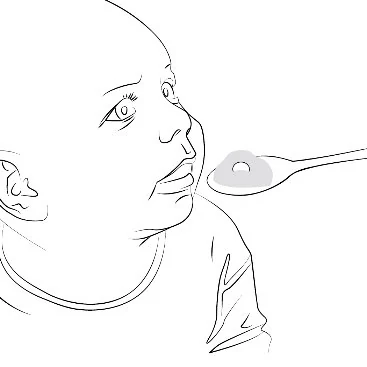 | |
❏ Step 8: Washing parts
| 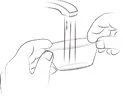 | |
Giving ELIQUIS tablets prepared as a suspension through a nasogastric tube (NG tube) or gastrostomy tube (G tube): Follow steps 1 through 6 to prepare the dose to be given. Follow the manufacturer instructions for how to place the syringe tip into the tube and give the medicine to your child. After the medicine has been placed into the tube, using the syringe flush the tube with additional water or infant formula. The flush volume is shown in the table below.  Talk to your healthcare provider if you have any questions. How should I store ELIQUIS tablets? Store ELIQUIS at room temperature between 68°F to 77°F (20°C to 25°C). Keep ELIQUIS and all medicines out of the reach of children. Marketed by: Bristol-Myers Squibb Company Princeton, NJ 08543 USA and Pfizer Inc New York, NY 10001 USA All other trademarks are property of their respective companies. For more information, call 1-855-354-7847 (1-855-ELIQUIS) or go to www.ELIQUIS.com. | ||
| This Instructions for Use has been approved by the U.S. Food and Drug Administration. | Issued: 04/2025 |
INSTRUCTIONS FOR USE
ELIQUIS® SPRINKLE (ELL EH KWISS SPRINK EL)
(APIXABAN)
FOR ORAL SUSPENSION
Important information you need to know before giving a dose of ELIQUIS SPRINKLE for oral suspension:
|
PREPARING the prescribed DOSE of ELIQUIS SPRINKLE for oral suspension
❏ Step 1: Prepare Supplies
- Wash and dry your hands.
- Clean and prepare a flat work surface.
- Gather your supplies:
- Oral dosing syringe (to give medicine to your child).
- Medicine cup (to mix medicine)
- Small spoon.
- Mixing liquid (use infant formula or water).
You can ask your pharmacist for the oral dosing syringe and medicine cup.
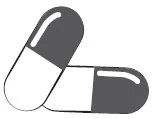
Capsule(s)
Mixing liquid (use infant formula or water) (not included)
Small spoon
(not included)
Medicine cup
(not included)
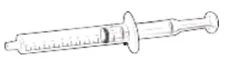
Oral dosing syringe (not included)
❏ Step 2: Check prescription label for number of capsules needed
- Repeat Step 3 and Step 4, if needed, to get the full prescribed dose.
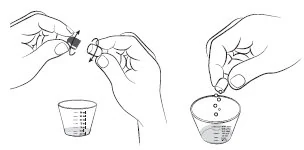
❏ Step 3: Tap capsule
- Hold the capsule with the colored end up.
- Tap the clear end to get medicine into the clear end.
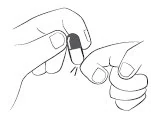
❏ Step 4: Open capsule
- Hold the capsule over the medicine cup.
- Twist both ends of the capsule and slowly pull it apart.
- Sprinkle the contents of the capsule into the medicine cup.
- Check the capsule shells to make sure they are empty.
Note: Do not swallow capsule.
- Throw away (discard) capsule shells into the household trash.
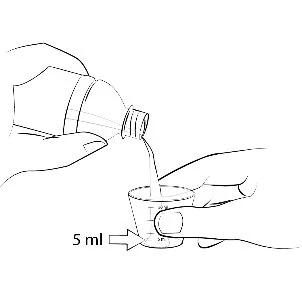
❏ Step 5: Add liquid to the medicine cup
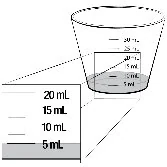
- You will need 5 mL (1 teaspoon) of liquid regardless of the number of capsule(s) prescribed.
- For children with fluid restrictions, your healthcare provider will tell you if you can use 2.5 mL of liquid.
Use water or infant formula only as the liquid. Do not use any other type of liquid.
Important: To make sure your child gets the full dose, do not put the medicine in a baby bottle.
❏ Step 6: Mix medicine and liquid
- Hold the medicine cup with one hand.
- Stir the medicine in the liquid using a small spoon.
- Continue to stir until the powder particles can no longer be seen.
❏ Step 7: Give oral suspension
This is a 2-part process to make sure all the medicine is given.
Follow Part 1 and Part 2.
Part 1: Pull up all liquid mixture with the oral dosing syringe and give all medicine in syringe.
Push plunger all the way down.
Place the syringe tip into the cup and pull up all the liquid mixture.
With the child seated upright or slightly inclined (tilted back), place the oral syringe into the mouth with the tip along either cheek.
Slowly push the plunger all the way down to give all medicine in the syringe.
Part 2: Repeat Steps 5 through 7 to be certain you give any medicine remaining in the cup:
Add about 5 mL (1 teaspoon liquid to medicine cup.
For children with fluid restrictions, your healthcare provider will tell you if you can use 2.5 mL (½ teaspoon) of liquid.
Gently stir liquid with small spoon.
Push plunger all the way down.
Place the syringe tip into cup and pull up all the liquid mixture.
With the child seated upright or slightly inclined (tilted back), place the oral syringe into the mouth with the tip along either cheek.
Slowly push the plunger all the way down to give all medicine in the syringe.
❏ STEP 8: Washing parts
- Remove the syringe plunger from the syringe barrel.
- Use only clean water to rinse the syringe parts, the cup and spoon. Let all items dry before the next use.
- Put the syringe plunger back into the syringe barrel when dry.
How should I store ELIQUIS SPRINKLE for oral suspension?
Store ELIQUIS SPRINKLE at room temperature between 68°F to 77°F (20°C to 25°C).
Keep ELIQUIS SPRINKLE and all medicines out of the reach of children.
Marketed by:
Bristol-Myers Squibb Company Princeton, NJ 08543 USA
and
Pfizer Inc New York, NY 10001 USA
All other trademarks are property of their respective companies.
For more information, call 1-855-354-7847 (1-855-ELIQUIS) or go to www.ELIQUIS.com.
| This Instructions for Use has been approved by the U.S. Food and Drug Administration. | Issued: 04/2025 |