


Patient information: uses, side effects, how to take - Duvyzat
What is the most important information I should know about DUVYZAT?
DUVYZAT can cause serious side effects including:
- Low platelet counts in your blood (thrombocytopenia). Platelets are important for blood clotting, and a decrease in their numbers can lead to an increased risk of bleeding or bruising. Your healthcare provider will check your blood count before you start DUVYZAT and regularly during treatment for any signs of thrombocytopenia. Call your healthcare provider right away if you notice any unusual bleeding or small red or purple spots on the skin called petechiae. Your healthcare provider may change your dose of DUVYZAT if your blood platelet counts continue to be low or may stop your treatment with DUVYZAT.
- Increased levels of fat (triglycerides) in your blood. You may not have any symptoms, so your healthcare provider will do blood tests before you start DUVYZAT and regularly during treatment to check your triglyceride levels. Your healthcare provider may change your dose of DUVYZAT if your triglyceride levels continue to be high or may stop your treatment with DUVYZAT.
- Frequent watery loose stools (diarrhea) and vomiting. DUVYZAT can cause vomiting and moderate to severe diarrhea. If diarrhea occurs, you should keep track of the frequency and severity of your diarrhea symptoms, drink plenty of fluids, and contact your healthcare provider. Your healthcare provider may change your dose of DUVYZAT if the diarrhea cannot be managed or does not go away. Your healthcare provider may also stop your treatment with DUVYZAT.
What is DUVYZAT?
DUVYZAT is a prescription medicine that is used for the treatment of Duchenne muscular dystrophy (DMD) in people 6 years of age and older.
It is not known if DUVYZAT is safe and effective in children under 6 years of age.
Before taking DUVYZAT, tell your healthcare provider about all of your medical conditions, including if you:
- have any heart problems or if you take any medicines that could increase your chance for irregular heart rhythms.
- have any bleeding problems.
Tell your healthcare provider about all of the medicines you take, including prescription and over-the-counter medicines, vitamins, and herbal supplements.
Taking DUVYZAT with certain other medicines may affect each other. Taking DUVYZAT with other medicines can cause serious side effects. Do not start or stop other medicines without talking to your healthcare provider.
Know the medicines you take. Keep a list of them to show your healthcare provider and pharmacist when you get a new medicine.
How should I take DUVYZAT?
- See the Instructions for Use that came with your DUVYZAT medicine for detailed instructions on how to take DUVYZAT the right way.
- Take DUVYZAT by mouth with food.
- Take DUVYZAT exactly as prescribed. Your healthcare provider will tell you how much DUVYZAT to take and when to take it.
- Your healthcare provider may change your dose of DUVYZAT if needed. Do not change your dose of DUVYZAT without talking to your healthcare provider.
- Shake the bottle for at least 30 seconds by continuously turning the bottle up and down. Stop when the DUVYZAT suspension looks the same throughout.
- Take the prescribed dose of DUVYZAT by mouth (orally) using the oral syringe that came with your DUVYZAT medicine. Do not throw away the oral syringe.
- DUVYZAT should not be mixed with water or other liquids.
- If you miss a dose of DUVYZAT, skip the missed dose and take your next dose of DUVYZAT as scheduled.
What are the possible side effects of DUVYZAT?
DUVYZAT can cause serious side effects, including:
- see “What is the most important information I should know about DUVYZAT?”
- changes in the electrical activity of your heart called QT Prolongation. QT Prolongation can increase the risk of developing a type of irregular heart rhythm known as Torsades de Pointes. Call your healthcare provider right away if you feel faint, have an irregular heartbeat, feel dizzy, or lose consciousness.
The most common side effects of DUVYZAT include:
- loose, watery stools (diarrhea)
- nausea
- vomiting
- stomach (abdominal) pain
- low platelet counts in the blood
- increased fat levels in the blood
- fever
Tell your healthcare provider if you have any side effect that bothers you or that does not go away.
These are not all of the possible side effects of DUVYZAT. For more information, ask your healthcare provider or pharmacist.
Call your doctor for medical advice about side effects. You may report side effects to FDA at 1-800-FDA-1088.
General information about the safe and effective use of DUVYZAT.
Medicines are sometimes prescribed for purposes other than those listed in a Medication Guide. Do not use DUVYZAT for a condition for which it was not prescribed. Do not give DUVYZAT to other people, even if they have the same symptoms that you have. It may harm them.
You can ask your pharmacist or healthcare provider for information about DUVYZAT that is written for healthcare professionals.
What are the ingredients in DUVYZAT?
Active ingredient: givinostat
Inactive ingredients: cream flavor, glycerin, non-crystallizing sorbitol solution, peach flavor, polysorbate 20, purified water, saccharin sodium, sodium benzoate, sodium hydroxide, tartaric acid, and tragacanth.
Distributed by:
ITF Therapeutics, LLC
Concord, MA 01742
For more information, go to www.DUVYZAT.com or call 1-833-582-4312
INSTRUCTIONS FOR USE DUVYZAT [doo' vi zat] (givinostat) oral suspension |
This Instructions for Use contains information on how to take DUVYZAT. Ask your healthcare provider or pharmacist if you have any questions on how to take DUVYZAT.
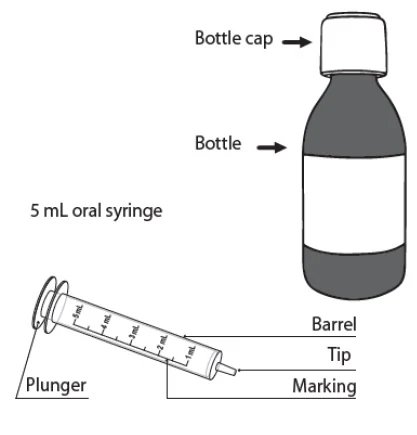
Each DUVYZAT carton contains (see Figure A):
- 1 (one) bottle of 140 mL oral suspension
- 1 (one) 5 mL oral syringe
 |
| Figure A |
Important information you need to know before you take DUVYZAT:
- Keep these instructions for future use.
- Do not share DUVYZAT with anyone else.
- Do not mix DUVYZAT with water or other liquids.
- Ask your healthcare provider or pharmacist to show you how to measure your prescribed dose.
- Do not throw away the oral syringe. Always use the oral syringe that comes with DUVYZAT to measure your prescribed dose.
- Use the medicine in the bottle within 60 days after you first open it. Throw away any unused DUVYZAT remaining in this bottle after 60 days. Write the date you open the bottle on the bottle label.
How to take DUVYZAT:
- Take DUVYZAT exactly as prescribed by your healthcare provider.
- Take DUVYZAT by mouth (orally) 2 times each day.
- The dose of DUVYZAT is based on how much you weigh.
- Take DUVYZAT with food.
- Take DUVYZAT using the oral syringe that comes with DUVYZAT.
Remove the DUVYZAT bottle and the oral syringe from the carton (see Figure A above).
| Step 1. Make sure the bottle is closed properly and shake the bottle for at least 30 seconds by continuously turning the bottle up and down (see Figure B). Stop when the DUVYZAT oral suspension is mixed well and looks the same throughout. | 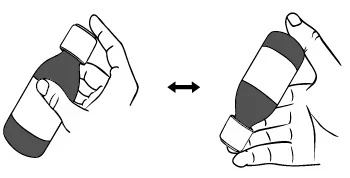 Figure B |
| Step 2. Open the bottle by pressing down on the bottle cap and turning it to the left (counter-clockwise) (see Figure C). Do not throw away the bottle cap. | 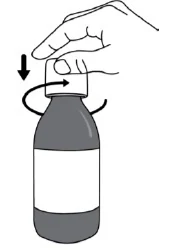 Figure C |
Step 3. For first time use only: Take the provided oral syringe to be used and firmly insert the tip of the oral syringe into the bottle adapter opening (see Figure D). For all other uses: Take the provided oral syringe to be used, push the plunger all the way down (to remove the air) and firmly insert the tip of the oral syringe into the bottle adapter opening (see Figure D). | 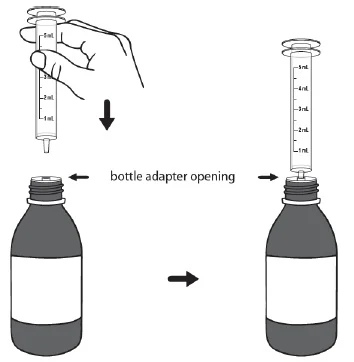 Figure D |
| Step 4. While holding the oral syringe in place, turn the bottle upside down. Slowly pull the plunger down to pull back a small amount of the suspension. Then push the plunger all the way up to remove any air bubbles (see Figure E). | 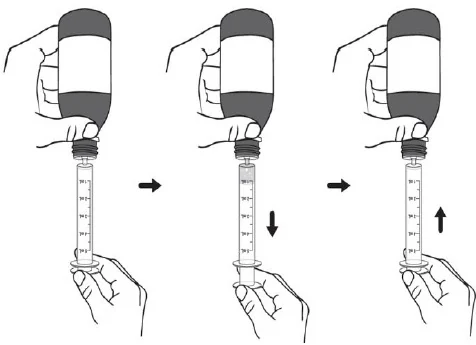 Figure E |
| Step 5. Slowly pull the plunger down until the bottom of the plunger is even with the markings on the oral syringe for the prescribed dose of DUVYZAT (see Figure F). If your prescribed dose is more than 5 mL, you will need to use the same oral syringe more than one time. | 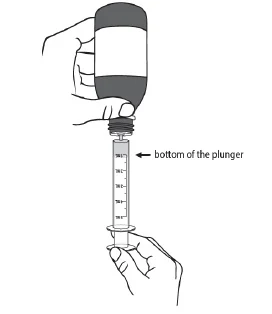 Figure F |
Step 6. While keeping the plunger in the same position, turn the bottle upright, and place it carefully on a flat surface. Remove the oral syringe by gently twisting or pulling it out from the bottle adapter opening. Do not hold the oral syringe by the plunger because the plunger may come out (see Figure G). Take or give DUVYZAT right away after it is drawn up into the oral syringe. Do not store the filled oral syringe. | 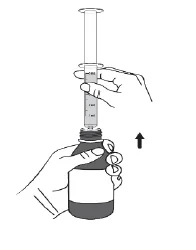 Figure G |
| Step 7. Check that the prescribed volume (mL) of DUVYZAT has been drawn up into the oral syringe (see Figure H). Figure H shows an example of a 5 mL dose. Your dose may be a different volume. | 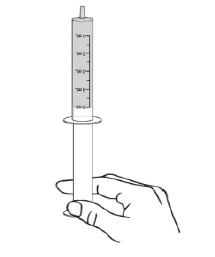 Figure H |
Step 8. The child or adult should sit upright to take a dose of DUVYZAT. Place the tip of the oral syringe against the inside of the cheek. Slowly push the plunger all the way down until there is no more medicine left in the oral syringe. If your prescribed dose is more than 5 mL, repeat Step 3 through Step 8 to give the remaining part of the dose. | |
| Step 9. After use, replace the bottle cap and turn the bottle cap to the right (clockwise) to close the bottle (see Figure I). | 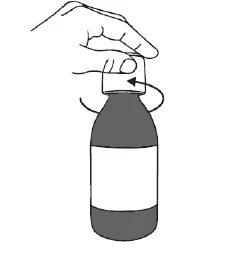 Figure I |
| Step 10. Wash the oral syringe in water and allow to dry. |
Keep the oral syringe for use with this bottle of DUVYZAT. Store the oral syringe in a clean, dry place.
How to store DUVYZAT:
- Store DUVYZAT at room temperature between 68°F to 77°F (20°C to 25°C).
- Do not freeze DUVYZAT.
- Store DUVYZAT upright.
- After opening the bottle of DUVYZAT, use within 60 days. Throw away (dispose of) any DUVYZAT that is not used within 60 days after opening the bottle. Ask your pharmacist how to properly throw away (dispose of) medicines you no longer use.
- Do not use DUVYZAT after the expiration date (EXP) on the carton and the bottle. The expiration date is the last day of the expiration month.
- Keep the bottle tightly closed between each use.
- Keep DUVYZAT and all medicines out of the sight and reach of children.
This Instructions for Use has been approved by the U.S. Food and Drug Administration.
Approved: 3/2024