


Patient information: uses, side effects, how to take - Daytrana
What is the most important information I should know about DAYTRANA?
DAYTRANA may cause serious side effects, including:
Abuse, misuse, and addiction. DAYTRANA has a high chance for abuse and misuse and may lead to substance use problems, including addiction. Misuse and abuse of DAYTRANA, other methylphenidate containing medicines, and amphetamine containing medicines, can lead to overdose and death. The risk of overdose and death is increased with higher doses of DAYTRANA or when it is used in ways that are not approved, such as snorting or injection.
- Your healthcare provider should check your child's risk for abuse, misuse, and addiction before starting treatment with DAYTRANA and will monitor your child during treatment.
- DAYTRANA may lead to physical dependence after prolonged use, even if taken as directed by your healthcare provider.
- Do not give DAYTRANA to anyone else. See "What is DAYTRANA?" for more information.
- Keep DAYTRANA in a safe place and properly dispose of any unused medicine. See "How should I store DAYTRANA?" for more information.
- Tell your healthcare provider if your child has ever abused or been dependent on alcohol, prescription medicines, or street drugs.
Risks for people with serious heart disease. Sudden death has happened in people who have heart defects or other serious heart disease.
Your child's healthcare provider should check your child carefully for blood pressure and heart problems before starting treatment with and while you are using DAYTRANA. Tell your child's healthcare provider if your child has any heart problems, heart disease or heart defects.
Remove the DAYTRANA transdermal system (patch) and call your child's healthcare provider or go to the nearest emergency room right away if your child has any signs of heart problems such as chest pain, shortness of breath, or fainting during treatment with DAYTRANA.
Increased blood pressure and heart rate.
Your child's healthcare provider should check your child's blood pressure and heart rate regularly during treatment with DAYTRANA.
Mental (psychiatric) problems, including:
- new or worse behavior or thought problems
- new or worse bipolar illness
- new psychotic symptoms (such as hearing voices, or seeing or believing things that are not real) or manic symptoms
Tell your child's healthcare provider about any mental problems your child has or about a family history of suicide, bipolar illness, or depression.
Call your child's healthcare provider right away if your child has any new or worsening mental symptoms or problems during treatment with DAYTRANA, especially hearing voices, seeing, or believing things that are not real, or new manic symptoms.
What is DAYTRANA?
DAYTRANA is a central nervous system (CNS) stimulant prescription medication used for the treatment of Attention Deficit Hyperactivity Disorder (ADHD) in children 6 to 17 years of age. DAYTRANA may help increase attention and decrease impulsiveness and hyperactivity in children with ADHD.
DAYTRANA is not recommended for use in children under 6 years of age with ADHD.
DAYTRANA is a federally controlled substance (CII) because it contains methylphenidate that can be a target for people who abuse prescription medicines or street drugs. Keep DAYTRANA in a safe place to protect it from theft. Never give your DAYTRANA to anyone else because it may cause death or harm them. Selling or giving away DAYTRANA may harm others and is against the law.
Do not use DAYTRANA if your child:
- is allergic to methylphenidate or any of the ingredients in DAYTRANA. See the end of this Medication Guide for a complete list of ingredients in DAYTRANA.
- is taking, or has stopped taking withing the past 14 days, a medicine used to treat depression called a monoamine oxidase inhibitor (MAOI)
Before using DAYTRANA, tell your child's healthcare provider about all of your child's medical conditions, including if your child:
- has heart problems, heart disease, heart defects, or high blood pressure
- has mental problems including psychosis, mania, bipolar illness, or depression, or has a family history of suicide bipolar illness, or depression
- has seizures or have had an abnormal brain wave test (EEG)
- has circulation problems in fingers or toes
- has skin problems such as eczema or psoriasis, or have skin reactions to soaps, lotions, make-up, or adhesives (glues)
- has a history of vitiligo or a family history of vitiligo
- has eye problems, including increased pressure in your eye, glaucoma, or problems with your close-up vision (farsightedness)
- has or had repeated movements or sounds (tics) or Tourettes syndrome, or have a family history of tics or Tourettes syndrome
is pregnant or plans to become pregnant. It is not known if DAYTRANA will harm the unborn baby. Tell your child's healthcare provider if your child becomes pregnant during treatment with DAYTRANA.
- There is a pregnancy registry for females who are exposed to DAYTRANA during pregnancy. The purpose of the registry is to collect information about the health of women exposed to DAYTRANA and their baby. If your child becomes pregnant during treatment with DAYTRANA, talk to your child's healthcare provider about registering with the National Pregnancy Registry of Psychostimulants at 1-866-961-2388 or visit online at https://womensmentalhealth.org/adhd-medications/.
- is breast feeding or plan to breast feed. DAYTRANA passes into breast milk. Talk to your child's healthcare provider about the best way to feed the baby during treatment with DAYTRANA.
- a history of vitiligo and/or a family history of vitiligo
Tell your child's healthcare provider about all of the medicines your child takes, including prescription and over-the-counter medicines, vitamins, and herbal supplements.
DAYTRANA and some medicines may interact with each other and cause serious side effects. Sometimes the doses of other medicines will need to be changed during treatment with DAYTRANA. Your child's healthcare provider will decide if DAYTRANA can be taken with other medicines.
Especially tell your child's healthcare provider if your child takes:
- blood pressure medicines (anti-hypertensive)
Know the medicines that your child takes. Keep a list of your child's medicines with you to show your child's healthcare provider and pharmacist when your child gets a new medicine. Do not start any new medicine while using DAYTRANA without first talking to your child's healthcare provider.
How should DAYTRANA be used?
- See the detailed “Instructions for Use” at the end of this Medication Guide for information about the right way to apply, remove, and dispose of DAYTRANA.
- Use DAYTRANA exactly as prescribed by your child's healthcare provider.
- Your child's healthcare provider may change the dose if needed.
- Apply DAYTRANA to the hip area 2 hours before an effect is needed and remove DAYTRANA within 9 hours after it is applied. Do not wear DAYTRANA longer than 9 hours a day.
- If DAYTRANA falls off, a new patch may be applied to a different area of the same hip.
- If you forget to apply DAYTRANA at your usual scheduled time each day, you may apply the patch later in the day. The patch should be removed at the usual time of day to lower the chance of side effects later in the day.
- If your child has loss of appetite or trouble sleeping in the evening, ask your child's healthcare provider if your child can take the patch off earlier in the day.
- Contact with water while bathing, swimming, or showering can make the patch not stick well.
- Do not use bandages, tape, or other household adhesives (glue) to hold the patch onto the skin.
If your child uses too much DAYTRANA transdermal systems call your healthcare provider or Poison Help line at 1-800-222-1222 or go to the nearest hospital emergency room right away.
What should your child avoid while using DAYTRANA?
- After applying the DAYTRANA patch, avoid exposing the application site to direct external heat sources, such as hair dryers, heating pads, electric blankets, heated water beds or other heat sources. Exposure to heat can cause too much medicine to pass into the body and cause serious side effects.
What are the possible side effects of DAYTRANA?
DAYTRANA may cause serious side effects, including:
- See "What is the most important information I should know about DAYTRANA?"
- Seizures. Your child's healthcare provider may stop treatment with DAYTRANA if your child has a seizure.
- Painful and prolonged erections (priapism). Priapism that may require surgery has happened in people who take products that contain methylphenidate. If your child develops priapism, get medical help right away.
Circulation problems in fingers and toes (peripheral vasculopathy, including Raynauds phenomenon). Signs and symptoms may include:
- fingers or toes may feel numb, cool, or painful
- fingers and toes may change color from pale, to blue, to red
Tell your child's healthcare provider if your child has any numbness, pain, skin color change, or sensitivity to temperature in the fingers or toes.
Call your healthcare provider right away if your child has any signs of unexplained wounds appearing on fingers or toes during treatment with DAYTRANA.
- Slowing of growth (height and weight) in children. Your child should have their height and weight checked often during treatment with DAYTRANA. Your healthcare provider may stop your child’s DAYTRANA treatment if they are not growing or gaining weight as expected.
- Eyes problems (increased pressure in the eye and glaucoma). Call your healthcare provider right away if you or your child develop changes in your vision or eye pain, swelling, or redness.
- New or worsening tics or worsening Tourette's syndrome. Tell your healthcare provider if you or your child get any new or worsening tics or worsening Tourettes syndrome during treatment with DAYTRANA.
- Loss of skin color. DAYTRANA may cause a persistent loss of skin-color where the patch is applied or around the patch application site. Loss of skin-color, in some cases, has been reported at locations on the skin far from any application site. The loss of skin-color may be permanent even after removing the patch or DAYTRANA is stopped. Call your healthcare provider right away if your child has changes in skin-color. DAYTRANA treatment may be stopped if your child has changes in skin color.
- Allergic skin rash (contact sensitization). Stop using DAYTRANA and tell your child's healthcare provider right away if your child develops swelling or blisters at or around the application site. Your child may have a skin allergy to DAYTRANA. People who have skin allergies to DAYTRANA may develop an allergy to all medicines that contain methylphenidate, even methylphenidate medicines taken by mouth.
The most common side effects of DAYTRANA in children 6 to 12 years old include:
- decreased appetite
- trouble sleeping
- nausea
- vomiting
- weight loss
- tics
- changes in mood
- trouble eating
The most common side effects of DAYTRANA in children 13 to 17 years old include:
- decreased appetite
- nausea
- trouble sleeping
- weight loss
- dizziness
- stomach pain
- trouble eating
DAYTRANA may also cause skin problems where it is applied (redness, small bumps, itching)
Your child's doctor may do certain blood tests while your child uses DAYTRANA.
These are not all the possible side effects of DAYTRANA.
Call your doctor for medical advice about side effects. You may report side effects to FDA at 1-800-FDA-1088.
How should I store DAYTRANA?
- Store DAYTRANA at room temperature between 68° F to 77° F (20° C to 25° C).
- Store DAYTRANA in a safe place, like a locked cabinet.
- Do not store DAYTRANA in the refrigerator or freezer.
- Keep DAYTRANA in their unopened pouches until you are ready to use them.
- Use or throw away the patches within 2 months after you open the sealed tray.
- Dispose of remaining, unused, or expired DAYTRANA by a medicine take-back program at a U.S. Drug Enforcement Administration (DEA) authorized collection site. If no take-back program or DEA authorized collector is available, each unused patch should be removed from its individual pouch, separated from the protective liner, folded in half so that the sticky sides stick together, and flushed down the toilet. Put the pouch and liner in a container with a lid, close the container and throw away the container in the household trash. Do not flush the pouch and liner down the toilet. Visit www.fda.gov/drugdisposal for additional information on disposal of unused medicines.
Keep DAYTRANA and all medicines out of the reach of children.
General information about the safe and effective use of DAYTRANA.
Medicines are sometimes prescribed for purposes other than those listed in a Medication Guide. Do not use DAYTRANA for a condition for which it was not prescribed. Do not give DAYTRANA to other people, even if they have the same symptoms. It may harm them and it is against the law.
You can ask your pharmacist or healthcare provider for information about DAYTRANA that is written for healthcare professionals.
What are the ingredients in DAYTRANA?
Active ingredient: methylphenidate
Inactive ingredients: acrylic adhesive, silicone adhesive
Manufactured by: Noven Pharmaceuticals, Inc., Miami, FL 33186
DAYTRANA® is a trademark of Noven Therapeutics, LLC.
For more information, go to www.daytrana.com, or call 1-800-455-8070.
INSTRUCTIONS FOR USE DAYTRANA® (day-TRON-ah) (methylphenidate transdermal system) CII |
1. DAYTRANA Dosing Chart
Each carton of DAYTRANA contains a DAYTRANA Dosing Chart to help you keep track of your DAYTRANA transdermal system (patch) including:
- when you apply patch to the skin on your hip each morning
- when you remove the patch
- how and where you threw DAYTRANA away
To use the DAYTRANA Dosing Chart, follow these instructions:
- Each day, when a new patch is applied to your hip, write down the date and time that you applied the patch.
- Use the DAYTRANA schedule below so you can decide when to remove the patch. For example, if the patch is applied to the skin at 6:00 a.m., remove the patch at 3:00 p.m. on the same day. After you remove and throw away the patch, write down the time you removed the patch and how and where you threw it away.
If the patch you placed on your child is missing, ask your child:
- when the patch came off
- how the patch came off
- where the patch is
DAYTRANA Schedule for 9 Hour Dosing
| If you put the patch on at: | On the same day, remove the patch at: |
| 5:00 a.m. | 2:00 p.m. |
| 6:00 a.m. | 3:00 p.m. |
| 7:00 a.m. | 4:00 p.m. |
| 8:00 a.m. | 5:00 p.m. |
| 9:00 a.m. | 6:00 p.m. |
| 10:00 a.m. | 7:00 p.m. |
| 11:00 a.m. | 8:00 p.m. |
| 12:00 p.m. | 9:00 p.m. |
2. Where to apply DAYTRANA
- Apply patch to your hip area. Do not put the patch near your waist. Clothing and movement may make your patch rub off (See Figure A).
- Use your other hip when you apply a new patch the next morning. Make sure there is no redness, small bumps or itching at the site where the patch is going to be applied.
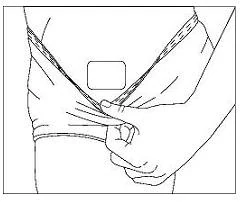
Figure A
3. Before you apply DAYTRANA
Make sure your skin:
- Is clean (freshly washed), dry, and cool
- Does not have any powder, oil, or lotion
- Does not have any cuts and irritation (rashes, inflammation, redness, or other skin problems).
4. How to apply DAYTRANA
- Open the sealed tray and throw away the small packet (drying agent).
- Each patch is sealed in its own protective pouch.
- Carefully cut the protective pouch open with scissors, being careful not to cut the patch. Do not use patches that have been cut or damaged in any way (See Figure B).
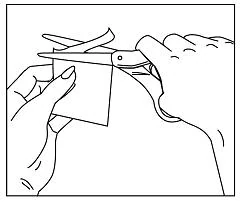
Figure B
- Remove the patch from the protective pouch.
- Look at the patch to make sure it is not damaged. The patch should separate easily from the protective liner. Throw away the patch if the protective liner is hard to remove.
DAYTRANA has 3 layers. The 3 layers are pictured below. The pictures show both sides of the patch:
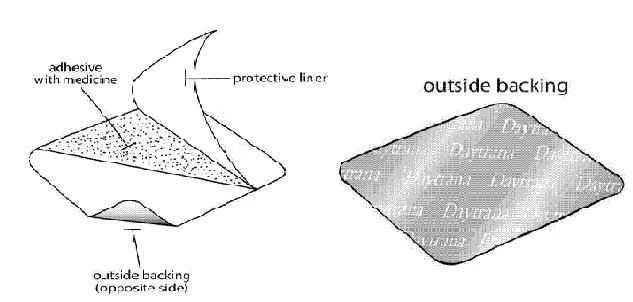
Figure C Figure D
Layers:
- Protective liner: The protective liner is the layer that you remove before you put the patch on (See Figure C).
- Adhesive with medicine: The adhesive with medicine is the layer that sticks to your skin (See Figure C).
- Outside backing: The outside backing is the layer that you see after you put the patch on your skin. The word "Daytrana" is printed on this layer (See Figure D).
- Apply the patch right away after you remove the patch from protective pouch.
- Hold the patch with the hard protective liner facing you. The word DAYTRANA will appear backwards.
- Gently bend the patch along the faint line and slowly peel half the liner, which covers the sticky surface of the patch (See Figure E).
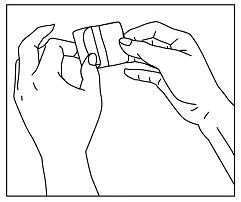
Figure E
- Avoid touching the sticky side of the patch with your fingers.
- If you accidentally touch the sticky side of the patch, apply the patch, then wash your hands right away so that the medicine does not go into the skin on your hands.
- Using the other half of the protective liner as a handle, apply the sticky side of the patch to the selected area of the child's hip (See Figure F).
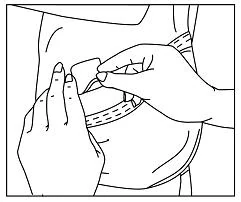
Figure F
- Press the sticky side of the patch firmly into place and smooth it down.
- While you are still holding the sticky side down, gently fold back the other half of the patch.
- Hold an edge of the remaining protective liner and slowly peel it off (See Figure G).
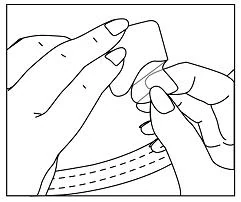
Figure G
- After the protective liner is removed, there should not be any adhesive (glue) sticking to the liner.
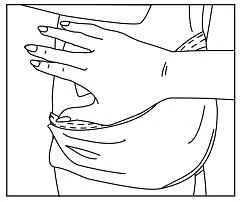
Figure H
- Press the entire patch firmly into place with the palm of your hand over the patch for about 30 seconds (See Figure H).
- Make sure that the patch firmly sticks to your skin.
- Gently rub the edges of the patch with your fingers to make sure the patch sticks to your skin.
- Wash your hands after you apply your patch.
- Write the time you applied your patch on the dosing chart on the carton. Use the dosing schedule so you know what time you should remove your patch.
5. How to remove and throw away DAYTRANA
When you remove the patch, peel it off slowly. If the patch is too sticky on your skin and you need something to help you remove it:
- Gently apply an oil-based product (petroleum jelly, olive oil, or mineral oil) to the patch edges. Gently spread the oil underneath the patch edges.
- Apply an oil-based product or lotion to your skin if any adhesive (glue) remains after you remove your patch. This will gently loosen and remove any adhesive that is left over.
- If you still cannot easily remove the patch, ask your doctor or pharmacist about what to do for this problem.
- Fold the used patch in half and press it together firmly so that the sticky side sticks to itself. Flush the used patch down the toilet.
- Do not flush the protective pouches or the protective liners down the toilet. These items should be thrown away in a container with a lid.
- Wash your hands after you handle the patch.
- After you remove the patch and throw the patch away, write down the time on the dosing chart.
Safely throw away any unused patches that are left over from the prescription as soon as they are no longer needed.
To safely throw away the patches:
- Remove the leftover patches from their protective pouches and remove the protective liners.
- Either fold the patches in half with the sticky sides together, and flush the patches down the toilet, or
- Dispose of remaining, unused, or expired DAYTRANA by a medicine take-back program at a U.S. Drug Enforcement Administration (DEA) authorized collection site. If no take-back program or DEA authorized collector is available, each unused patch should be removed from its individual pouch, separated from the protective liner, folded in half so that the sticky sides stick together, and flushed down the toilet. Put the pouch and liner in a container with a lid, close the container and throw away the container in the household trash. Do not flush the pouch and liner down the toilet. Visit www.fda.gov/drugdisposal for additional information on disposal of unused medicines.
Manufactured for: Noven Therapeutics, LLC, Miami, FL 33186.
By: Noven Pharmaceuticals, Inc., Miami, FL 33186.
This Instructions for Use has been approved by the U.S. Food and Drug Administration.
Revised: 11/2024
102086-23