


Patient information: uses, side effects, how to take - Bimatoprost
What is hypotrichosis of the eyelashes?
Hypotrichosis is another name for having inadequate or not enough eyelashes.
What is bimatoprost ophthalmic solution?
Bimatoprost ophthalmic solution is a prescription treatment for hypotrichosis used to grow eyelashes, making them longer, thicker and darker.
Who should NOT take bimatoprost ophthalmic solution?
Do not use bimatoprost ophthalmic solution if you are allergic to one of its ingredients.
Are there any special warnings associated with bimatoprost ophthalmic solution use?
Bimatoprost ophthalmic solution is intended for use on the skin of the upper eyelid margins at the base of the eyelashes. Refer to Illustration 2 below. DO NOT APPLY to the lower eyelid. If you are using Lumigan® or other products in the same class for elevated intraocular pressure (IOP), or if you have a history of abnormal IOP, you should only use bimatoprost ophthalmic solution under the close supervision of your physician.
Bimatoprost ophthalmic solution use may cause darkening of the eyelid skin which may be reversible. Bimatoprost ophthalmic solution use may also cause increased brown pigmentation of the colored part of the eye which is likely to be permanent.
It is possible for hair growth to occur in other areas of your skin that bimatoprost ophthalmic solution frequently touches. Any excess solution outside the upper eyelid margin should be blotted with a tissue or other absorbent material to reduce the chance of this from happening. It is also possible for a difference in eyelash length, thickness, fullness, pigmentation, number of eyelash hairs, and/or direction of eyelash growth to occur between eyes. These differences, should they occur, will usually go away if you stop using bimatoprost ophthalmic solution.
Who should I tell that I am using bimatoprost ophthalmic solution?
You should tell your physician you are using bimatoprost ophthalmic solution especially if you have a history of eye pressure problems.
You should also tell anyone conducting an eye pressure screening that you are using bimatoprost ophthalmic solution.
What should I do if I get bimatoprost ophthalmic solution in my eye?
Bimatoprost ophthalmic solution is an ophthalmic drug product. Bimatoprost ophthalmic solution is not expected to cause harm if it gets into the eye proper. Do not attempt to rinse your eye in this situation.
What are the possible side effects of bimatoprost ophthalmic solution?
The most common side effects after using bimatoprost ophthalmic solution are an itching sensation in the eyes and/or eye redness. This was reported in approximately 4% of patients. Bimatoprost ophthalmic solution may cause other less common side effects which typically occur on the skin close to where bimatoprost ophthalmic solution is applied, or in the eyes. These include skin darkening, eye irritation, dryness of the eyes, and redness of the eyelids.
If you develop a new ocular condition (e.g., trauma or infection), experience a sudden decrease in visual acuity, have ocular surgery, or develop any ocular reactions, particularly conjunctivitis and eyelid reactions, you should immediately seek your physician’s advice concerning the continued use of bimatoprost ophthalmic solution.
What happens if I stop using bimatoprost ophthalmic solution?
If you stop using bimatoprost ophthalmic solution, your eyelashes are expected to return to their previous appearance over several weeks to months.
Any eyelid skin darkening is expected to reverse after several weeks to months.
Any darkening of the colored part of the eye known as the iris is NOT expected to reverse and is likely permanent.
How do I use bimatoprost ophthalmic solution?
The recommended dosage is one application nightly to the skin of the upper eyelid margin at the base of the eyelashes only.
Once nightly, start by ensuring your face is clean, makeup and contact lenses are removed. Remove an applicator from its tray. Then, holding the sterile applicator horizontally, place one drop of bimatoprost ophthalmic solution on the area of the applicator closest to the tip but not on the tip (see Illustration 1). Then immediately draw the applicator carefully across the skin of the upper eyelid margin at the base of the eyelashes (where the eyelashes meet the skin) going from the inner part of your lash line to the outer part (see Illustration 2). Blot any excess solution beyond the eyelid margin. Dispose of the applicator after one use.
Repeat for the opposite upper eyelid margin using a new sterile applicator. This helps minimize any potential for contamination from one eyelid to another.
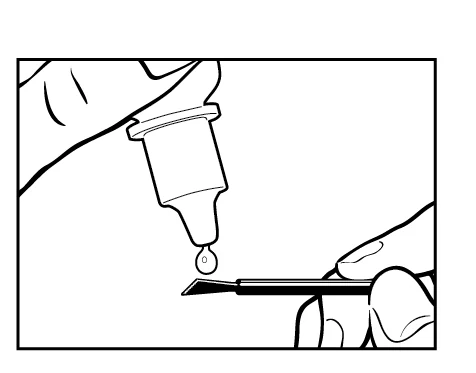
Illustration 1 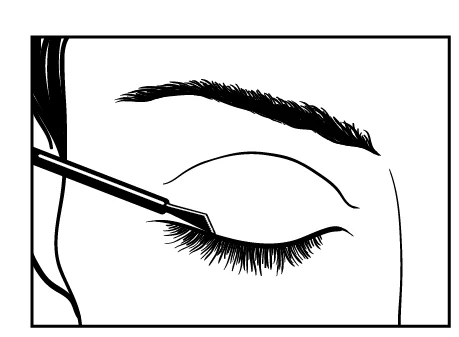
Illustration 2
DO NOT APPLY in your eye or to the lower lid. ONLY use the sterile applicators supplied with bimatoprost ophthalmic solution to apply the product. If you miss a dose, don’t try to “catch up”. Just apply bimatoprost ophthalmic solution the next evening. Fifty percent of patients treated with bimatoprost ophthalmic solution in a clinical study saw significant improvement by 2 months after starting treatment.
If any bimatoprost ophthalmic solution gets into the eye proper, it is not expected to cause harm. The eye should not be rinsed.
Don’t allow the tip of the bottle or applicator to contact surrounding structures, fingers, or any other unintended surface in order to avoid contamination by common bacteria known to cause infections.
Contact lenses should be removed prior to application of bimatoprost ophthalmic solution and may be reinserted 15 minutes following its administration.
Use of bimatoprost ophthalmic solution more than once a day will not increase the growth of eyelashes more than use once a day.
Store bimatoprost ophthalmic solution at 36° to 77°F (2° to 25°C).
General Information about bimatoprost ophthalmic solution.
Prescription treatments are sometimes prescribed for conditions that are not mentioned in patient information leaflets. Do not use bimatoprost ophthalmic solution for a condition for which it was not prescribed. Do not give bimatoprost ophthalmic solution to other people. It may not be appropriate for them to use.
This leaflet summarizes the most important information about bimatoprost ophthalmic solution. If you would like more information, talk with your physician. You can also call Sandoz Inc., at 1-800-525-8747.
What are the ingredients in bimatoprost ophthalmic solution?
Active ingredient: bimatoprost
Inactive ingredients: benzalkonium chloride, citric acid, purified water, sodium chloride and sodium phosphate dibasic. Sodium hydroxide and/or hydrochloric acid may be added to adjust pH. The pH during its shelf life ranges from 6.8 to 7.8.
Lumigan® is a registered trademark of Allergan, Inc.
Manufactured by Alcon Laboratories, Inc.
Fort Worth, Texas 76134 for
Sandoz Inc.
Princeton, NJ 08540
300063034
Rev. Aug 2023