


Patient information: uses, side effects, how to take - Atzumi
What is the most important information I should know about ATZUMI?
ATZUMI can cause serious side effects, including:
Serious problems with blood circulation to your legs and feet (peripheral ischemia). ATZUMI can cause peripheral ischemia when you take it with certain medicines known as CYP3A4 inhibitors. Peripheral ischemia may lead to a stroke and death. Stop taking ATZUMI and get emergency medical help right away if you have any of the following symptoms:
- cramping and pain in your legs or hips
- feeling of heaviness or tightness in your leg muscles
- burning or aching pain in your feet or toes while resting
- numbness, tingling, or weakness in your legs
- cold feeling or color changes in 1 or both legs or feet
- slurred speech
- sudden weakness
Do not take medicines known as strong CYP3A4 inhibitors, such as:
- ritonavir
- nelfinavir
- erythromycin
- clarithromycin
- ketoconazole
- itraconazole
These are not all of the medicines that could affect how ATZUMI works. Your healthcare provider can tell you if it is safe to take ATZUMI with other medicines.
What is ATZUMI?
ATZUMI is a prescription medicine used for the acute treatment of migraine with or without aura in adults.
- ATZUMI is not used to prevent migraine.
- ATZUMI is not used to treat other types of headaches such as hemiplegic (that make you unable to move on one side of your body) or basilar (rare form of migraine with aura) migraines.
It is not known if ATZUMI is safe and effective in children.
Who should not take ATZUMI?
Do not take ATZUMI if you:
- are taking medicines known as strong CYP3A4 inhibitors.
- have heart problems or a history of heart problems.
- have uncontrolled high blood pressure.
- have narrowing of blood vessels in your legs, arms, stomach, or kidneys (peripheral vascular disease).
- have sepsis.
- have had vascular surgery.
- have severe liver problems.
- have severe kidney problems.
- are allergic to dihydroergotamine, ergot alkaloids, or any of the ingredients in ATZUMI. See the end of this Medication Guide for a complete list of ingredients in ATZUMI.
have taken any of the following medicines in the last 24 hours:
- sumatriptan
- almotriptan
- eletriptan
- frovatriptan
- naratriptan
- rizatriptan
- zolmitriptan
- ergotamine or ergotamine-type medicines
- have taken any medicines that constrict your blood vessels or raise your blood pressure.
Ask your healthcare provider if you are not sure if you are taking any of these medicines.
Your healthcare provider can tell you if it is safe to take ATZUMI with other medicines.
Before you take ATZUMI, tell your healthcare provider about all of your medical conditions, including if you:
- have high blood pressure.
- have liver problems.
- have kidney problems.
have risk factors for heart disease. You have a higher risk for heart disease if you:
- have high blood pressure
- have high cholesterol levels
- smoke
- are overweight
- have diabetes
- have a family history of heart disease
- are taking medicines known as strong CYP3A4 inhibitors.
are pregnant or plan to become pregnant. ATZUMI may cause preterm labor. ATZUMI should be avoided during pregnancy. Talk to your healthcare provider right away if you are pregnant or want to become pregnant.
- are breastfeeding or plan to breastfeed. ATZUMI may reduce breast milk supply and pass into your breast milk. ATZUMI may be harmful to your baby. Do not breastfeed your baby while taking ATZUMI and for 3 days after you use ATZUMI. Talk with your healthcare provider about the best way to feed your baby if you take ATZUMI.
Tell your healthcare provider about all the medicines you take, including prescription and over-the-counter medicines, vitamins, and herbal supplements. Your healthcare provider will decide if you can take ATZUMI with your other medicines.
How should I take ATZUMI?
- ATZUMI is for nasal use only (use in the nose).
- Certain people should take their first dose of ATZUMI in their healthcare provider's office or in another medical setting. Ask your healthcare provider if you should take your first dose in a medical setting.
- Use ATZUMI exactly as your healthcare provider tells you to use it. Read and follow the instructions in the Instructions for Use or use the Quick Reference Guide located on the ATZUMI protective foil pouch.
- If your headache comes back after the first complete dose or you only get some relief from your headache, you can use a second dose 1 hour after the first complete dose. Use a new ATZUMI nasal powder device for the second dose, if needed.
- Do not take more than 2 doses of ATZUMI within a 24-hour period. It is not known if it is safe to take more than 4 doses of ATZUMI in a 7-day period or 12 doses in a 30-day period.
- Taking ATZUMI for 10 or more days in 1 month may make your headaches worse. You should write down when you have headaches and when you take ATZUMI so that you can talk with your healthcare provider about how ATZUMI is working for you. See "What are the possible side effects of ATZUMI?".
If you use too much ATZUMI, call your healthcare provider or Poison Help line at 1-800-222-1222, or go to the nearest hospital emergency room right away.
What are the possible side effects of ATZUMI?
ATZUMI can cause serious side effects, including:
See "What is the most important information I should know about ATZUMI?"
Heart attack and other heart problems. Heart problems may lead to death. Stop taking ATZUMI and get emergency medical help right away if you have any of the following symptoms of a heart attack:
- discomfort in the center of your chest that lasts for more than a few minutes, or that goes away and comes back
- severe tightness, pain, pressure, or heaviness in your chest, throat, neck, or jaw
- pain or discomfort in your arms, back, neck, jaw, or stomach
- shortness of breath with or without chest discomfort
- breaking out in a cold sweat
- feeling lightheaded
- nausea or vomiting
ATZUMI is not for people with risk factors for heart disease unless a heart exam is done and shows no problem. See "Before you take ATZUMI, tell your healthcare provider about all of your medical conditions, including if you:" for the risk factors for heart disease.
Stroke. Stop taking ATZUMI and get emergency medical help right away if you have any of the following symptoms of a stroke:
- face drooping
- unusual weakness or numbness
- slurred speech
- Changes in color or sensation in your fingers and toes (Raynaud's syndrome).
Stomach and intestinal problems (gastrointestinal and colonic ischemic events). Symptoms of gastrointestinal and colonic ischemic events include:
- sudden or severe stomach pain
- constipation or diarrhea
- stomach pain after meals
- bloody diarrhea
- weight loss
- fever
- nausea or vomiting
- Increased blood pressure.
- Medicine overuse headache. Some people who use too much ATZUMI may make their headaches worse (medicine overuse headache). If your headaches get worse, your healthcare provider may decide to stop your treatment with ATZUMI.
- Preterm labor.
- Tissue changes (fibrotic complications). Inflammation and fiber-like tissue that is not normal (fibrosis) can occur around the lungs and stomach.
- Nose irritation. Discomfort in your nose, change in taste, stuffy nose, and cold-type symptoms, (such as, runny nose, sneezing, and cough) can occur.
The most common side effects of ATZUMI include:
- runny nose
- nausea
- abnormal taste
- application site reactions
- dizziness
- vomiting
- sleepiness
- sore throat
- diarrhea
These are not all of the possible side effects of ATZUMI.
Call your doctor for medical advice about side effects. You may report side effects to FDA at 1-800-FDA-1088.
How should I store ATZUMI?
- Store ATZUMI at room temperature between 68°F to 77°F (20°C to 25°C).
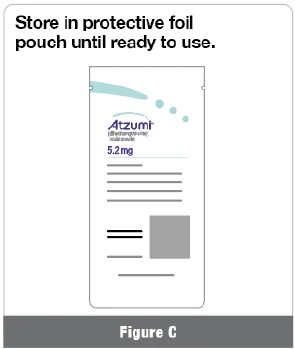
- Store ATZUMI in its protective foil pouch until ready to use.
Keep ATZUMI and all medicines out of the reach of children.
General information about the safe and effective use of ATZUMI.
Medicines are sometimes prescribed for purposes other than those listed in a Medication Guide. Do not use ATZUMI for a condition for which it was not prescribed. Do not give ATZUMI to other people, even if they have the same symptoms you have. It may harm them. You can ask your pharmacist or healthcare provider for information about ATZUMI that is written for health professionals.
What are the ingredients in ATZUMI?
Active ingredient: Dihydroergotamine
Inactive ingredients: Hypromellose, mannitol, and microcrystalline cellulose
ATZUMI is a trademark of Satsuma Pharmaceuticals, Inc.
Manufactured for Satsuma Pharmaceuticals, Inc., Durham, NC 27703
© 2026. Satsuma Pharmaceuticals, Inc. All rights reserved.
For more information, go to www.atzumi.com or call 1-888-273-2480.
INSTRUCTIONS FOR USE
ATZUMI™ (at zoo' mee)
(dihydroergotamine)
nasal powder
For Nasal Use Only
This Instructions for Use contains information on how to use ATZUMI.
Read this Instructions for Use before using ATZUMI.
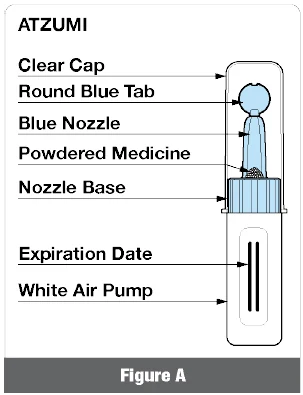
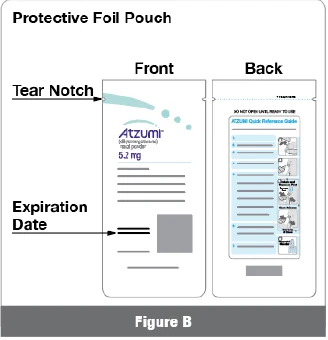
Important Information You Need to Know Before Using ATZUMI
- ATZUMI contains 1 complete dose of medicine and should be thrown away after each use.
- ATZUMI is for nasal (nose) use only.
- Deliver all the powdered medicine into only 1 nostril.
- Do not use ATZUMI if it is damaged or expired.
- Do not squeeze ATZUMI before inserting it into the nostril. Priming is not required.
- Powdered medicine is inside the blue nozzle. When you squeeze the white air pump, air is pushed into the blue nozzle and pushes the powdered medicine into your nose.
- Do not squeeze slowly, partially or with any hesitation. When dosing, you must fully squeeze the white air pump as fast as you can. A fast, pulse-like squeezing action is needed.
How often can you use ATZUMI?
- If needed, you may take a second dose 1 hour after your first dose. Wait at least 1 hour before taking the second dose.
- Do not take more than 2 doses within a 24-hour period.
- It is not known if it is safe to take more than 4 doses of ATZUMI in a 7-day period or 12 doses in a 30-day period.
Storing ATZUMI
- Store ATZUMI at room temperature between 68°F to 77°F (20°C to 25°C).
- Store ATZUMI in its protective foil pouch until ready to use (Figure C).
- Keep ATZUMI and all medicines out of the reach of children.
Step 1. Preparing to Use ATZUMI
1.1 Blow Your Nose
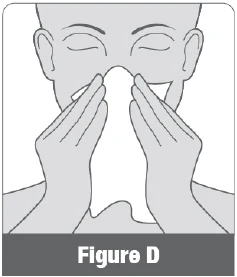 Blow your nose to clear your nostrils (Figure D).
1.2 Take Out ATZUMI
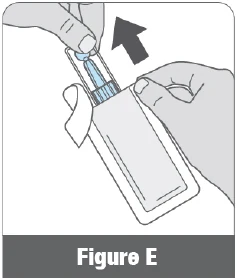 Open the protective foil pouch by tearing at the notch.
Remove ATZUMI from the protective foil pouch (Figure E).
1.3 Check ATZUMI
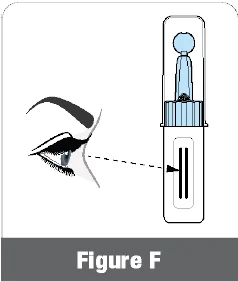 Check the Expiration Date to make sure ATZUMI is not expired (Figure F).
Check ATZUMI for damage.
If ATZUMI is expired or damaged, throw it away in your household trash and get a new ATZUMI.
- 1.4 Remove Clear Cap
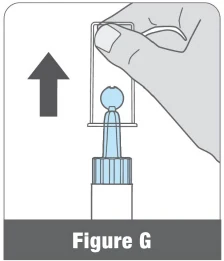 Pull the clear cap straight off (Figure G).
Step 2. Using ATZUMI
2.1 Remove Round Blue Tab
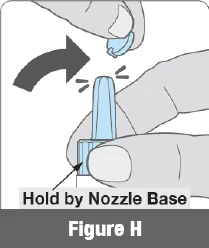 Hold the nozzle base in 1 hand.
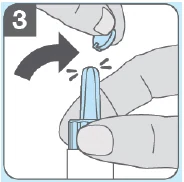
Remove the round blue tab by bending it back and forth or twisting it to break it off (Figure H).
This creates an opening for the powdered medicine to pass through.
Important: Do not squeeze the white air pump yet. Wait until Step 2.3.
- 2.2 Insert Into Nostril
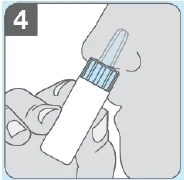
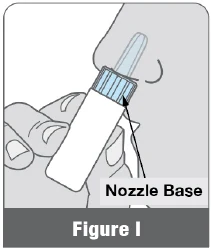 Hold the white air pump as shown in Figure I and insert the blue nozzle into 1 nostril as far as it will comfortably go. The nozzle base should touch your nose (Figure I).
- 2.3 Deliver All of the Powdered Medicine into Only 1 Nostril
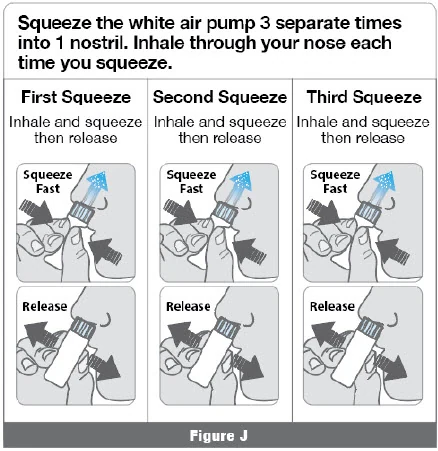
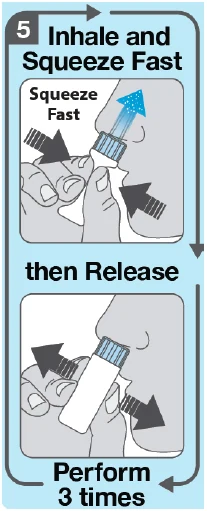
- Squeeze the white air pump 3 separate times into 1 nostril. Inhale through your nose each time you squeeze (Figure J).
- Fast, complete, pulse-like squeezes are needed to push the powdered medicine and deliver the complete dose.
- Do not squeeze slowly, partially or with any hesitation.
- Allow the white air pump to expand back to its original shape between squeezes (Figure J).
 Important:
Deliver all the powdered medicine into only 1 nostril.

- Allow the white air pump to expand back to its original shape between squeezes (Figure J).
Step 3. Inspecting ATZUMI
- 3.1 Check for Remaining Powdered Medicine
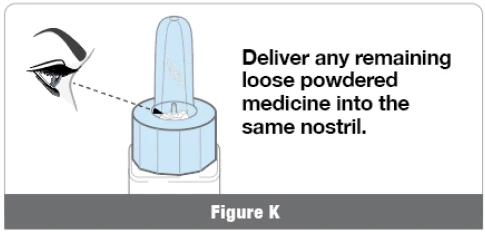
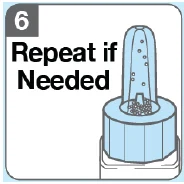
- Keep ATZUMI upright and look inside the blue nozzle to see if any loose powdered medicine remains at the bottom (Figure K).
- If loose powdered medicine remains, repeat Step 2.3 to dose into the same nostril, but squeeze the white air pump faster. Repeat Step 2.3 until no loose powdered medicine remains.
Note:
- It is normal to see a light coating of powdered medicine in the blue nozzle after delivering the complete dose.
- If you are not sure whether you have delivered all of the loose powdered medicine, then repeat Step 2.3 with the same ATZUMI device in the same nostril.
Step 4. Throwing Away ATZUMI
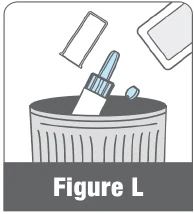 After use, throw away the protective foil pouch, the ATZUMI device, the round blue tab, and the clear cap in your household trash (Figure L).
Do not save ATZUMI after use. ATZUMI contains a one-time (single) dose.
This Instructions for Use has been approved by the U.S. Food and Drug Administration.
Approved: 4/2025
Quick Reference Guide
This is a Quick Reference Guide. Read the full Instructions for Use before using ATZUMI. Deliver ATZUMI into only 1 nostril.
- 1. Blow your nose to clear your nostrils.
- 2. Pull the clear cap straight off.
- 3. Twist or bend the round blue tab to break it off.
- 4. Insert the blue nozzle all the way into your nostril.
- 5.
Squeeze the white air pump 3 separate times into 1 nostril. Inhale through your nose each time you squeeze. Fast, complete, pulse-like squeezes are needed. Do not squeeze slowly, partially or with hesitation.
Allow the white air pump to expand back to its original shape between squeezes.
Deliver all of the powdered medicine into only 1 nostril.
- 6. Check inside the blue nozzle. If loose powdered medicine remains, repeat Step 5 with the same ATZUMI device in the same nostril, but with a faster squeeze.
- 7. Throw away ATZUMI in your household trash. ATZUMI is for one-time (single) use only.
This Quick Reference Guide has been approved by the U.S. Food and Drug Administration.
Approved: 04/2025